Mechanical Watch
ProductAlso known as: watch, wristwatch, automatic watch, self-winding watch
Overview
A mechanical watch is a machine of about a hundred parts that stores energy in a spring and lets it out in equal steps, 28,800 of them an hour, to move a set of hands. The parts group into four assemblies. The Case Assembly protects the mechanism and seals it against water and dust. The Automatic Caliber, the calibre, is the mechanism itself: mainspring, gear train, escapement, balance, winding and the wheels that drive the hands. The Dial & Hands assembly is the face that shows the time, and the Bracelet holds the watch on the wrist.
This page describes an automatic wristwatch, one that winds itself from the motion of the wearer's arm. A hand-wound watch is the same machine without the automatic module; a quartz watch replaces the mainspring, escapement and balance with a battery, a crystal oscillator and a stepper motor and is covered on its own page.
The parts of a watch and what each does
Case. The Case Assembly is a small pressure vessel. The Case Middle is the machined steel or titanium ring that carries everything: the Bezel on top, which clamps the Sapphire Crystal in place, and the Caseback underneath, screwed or pressed on and often fitted with a sapphire window to show the movement. Between each of these joints sits a gasket from the O-Ring Set, and it is these rubber rings, not the metal, that keep water out; a "water resistant to 100 m" rating means the gaskets held at that pressure when new. The Crown is the knob on the side used to wind and set the watch; on a dive watch it screws down against its own gasket. Two Spring Bar pins, spring-loaded rods between the case lugs, attach the bracelet or strap.
Crystal. The Sapphire Crystal is the transparent window over the dial. Synthetic sapphire, at 9 on the Mohs scale, is used on most mechanical watches because almost nothing but diamond will scratch it; mineral glass and acrylic are cheaper and softer. Its underside usually carries an anti-reflective coating.
Mainspring and barrel. Inside the movement, the Mainspring Barrel is the energy store. The mainspring, a long ribbon Coil Spring of hardened alloy, is coiled inside the Barrel, a shallow drum with teeth around its rim. Winding tightens the spring; as it slowly unwinds it turns the barrel, and the barrel's teeth drive the gear train. A full wind holds about 42 hours of running on this calibre, the power reserve.
Gear train. The Gear Train is a series of Train Wheel gears, each a toothed wheel on an arbor with a small pinion, that steps the barrel's slow rotation up to the fast rotation the escapement needs. The barrel turns once in several hours; the last wheel in the train, the escape wheel, turns several times a minute. Each wheel's arbor runs in a synthetic ruby from the Jewel Set, the "jewels" of a jewelled movement, chosen because ruby is hard and takes a mirror polish so the pivots turn with almost no friction or wear.
Escapement. The Escapement is the part that turns continuous unwinding into ticks. The Escape Wheel is the last wheel of the train; the Pallet Fork is a lever with two ruby pallets that alternately lock and release its teeth. Each release lets the train advance one tooth and, in the same motion, gives the balance a small push to keep it swinging. The lever escapement invented by Thomas Mudge in the 1750s is still, with refinements, what nearly every mechanical watch uses.
Balance. The Balance Assembly is the timekeeper. The Balance Wheel & Staff is a weighted rim on a staff, and a fine spiral hairspring, a tiny Coil Spring of a temperature-stable alloy, returns it to centre after each swing. The two together form a harmonic oscillator that swings back and forth at a rate set by the wheel's inertia and the spring's stiffness: on this calibre 4 Hz, eight beats a second, 28,800 an hour. The pallet fork's pushes replace the energy lost to friction; the balance's regular swing in turn gates the fork. Regulating a watch means adjusting the effective length of the hairspring by a hair to make it run a few seconds a day faster or slower.
Keyless works. The Keyless Works is the mechanism behind the crown, named because it replaced the separate key that early watches were wound with. The Winding Stem & Clutch passes from the crown into the movement; pushed in, turning it winds the mainspring through a clutch and ratchet; pulled out one stop it sets the date, and at the second stop it engages the motion works to set the hands.
Automatic winding. The Automatic Winding module is what makes the watch self-winding. A semicircular Rotor, a weight that swings freely on a Ball Bearing as the wrist moves, drives a pair of Reverser Wheel gears that turn motion in either direction into winding in one, and feed it to the barrel. A slipping bridle at the outer end of the mainspring lets the rotor keep turning after the spring is full without overwinding it.
Motion works and calendar. The Motion Works is the set of wheels under the dial that take the gear train's once-a-minute rotation and gear it down to once an hour for the minute hand and once in twelve hours for the hour hand, the three hands stacked on concentric shafts through the dial centre. The Date Wheel is a ring with 31 numbers that a finger on the hour wheel advances once a day, snapping over at midnight.
Mainplate. The Mainplate & Bridges is the brass or steel plate all of this is built on, with bridges screwed over it by a watch-sized Fastener Set to hold the upper pivots. The whole movement lifts out of the case as one unit.
Dial and hands. The Dial & Hands assembly is what the wearer sees: the Dial, a brass disc lacquered, printed or enamelled, with applied Applied Marker indices and the Hand of hour, minute and seconds hands, often filled with a luminous compound.
Bracelet. The Bracelet is a chain of Bracelet Link elements joined by pins or screws, ending in a folding Clasp, and attached at the case by the two spring bars. A leather or rubber strap takes the same spring bars.
How a mechanical watch works
Movement of the wrist swings the rotor, the reversers turn that into winding, and the mainspring tightens in its barrel. The barrel turns the gear train, the train turns the escape wheel, and the escape wheel presses against the pallet fork, trying to unwind everything in a single spin. The balance stops it. Swinging at exactly four cycles a second, the balance unlocks the fork once each way, letting the escape wheel advance one tooth per swing, and receives a tiny impulse in return that keeps it swinging. That is the tick: the escape wheel is being let go, 28,800 times an hour, in steps the balance measures out. The gear train ratios divide those steps down to one revolution a minute at the seconds hand, and the motion works divide again for the minute and hour hands.
Materials
Cases are 316L stainless steel, titanium or gold; crystals are sapphire; gaskets are nitrile or fluoroelastomer. Inside, plates and wheels are brass, often rhodium plated; pinions, arbors and the escapement are hardened steel; the pivots run in synthetic ruby. The mainspring is a cobalt-nickel alloy that does not fatigue; the hairspring is Nivarox, an iron-nickel alloy whose stiffness barely changes with temperature, or silicon on recent calibres. The parts are small enough that a full movement weighs a few grams.
Common failures
A mechanical watch is a machine with oil in it, and the oil ages. Every five to ten years it is disassembled, cleaned, re-lubricated and re-gasketed; skipping that wears the pivots and jewels. Gaskets harden and let moisture in, which corrodes the movement and fogs the crystal. Magnetism from speakers and clasps makes the hairspring coils stick together and the watch run fast by minutes a day, fixed in seconds with a demagnetiser. A watch that stops when worn but runs on the desk usually has a broken automatic module; one that runs but will not set has a worn keyless works.
Common questions
What are the parts of a watch called?
Case (case middle, bezel, crystal, caseback, gaskets, crown, spring bars), movement (mainspring and barrel, gear train, escapement, balance wheel and hairspring, jewels, keyless works, automatic rotor, motion works, mainplate and bridges), dial and hands, and the bracelet or strap with its clasp.
What is the part inside a watch that ticks?
The escapement. The pallet fork locks and releases the escape wheel once for every swing of the balance wheel, and each release is one tick. On a 4 Hz movement that is eight ticks a second.
How does a mechanical watch keep time?
With a balance wheel on a hairspring, a small oscillator that swings at a fixed rate. The escapement lets the gear train advance one tooth per swing, so the hands move in steps counted by the balance. Accuracy depends on how constant that swing rate is; a good movement holds within a few seconds a day.
What does "jewels" mean on a watch?
Synthetic rubies used as bearings for the fast-turning pivots. A basic automatic has 21 to 25; more means more pivots are jewelled, not necessarily a better watch.
Automatic or manual winding?
An automatic winds itself from wrist motion through a rotor and can also be wound by the crown. A manual watch has no rotor and must be wound every day or two. The rest of the movement is the same.
Mechanical Watch parts and their functions
4 top-level parts · 58 parts in total · full bill of materials below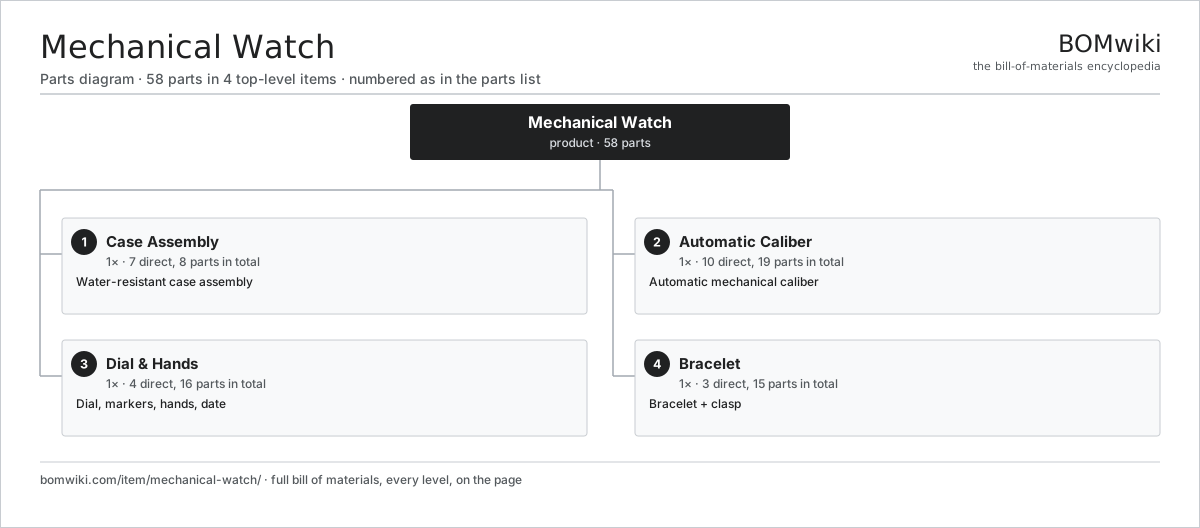
| # | Part | Qty | What it does |
|---|---|---|---|
| 1 | Case Assembly 7 parts | 1× | Water-resistant case assembly |
| 2 | Automatic Caliber 10 parts | 1× | Automatic mechanical caliber |
| 3 | Dial & Hands 4 parts | 1× | Dial, markers, hands, date |
| 4 | Bracelet 3 parts | 1× | Bracelet + clasp |
3D model
No 3D model yet. Have a CAD file of this? Add a 3D model. STL renders right on this page; STEP, FreeCAD, and OpenSCAD sources are welcome too (openly licensed, like all 3D models on BOMwiki).
Build & assembly graph
expand / collapse · shared sub-assemblies converge · links to related products · est. labourTap an assembly to expand/collapse · tap a part to open it · use “Open page” for any node · drag to pan, scroll to zoom.
Bill of materials for Mechanical Watch
4 top-level lines · 40 rows shown · 58 parts total · indented to 3 levels| # | Item / sub-assembly | Part no. | Qty/assy | Ext. qty | Parts | Type |
|---|---|---|---|---|---|---|
| 1 | Case Assembly 7 parts | mechanical-watch-case | 1× | 1 | 8 | assembly |
| 1.1 | Case Middle | mechanical-watch-case-middle | 1× | 1 | · | part |
| 1.2 | Bezel | mechanical-watch-bezel | 1× | 1 | · | part |
| 1.3 | Caseback | mechanical-watch-caseback | 1× | 1 | · | part |
| 1.4 | O-Ring Set | oring-set | 1× | 1 | · | part |
| 1.5 | Sapphire Crystal | mechanical-watch-crystal | 1× | 1 | · | part |
| 1.6 | Crown | mechanical-watch-crown | 1× | 1 | · | part |
| 1.7 | Spring Bar | mechanical-watch-spring-bar | 2× | 2 | · | part |
| 2 | Automatic Caliber 10 parts | mechanical-watch-movement | 1× | 1 | 19 | assembly |
| 2.1 | Mainplate & Bridges | mechanical-watch-mainplate | 1× | 1 | · | part |
| 2.2 | Jewel Set | mechanical-watch-jewel-set | 1× | 1 | · | part |
| 2.3 | Fastener Set | fastener-set | 1× | 1 | · | part |
| 2.4 | Mainspring Barrel 2 parts | mechanical-watch-barrel-assembly | 1× | 1 | 2 | assembly |
| 2.4.1 | Barrel | mechanical-watch-barrel | 1× | 1 | · | part |
| 2.4.2 | Coil Spring | coil-spring | 1× | 1 | · | part |
| 2.5 | Gear Train 1 parts | mechanical-watch-gear-train | 1× | 1 | 3 | assembly |
| 2.5.1 | Train Wheel | mechanical-watch-train-wheel | 3× | 3 | · | part |
| 2.6 | Escapement 2 parts | mechanical-watch-escapement | 1× | 1 | 2 | assembly |
| 2.6.1 | Escape Wheel | mechanical-watch-escape-wheel | 1× | 1 | · | part |
| 2.6.2 | Pallet Fork | mechanical-watch-pallet-fork | 1× | 1 | · | part |
| 2.7 | Balance Assembly 3 parts | mechanical-watch-balance | 1× | 1 | 3 | assembly |
| 2.7.1 | Balance Wheel & Staff | mechanical-watch-balance-wheel | 1× | 1 | · | part |
| 2.7.2 | Coil Spring | coil-spring | 1× | 1 | · | part |
| 2.7.3 | Jewel Set | mechanical-watch-jewel-set | 1× | 1 | · | part |
| 2.8 | Keyless Works 1 parts | mechanical-watch-keyless-works | 1× | 1 | 1 | assembly |
| 2.8.1 | Winding Stem & Clutch | mechanical-watch-winding-stem | 1× | 1 | · | part |
| 2.9 | Automatic Winding 3 parts | mechanical-watch-auto-winding | 1× | 1 | 4 | assembly |
| 2.9.1 | Rotor | mechanical-watch-rotor | 1× | 1 | · | part |
| 2.9.2 | Ball Bearing | ball-bearing | 1× | 1 | · | part |
| 2.9.3 | Reverser Wheel | mechanical-watch-reverser-wheel | 2× | 2 | · | part |
| 2.10 | Motion Works | mechanical-watch-motion-works | 1× | 1 | · | part |
| 3 | Dial & Hands 4 parts | mechanical-watch-dial-hands | 1× | 1 | 16 | assembly |
| 3.1 | Dial | mechanical-watch-dial | 1× | 1 | · | part |
| 3.2 | Applied Marker | mechanical-watch-applied-marker | 11× | 11 | · | part |
| 3.3 | Hand | mechanical-watch-hand-set | 3× | 3 | · | part |
| 3.4 | Date Wheel | mechanical-watch-date-wheel | 1× | 1 | · | part |
| 4 | Bracelet 3 parts | mechanical-watch-bracelet | 1× | 1 | 15 | assembly |
| 4.1 | Bracelet Link | mechanical-watch-link | 12× | 12 | · | part |
| 4.2 | Clasp | mechanical-watch-clasp | 1× | 1 | · | part |
| 4.3 | Spring Bar | mechanical-watch-spring-bar | 2× | 2 | · | part |
Something wrong in this list? Report a problem with this BOM.
Related products
same domain, ranked by shared parts Chronograph Watch
63 parts · shares 2 with this page
Chronograph Watch
63 parts · shares 2 with this page
 Dive Watch
34 parts · shares 1 with this page
Dive Watch
34 parts · shares 1 with this page
 Quartz Watch
76 parts · shares 1 with this page
Quartz Watch
76 parts · shares 1 with this page
 Railway Station Clock
43 parts · shares 1 with this page
Railway Station Clock
43 parts · shares 1 with this page
 Flip Clock
119 parts · shares 1 with this page
Flip Clock
119 parts · shares 1 with this page
 Grandfather Clock
168 parts · shares 1 with this page
Grandfather Clock
168 parts · shares 1 with this page
Sourcing: possible vendors
Browse the supplier directory → Prices, MOQ, and lead times are algorithmic estimates, not quotes, and not claims about these companies. Company mappings are curated by keyword; est. price band $20–$50k. How estimates work| Vendor | HQ | Specialty | MOQ | Lead time |
|---|---|---|---|---|
|
🇯🇵Seiko
seikowatches.com ↗
|
Tokyo, JP | Watches | 500 units | 8–14 wks |
|
🇯🇵Citizen
citizenwatch-global.com ↗
|
Tokyo, JP | Watches | 500 units | 8–14 wks |
|
🇯🇵Casio
casio.com ↗
|
Tokyo, JP | Watches & electronics | 500 units | 8–14 wks |
| swatchgroup.com ↗ | Biel, CH | Watches (Omega, Tissot) | 500 units | 8–14 wks |
| titancompany.in ↗ | Bengaluru, IN | Watches & timepieces | 500 units | 8–14 wks |
1,710-word article