Metal Shaper
ProductOverview
A metal shaper is a compact precision machine tool that generates flat, contoured, or stepped surfaces using a vertically reciprocating Cutting Ram Assembly. Unlike planers (which move the workpiece) or mills (which rotate the cutter), a shaper delivers the tool downward in a series of fast cutting strokes followed by rapid air returns. Each stroke removes 0.2–1 mm of material; automatic Work Table with Feeds mechanisms advance the workpiece after each stroke, building up the finished surface. Shapers are versatile: they can cut straight slots, angles, circles, and complex profiles by indexing the Table Casting under a stationary tool. They excel at small to medium-sized work, die blocks, jigs, fixtures, machine frames, and are particularly valued for prototype and one-off jobs because setup is simple and tool costs are minimal.
Reciprocating mechanism
The Crank and Linkage converts motor rotation to vertical ram motion. A Crankshaft with an eccentric crank-pin is driven by the Drive Motor (typically 2–7 kW) via a Drive Belt and Speed Gearbox. As the crank rotates, the Connecting Rod pulls the Cutting Ram Assembly downward on the power stroke (forward), then returns it rapidly as the crank reverses. The stroke length is typically 50–300 mm; many machines have a Adjustable Stroke Block that varies the effective crank radius, allowing the operator to select the stroke length needed for the workpiece. Stroke frequency ranges from 30 strokes/min (coarse, heavy roughing) to 120 strokes/min (fine finishing), controlled by the Speed Gearbox. The faster the stroke, the shorter the dwell time, so sharp tools and good coolant become essential.
Clapper mechanism
The Clapper Box (Tool Holder) is the machine's ingenious solution to avoiding reverse cutting. It's a pivoting block mounted on the Cutting Ram Assembly that holds the Tool Bit in a Tool Post. During the forward (cutting) stroke, the tool engages the workpiece and the force pushes down on the Clapper Pivot Pin, keeping the clapper box rigid. When the ram reaches the bottom of the stroke and begins its rapid return, the tool is no longer under load; the Clapper Box Casting swings upward about its pivot, withdrawing the tool from the surface and preventing a damaging reverse cut. This simple mechanical action requires no actuation, it's entirely reactive. Clapper designs vary; some use a gravity pivot, others an air or hydraulic cylinder to assist the swing.
Work table and automatic feeds
The Work Table with Feeds is a horizontal ductile iron Table Casting that sits on precision Table Precision Ways, allowing motion in two orthogonal directions (X and Y). Two independent feed mechanisms, the X-Feed Ratchet and Y-Feed Ratchet, are pawl-and-ratchet systems linked to the crankshaft via cams. Each time the ram completes a cycle, a cam lobe engages a feed solenoid or mechanical trigger, advancing the X ratchet by a fixed increment (typically 0.5–5 mm). Similarly, after a selectable number of X feeds (every 10 strokes, for example), the Y feed engages and moves the table longitudinally. This allows the tool to trace grid patterns, pockets, and faces without manual repositioning. Table Clamp Sets (standard T-slot clamps) secure the workpiece firmly to prevent lifting or shifting under cutting forces.
Ram and column
The Cutting Ram Assembly is a precision-machined steel shaft guided by hardened and scraped Ram Guides mounted in the Main Column. The column itself is a large ductile iron or nodular iron vertical casting, typically 1.5–2 m tall, with a Column Casting that is precision-ground to very tight V-ways tolerances. The Column Base Feet provides mounting feet for the shop floor, usually with vibration isolators. The entire structure must be rigid to prevent chatter (self-excited vibration) and maintain straightness; a poorly mounted shaper on a soft floor will produce poor finishes and tool breakage.
Tool and cutting action
The Tool Bit, usually a simple rectangular high-speed steel tool or carbide insert, is 5–10 mm wide and held in the Tool Post at a slight back-rake and side-rake angle. The tool engages the workpiece at the bottom of each forward stroke, removing a shallow chip (0.2–1 mm per stroke); the depth of cut is manually adjusted by positioning the Table Casting height. Cutting speed for steel is typically 30–80 m/min; aluminum can take 100–150 m/min. Sharp tools produce excellent surface finishes (Ra ~0.8–3 µm); dull tools generate heat and chatter. Tool life is typically 30–100 strokes before resharpening or replacement, depending on material and feed rate.
Drive and electrical
The Drive Motor is a standard 2–7 kW three-phase AC motor, usually belt-driven to the crankshaft with a Motor Pulley. The Speed Gearbox provides 2–4 selectable stroke frequencies; selecting a lower gear (fewer strokes/min) gives longer dwell time and more cutting time per stroke, ideal for harder materials. The Electrical System system includes a Main Contactor for motor control and a Feed Engagement Solenoid that engages the X and Y ratchet pawls at the programmed times. Manual machines require the operator to manually engage the feeds via levers; semi-automatic machines (with a simple mechanical or electrical timer) self-feed; fully automatic machines run complex feed cycles under cam or electronic logic.
Coolant and chip disposal
The Coolant Delivery is simple: a Coolant Pump (often hand-operated on older machines, electric on modern ones) supplies a Coolant Tank reservoir via a Coolant Nozzle directed at the tool. The coolant (usually a dilute oil emulsion or soluble oil) reduces tool wear and improves surface finish. Chips fall into a tray at the base of the machine; on long production runs, a chip conveyor might be added.
Typical shaping cycle
A 100 × 50 mm die block is clamped to the Table Casting. The operator sets the tool height to 0.5 mm above the highest point, selects 80 strokes/min (a medium speed for steel), and engages X-feed of 1 mm per stroke. The motor starts; the Cutting Ram Assembly reciprocates, cutting a 1 mm deep pass across the 100 mm length in roughly 2.5 seconds. The X-Feed Ratchet indexes the table 1 mm, and the next pass begins. After 10 passes (10 mm depth), the job is done. Surface finish is excellent and requires no subsequent hand work. The same machine can then cut a slot (using Y-feed only) or a contoured profile (with both X and Y feeds synchronized to a cam), all with the same simple tooling.
Metal Shaper parts and their functions
8 top-level parts · 43 parts in total · full bill of materials below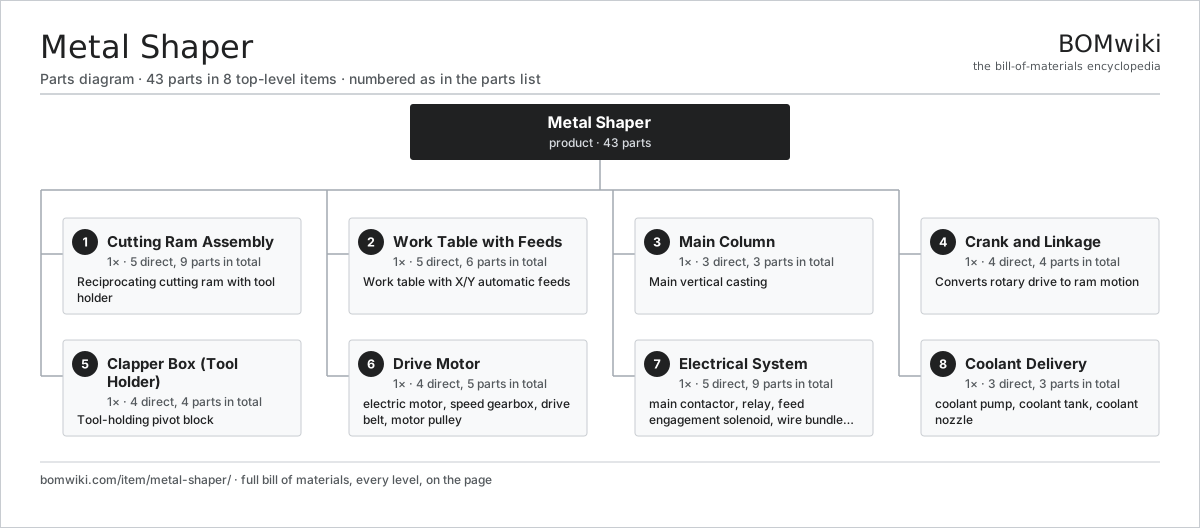
| # | Part | Qty | What it does |
|---|---|---|---|
| 1 | Cutting Ram Assembly 5 parts | 1× | Reciprocating cutting ram with tool holder |
| 2 | Work Table with Feeds 5 parts | 1× | Work table with X/Y automatic feeds |
| 3 | Main Column 3 parts | 1× | Main vertical casting |
| 4 | Crank and Linkage 4 parts | 1× | Converts rotary drive to ram motion |
| 5 | Clapper Box (Tool Holder) 4 parts | 1× | Tool-holding pivot block |
| 6 | Drive Motor 4 parts | 1× | AC three-phase motor driving the crankshaft via belt. |
| 7 | Electrical System 5 parts | 1× | Motor control, solenoid feed engagement, and safety interlocks. |
| 8 | Coolant Delivery 3 parts | 1× | Simple pump and nozzle delivering cutting fluid to the tool-workpiece interface. |
3D model
No 3D model yet. Have a CAD file of this? Add a 3D model. STL renders right on this page; STEP, FreeCAD, and OpenSCAD sources are welcome too (openly licensed, like all 3D models on BOMwiki).
Build & assembly graph
expand / collapse · shared sub-assemblies converge · links to related products · est. labourTap an assembly to expand/collapse · tap a part to open it · use “Open page” for any node · drag to pan, scroll to zoom.
Bill of materials for Metal Shaper
8 top-level lines · 45 rows shown · 43 parts total · indented to 3 levels| # | Item / sub-assembly | Part no. | Qty/assy | Ext. qty | Parts | Type |
|---|---|---|---|---|---|---|
| 1 | Cutting Ram Assembly 5 parts | metal-shaper-ram | 1× | 1 | 9 | assembly |
| 1.1 | Ram Shaft | metal-shaper-ram-shaft | 1× | 1 | · | part |
| 1.2 | Ram Guides | metal-shaper-ram-guides | 2× | 2 | · | part |
| 1.3 | Ram Bearing Block | metal-shaper-ram-bearing-block | 1× | 1 | · | part |
| 1.4 | Clapper Box (Tool Holder) 4 parts | metal-shaper-clapper-box | 1× | 1 | 4 | assembly |
| 1.4.1 | Clapper Box Casting | metal-shaper-clapper-box-body | 1× | 1 | · | part |
| 1.4.2 | Tool Post | metal-shaper-tool-post | 1× | 1 | · | part |
| 1.4.3 | Clapper Pivot Pin | metal-shaper-clapper-pivot-pin | 1× | 1 | · | part |
| 1.4.4 | Tool Bit | metal-shaper-tool-bit-holder | 1× | 1 | · | part |
| 1.5 | Fastener Set | fastener-set | 1× | 1 | · | part |
| 2 | Work Table with Feeds 5 parts | metal-shaper-table-with-feeds | 1× | 1 | 6 | assembly |
| 2.1 | Table Casting | metal-shaper-table-casting | 1× | 1 | · | part |
| 2.2 | Table Precision Ways | metal-shaper-table-ways | 2× | 2 | · | part |
| 2.3 | X-Feed Ratchet | metal-shaper-x-feed-mechanism | 1× | 1 | · | part |
| 2.4 | Y-Feed Ratchet | metal-shaper-y-feed-mechanism | 1× | 1 | · | part |
| 2.5 | Table Clamp Sets | metal-shaper-table-clamps | 1× | 1 | · | part |
| 3 | Main Column 3 parts | metal-shaper-column | 1× | 1 | 3 | assembly |
| 3.1 | Column Casting | metal-shaper-column-body | 1× | 1 | · | part |
| 3.2 | Column Base Feet | metal-shaper-column-base | 1× | 1 | · | part |
| 3.3 | Fastener Set | fastener-set | 1× | 1 | · | part |
| 4 | Crank and Linkage 4 parts | metal-shaper-crank-mechanism | 1× | 1 | 4 | assembly |
| 4.1 | Crankshaft | metal-shaper-crankshaft | 1× | 1 | · | part |
| 4.2 | Connecting Rod | metal-shaper-connecting-rod | 1× | 1 | · | part |
| 4.3 | Adjustable Stroke Block | metal-shaper-stroke-adjustment-block | 1× | 1 | · | part |
| 4.4 | Drive Pulley | metal-shaper-drive-pulley | 1× | 1 | · | part |
| 5 | Clapper Box (Tool Holder) 4 parts | metal-shaper-clapper-box | 1× | 1 | 4 | assembly |
| 5.1 | Clapper Box Casting | metal-shaper-clapper-box-body | 1× | 1 | · | part |
| 5.2 | Tool Post | metal-shaper-tool-post | 1× | 1 | · | part |
| 5.3 | Clapper Pivot Pin | metal-shaper-clapper-pivot-pin | 1× | 1 | · | part |
| 5.4 | Tool Bit | metal-shaper-tool-bit-holder | 1× | 1 | · | part |
| 6 | Drive Motor 4 parts | metal-shaper-drive-motor | 1× | 1 | 5 | assembly |
| 6.1 | Electric Motor | metal-shaper-drive-motor-body | 1× | 1 | · | part |
| 6.2 | Speed Gearbox | metal-shaper-speed-gearbox | 1× | 1 | · | part |
| 6.3 | Drive Belt | drive-belt | 2× | 2 | · | part |
| 6.4 | Motor Pulley | metal-shaper-motor-pulley | 1× | 1 | · | part |
| 7 | Electrical System 5 parts | metal-shaper-electrical | 1× | 1 | 9 | assembly |
| 7.1 | Main Contactor | metal-shaper-main-contactor | 1× | 1 | · | part |
| 7.2 | Relay | relay | 2× | 2 | · | part |
| 7.3 | Feed Engagement Solenoid | metal-shaper-feed-solenoid | 1× | 1 | · | part |
| 7.4 | Wire Bundle | wire-bundle | 1× | 1 | · | part |
| 7.5 | Connector | connector | 4× | 4 | · | part |
| 8 | Coolant Delivery 3 parts | metal-shaper-coolant-system | 1× | 1 | 3 | assembly |
| 8.1 | Coolant Pump | metal-shaper-coolant-pump | 1× | 1 | · | part |
| 8.2 | Coolant Tank | metal-shaper-coolant-tank | 1× | 1 | · | part |
| 8.3 | Coolant Nozzle | metal-shaper-coolant-nozzle | 1× | 1 | · | part |
Something wrong in this list? Report a problem with this BOM.
Related products
same domain, ranked by shared parts Aluminum Extrusion Press
365 parts · shares 1 with this page
Bar Chamfering Machine
1,148 parts · shares 1 with this page
Aluminum Extrusion Press
365 parts · shares 1 with this page
Bar Chamfering Machine
1,148 parts · shares 1 with this page
 Bevel Gear Generator
201 parts · shares 1 with this page
Bevel Gear Generator
201 parts · shares 1 with this page
 Blacksmith Power Hammer
34 parts · shares 1 with this page
Blanking Press Line
350 parts · shares 1 with this page
Blacksmith Power Hammer
34 parts · shares 1 with this page
Blanking Press Line
350 parts · shares 1 with this page
Sourcing: possible vendors
Browse the supplier directory → Prices, MOQ, and lead times are algorithmic estimates, not quotes, and not claims about these companies. Company mappings are curated by keyword; est. price band $10k–$1M. How estimates work| Vendor | HQ | Specialty | MOQ | Lead time |
|---|---|---|---|---|
|
🇩🇪DMG MORI
dmgmori.com ↗
|
Bielefeld, DE | Machine tools | 5 units | 12–20 wks |
|
🇯🇵Mazak
mazak.com ↗
|
Oguchi, JP | Machine tools | 5 units | 12–20 wks |
| haascnc.com ↗ | Oxnard, US | CNC machine tools | 5 units | 12–20 wks |
|
🇯🇵Okuma
okuma.com ↗
|
Niwa, JP | Machine tools | 5 units | 12–20 wks |
|
🇩🇪Trumpf
trumpf.com ↗
|
Ditzingen, DE | Laser & sheet-metal machines | 5 units | 12–20 wks |
1,169-word article