Mechanical Metronome
ProductOverview
The mechanical metronome is a clockwork machine that beats audible time for musicians. The pyramid form was patented by Johann Maelzel in 1815, building on Dietrich Winkel's double-weighted pendulum, and the design has barely changed since: a Winding Drive powers an Escapement & Gearing whose ticking rate is set by sliding a weight along an inverted pendulum. The printed range of 40 to 208 beats per minute and the tempo names on the Scale Plate are the reason sheet music says "M.M. ♩= 120", Maelzel's Metronome.
The whole mechanism lives in the Pyramid Case, whose hollow tapered shell is a sounding box: the tick is the escapement locking, amplified by the wood or plastic body.
The double-weighted pendulum
An ordinary clock pendulum hangs below its pivot and a useful tempo range would need an impractically long rod. Winkel's insight was the compound pendulum of the Pendulum Assembly: a fixed Counterweight sits below the pivot and the Sliding Weight rides on the Pendulum Rod above it. The two weights act in opposition, so the system's restoring torque is the small difference between them while its moment of inertia stays large. Small movements of the slider therefore swing the period over a five-to-one range, 40 to 208 BPM, on a rod only about 200 mm long.
The musician lifts the Front Lid, drops the slider so its top edge aligns with the desired graduation, and gives the pendulum a push. Tempo accuracy is typically within one or two percent if the case sits level; tilting the case fore-aft changes the gravity component acting on the weights and shifts the beat, which is why the Rubber Feet and a flat surface matter.
Escapement and power
Driving the pendulum is a deliberately crude but robust clockwork. The Mainspring is a flat open spiral rather than a barrel-enclosed spring; the Winding Key on the case side charges it through a Click & Ratchet. A short step-up Helical Gear Pair takes the spring's slow rotation to the Escape Wheel.
The escapement is the inverse of a clock's in spirit: here timekeeping precision matters less than a loud, crisp tick. The Pallet is fixed directly to the pendulum staff, riding in hardened Staff Pivots. Each half-swing, one pallet arm releases an escape-wheel tooth and the other catches the next; the catch is the tick, and the tooth sliding across the pallet face hands the pendulum a small impulse that replaces energy lost to friction and air drag. Because impulse arrives every half-swing, the metronome ticks on both sides of the swing, at 208 BPM the escape wheel is being released nearly 3.5 times per second. A full wind runs roughly twenty minutes at fast tempos and up to forty at slow ones, since the escape wheel turns more slowly at low BPM.
The bell
Marking the downbeat is the job of the Bell Mechanism. The Count Cam is a stepped wheel advanced one notch per tick; slots cut at intervals of two, three, four, or six notches let a follower drop, releasing the sprung Bell Hammer against the Bell. The Selector Knob shifts the follower between slot tracks, so the player can accent 2/4, 3/4, 4/4, or 6/8 time, or pull the knob to silence the bell. The bell rings simultaneously with a normal tick, so the ear hears tick-tick-tick-DING in four, with the ding on beat one.
Construction and service
The movement is built between stamped Movement Plates riveted into a rigid frame screwed to the Base Plate; the case shell lifts off over it. Traditional cases are veneered hardwood, the Wittner pyramid being the canonical example, while student models use ABS, which sounds slightly sharper and quieter. There is almost nothing to service: pivots get a trace of clock oil at long intervals, and the most common fault is a dried or gummed mainspring, or a metronome stored on its side whose Sliding Weight has lost friction and slides under gravity. The slider's grip on the rod is a simple stamped spring fit and can be re-tensioned.
Mechanical metronomes survive in the electronic era partly because the swinging rod gives a visual beat that a beeping box does not: players track the pendulum with peripheral vision the way they would a conductor. The Lid Latch and lid also make the instrument its own shipping case, another piece of the 1815 design that never needed improving.
Mechanical Metronome parts and their functions
6 top-level parts · 27 parts in total · full bill of materials below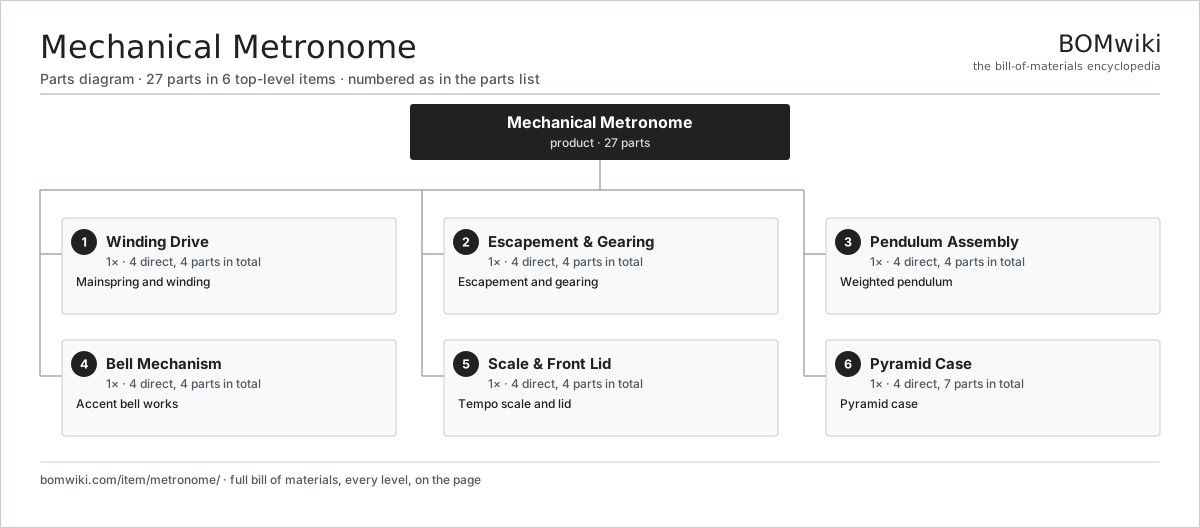
| # | Part | Qty | What it does |
|---|---|---|---|
| 1 | Winding Drive 4 parts | 1× | Mainspring and winding |
| 2 | Escapement & Gearing 4 parts | 1× | Escapement and gearing |
| 3 | Pendulum Assembly 4 parts | 1× | Weighted pendulum |
| 4 | Bell Mechanism 4 parts | 1× | Accent bell works |
| 5 | Scale & Front Lid 4 parts | 1× | Tempo scale and lid |
| 6 | Pyramid Case 4 parts | 1× | Pyramid case |
3D model
No 3D model yet. Have a CAD file of this? Add a 3D model. STL renders right on this page; STEP, FreeCAD, and OpenSCAD sources are welcome too (openly licensed, like all 3D models on BOMwiki).
Build & assembly graph
expand / collapse · shared sub-assemblies converge · links to related products · est. labourTap an assembly to expand/collapse · tap a part to open it · use “Open page” for any node · drag to pan, scroll to zoom.
Bill of materials for Mechanical Metronome
6 top-level lines · 30 rows shown · 27 parts total · indented to 3 levels| # | Item / sub-assembly | Part no. | Qty/assy | Ext. qty | Parts | Type |
|---|---|---|---|---|---|---|
| 1 | Winding Drive 4 parts | metronome-winding-drive | 1× | 1 | 4 | assembly |
| 1.1 | Mainspring | metronome-mainspring | 1× | 1 | · | part |
| 1.2 | Winding Key | metronome-winding-key | 1× | 1 | · | part |
| 1.3 | Click & Ratchet | metronome-click-ratchet | 1× | 1 | · | part |
| 1.4 | Fastener Set | fastener-set | 1× | 1 | · | part |
| 2 | Escapement & Gearing 4 parts | metronome-escapement | 1× | 1 | 4 | assembly |
| 2.1 | Escape Wheel | metronome-escape-wheel | 1× | 1 | · | part |
| 2.2 | Pallet | metronome-pallet | 1× | 1 | · | part |
| 2.3 | Movement Plates | metronome-movement-plates | 1× | 1 | · | part |
| 2.4 | Helical Gear Pair | gear-pair | 1× | 1 | · | part |
| 3 | Pendulum Assembly 4 parts | metronome-pendulum | 1× | 1 | 4 | assembly |
| 3.1 | Pendulum Rod | metronome-pendulum-rod | 1× | 1 | · | part |
| 3.2 | Sliding Weight | metronome-sliding-weight | 1× | 1 | · | part |
| 3.3 | Counterweight | metronome-counterweight | 1× | 1 | · | part |
| 3.4 | Staff Pivots | metronome-staff-pivots | 1× | 1 | · | part |
| 4 | Bell Mechanism 4 parts | metronome-bell-mechanism | 1× | 1 | 4 | assembly |
| 4.1 | Bell | metronome-bell | 1× | 1 | · | part |
| 4.2 | Bell Hammer | metronome-bell-hammer | 1× | 1 | · | part |
| 4.3 | Count Cam | metronome-count-cam | 1× | 1 | · | part |
| 4.4 | Selector Knob | metronome-selector-knob | 1× | 1 | · | part |
| 5 | Scale & Front Lid 4 parts | metronome-scale-front | 1× | 1 | 4 | assembly |
| 5.1 | Scale Plate | metronome-scale-plate | 1× | 1 | · | part |
| 5.2 | Front Lid | metronome-front-lid | 1× | 1 | · | part |
| 5.3 | Lid Latch | metronome-lid-latch | 1× | 1 | · | part |
| 5.4 | Fastener Set | fastener-set | 1× | 1 | · | part |
| 6 | Pyramid Case 4 parts | metronome-case | 1× | 1 | 7 | assembly |
| 6.1 | Case Shell | metronome-case-shell | 1× | 1 | · | part |
| 6.2 | Base Plate | metronome-base-plate | 1× | 1 | · | part |
| 6.3 | Rubber Feet | metronome-rubber-feet | 4× | 4 | · | part |
| 6.4 | Fastener Set | fastener-set | 1× | 1 | · | part |
Something wrong in this list? Report a problem with this BOM.
Related products
same domain, ranked by shared parts Carriage Clock
49 parts · shares 1 with this page
Carriage Clock
49 parts · shares 1 with this page
 Cuckoo Clock
79 parts · shares 1 with this page
Cuckoo Clock
79 parts · shares 1 with this page
 Flip Clock
119 parts · shares 1 with this page
Flip Clock
119 parts · shares 1 with this page
 Marine Chronometer
46 parts · shares 1 with this page
Marine Chronometer
46 parts · shares 1 with this page
 Radio-Controlled Atomic Clock
130 parts · shares 1 with this page
Radio-Controlled Atomic Clock
130 parts · shares 1 with this page
 Railway Station Clock
43 parts · shares 1 with this page
Railway Station Clock
43 parts · shares 1 with this page
Sourcing: possible vendors
Browse the supplier directory → Prices, MOQ, and lead times are algorithmic estimates, not quotes, and not claims about these companies. Company mappings are curated by keyword; est. price band $20–$50k. How estimates work| Vendor | HQ | Specialty | MOQ | Lead time |
|---|---|---|---|---|
|
🇯🇵Seiko
seikowatches.com ↗
|
Tokyo, JP | Watches | 500 units | 8–14 wks |
|
🇯🇵Citizen
citizenwatch-global.com ↗
|
Tokyo, JP | Watches | 500 units | 8–14 wks |
|
🇯🇵Casio
casio.com ↗
|
Tokyo, JP | Watches & electronics | 500 units | 8–14 wks |
| swatchgroup.com ↗ | Biel, CH | Watches (Omega, Tissot) | 500 units | 8–14 wks |
| titancompany.in ↗ | Bengaluru, IN | Watches & timepieces | 500 units | 8–14 wks |
776-word article