Mezzanine Goods Lift
ProductOverview
A mezzanine goods lift (or vertical conveyor lift) is a compact, continuously moving platform system designed to transport goods and packages up multiple stories within a warehouse or distribution center. Unlike traditional goods lifts with full-height guide rails and large motor rooms, mezzanine lifts use a simple roller chain or cable loop driven by a geared electric motor. The moving platform continuously ascends and descends along a lightweight mast guide system, allowing workers to simply load cargo onto the platform at the lower level and unload it as it passes the upper mezzanine.
Mezzanine lifts are common in multi-level warehouses, e-commerce distribution centers, and industrial facilities where floor-to-mezzanine transfers must be fast, space-efficient, and affordable. A typical system lifts 500–2000 kg per cycle at speeds of 0.3–0.6 m/s, completing a full vertical journey (2–10 m) in 10–30 seconds. The continuous motion design means multiple loads can be in transit simultaneously (a lower load ascending while an upper load descends), maximizing throughput.
The chain-driven architecture is mechanically simple and inherently safe: if the motor stops, the spring-applied brake immediately halts the platform, holding it indefinitely at any intermediate height. The roller chain is a common industrial component, easily inspected and maintained. Most mezzanine lifts can operate reliably for 10–15 years with minimal maintenance beyond annual chain inspection and lubrication.
How it Works
A warehouse worker carries or forklifts a pallet of goods to the lower level of the mezzanine lift. The load stops (raised bars) on the moving platform prevent the cargo from sliding during motion. The worker places the pallet onto the platform and presses the UP button on the control station.
The electrical control system energizes the AC motor (typically 2–5 kW). The motor drives the gear reducer, stepping down the speed from 1500 rpm to approximately 30–75 rpm. The reducer output couples via a flexible coupling to the drive sprocket.
The drive sprocket, meshing with the roller chain, begins to rotate. The chain, which forms a continuous loop anchored to the platform via welded lugs, pulls the platform upward at a steady speed (typically 0.3–0.6 m/s).
The platform rises along the lightweight mast and guide rails. The platform frame incorporates guide brackets (rollers or sliding blocks) that ride on vertical guide channels on each side of the mast. These guides keep the platform vertical and centered, preventing swinging or tilting. Sealed roller bearings in the guide blocks minimize friction.
As the platform approaches the upper mezzanine level, a mechanical limit switch (triggered by a cam or magnetic sensor) detects the arrival. The control system cuts power to the motor, and the spring-applied brake immediately engages, halting the platform. The platform is now stopped at the upper level; the worker unloads the cargo.
The platform then waits. If the motor is de-energized and the control system is idle (no further UP or DOWN commands), the platform remains stopped indefinitely, held by the brake. This is safe and power-efficient: the motor does not run unless commanded.
However, in a high-throughput system, a second pallet may be loading at the lower level while the first is unloading at the upper level. Once the upper cargo is unloaded and the control system receives a DOWN command, the motor reverses (or a separate motor energizes for the return journey). The platform descends, the chain returns the platform to the lower level where the next pallet awaits. The system can thus complete a cycle every 10–30 seconds, allowing 200–400 loads per 8-hour shift from a single lift.
Load Handling and Safety
The load stop bars are essential for safe operation. Placed at the front (upslope) side of the platform, they prevent cargo from sliding backward during ascent if the pallet is not centered or if the floor is inclined. During descent, gravity naturally holds the load against the stop bar, preventing sliding.
The roller chain is rated for the maximum lifted load plus the platform weight. A typical chain might be rated for 3000 kg safe working load, supporting a 2000 kg cargo + 500 kg platform with a 1.5× safety margin.
The control system includes a gate interlock at the lower and upper access points. If an access gate is left open, the electrical interlock prevents the motor from starting. This prevents workers from being struck by the moving platform.
An optional pressure-sensitive edge strip around the platform perimeter provides additional protection: if the platform contacts any obstacle (a worker's arm, a protruding pallet), the sensor triggers an emergency stop.
The spring-applied brake is the ultimate safety device. If power is lost, the brake immediately engages, suspending the platform at its current position indefinitely. No additional manual intervention is required.
Descent Control
Downward motion is controlled via the gear reducer. As the motor drives the sprocket in reverse, the chain pulls the platform downward. However, the load's weight creates a natural tendency to accelerate downward. The spring-applied brake, which is held in the release state by motor torque, prevents runaway descent: if the motor torque decreases or fails, the brake re-engages immediately.
The control system modulates motor speed during descent, typically reducing speed to 0.2–0.4 m/s (slower than ascent) to provide additional safety margin. An optional load-sensing valve in the hydraulic circuit (if the system uses an auxiliary hydraulic pump for brake release) can restrict descent speed further, ensuring controlled lowering even if the motor stalls.
Most modern mezzanine lifts use electrical soft-starters or variable-frequency drives (VFDs) on the AC motor, allowing smooth acceleration and deceleration profiles that prevent shock loads on the chain and reduce wear.
Maintenance and Longevity
The roller chain is the primary wear item. Inspection intervals are:
- Weekly: Visual inspection of the chain for broken links, tight sections, or rust.
- Monthly: Manual chain tensioning check; optimal tension is approximately 12–15 mm of deflection at the midpoint. Over-tightening accelerates sprocket wear; under-tightening causes chain slip.
- Every 2000 hours (typically 1 year for a busy system): Chain lubrication; sprocket inspection for tooth wear (teeth should be sharp, not hooked). Replacement of any sprocket with more than 10% tooth wear.
- Every 3–5 years: Chain replacement (typical life is 5000–10000 hours). Overhaul of motor and brake.
Roller chain, though simple, requires attention. Proper lubrication (chain-specific oil or grease, not general-purpose lubricants) extends chain life significantly. Rust formation due to moisture or salt spray (in humid or coastal environments) accelerates chain failure; stainless-steel chains are available for corrosive environments but cost 2–3× more.
The AC motor and gear reducer, if not cavitated or run dry of lubricant, typically last 10,000+ hours (10+ years in a typical 8-hour workday environment). The spring-applied brake should be functionally tested quarterly; brake springs can weaken over time, reducing holding force.
A well-maintained mezzanine lift can operate reliably for 15–20 years. Total cost of ownership is low: the installed system costs 15,000–40,000 USD depending on height and capacity, with annual maintenance costs of 1000–2000 USD.
Comparison with Alternative Systems
Vertical goods lifts are heavier and more complex, requiring full guide rails and larger motors; they are used for larger capacities (5000+ kg) and taller heights (10+ floors). Conveyor belts and inclined conveyors are efficient for horizontal or slightly inclined transport but cannot handle multi-story vertical lifts. Mobile scissor lifts or forklifts can move between locations but are slower and more labor-intensive.
Mezzanine lifts strike a balance: they are simpler and cheaper than full-size goods lifts, space-efficient compared to spiral stairs or ramps, and capable of handling high throughput with minimal maintenance.
Mezzanine Goods Lift parts and their functions
8 top-level parts · 240 parts in total · full bill of materials below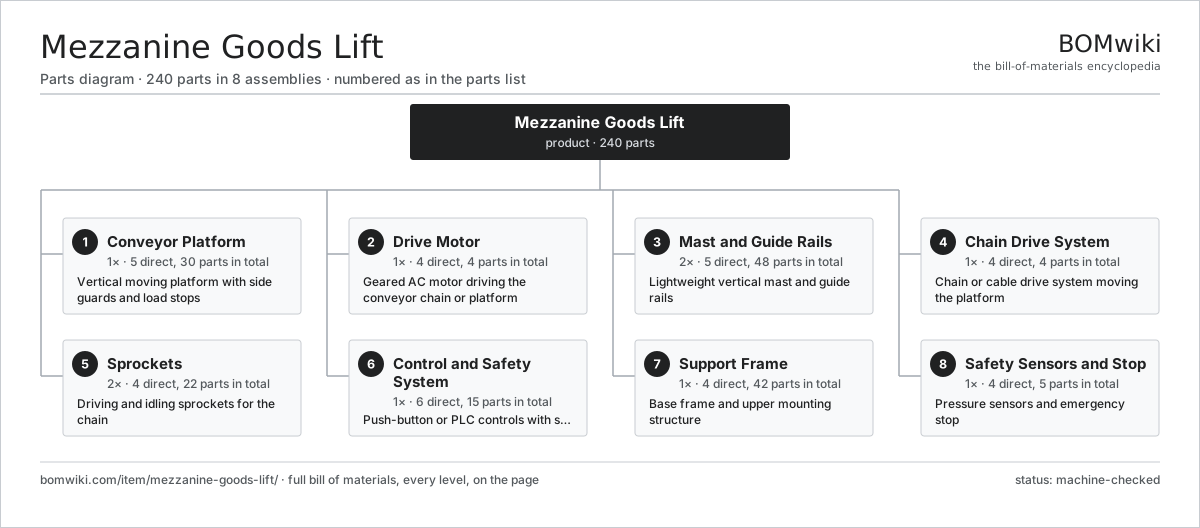
| # | Part | Qty | What it does |
|---|---|---|---|
| 1 | Conveyor Platform 5 parts | 1× | Vertical moving platform with side guards and load stops |
| 2 | Drive Motor 4 parts | 1× | Geared AC motor driving the conveyor chain or platform |
| 3 | Mast and Guide Rails 5 parts | 2× | Lightweight vertical mast and guide rails |
| 4 | Chain Drive System 4 parts | 1× | Chain or cable drive system moving the platform |
| 5 | Sprockets 4 parts | 2× | Driving and idling sprockets for the chain |
| 6 | Control and Safety System 6 parts | 1× | Push-button or PLC controls with safety interlocks |
| 7 | Support Frame 4 parts | 1× | Base frame and upper mounting structure |
| 8 | Safety Sensors and Stop 4 parts | 1× | Pressure sensors and emergency stop |
3D model
No 3D model yet. Have a CAD file of this? Add a 3D model — STL renders right on this page; STEP, FreeCAD, and OpenSCAD sources are welcome too (openly licensed, like all 3D models on BOMwiki).
Build & assembly graph
expand / collapse · shared sub-assemblies converge · links to related products · est. labourTap an assembly to expand/collapse · tap a part to open it · use “Open page” for any node · drag to pan, scroll to zoom.
Bill of materials for Mezzanine Goods Lift
8 top-level lines · 44 rows shown · 240 parts total · indented to 3 levels| # | Item / sub-assembly | Part no. | Qty/assy | Ext. qty | Parts | Type |
|---|---|---|---|---|---|---|
| 1 | Conveyor Platform 5 parts | mezzanine-goods-lift-conveyor-platform | 1× | 1 | 30 | assembly |
| 1.1 | Platform Deck | mezzanine-goods-lift-platform-deck | 1× | 1 | · | part |
| 1.2 | Platform Frame | mezzanine-goods-lift-platform-frame | 1× | 1 | · | part |
| 1.3 | Load Stop Bar | mezzanine-goods-lift-load-stop | 2× | 2 | · | part |
| 1.4 | Guide Bracket | mezzanine-goods-lift-guide-bracket | 2× | 2 | · | part |
| 1.5 | Fastener Set | fastener-set | 24× | 24 | · | part |
| 2 | Drive Motor 4 parts | mezzanine-goods-lift-drive-motor | 1× | 1 | 4 | assembly |
| 2.1 | AC Motor | mezzanine-goods-lift-ac-motor | 1× | 1 | · | part |
| 2.2 | Gear Reducer | mezzanine-goods-lift-gear-reducer | 1× | 1 | · | part |
| 2.3 | Brake | mezzanine-goods-lift-motor-brake | 1× | 1 | · | part |
| 2.4 | Coupling | mezzanine-goods-lift-flexible-coupling | 1× | 1 | · | part |
| 3 | Mast and Guide Rails 5 parts | mezzanine-goods-lift-mast-rails | 2× | 2 | 48 | assembly |
| 3.1 | Mast Tube | mezzanine-goods-lift-mast-tube | 2× | 4 | · | part |
| 3.2 | Mast Base Mount | mezzanine-goods-lift-mast-mounting | 4× | 8 | · | part |
| 3.3 | Guide Channel | mezzanine-goods-lift-guide-channel | 2× | 4 | · | part |
| 3.4 | Ball Bearing | ball-bearing | 8× | 16 | · | part |
| 3.5 | Fastener Set | fastener-set | 32× | 64 | · | part |
| 4 | Chain Drive System 4 parts | mezzanine-goods-lift-chain-drive | 1× | 1 | 4 | assembly |
| 4.1 | Roller Chain | mezzanine-goods-lift-roller-chain | 1× | 1 | · | part |
| 4.2 | Chain Attachment | mezzanine-goods-lift-chain-attachment | 1× | 1 | · | part |
| 4.3 | Return Idler | mezzanine-goods-lift-return-idler | 1× | 1 | · | part |
| 4.4 | Chain Tensioner | mezzanine-goods-lift-chain-tensioner | 1× | 1 | · | part |
| 5 | Sprockets 4 parts | mezzanine-goods-lift-sprockets | 2× | 2 | 22 | assembly |
| 5.1 | Drive Sprocket | mezzanine-goods-lift-drive-sprocket | 1× | 2 | · | part |
| 5.2 | Return Sprocket | mezzanine-goods-lift-return-sprocket | 1× | 2 | · | part |
| 5.3 | Ball Bearing | ball-bearing | 4× | 8 | · | part |
| 5.4 | Fastener Set | fastener-set | 16× | 32 | · | part |
| 6 | Control and Safety System 6 parts | mezzanine-goods-lift-control-system | 1× | 1 | 15 | assembly |
| 6.1 | Control Enclosure | mezzanine-goods-lift-control-enclosure | 1× | 1 | · | part |
| 6.2 | Push-Button Station | mezzanine-goods-lift-push-buttons | 1× | 1 | · | part |
| 6.3 | Limit Switch | mezzanine-goods-lift-limit-switch | 2× | 2 | · | part |
| 6.4 | Gate Interlock | mezzanine-goods-lift-safety-interlock | 1× | 1 | · | part |
| 6.5 | Relay | relay | 4× | 4 | · | part |
| 6.6 | Connector | connector | 6× | 6 | · | part |
| 7 | Support Frame 4 parts | mezzanine-goods-lift-support-frame | 1× | 1 | 42 | assembly |
| 7.1 | Base Frame | mezzanine-goods-lift-base-frame | 1× | 1 | · | part |
| 7.2 | Upper Mount Bracket | mezzanine-goods-lift-upper-mount | 1× | 1 | · | part |
| 7.3 | Anchor Bolt | mezzanine-goods-lift-anchor-bolt | 8× | 8 | · | part |
| 7.4 | Fastener Set | fastener-set | 32× | 32 | · | part |
| 8 | Safety Sensors and Stop 4 parts | mezzanine-goods-lift-safety-edges | 1× | 1 | 5 | assembly |
| 8.1 | Pressure-Sensitive Strip | mezzanine-goods-lift-pressure-sensor | 1× | 1 | · | part |
| 8.2 | Sensor Safety Relay | mezzanine-goods-lift-sensor-relay | 1× | 1 | · | part |
| 8.3 | Emergency Stop Button | mezzanine-goods-lift-emergency-button | 1× | 1 | · | part |
| 8.4 | Connector | connector | 2× | 2 | · | part |
Sourcing: possible vendors
Prices, MOQ, and lead times are algorithmic estimates, not quotes, and not claims about these companies. Company mappings are curated by keyword; est. price band $10k–$200k. How estimates work| Vendor | HQ | Specialty | MOQ | Lead time |
|---|---|---|---|---|
|
🇺🇸Otis
otis.com ↗
|
Farmington, US | Elevators & escalators | 20 units | 14–24 wks |
| schindler.com ↗ | Ebikon, CH | Elevators & escalators | 20 units | 14–24 wks |
|
🇫🇮KONE
kone.com ↗
|
Espoo, FI | Elevators & escalators | 20 units | 14–24 wks |
| tkelevator.com ↗ | Düsseldorf, DE | Elevators | 20 units | 14–24 wks |
| mitsubishielectric.com ↗ | Tokyo, JP | Elevators & electronics | 20 units | 14–24 wks |
1,473-word article