Microfiche Reader
ProductOverview
A microfiche reader is a desktop optical instrument for reading microfilm microfiche, tiny photographic reproductions of documents reduced to 1/50th original size. Libraries, archives, and government agencies use readers to provide access to historical documents, newspapers, legal records, and out-of-print materials stored on 105×148 mm COM (Computer Output Microfilm) fiche cards.
Each fiche typically contains 60–300 document pages in a grid layout. The reader illuminates the fiche from behind, projects the image through a magnifying lens, and displays it on a rear-projection screen at 24–42× magnification, making text legible.
How It Works
An operator places a microfiche card in the Microfiche Carrier Stage with printed side facing the projection optics. The Light Source illuminates the fiche from behind; light passes through the transparent fiche base, carrying the image of documents.
The light travels through the Lens & Projection System system: the Condenser Lens collects and collimates light, the Objective Lens magnifies the image (10×–40× selectable via the Magnification Lens Carousel), and the Relay Optics focuses the magnified image onto the Rear-Projection Screen.
The Microfiche Carrier Stage is an XY motorized platform. The X-Axis Stepper Motor and Y-Axis Stepper Motor motors allow the operator to move the fiche under the optical axis, bringing different documents into view. The Motorized Z-Axis Focus drives the Focus Drive Screw to adjust the distance between the objective lens and fiche, maintaining sharp focus.
The Control & Power Electronics microcontroller accepts input from a keypad or touchscreen, commanding the stepper motors to move the stage and adjust focus. Modern systems also support computer interface (USB) for automated batch scanning or archive digitization.
Microfiche Format & Density
Standard microfiche is a 105×148 mm (4×6 inch) transparent film base with a grid of document images. COM (Computer Output Microfilm) generation 3 fiche typically hold 60–300 document pages depending on page size and reduction ratio (10:1 to 48:1 reduction).
Each document frame is usually 6–8 mm square. The fiche header (top) contains a title, date, and index number. The frame grid is typically 5×8 or 7×10 frames per fiche.
Older aperture card format (single document on punched tabulating card) is rarely encountered. Microfiche is the dominant archived format, especially in US patent offices, court records, and library special collections.
Optical Resolution & Magnification
Microfiche film is high-resolution (typically capable of resolving 3–5 microns on film), equivalent to 150–250 DPI at original document size. The Objective Lens 10×–40× magnification range allows viewing documents at original size (10× for large documents) up to reading fine print (40× magnification).
The Relay Optics and Rear-Projection Screen arrangement forms a virtual image: light from the objective does not directly project onto the screen; instead, it forms a virtual image plane, and the relay optics re-magnify this virtual image onto the physical screen at 10×12 inches.
Total magnification (on-screen) is objective magnification × relay relay factor. A 10× objective with 2× relay yields 20× on-screen magnification, a 2 mm frame becomes 40 mm on the screen, roughly 150% of eye-comfortable viewing distance (20–40 cm).
Light Source Options
Traditional readers use Halogen Light Source 150–250W halogen lamps at 3000K (warm white), chosen because tungsten filament color temperature matches human eye sensitivity for document reading.
Modern readers increasingly use LED arrays (20W white 5000K), offering:
- Lower power consumption (50W vs 250W)
- Longer life (50,000 hours vs 2,000 hours)
- No heat generation
- Instant on/off (no warm-up delay)
The Heat Filter dichroic filter removes infrared radiation from the halogen lamp, preventing heat damage to fiche and reducing operator hand proximity fatigue.
Screen Technology
The Rear-Projection Screen is a rear-projection ground-glass or Fresnel lens screen 10×12 inches, located behind the optical path. Fresnel screens use concentric ridges to redirect light rays, improving brightness uniformity. Ground glass provides softer diffusion for wide viewing angles.
Screen brightness is primarily determined by lamp power. Halogen systems typically output 500–1000 lux on screen (bright enough for comfortable reading in normal office lighting). LED systems are slightly dimmer but still adequate.
Some modern systems add optional supplemental Screen Led backlighting for low-light environments, though this is rarely needed.
Motorized Stage & Navigation
The Microfiche Carrier Stage XY stage uses stepper motors for precise positioning. Each stepper motor is 200 steps per revolution, driving 1:1 through mechanical gearing or directly through Linear Bearing Rail bearings.
Step resolution is typically 0.1–0.5 mm, allowing fine positioning of individual document frames. Most systems allow setting "frame addresses" (e.g., row 3, column 5) and automatically moving the stage to that location.
The Motorized Z-Axis Focus stepper drives the Focus Drive Screw (typically 1 mm pitch) to adjust objective-to-fiche distance. Focus range is usually 10–50 mm, covering viewing magnifications from 10× to 42×.
Control Interfaces
Vintage microfiche readers (1980s–2000s) use mechanical knobs and manual stage. Modern readers offer:
- Analog knobs (still present for manual fine-tuning)
- Keypad interface for frame address entry
- USB interface for computer control
- Touchscreen on integrated display models
Computer control enables high-throughput batch scanning: a computer automatically sequences through microfiche frames, capturing images for digitization into searchable PDF archives.
Use Cases & Decline
Microfiche reading peaked in the 1990s–2000s as primary archival format. Legal documents, property records, patent databases, and historical newspapers were microfilmed by the millions.
As digital imaging costs dropped (1990s–2010s), institutions began retroactive digitization projects. Many libraries now operate microfiche readers primarily for:
- Legacy access when fiche is cheaper to retrieve than digitize
- Cold storage archives (fiche stable for 100+ years)
- Legal/patent systems where fiche is legally recognized as official record
Demand for new readers has plummeted; most institutions maintain aging 1980s–2000s equipment. Replacement part availability is becoming challenging.
Preservation & Environmental Sensitivity
Microfiche film is cellulose acetate or polyester base. Acetate film is chemically unstable and undergoes "vinegar syndrome" (acidic degradation) over decades, especially in humid conditions. Proper storage (cool, dry, <50% RH) is essential.
Readers should not be used in high-humidity environments without air handling; moisture can condense on fiche, causing photographic emulsion damage.
Technical Skills & Training
Operating a microfiche reader requires minimal training: load fiche, adjust focus, navigate to desired frame. However, maintaining optimal image quality (focus, brightness) requires operator familiarity. Many institutions find that only a few staff members become proficient, limiting flexibility.
Digitization workflows using computer-controlled readers require technical setup and software, but enable bulk processing without manual operator fatigue.
Microfiche Reader parts and their functions
8 top-level parts · 35 parts in total · full bill of materials below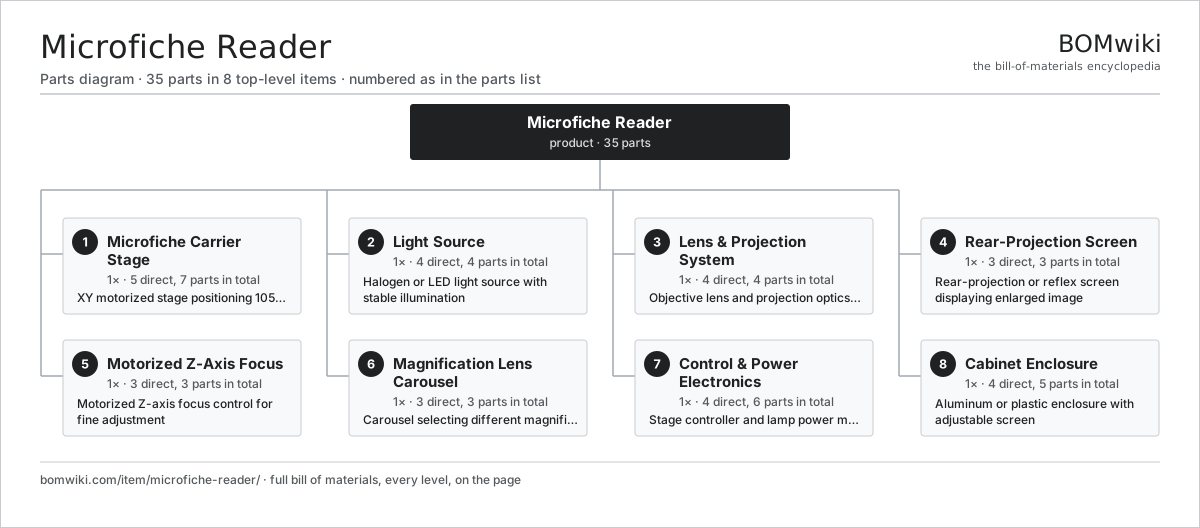
| # | Part | Qty | What it does |
|---|---|---|---|
| 1 | Microfiche Carrier Stage 5 parts | 1× | XY motorized stage positioning 105×148 mm microfiche |
| 2 | Light Source 4 parts | 1× | Halogen or LED light source with stable illumination |
| 3 | Lens & Projection System 4 parts | 1× | Objective lens and projection optics magnifying 24–42× |
| 4 | Rear-Projection Screen 3 parts | 1× | Rear-projection or reflex screen displaying enlarged image |
| 5 | Motorized Z-Axis Focus 3 parts | 1× | Motorized Z-axis focus control for fine adjustment |
| 6 | Magnification Lens Carousel 3 parts | 1× | Carousel selecting different magnification lenses |
| 7 | Control & Power Electronics 4 parts | 1× | Stage controller and lamp power management |
| 8 | Cabinet Enclosure 4 parts | 1× | Aluminum or plastic enclosure with adjustable screen |
3D model
No 3D model yet. Have a CAD file of this? Add a 3D model. STL renders right on this page; STEP, FreeCAD, and OpenSCAD sources are welcome too (openly licensed, like all 3D models on BOMwiki).
Build & assembly graph
expand / collapse · shared sub-assemblies converge · links to related products · est. labourTap an assembly to expand/collapse · tap a part to open it · use “Open page” for any node · drag to pan, scroll to zoom.
Bill of materials for Microfiche Reader
8 top-level lines · 38 rows shown · 35 parts total · indented to 3 levels| # | Item / sub-assembly | Part no. | Qty/assy | Ext. qty | Parts | Type |
|---|---|---|---|---|---|---|
| 1 | Microfiche Carrier Stage 5 parts | microfiche-reader-fiche-stage | 1× | 1 | 7 | assembly |
| 1.1 | Stage Carrier Plate | microfiche-reader-stage-plate | 1× | 1 | · | part |
| 1.2 | X-Axis Stepper Motor | microfiche-reader-stepper-x | 1× | 1 | · | part |
| 1.3 | Y-Axis Stepper Motor | microfiche-reader-stepper-y | 1× | 1 | · | part |
| 1.4 | Linear Bearing Rail | microfiche-reader-linear-rail | 2× | 2 | · | part |
| 1.5 | Home Position Sensor | microfiche-reader-position-sensor | 2× | 2 | · | part |
| 2 | Light Source 4 parts | microfiche-reader-projection-lamp | 1× | 1 | 4 | assembly |
| 2.1 | Halogen Light Source | microfiche-reader-halogen-lamp | 1× | 1 | · | part |
| 2.2 | Lamp Power Supply | microfiche-reader-lamp-ballast | 1× | 1 | · | part |
| 2.3 | Parabolic Reflector | microfiche-reader-lamp-reflector | 1× | 1 | · | part |
| 2.4 | Heat Filter | microfiche-reader-heat-filter | 1× | 1 | · | part |
| 3 | Lens & Projection System 4 parts | microfiche-reader-optics | 1× | 1 | 4 | assembly |
| 3.1 | Objective Lens | microfiche-reader-objective-lens | 1× | 1 | · | part |
| 3.2 | Relay Optics | microfiche-reader-relay-lens | 1× | 1 | · | part |
| 3.3 | Condenser Lens | microfiche-reader-condenser | 1× | 1 | · | part |
| 3.4 | Adjustable Iris | microfiche-reader-aperture-iris | 1× | 1 | · | part |
| 4 | Rear-Projection Screen 3 parts | microfiche-reader-screen | 1× | 1 | 3 | assembly |
| 4.1 | Projection Screen | microfiche-reader-screen-substrate | 1× | 1 | · | part |
| 4.2 | Screen Bracket | microfiche-reader-screen-mount | 1× | 1 | · | part |
| 4.3 | Screen Led | microfiche-reader-screen-led | 1× | 1 | · | part |
| 5 | Motorized Z-Axis Focus 3 parts | microfiche-reader-focus-motor | 1× | 1 | 3 | assembly |
| 5.1 | Focus Stepper Motor | microfiche-reader-focus-stepper | 1× | 1 | · | part |
| 5.2 | Focus Drive Screw | microfiche-reader-focus-screw | 1× | 1 | · | part |
| 5.3 | Focus Position Sensor | microfiche-reader-focus-sensor | 1× | 1 | · | part |
| 6 | Magnification Lens Carousel 3 parts | microfiche-reader-lens-turret | 1× | 1 | 3 | assembly |
| 6.1 | Turret Selector Motor | microfiche-reader-turret-motor | 1× | 1 | · | part |
| 6.2 | Lens Carousel | microfiche-reader-turret-disc | 1× | 1 | · | part |
| 6.3 | Turret Detent | microfiche-reader-turret-click-stop | 1× | 1 | · | part |
| 7 | Control & Power Electronics 4 parts | microfiche-reader-control-electronics | 1× | 1 | 6 | assembly |
| 7.1 | Microcontroller Board | microfiche-reader-mcu-board | 1× | 1 | · | part |
| 7.2 | Stepper Driver IC | microfiche-reader-stepper-driver | 3× | 3 | · | part |
| 7.3 | Lamp Power Supply | microfiche-reader-lamp-psu | 1× | 1 | · | part |
| 7.4 | Control Interface | microfiche-reader-interface-panel | 1× | 1 | · | part |
| 8 | Cabinet Enclosure 4 parts | microfiche-reader-housing | 1× | 1 | 5 | assembly |
| 8.1 | Base Frame | microfiche-reader-base-frame | 1× | 1 | · | part |
| 8.2 | Support Column | microfiche-reader-column | 2× | 2 | · | part |
| 8.3 | Top Service Cover | microfiche-reader-top-cover | 1× | 1 | · | part |
| 8.4 | Fastener Set | fastener-set | 1× | 1 | · | part |
Something wrong in this list? Report a problem with this BOM.
Sourcing: possible vendors
Browse the supplier directory → Prices, MOQ, and lead times are algorithmic estimates, not quotes, and not claims about these companies. Company mappings are curated by keyword; est. price band $50–$15k. How estimates work| Vendor | HQ | Specialty | MOQ | Lead time |
|---|---|---|---|---|
|
🇯🇵Canon
canon.com ↗
|
Tokyo, JP | Imaging & optics | 500 units | 8–12 wks |
|
🇯🇵Ricoh
ricoh.com ↗
|
Tokyo, JP | Office imaging | 500 units | 8–12 wks |
|
🇺🇸Xerox
xerox.com ↗
|
Norwalk, US | Printers & copiers | 500 units | 8–12 wks |
|
🇯🇵Epson
epson.com ↗
|
Suwa, JP | Printers & projectors | 500 units | 8–12 wks |
|
🇯🇵Brother
brother.com ↗
|
Nagoya, JP | Printers & sewing | 500 units | 8–12 wks |
1,117-word article