Microtunneling Machine
ProductOverview
A microtunneling machine (MTBM) is a small-diameter (<2.5 m) remotely piloted tunnel boring machine that excavates underground utility tunnels, sewer, water, gas, communications, with precision guidance and minimal surface disruption. Unlike full-size slurry TBMs, microtunneling systems are economical for short drives (100–500 m) under single streets or across rivers, where open trenching is impractical or prohibited.
The MTBM combines an microtunneling-machine-cutting-shield (open or slurry-supported cutterhead), Jacking Frame Assembly launching equipment, Slurry Separation System for face support and spoil removal, and precision Laser Guidance and Alignment for laser steering. The entire operation is remote, no workers enter pressurized chambers, and no open-cut surface disturbance occurs.
Earth Pressure Balance Operation
Most modern MTBMs use the Earth Pressure Balance (EPB) principle: the EPB (Earth Pressure Balance) Chamber (excavation chamber) is pressurized at 1–4 bar to match face pressure and prevent collapse. Excavated soil does not escape to surface; instead, it remains in the chamber as a "soil plug." The Spoil Screw Auger Conveyor, rotating at 5–30 rpm, pushes soil forward while controlling backpressure on the plug.
The plug backpressure equals soil-weight pressure at depth plus hydrostatic pressure (if below water table). The microtunneling-machine-control-unit continuously monitors chamber pressure via Pressure Sensor transducers; operators adjust screw-auger speed to maintain stable pressure (±0.2 bar tolerance) and prevent face heave or collapse.
Face Pressure Maintenance
Slurry-conditioned or foam-stabilized systems (alternative to pure EPB) inject bentonite slurry or polyurethane foam into the EPB (Earth Pressure Balance) Chamber to:
- Improve soil plasticity and reduce arching
- Reduce friction on the screw auger
- Minimize face settlement by increasing apparent cohesion
Typical conditioner dosage is 50–150 kg/m³ of excavated soil.
Jacking and Advancement
The microtunneling-machine-main-jacking-station in the launch shaft houses Jacking Hydraulic Cylinders (300–600 mm bore × 1500+ mm stroke) that push the MTBM and pipe string forward. Jacking force reaches 2000–5000 kN for large pipes in firm soil. Pressure transducers monitor load distribution and prevent uneven jack extension (differential >100 kN signals misalignment).
Advance rate is proportional to screw-auger discharge: loose soil allows 20–50 m/day; dense clay or sand requires 5–15 m/day. Water-bearing silts demand reduced advance rates and heightened pressure control to prevent liquefaction.
Laser Guidance and Steering
Microtunneling precision is critical, utilities ±50 mm and ±10 mm/km grade (0.1%). The Laser Theodolite Transmitter in the launch shaft projects a laser beam through the tunnel toward a Laser Target Reflector Panel prism on the MTBM. A Position Data Logger records beam displacement and alerts operators if drift exceeds limits.
The Digital Inclinometer Sensor measures pitch and roll angles. Real-time feedback allows manual steering corrections via proportional joystick on the microtunneling-machine-control-unit, which modulates individual jacking cylinders or optional steerable pads to correct trajectory.
Typical laser setup achieves ±10–20 mm position accuracy over 200 m drives.
Spoil Removal Strategy
Screw-auger discharge (EPB mode):
- Rotating auger pushes soil forward within chamber
- Soil is discharged into a hopper above the launch shaft
- Conveyor or mucking vehicle removes soil to surface or temporary storage
- Fines dewatering via centrifuge or belt filter reduces volume 30–40%
Slurry discharge (alternative):
- Bentonite slurry mixed with cuttings is ejected via microtunneling-machine-spoil-pump to microtunneling-machine-separation-plant
- Hydrocyclones and screens separate soil; slurry is recovered and recirculated
- Dewatering reduces spoil to ~30% of original wet volume
EPB is preferred in dense clay; slurry suits sandy or granular soils.
Pipe Segments and Ring Assembly
Precast concrete pipe segments (0.5–2.5 m length, 10–40 tonnes) are jacked into place sequentially by the Jacking Hydraulic Cylinders. Each segment is:
- Pushed by its predecessor
- Centered via a microtunneling-machine-guide-ring and Pipe Guidance Shoes bearing block
- Bolted or gasket-locked to create a continuous pipe string
Ring installation is automatic, no workers enter the pipe; all assembly occurs in the launch pit via robotic or manual segment placement.
Typical Micro Drive Sequence
Setup (7–14 days):
- Excavate launch shaft (20 m × 12 m × 10 m deep typical)
- Install Jacking Reaction Frame, jacking frame, and guide ring
- Position MTBM in shaft and align with laser theodolite
- Connect slurry lines, electrical, and jacking hoses
Drive (20–50 days for 200 m):
- First segments installed; MTBM begins rotating cutterhead at 10 rpm
- Jacks advance at 5–20 mm/min; laser and inclinometer monitored continuously
- Screw auger backpressure adjusted every 10–20 minutes to maintain face pressure
- Spoil removed hourly; MTBM position recorded daily
- After 200 m, jacking frame is dismantled; MTBM retrieved or pushed further via intermediate jacking station
Retrieval (3–7 days):
- MTBM pushed into arrival shaft by final pipe segments
- Pipe string backfilled and isolated
- MTBM winched onto trailer for next project
Common Challenges
Settlement and Heave:
- Under-pressure causes face collapse and surface settlement
- Over-pressure causes ground uplift and potential utility damage
- Careful pressure control (±0.2 bar) minimizes risk; typical settlement <10 mm for 15+ m depth
Face Instability:
- Unexpected change in soil density (layer boundary) can destabilize plug
- Probe drilling ahead detects changes and guides pressure adjustment
- High water pressure requires overburden-matched face pressure
Screw Auger Blockage:
- Sticky clay or very loose soil can jam auger
- Reduced advance rate and manual auger cleaning required; typical issue in mixed-face conditions
Pipe Misalignment:
- Laser drift or jacking imbalance causes pipe wander
- Correction via selective jack modulation within ±50 mm tolerance
- Geodetic survey checkpoint every 50 m verifies alignment
Maintenance and Spares
- Cutterhead tools: disc cutters and scrapers replaced every 100–200 m (cost ~5% of project budget)
- Screw auger: replaceable in launch shaft; wear increases friction every 100 m
- Pipe segments: standard catalog items; 5–10% inventory on-site for contingency
- Laser theodolite: annual recalibration; emergency backup unit on standby
Total project cost: €10–50k per meter depending on soil, depth, and drive length.
Microtunneling Machine parts and their functions
6 top-level parts · 35 parts in total · full bill of materials below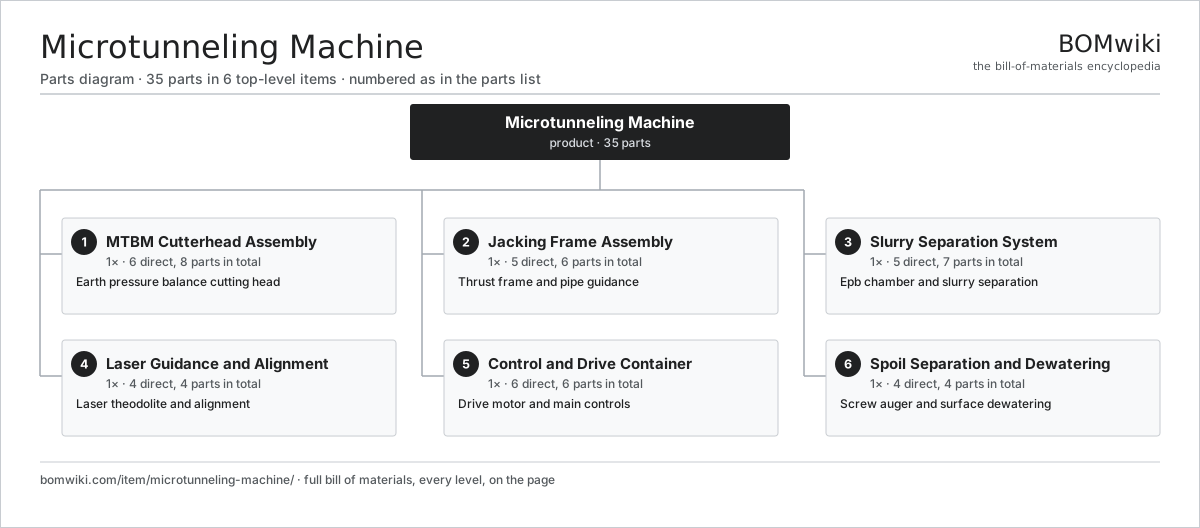
| # | Part | Qty | What it does |
|---|---|---|---|
| 1 | MTBM Cutterhead Assembly 6 parts | 1× | Earth pressure balance cutting head |
| 2 | Jacking Frame Assembly 5 parts | 1× | Thrust frame and pipe guidance |
| 3 | Slurry Separation System 5 parts | 1× | Epb chamber and slurry separation |
| 4 | Laser Guidance and Alignment 4 parts | 1× | Laser theodolite and alignment |
| 5 | Control and Drive Container 6 parts | 1× | Drive motor and main controls |
| 6 | Spoil Separation and Dewatering 4 parts | 1× | Screw auger and surface dewatering |
3D model
No 3D model yet. Have a CAD file of this? Add a 3D model. STL renders right on this page; STEP, FreeCAD, and OpenSCAD sources are welcome too (openly licensed, like all 3D models on BOMwiki).
Build & assembly graph
expand / collapse · shared sub-assemblies converge · links to related products · est. labourTap an assembly to expand/collapse · tap a part to open it · use “Open page” for any node · drag to pan, scroll to zoom.
Bill of materials for Microtunneling Machine
6 top-level lines · 36 rows shown · 35 parts total · indented to 3 levels| # | Item / sub-assembly | Part no. | Qty/assy | Ext. qty | Parts | Type |
|---|---|---|---|---|---|---|
| 1 | MTBM Cutterhead Assembly 6 parts | microtunneling-machine-cutterhead | 1× | 1 | 8 | assembly |
| 1.1 | Disc Cutters (Set) | microtunneling-machine-cutting-disc | 1× | 1 | · | part |
| 1.2 | EPB (Earth Pressure Balance) Chamber | microtunneling-machine-epb-chamber | 1× | 1 | · | part |
| 1.3 | EPB Chamber Access Door | microtunneling-machine-chamber-door | 1× | 1 | · | part |
| 1.4 | Main Cutterhead Bearing | microtunneling-machine-main-bearing | 1× | 1 | · | part |
| 1.5 | Ball Bearing | ball-bearing | 2× | 2 | · | part |
| 1.6 | Pressure Sensor | pressure-sensor | 2× | 2 | · | part |
| 2 | Jacking Frame Assembly 5 parts | microtunneling-machine-jacking-frame | 1× | 1 | 6 | assembly |
| 2.1 | Jacking Reaction Frame | microtunneling-machine-reaction-frame | 1× | 1 | · | part |
| 2.2 | Jacking Hydraulic Cylinders | microtunneling-machine-jacking-cylinders | 1× | 1 | · | part |
| 2.3 | Pipe Centering Guide Ring | microtunneling-machine-pipe-guide | 1× | 1 | · | part |
| 2.4 | Pipe Guidance Shoes | microtunneling-machine-guide-shoes | 1× | 1 | · | part |
| 2.5 | Pressure Sensor | pressure-sensor | 2× | 2 | · | part |
| 3 | Slurry Separation System 5 parts | microtunneling-machine-slurry-system | 1× | 1 | 7 | assembly |
| 3.1 | Bentonite Slurry Pump | microtunneling-machine-bentonite-pump | 1× | 1 | · | part |
| 3.2 | Slurry Separation Plant | microtunneling-machine-separation-unit | 1× | 1 | · | part |
| 3.3 | Slurry Supply and Return Hose | microtunneling-machine-slurry-hose | 1× | 1 | · | part |
| 3.4 | Slurry Storage Tank | microtunneling-machine-slurry-tank | 1× | 1 | · | part |
| 3.5 | Pressure Sensor | pressure-sensor | 3× | 3 | · | part |
| 4 | Laser Guidance and Alignment 4 parts | microtunneling-machine-guidance-system | 1× | 1 | 4 | assembly |
| 4.1 | Laser Theodolite Transmitter | microtunneling-machine-laser-unit | 1× | 1 | · | part |
| 4.2 | Laser Target Reflector Panel | microtunneling-machine-target-panel | 1× | 1 | · | part |
| 4.3 | Digital Inclinometer Sensor | microtunneling-machine-inclinometer | 1× | 1 | · | part |
| 4.4 | Position Data Logger | microtunneling-machine-data-logger | 1× | 1 | · | part |
| 5 | Control and Drive Container 6 parts | microtunneling-machine-control-container | 1× | 1 | 6 | assembly |
| 5.1 | Main Drive Motor | microtunneling-machine-motor | 1× | 1 | · | part |
| 5.2 | Planetary Reduction Gearbox | microtunneling-machine-gearbox | 1× | 1 | · | part |
| 5.3 | Variable-Frequency Drive Cabinet | microtunneling-machine-vfd-panel | 1× | 1 | · | part |
| 5.4 | Wireless Remote Control Pendant | microtunneling-machine-remote-control | 1× | 1 | · | part |
| 5.5 | IGBT Power Module | igbt-module | 1× | 1 | · | part |
| 5.6 | Pressure Sensor | pressure-sensor | 1× | 1 | · | part |
| 6 | Spoil Separation and Dewatering 4 parts | microtunneling-machine-spoil-removal | 1× | 1 | 4 | assembly |
| 6.1 | Spoil Screw Auger Conveyor | microtunneling-machine-screw-auger | 1× | 1 | · | part |
| 6.2 | Vibrating Screen Unit | microtunneling-machine-screen-unit | 1× | 1 | · | part |
| 6.3 | Dewatering Equipment | microtunneling-machine-dewatering-plant | 1× | 1 | · | part |
| 6.4 | Auger Drive Motor | microtunneling-machine-auger-motor | 1× | 1 | · | part |
Something wrong in this list? Report a problem with this BOM.
Related products
same domain, ranked by shared parts Main Beam Tunnel Boring Machine
10,126 parts · shares 2 with this page
Main Beam Tunnel Boring Machine
10,126 parts · shares 2 with this page
 Pipe Jacking Machine
38 parts · shares 2 with this page
Rebar Shearing and Bending Line
361 parts · shares 2 with this page
Pipe Jacking Machine
38 parts · shares 2 with this page
Rebar Shearing and Bending Line
361 parts · shares 2 with this page
 Slurry Tunnel Boring Machine
57 parts · shares 2 with this page
Slurry Tunnel Boring Machine
57 parts · shares 2 with this page
 Tunnel Muck Conveyor
43 parts · shares 2 with this page
Tunnel Muck Conveyor
43 parts · shares 2 with this page
 Tunnel Ventilation Fan
33 parts · shares 2 with this page
Tunnel Ventilation Fan
33 parts · shares 2 with this page
Sourcing: possible vendors
Browse the supplier directory → Prices, MOQ, and lead times are algorithmic estimates, not quotes, and not claims about these companies. Company mappings are curated by keyword; est. price band $15k–$2M. How estimates work| Vendor | HQ | Specialty | MOQ | Lead time |
|---|---|---|---|---|
| caterpillar.com ↗ | Irving, US | Construction & mining equipment | made to order | 16–28 wks |
|
🇯🇵Komatsu
komatsu.com ↗
|
Tokyo, JP | Construction & mining equipment | made to order | 16–28 wks |
|
🇸🇪Volvo CE
volvoce.com ↗
|
Gothenburg, SE | Construction equipment | made to order | 16–28 wks |
|
🇨🇭Liebherr
liebherr.com ↗
|
Bulle, CH | Cranes & heavy equipment | made to order | 16–28 wks |
|
🇨🇳XCMG
xcmg.com ↗
|
Xuzhou, CN | Construction machinery | made to order | 16–28 wks |
1,022-word article