Military Water Purification Unit
ProductOverview
The Military Water Purification Unit is a self-contained reverse-osmosis (RO) plant mounted on a towed trailer, designed to produce potable water from contaminated surface sources (rivers, lakes, groundwater wells) in field and forward deployed locations. The system combines multiple filtration stages, high-pressure RO membranes, and diesel generation to generate 2,000+ liters of fresh water daily with zero dependency on base infrastructure or chemical additives.
The unit's footprint is compact enough to be towed behind a standard 5-ton military truck, yet its membrane capacity handles water demands for 150–200 personnel per day (assuming 10–12 liters per person for drinking, cooking, and basic hygiene). The reverse-osmosis process rejects dissolved salts, bacteria, viruses, and organic contaminants in a single pass, producing water that meets potable standards (TDS < 500 mg/L) without additional treatment. The reject brine stream is collected in a separate tank and disposed of safely, minimizing environmental impact.
The Diesel Engine runs continuously during operation, driving a high-pressure piston pump that forces raw water (after pre-filtration) through the membrane array at 200 bar. A programmable logic controller monitors system pressure and flow rate, automatically shutting down the pump if pressure exceeds a threshold, protecting the membranes from overpressure rupture. The entire unit is weatherproof and designed for rapid deployment: hookup time from towing to first water output is 30–45 minutes once a suitable water source is identified.
How it works
The unit is positioned near a water source, river, lake, or hand-dug well, and the raw water intake hose is submerged. The intake diameter is large (typically 50 mm) to minimize friction losses; a Suction Strainer with 100-micron mesh catches visible debris and prevents sand from entering the feed pump. The suction line must remain flooded (intake below water level) to avoid cavitation and air lock.
The diesel engine is started, bringing the generator online and energizing all control systems. As the engine reaches operating temperature, the Feed Pump (a 5 HP centrifugal unit) begins drawing raw water from the intake and pushing it through the pre-filtration stage. The water first passes through two Sediment Filter cartridges (20 micron rating) that trap suspended solids, silt, and algae. Pressure across these filters is monitored; when it exceeds 3 bar, indicating cartridge saturation, the operator stops the system and replaces the cartridges (a 10-minute task).
The filtered water then enters the Carbon Filter, a pressure vessel containing granular activated carbon. This removes chlorine, some organic contaminants (pesticides, hydrocarbons), and improves taste and odor. Carbon filters are replaced every 3–6 months depending on source water quality and volume processed.
Water exiting the carbon filter (now 1–2 bar) enters the High-Pressure Pump, a positive-displacement axial piston pump rated for 200 bar continuous pressure. This pump pressurizes the water and forces it into the RO Membrane bank. The membrane bank consists of two Membrane Vessel housings, each containing three spiral-wound membrane elements rated at 100 GPD. At 200 bar, the six membranes produce approximately 600 GPD (2,270 L/day) of purified water at standard conditions (25°C, 500 mg/L TDS source water).
The RO membranes are the heart of the system. Each element consists of multiple thin plastic films laminated together, with microscopic pores only 0.0001 microns wide. Only water molecules and a few small ions pass through; salt ions, bacteria, viruses, and larger organic molecules cannot penetrate and are forced toward the reject outlet. The high pressure overcomes the osmotic potential of dissolved salts, reversing the natural osmotic flow and purifying the water.
Inside each membrane vessel, the incoming high-pressure water splits into two streams: permeate (pure water) that passes through the membranes and drains from the vessel bottom, and concentrate (brine) that exits from the vessel end. A Permeate Valve at the system outlet allows the operator to adjust the split ratio between permeate and concentrate; typically 25–35% of input becomes product water, while 65–75% becomes reject brine.
The permeate water flows by gravity into the Permeate Tank, a 2,000-liter stainless steel reservoir that provides storage for surge demand and allows continuous production even if water is not being drawn. A Tank Outlet Valve with float gauge allows operators to monitor tank level and control when water is distributed to users.
The brine (concentrate) stream enters the Brine Tank, a 1,000-liter holding reservoir. Once the brine tank is full, the operator either closes the Permeate Valve to reduce concentrate flow (and increase permeate yield) or stops the high-pressure pump entirely and disposes of the brine safely away from the water source, typically in a dug pit at least 50 meters downwind.
The Control Panel displays real-time flow rate (in GPM) via a Flow Meter, and three Pressure Gauge Set gauges show pre-filter pressure, post-filter pressure, and high-pressure RO line pressure. The PLC Controller (programmable logic controller) continuously reads these sensors; if high-pressure exceeds 220 bar (indicative of membrane fouling or blockage), the controller automatically de-energizes the high-pressure pump contactor, stopping water flow and protecting the membranes from rupture.
Design rationale
Reverse osmosis was selected over competing technologies (distillation, ion exchange, UV treatment) because it produces the most reliable potable water with the least chemical dependency and lowest energy cost. Distillation requires boiling large volumes and is slow; ion-exchange resins become exhausted and require regeneration chemicals; UV treatment does not remove dissolved salts or some viruses. RO membranes are self-contained, require no chemicals beyond basic chlorination if biological growth occurs, and can be regenerated by flushing with purified water if flow drops temporarily.
The pre-filtration stages (strainer, sediment, carbon) protect the expensive membranes from fouling. Sediment above 5 microns clogs membranes rapidly and reduces flow; carbon removes chlorine (which degrades membranes) and some organics that would otherwise foul the membrane surface. This multi-stage approach extends membrane life from months (if unfiltered water were applied directly) to 2–3 years under field conditions.
The 200-bar operating pressure is a proven standard for RO systems at this scale. Higher pressures (250 bar) provide slightly more flow but reduce membrane life and require heavier, more expensive equipment; lower pressures (150 bar) reduce power consumption but slow production for salty sources. At 200 bar, a 25 kW diesel engine driving a 15 kW pump provides adequate margin for system losses and maintains steady production through normal source water variations.
The diesel generator was chosen because it provides rugged, predictable power in field environments where grid electricity or quality fuel reliability is uncertain. Diesel fuel is widely supplied in military logistics chains and burns cleaner than gasoline in turbocharged engines. The 25 kW output is sized to run the high-pressure pump (15 kW) plus feed pump (5 kW) and control electronics (2 kW) with 3 kW reserve headroom.
The 2,000-liter permeate tank and 1,000-liter brine tank are sized to handle approximately 8 hours of continuous operation at rated capacity before requiring water distribution or brine disposal. This allows a single crew to operate the unit on a day-shift schedule without returning to tank maintenance during meal breaks.
Operational constraints
RO membrane performance varies with source water temperature and salinity. At 25°C with 500 mg/L TDS (typical for a freshwater source), the unit produces 600 GPD. The same unit processing 2,000 mg/L TDS water (brackish or slightly saline source) will produce only 300 GPD at the same pressure, as the osmotic back-pressure increases. Very cold water (near 0°C) flows more slowly through membranes and reduces output further.
Membrane fouling is a critical maintenance issue. If sediment, algae, or biological slime builds up on the membrane surface, flow drops and pressure rises. Initial fouling is reversed by a chemical clean (flushing with mild acid or enzymatic cleaners approved for RO), which removes inorganic scale or biofouling without damaging the membranes. Complete membrane element replacement is required if fouling cannot be reversed or if the membrane is physically ruptured.
The reject brine must be disposed of responsibly. In coastal areas, brine can sometimes be discharged back to the sea; inland, it is typically evaporated in a dug pit or trucked to a treatment facility. Discharging brine directly into a freshwater source would contaminate the source for downstream users and is prohibited.
Logistics and training
Field operators are trained to perform simple maintenance: replacing sediment and carbon filter cartridges, backflushing the system weekly to dislodge loose sediment, and reading all three pressure gauges. Advanced maintenance (membrane element replacement, pump seal service) is performed by dedicated water purification technicians from the engineering corps, typically rotating through theater on a 3–6 month cycle.
Spare membrane elements are held in theater stock and rotated to forward units on a predictable schedule. A contaminated membrane cannot be field-repaired and is replaced wholesale; typical consumption is one element per 3–6 months depending on source water quality. Sediment and carbon filters are replaced more frequently (every 10–50 operating days) and are held in larger quantities at supply depots.
The unit is winterized in cold climates by draining all water lines and flushing with isopropyl alcohol to prevent freeze damage. In extreme cold, the permeate tank is wrapped with heating tape powered by the diesel generator to prevent ice formation. Deployment time extends in winter because ice on intake water must be cleared and the engine requires extended warm-up before full-load operation.
Military Water Purification Unit parts and their functions
7 top-level parts · 203 parts in total · full bill of materials below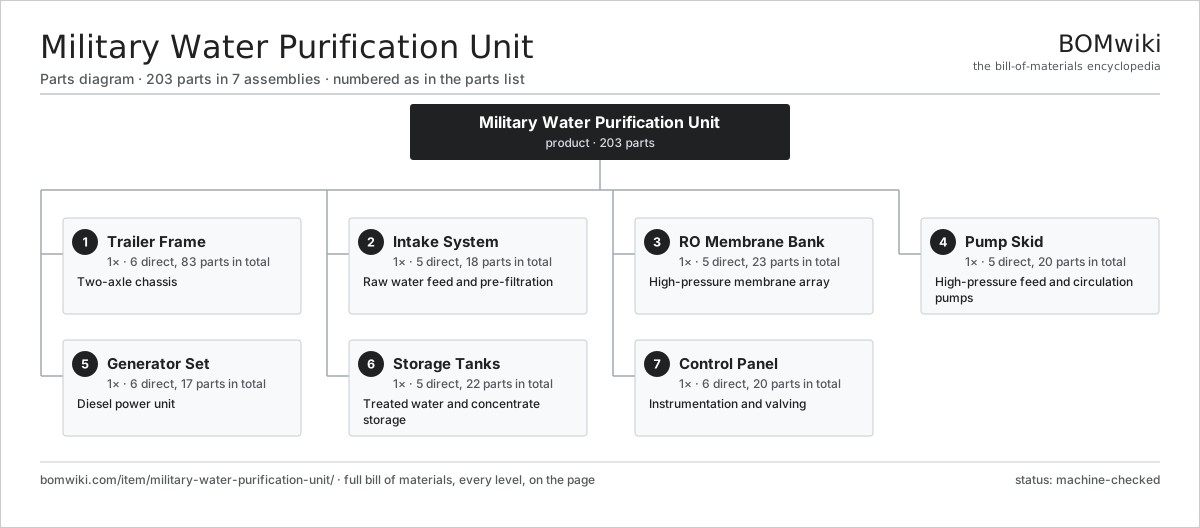
| # | Part | Qty | What it does |
|---|---|---|---|
| 1 | Trailer Frame 6 parts | 1× | Two-axle chassis |
| 2 | Intake System 5 parts | 1× | Raw water feed and pre-filtration |
| 3 | RO Membrane Bank 5 parts | 1× | High-pressure membrane array |
| 4 | Pump Skid 5 parts | 1× | High-pressure feed and circulation pumps |
| 5 | Generator Set 6 parts | 1× | Diesel power unit |
| 6 | Storage Tanks 5 parts | 1× | Treated water and concentrate storage |
| 7 | Control Panel 6 parts | 1× | Instrumentation and valving |
3D model
No 3D model yet. Have a CAD file of this? Add a 3D model — STL renders right on this page; STEP, FreeCAD, and OpenSCAD sources are welcome too (openly licensed, like all 3D models on BOMwiki).
Build & assembly graph
expand / collapse · shared sub-assemblies converge · links to related products · est. labourTap an assembly to expand/collapse · tap a part to open it · use “Open page” for any node · drag to pan, scroll to zoom.
Bill of materials for Military Water Purification Unit
7 top-level lines · 50 rows shown · 203 parts total · indented to 3 levels| # | Item / sub-assembly | Part no. | Qty/assy | Ext. qty | Parts | Type |
|---|---|---|---|---|---|---|
| 1 | Trailer Frame 6 parts | military-water-purification-unit-trailer-frame | 1× | 1 | 83 | assembly |
| 1.1 | Wheel Assembly 5 parts | wheel-assembly | 4× | 4 | 9 | assembly |
| 1.1.1 | Alloy Wheel | alloy-wheel | 1× | 4 | · | part |
| 1.1.2 | Tire | tire | 1× | 4 | · | part |
| 1.1.3 | TPMS Sensor | tpms-sensor | 1× | 4 | · | part |
| 1.1.4 | Lug Nut | lug-nut | 5× | 20 | · | part |
| 1.1.5 | Valve Stem | valve-stem | 1× | 4 | · | part |
| 1.2 | Frame Beam | field-kitchen-trailer-frame-beam | 2× | 2 | · | part |
| 1.3 | Axle Assembly | field-kitchen-trailer-axle-assembly | 2× | 2 | · | part |
| 1.4 | Hitch Pin | field-kitchen-trailer-hitch-pin | 1× | 1 | · | part |
| 1.5 | Sheet Metal Panel | sheet-panel | 10× | 10 | · | part |
| 1.6 | Fastener Set | fastener-set | 32× | 32 | · | part |
| 2 | Intake System 5 parts | military-water-purification-unit-intake-system | 1× | 1 | 18 | assembly |
| 2.1 | Suction Strainer | military-water-purification-unit-suction-strainer | 1× | 1 | · | part |
| 2.2 | Sediment Filter | military-water-purification-unit-sediment-filter | 2× | 2 | · | part |
| 2.3 | Carbon Filter | military-water-purification-unit-carbon-filter | 1× | 1 | · | part |
| 2.4 | Pressure Sensor | pressure-sensor | 2× | 2 | · | part |
| 2.5 | Fastener Set | fastener-set | 12× | 12 | · | part |
| 3 | RO Membrane Bank 5 parts | military-water-purification-unit-ro-membrane-bank | 1× | 1 | 23 | assembly |
| 3.1 | Membrane Vessel | military-water-purification-unit-membrane-vessel | 2× | 2 | · | part |
| 3.2 | RO Membrane | military-water-purification-unit-ro-membrane | 6× | 6 | · | part |
| 3.3 | Cartridge Holder | military-water-purification-unit-membrane-cartridge-holder | 6× | 6 | · | part |
| 3.4 | Permeate Valve | military-water-purification-unit-permeate-valve | 1× | 1 | · | part |
| 3.5 | Fastener Set | fastener-set | 8× | 8 | · | part |
| 4 | Pump Skid 5 parts | military-water-purification-unit-pump-skid | 1× | 1 | 20 | assembly |
| 4.1 | Feed Pump | military-water-purification-unit-feed-pump | 1× | 1 | · | part |
| 4.2 | High-Pressure Pump | military-water-purification-unit-high-pressure-pump | 1× | 1 | · | part |
| 4.3 | Pressure Accumulator | military-water-purification-unit-pressure-accumulator | 1× | 1 | · | part |
| 4.4 | Pressure Sensor | pressure-sensor | 1× | 1 | · | part |
| 4.5 | Fastener Set | fastener-set | 16× | 16 | · | part |
| 5 | Generator Set 6 parts | military-water-purification-unit-generator-set | 1× | 1 | 17 | assembly |
| 5.1 | Diesel Engine | military-water-purification-unit-diesel-engine | 1× | 1 | · | part |
| 5.2 | Alternator | military-water-purification-unit-alternator | 1× | 1 | · | part |
| 5.3 | Fuel Tank | military-water-purification-unit-fuel-tank | 1× | 1 | · | part |
| 5.4 | Radiator | radiator | 1× | 1 | · | part |
| 5.5 | Control Governor | military-water-purification-unit-control-governor | 1× | 1 | · | part |
| 5.6 | Fastener Set | fastener-set | 12× | 12 | · | part |
| 6 | Storage Tanks 5 parts | military-water-purification-unit-storage-tanks | 1× | 1 | 22 | assembly |
| 6.1 | Permeate Tank | military-water-purification-unit-permeate-tank | 1× | 1 | · | part |
| 6.2 | Brine Tank | military-water-purification-unit-brine-tank | 1× | 1 | · | part |
| 6.3 | Tank Outlet Valve | military-water-purification-unit-tank-outlet-valve | 2× | 2 | · | part |
| 6.4 | Tank Vent | military-water-purification-unit-tank-vent | 2× | 2 | · | part |
| 6.5 | Fastener Set | fastener-set | 16× | 16 | · | part |
| 7 | Control Panel 6 parts | military-water-purification-unit-control-panel | 1× | 1 | 20 | assembly |
| 7.1 | Pressure Gauge Set | military-water-purification-unit-pressure-gauge-set | 1× | 1 | · | part |
| 7.2 | Flow Meter | military-water-purification-unit-flow-meter | 1× | 1 | · | part |
| 7.3 | PLC Controller | military-water-purification-unit-pds-controller | 1× | 1 | · | part |
| 7.4 | LCD Panel | lcd-panel | 1× | 1 | · | part |
| 7.5 | Relay | relay | 4× | 4 | · | part |
| 7.6 | Fastener Set | fastener-set | 12× | 12 | · | part |
Related products
same domain, ranked by shared parts Field Kitchen Trailer
221 parts · shares 10 with this page
Field Kitchen Trailer
221 parts · shares 10 with this page
 Armored Bridge Layer
219 parts · shares 10 with this page
Armored Bridge Layer
219 parts · shares 10 with this page
 Armored Personnel Carrier
221 parts · shares 8 with this page
Armored Personnel Carrier
221 parts · shares 8 with this page
 Military Light Utility Vehicle
287 parts · shares 4 with this page
Military Light Utility Vehicle
287 parts · shares 4 with this page
 Amphibious Assault Vehicle
894 parts · shares 4 with this page
Amphibious Assault Vehicle
894 parts · shares 4 with this page
 Armored Recovery Vehicle
728 parts · shares 4 with this page
Armored Recovery Vehicle
728 parts · shares 4 with this page
Sourcing: possible vendors
Prices, MOQ, and lead times are algorithmic estimates, not quotes, and not claims about these companies. Company mappings are curated by keyword; est. price band $200–$100M. How estimates work| Vendor | HQ | Specialty | MOQ | Lead time |
|---|---|---|---|---|
| smithsdetection.com ↗ | London, GB | Security screening | made to order | 24–52 wks |
|
🇺🇸Leidos
leidos.com ↗
|
Reston, US | Security & screening | made to order | 24–52 wks |
|
🇺🇸Rapiscan
rapiscansystems.com ↗
|
Torrance, US | X-ray screening | made to order | 24–52 wks |
|
🇫🇷Thales
thalesgroup.com ↗
|
Paris, FR | Defense electronics | made to order | 24–52 wks |
| baesystems.com ↗ | London, GB | Defense | made to order | 24–52 wks |
1,662-word article