Mine Hoist
ProductOverview
A mine hoist (winder) is the stationary machine that moves everything between surface and the workings of a deep shaft mine: ore in skips, people in cages, and materials and equipment. It is among the most safety-critical machinery a mine owns, a single hoist may carry every person on the shift, and it is regulated accordingly, with statutory rope factors, brake tests and inspection intervals in every major mining jurisdiction.
Two winding principles exist. A drum winder coils each rope onto its own drum and suits shallower shafts and sinking work. A friction or Koepe winder, described here, drives the ropes by friction over a grooved Koepe Winder Wheel wheel; the ropes hang down both sides, with the Skip / Cage on one and a Counterweight (or a second conveyance) on the other. Because the wheel never stores rope, a Koepe machine can use several head ropes in parallel and reach payloads and depths impractical for drums, typically 10–50 t of ore per wind from 500 to about 2,000 m, at rope speeds up to 18–20 m/s.
How it works
The system is a balanced loop. Head Ropes run from the conveyance, up over the Headgear Sheaves (or directly over the wheel in a tower-mounted winder), across the winder and down to the counterweight. Tail Ropes hang in a loop beneath, connecting the bottoms of conveyance and counterweight: as the hoist winds, the head-rope weight that transfers from one side to the other is matched by tail rope moving the opposite way, so the out-of-balance load the motor sees is nearly constant and roughly equal to the payload alone.
Torque is transmitted purely by friction between rope and Friction Lining, with a friction coefficient around 0.25. The Euler capstan relation sets a limit on the tension ratio T1/T2 across the wheel; the design (counterweight sizing, deceleration limits) must keep the actual ratio below it, since exceeding it means rope slip. Sheave Monitoring and encoder cross-checks detect any slip immediately. The Tension Equalizer keeps load shared across all ropes, and the Groove Wear Gauge verifies the linings wear evenly so all ropes ride at the same effective diameter.
Drive
Modern large winders use a gearless Synchronous Ring Motor: a synchronous ring motor of 2–8 MW whose rotor sits directly on the Main Shaft, turning at the wheel's 30–90 rpm with no gearbox. The Frequency Converter gives full four-quadrant control, a hoist motors on the way up and brakes electrically on the way down, returning energy to the grid through the Converter Transformer. The Converter Control Unit runs the speed-distance profile: acceleration at about 0.7–1 m/s², constant speed through mid-shaft, and a precisely controlled creep into the dump or landing position, with position known from redundant Encoders re-synchronized at every Shaft Position Switch.
Brakes and safety
The Brake System is fail-safe by construction: Brake Calipers are clamped by springs and held open by hydraulic pressure from the Brake Hydraulic Unit, so loss of power or pressure applies the brakes. Regulations require at least two independent brake channels, each able to hold the maximum out-of-balance load with margin (commonly 1.6× or better). During an emergency stop the Brake Controller modulates pressure to hold deceleration in the 1.5–3 m/s² band, too little risks an overwind, too much risks rope slip on the friction wheel or slack rope at a conveyance.
Above the drive and brakes sits an independent protection layer: redundant Safety PLCs and a separate Overspeed Monitor enforce a speed-versus-depth envelope, the Slack Rope Detector trips on tension loss, and a mechanical Overwind Arrestor above the top landing catches the conveyance if everything else fails. Personnel winding runs at reduced speeds and tighter envelopes than ore winding under the same Winder Control System.
Operation and maintenance
Routine winding is automatic; a driver at the Operator Desk supervises and takes manual control for shaft inspection, rope-end adjustment and non-standard moves, signalled from each level through Station Signal Units. Statutory maintenance dominates the calendar: daily brake and trip tests, electromagnetic rope testing at fixed intervals with discard criteria on broken wires and diameter loss, periodic recapping of Rope Attachments, ultrasonic inspection of the main shaft, and continuous monitoring of Main Bearing temperature and vibration fed by the Lubrication System system, which interlocks the winder against running without oil flow. Head ropes on a hard-working ore winder are typically retired after two to four years regardless of condition trends.
Mine Hoist parts and their functions
8 top-level parts · 140 parts in total · full bill of materials below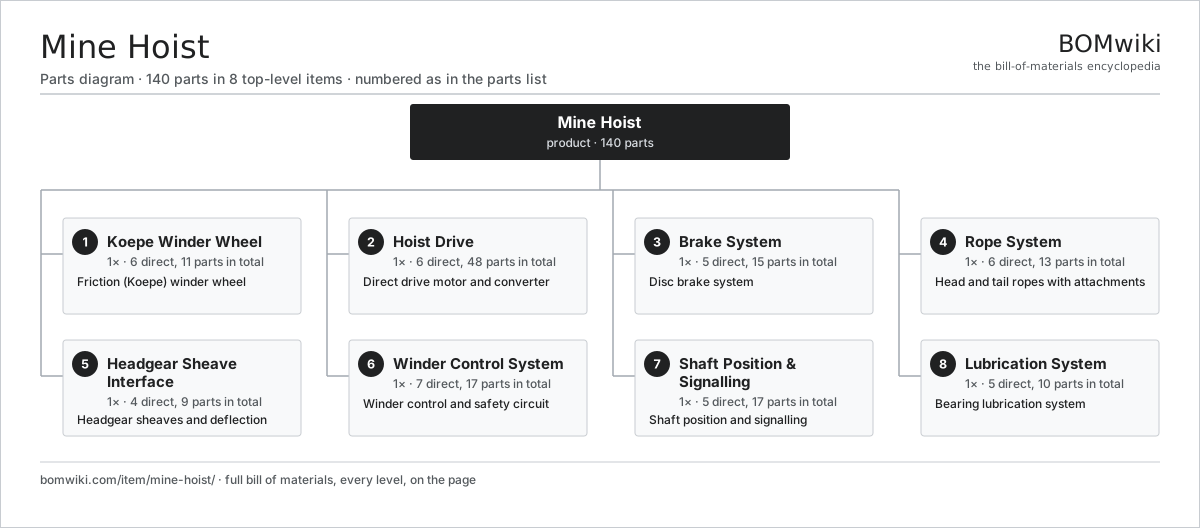
| # | Part | Qty | What it does |
|---|---|---|---|
| 1 | Koepe Winder Wheel 6 parts | 1× | Friction (Koepe) winder wheel |
| 2 | Hoist Drive 6 parts | 1× | Direct drive motor and converter |
| 3 | Brake System 5 parts | 1× | Disc brake system |
| 4 | Rope System 6 parts | 1× | Head and tail ropes with attachments |
| 5 | Headgear Sheave Interface 4 parts | 1× | Headgear sheaves and deflection |
| 6 | Winder Control System 7 parts | 1× | Winder control and safety circuit |
| 7 | Shaft Position & Signalling 5 parts | 1× | Shaft position and signalling |
| 8 | Lubrication System 5 parts | 1× | Bearing lubrication system |
3D model
No 3D model yet. Have a CAD file of this? Add a 3D model. STL renders right on this page; STEP, FreeCAD, and OpenSCAD sources are welcome too (openly licensed, like all 3D models on BOMwiki).
Build & assembly graph
expand / collapse · shared sub-assemblies converge · links to related products · est. labourTap an assembly to expand/collapse · tap a part to open it · use “Open page” for any node · drag to pan, scroll to zoom.
Bill of materials for Mine Hoist
8 top-level lines · 60 rows shown · 140 parts total · indented to 3 levels| # | Item / sub-assembly | Part no. | Qty/assy | Ext. qty | Parts | Type |
|---|---|---|---|---|---|---|
| 1 | Koepe Winder Wheel 6 parts | mine-hoist-winder | 1× | 1 | 11 | assembly |
| 1.1 | Wheel Body | mine-hoist-wheel-body | 1× | 1 | · | part |
| 1.2 | Friction Lining | mine-hoist-friction-lining | 4× | 4 | · | part |
| 1.3 | Main Shaft | mine-hoist-main-shaft | 1× | 1 | · | part |
| 1.4 | Main Bearing | mine-hoist-main-bearing | 2× | 2 | · | part |
| 1.5 | Brake Disc | mine-hoist-brake-disc | 2× | 2 | · | part |
| 1.6 | Groove Wear Gauge | mine-hoist-rope-groove-gauge | 1× | 1 | · | part |
| 2 | Hoist Drive 6 parts | mine-hoist-drive | 1× | 1 | 48 | assembly |
| 2.1 | Synchronous Ring Motor 4 parts | mine-hoist-drive-motor | 1× | 1 | 24 | assembly |
| 2.1.1 | Stator Assembly 3 parts + deeper › | stator-assembly | 1× | 1 | 3 | assembly |
| 2.1.2 | Rotor Assembly 4 parts + deeper › | rotor-assembly | 1× | 1 | 19 | assembly |
| 2.1.3 | Copper Winding | copper-winding | 1× | 1 | · | part |
| 2.1.4 | Fastener Set | fastener-set | 1× | 1 | · | part |
| 2.2 | Frequency Converter 4 parts | mine-hoist-converter | 1× | 1 | 19 | assembly |
| 2.2.1 | IGBT Power Module | igbt-module | 12× | 12 | · | part |
| 2.2.2 | Converter Control Unit | mine-hoist-converter-control | 1× | 1 | · | part |
| 2.2.3 | Wire Bundle | wire-bundle | 2× | 2 | · | part |
| 2.2.4 | Connector | connector | 4× | 4 | · | part |
| 2.3 | Converter Transformer | mine-hoist-drive-transformer | 1× | 1 | · | part |
| 2.4 | Drive Cooling Unit | mine-hoist-cooling-unit | 1× | 1 | · | part |
| 2.5 | Encoder | encoder | 2× | 2 | · | part |
| 2.6 | Excitation System | mine-hoist-slipring-exciter | 1× | 1 | · | part |
| 3 | Brake System 5 parts | mine-hoist-brake-system | 1× | 1 | 15 | assembly |
| 3.1 | Brake Caliper | mine-hoist-brake-caliper | 8× | 8 | · | part |
| 3.2 | Brake Hydraulic Unit | mine-hoist-brake-hydraulics | 1× | 1 | · | part |
| 3.3 | Brake Controller | mine-hoist-brake-controller | 1× | 1 | · | part |
| 3.4 | Pressure Sensor | pressure-sensor | 4× | 4 | · | part |
| 3.5 | Pad Wear Sensors | mine-hoist-pad-wear-sensors | 1× | 1 | · | part |
| 4 | Rope System 6 parts | mine-hoist-rope-system | 1× | 1 | 13 | assembly |
| 4.1 | Head Rope | mine-hoist-head-rope | 4× | 4 | · | part |
| 4.2 | Tail Rope | mine-hoist-tail-rope | 2× | 2 | · | part |
| 4.3 | Rope Attachment | mine-hoist-rope-attachment | 4× | 4 | · | part |
| 4.4 | Skip / Cage | mine-hoist-conveyance | 1× | 1 | · | part |
| 4.5 | Counterweight | mine-hoist-counterweight | 1× | 1 | · | part |
| 4.6 | Tension Equalizer | mine-hoist-rope-tension-equalizer | 1× | 1 | · | part |
| 5 | Headgear Sheave Interface 4 parts | mine-hoist-headgear-interface | 1× | 1 | 9 | assembly |
| 5.1 | Headgear Sheave | mine-hoist-head-sheave | 2× | 2 | · | part |
| 5.2 | Deflection Sheave | mine-hoist-deflection-sheave | 2× | 2 | · | part |
| 5.3 | Ball Bearing | ball-bearing | 4× | 4 | · | part |
| 5.4 | Sheave Monitoring | mine-hoist-sheave-monitoring | 1× | 1 | · | part |
| 6 | Winder Control System 7 parts | mine-hoist-control-system | 1× | 1 | 17 | assembly |
| 6.1 | Safety PLC | mine-hoist-safety-plc | 2× | 2 | · | part |
| 6.2 | Operator Desk | mine-hoist-operator-desk | 1× | 1 | · | part |
| 6.3 | Depth Indicator | mine-hoist-depth-indicator | 1× | 1 | · | part |
| 6.4 | Overspeed Monitor | mine-hoist-overspeed-monitor | 1× | 1 | · | part |
| 6.5 | LCD Panel | lcd-panel | 2× | 2 | · | part |
| 6.6 | Relay | relay | 8× | 8 | · | part |
| 6.7 | Power Supply | power-supply | 2× | 2 | · | part |
| 7 | Shaft Position & Signalling 5 parts | mine-hoist-shaft-signals | 1× | 1 | 17 | assembly |
| 7.1 | Shaft Position Switch | mine-hoist-shaft-switch | 8× | 8 | · | part |
| 7.2 | Station Signal Unit | mine-hoist-station-signal-unit | 4× | 4 | · | part |
| 7.3 | Slack Rope Detector | mine-hoist-slack-rope-detector | 1× | 1 | · | part |
| 7.4 | Overwind Arrestor | mine-hoist-arrestor-gear | 1× | 1 | · | part |
| 7.5 | Wire Bundle | wire-bundle | 3× | 3 | · | part |
| 8 | Lubrication System 5 parts | mine-hoist-lubrication | 1× | 1 | 10 | assembly |
| 8.1 | Lube Pump Unit | mine-hoist-lube-pump-unit | 1× | 1 | · | part |
| 8.2 | Lube Oil Cooler | mine-hoist-lube-cooler | 1× | 1 | · | part |
| 8.3 | Duplex Lube Filter | mine-hoist-lube-filter | 2× | 2 | · | part |
| 8.4 | Pressure Sensor | pressure-sensor | 2× | 2 | · | part |
| 8.5 | Oil Seal | oil-seal | 4× | 4 | · | part |
Something wrong in this list? Report a problem with this BOM.
Related products
same domain, ranked by shared parts Mine Ventilation Fan
148 parts · shares 9 with this page
Mine Ventilation Fan
148 parts · shares 9 with this page
 Mining Haul Truck
1,000 parts · shares 9 with this page
Mining Haul Truck
1,000 parts · shares 9 with this page
 Carbon Regeneration Kiln
141 parts · shares 10 with this page
Carbon Regeneration Kiln
141 parts · shares 10 with this page
 Electrowinning Cell
347 parts · shares 10 with this page
Flotation Reagent Dosing Skid
198 parts · shares 10 with this page
Electrowinning Cell
347 parts · shares 10 with this page
Flotation Reagent Dosing Skid
198 parts · shares 10 with this page
 Gold Elution Column
128 parts · shares 10 with this page
Gold Elution Column
128 parts · shares 10 with this page
Sourcing: possible vendors
Browse the supplier directory → Prices, MOQ, and lead times are algorithmic estimates, not quotes, and not claims about these companies. Company mappings are curated by keyword; est. price band $200k–$5M. How estimates work| Vendor | HQ | Specialty | MOQ | Lead time |
|---|---|---|---|---|
| caterpillar.com ↗ | Irving, US | Construction & mining equipment | made to order | 20–36 wks |
|
🇯🇵Komatsu
komatsu.com ↗
|
Tokyo, JP | Construction & mining equipment | made to order | 20–36 wks |
|
🇸🇪Sandvik
rocktechnology.sandvik ↗
|
Stockholm, SE | Mining & rock technology | made to order | 20–36 wks |
|
🇸🇪Epiroc
epiroc.com ↗
|
Stockholm, SE | Mining & drilling equipment | made to order | 20–36 wks |
|
🇫🇮Metso
metso.com ↗
|
Helsinki, FI | Crushing & minerals processing | made to order | 20–36 wks |
826-word article