Mobile Harbor Crane
ProductOverview
The mobile harbor crane is a general-purpose heavy-lifting machine deployed at breakbulk and multipurpose container terminals for loading and unloading cargo directly from ships. Unlike dedicated container cranes (which are fixed or gantry-mounted and serve specific ship-side slots), mobile harbor cranes provide flexibility: a single crane can serve multiple vessel positions, handle diverse cargo types (breakbulk, steel, project cargo), and adapt to different ship gear configurations.
Mobile harbor cranes are self-propelled (diesel-powered truck chassis with six or eight wheels), allowing independent positioning without shore-side infrastructure. A typical crane lifts 200–300 tonnes, operates a 30–40 meter boom, and can handle containers, steel beams, machinery, and specialized loads. Modern cranes are equipped with load weighing systems, winch control logic, and safety features meeting international standards (ISO 4305, FEM 1.001).
How It Works
A mobile harbor crane parks alongside a vessel at the cargo hold. The operator, positioned in the elevated Operator Cab, first deploys the Outrigger System: hydraulic cylinders extend the Outrigger Beams laterally and rearward, and large Outrigger Pads settle firmly on the quay surface, stabilizing the entire crane against the moment created by lifted loads.
The Diesel Engine (300–400 kW turbocharged) idles continuously, powering both the Transmission (for movement) and the hydraulic pump supplying all auxiliary systems. The Slew Motor (typically 40–75 kW) is energized, and the operator uses the Control Joysticks to rotate the Slewing Platform and boom, aligning the Lattice Boom over the cargo hold. The Slew Bearing (2–3m diameter roller bearing) provides smooth rotation.
Once positioned, the operator engages the Main Hoist Winch: the Winch Motor (300–500 kW AC motor, driven by a variable-frequency drive Variable Frequency Drives) begins rotating the Winch Drum, hauling the hoist line and raising the Hook Block Assembly from the hold or quay deck.
The Load Display in the cab shows real-time lifted load (measured by the Load Monitoring Device device, either a load cell in the block or a strain transducer on the boom). As the load rises, the operator modulates hoisting speed using the proportional joystick, slowing to 0.5–1 m/s as the load approaches deck level, ensuring smooth placement and operator control.
Once the load is on deck and secured (slings removed, load chained), the operator lowers the hook and prepares for the next lift. The Auxiliary Winch can move the Hook Block Assembly laterally along the boom (trolley movement) or adjust the boom reach via luffing motion, though many modern harbor cranes use a fixed boom and rely on operator positioning of the entire crane via slewing and travel.
When all cargo is discharged, the operator retracts the Outrigger System, raises the boom to a horizontal transport position, and drives the crane to the next vessel or storage position using the Truck Frame chassis.
Subsystems
Undercarriage
The Undercarriage is a self-propelled truck base enabling independent movement around the port. The Truck Frame is a heavy-gauge steel chassis supporting the entire crane superstructure. The Diesel Engine (300–400 kW turbocharged diesel) powers both the Transmission and hydraulic pump. The Transmission is a multi-speed automatic with retarder (engine brake), providing speeds from 0–20 km/h loaded, up to 30 km/h empty.
The Axles Assembly (typically three: one front steering axle and two rear drive axles, or tridem configuration) are heavy-duty units supporting 150–200 tonnes total weight. The Wheel Assembly (six wheels, typically 16.00 R25 or 18.00 R25 tires) provides ground contact and load distribution. The Steering System is fully hydraulic and power-assisted, enabling tight maneuvering despite the crane's large envelope.
Outrigger System
The Outrigger System is critical for stability during lifting. Four Outrigger Beams (steel box beams, 40–60cm section) extend laterally and rearward from the chassis. The Outrigger Cylinders (hydraulic double-acting, bore 15–25cm) extend the beams and control their angle. The Outrigger Pads (large steel or composite plates, 1–2 m²) settle on the quay surface, distributing load and preventing the outrigger legs from sinking into poor ground.
Typical outrigger spread is 3–5 meters outboard (side-to-side) and 2–4 meters rearward, creating a wide footprint that resists tipping when lifted loads create large overturning moments. The Outrigger Lock Pins (manual or automatic locking pins) mechanically secure outriggers in the fully extended position during lifting, preventing collapse if a hydraulic cylinder ruptures.
Slewing Platform
The Slewing Platform is the rotating superstructure. The Platform Deck is a welded steel structure supporting the boom base, winches, and cab. The Slew Bearing (2–3m diameter roller bearing mounted on the truck frame) enables 360-degree continuous rotation. The Slew Motor (40–75 kW AC motor with variable-frequency drive) drives slewing via a gear reducer and pinion engagement with the slew bearing. The Slew Brake (spring-applied hydraulic or electromagnetic brake) holds the boom stationary during lifting, preventing drift due to wind or rope tension imbalance.
Lattice Boom
The Lattice Boom is a tall triangulated steel structure (20–50m high, typically 30–40m) forming the main load path. The Boom Main Chords (two parallel angle or tube members) are the primary vertical members running from boom base to tip. The Boom Diagonal Bracing provides triangulated lateral support, minimizing deflection and vibration under dynamic loading. The Boom Hoist Sheave (1–1.5m diameter steel pulley) is mounted at the boom tip, redirecting the hoist line from the Winch Drum to the Hook Block Assembly.
The Boom Guy Cables (four or more steel wire ropes, typically 8–12mm diameter) extend from the boom top to lower boom sections or outrigger pads, providing additional support against lateral and rearward bending. These guy cables are pre-tensioned, carrying residual load even during no-lift conditions.
Hook Block Assembly
The Hook Block Assembly is the load-gripping mechanism. The Hook Block Frame is a ductile iron or steel casting providing structural rigidity. The Hook Sheaves (two or more 40–60cm diameter pulleys) support and redirect the hoist line, creating mechanical advantage (typically 4:1 or 6:1, meaning the hook lifts 4–6 times the drum torque). The Hook Pin is the load-attachment lug, typically a steel pin accepting a spreader bar, cargo hook, or load cell mounting. The Hook Safety Latch is a mechanical device preventing unintended load disengagement.
Hoisting System
The Main Hoist Winch is the primary hoisting mechanism. The Winch Motor (300–500 kW AC motor, soft-started via VFD) provides hoist force. Hoisting speed is proportional to line pull: light loads (10–20 tonnes) are hoisted at 30–60 m/min; heavy loads (250+ tonnes) at 3–6 m/min. The Winch Brake (spring-applied brake) holds the load stationary when the motor is de-energized, a critical safety feature.
The Winch Drum (1–2m diameter, typically 2–3 wraps of rope) winds and unwinds the hoist line. The Rope Guide distributes rope evenly on the drum to prevent overlapping and jamming. The Load Monitoring Device device (load cell or dynamometer) measures lifted load in real-time, feeding data to the Load Display in the operator cab. Safety interlocks prevent overloading: if load exceeds the safe working load (SWL) for the current boom angle, the control system automatically stops hoist motion.
Auxiliary Winch
The Auxiliary Winch provides trolley and luffing control. The Auxiliary Motor (50–100 kW) drives the Auxiliary Drum, manipulating auxiliary lines. On cranes with luffing booms (boom angle varies), the auxiliary winch controls boom tilt to maintain optimal reach and load distribution. On cranes with fixed booms, the auxiliary system may control a trolley moving along the boom boom to position the load laterally.
Electrical System
The Electrical System is the control and power backbone. The Main Switchboard distributes high-voltage (400 V 3-phase) power from a shore-side connection (or on-board diesel-generator in smaller cranes) to all motors. The Variable Frequency Drives (variable-frequency drives) for the main hoist and auxiliary motors provide soft-start (limiting inrush current) and proportional speed control. The Control Transformer steps down to 24 V DC for control circuits.
The Safety Relay is a hardwired relay enforcing safety logic: emergency stop buttons are hardwired to the safety relay, ensuring de-energization of all motors within milliseconds, independent of the control PLC. The Load Display integrates with the safety relay to prevent overloads.
Operator Cab
The Operator Cab is mounted on the slewing platform, providing the operator an elevated command post. The Cab Structure is welded steel with rubber vibration isolation. The Cab Windows (typically four large laminated glass panes) provide 360-degree visibility to the load, hook, cargo hold, and deck operations. The Operator Seat is an air-suspended ergonomic seat with adjustable tension and recline.
The Control Joysticks (two proportional joysticks) allow the operator to command hoist motion (up/down on one joystick) and slew rotation (clockwise/counterclockwise on the other joystick). Modern cranes add proportional control for auxiliary functions (luffing, trolley movement) via selector switches or a multi-axis joystick.
The Instrumentation Panel displays load (tonnes), engine RPM, fuel level, coolant temperature, hydraulic pressure, and boom angle. The Climate Control System (electric AC and heater) maintains operator comfort, critical for sustained concentration during long shifts.
Performance and Operational Characteristics
Mobile harbor cranes are workhorses at breakbulk terminals, achieving 30–50 lifts per hour (cycle time 1–2 minutes per lift including positioning, hoisting, and lowering). A typical 6-hour shift moves 200–300 tonnes of cargo.
Power consumption is moderate: the 300–400 kW diesel engine idles during non-hoisting periods and ramps up to full load during heavy lifts. Total fuel consumption is approximately 40–70 liters per hour of operation.
Safety is paramount. ISO 4305 standards govern design and certification. All cranes undergo formal load testing (125% of SWL) before delivery and periodic re-certification (every 2–4 years). Load monitoring systems prevent overloading; if the real-time load exceeds SWL for the current boom angle and configuration, the control system prevents further hoisting and alerts the operator.
Maintenance involves regular diesel engine servicing (oil changes, filter replacement), hydraulic system monitoring (fluid sampling for water and contamination), brake inspection and wear measurement, and wire rope condition checks. Wire ropes are typically replaced every 3–5 years. Structural inspections (ultrasonic testing for fatigue cracks, especially at boom-to-platform joints) occur annually.
Environmental considerations include emission standards (diesel engines must meet TIER III or IV regulations in most ports), noise limits (typically 85 dB), and spill prevention for hydraulic fluid. Modern cranes integrate telematics systems tracking utilization, fuel consumption, maintenance hours, and accident history for fleet optimization.
Wind limits are enforced: most operators cease lifting if wind exceeds 12–15 m/s (25–30 knots), as wind forces on the boom and lifted load become uncontrollable. Sway and swing of the load increase with wind, risking cargo damage and accidents.
The versatility of mobile harbor cranes, handling breakbulk, steel, project cargo, and even containers (with proper spreader bars), makes them indispensable at general-purpose terminals. Their self-propulsion eliminates reliance on tug services or fixed positions, enabling dynamic port operations and responsive cargo handling.
Mobile Harbor Crane parts and their functions
9 top-level parts · 80 parts in total · full bill of materials below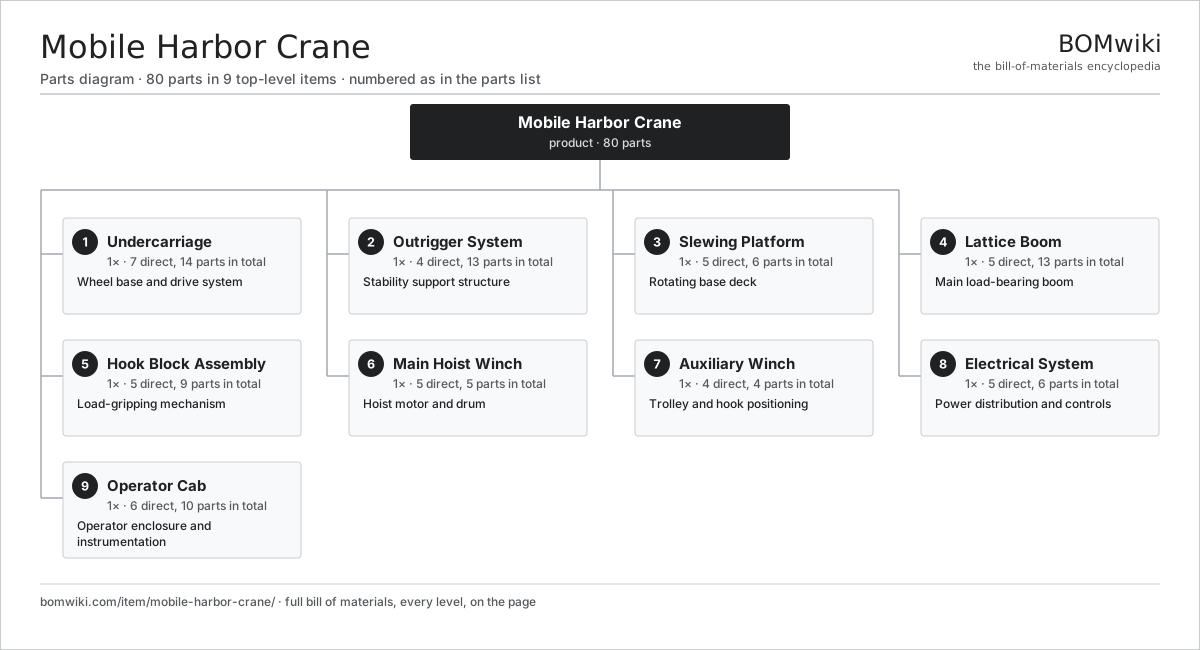
| # | Part | Qty | What it does |
|---|---|---|---|
| 1 | Undercarriage 7 parts | 1× | Wheel base and drive system |
| 2 | Outrigger System 4 parts | 1× | Stability support structure |
| 3 | Slewing Platform 5 parts | 1× | Rotating base deck |
| 4 | Lattice Boom 5 parts | 1× | Main load-bearing boom |
| 5 | Hook Block Assembly 5 parts | 1× | Load-gripping mechanism |
| 6 | Main Hoist Winch 5 parts | 1× | Hoist motor and drum |
| 7 | Auxiliary Winch 4 parts | 1× | Trolley and hook positioning |
| 8 | Electrical System 5 parts | 1× | Power distribution and controls |
| 9 | Operator Cab 6 parts | 1× | Operator enclosure and instrumentation |
3D model
No 3D model yet. Have a CAD file of this? Add a 3D model. STL renders right on this page; STEP, FreeCAD, and OpenSCAD sources are welcome too (openly licensed, like all 3D models on BOMwiki).
Build & assembly graph
expand / collapse · shared sub-assemblies converge · links to related products · est. labourTap an assembly to expand/collapse · tap a part to open it · use “Open page” for any node · drag to pan, scroll to zoom.
Bill of materials for Mobile Harbor Crane
9 top-level lines · 55 rows shown · 80 parts total · indented to 3 levels| # | Item / sub-assembly | Part no. | Qty/assy | Ext. qty | Parts | Type |
|---|---|---|---|---|---|---|
| 1 | Undercarriage 7 parts | mhc-undercarriage | 1× | 1 | 14 | assembly |
| 1.1 | Truck Frame | mhc-truck-frame | 1× | 1 | · | part |
| 1.2 | Diesel Engine | mhc-diesel-engine | 1× | 1 | · | part |
| 1.3 | Transmission | mhc-transmission | 1× | 1 | · | part |
| 1.4 | Axles Assembly | mhc-axles | 3× | 3 | · | part |
| 1.5 | Wheel Assembly | mhc-wheel-assembly | 6× | 6 | · | part |
| 1.6 | Steering System | mhc-steering-system | 1× | 1 | · | part |
| 1.7 | Drive Hydraulic System | mhc-hydraulic-system-drive | 1× | 1 | · | part |
| 2 | Outrigger System 4 parts | mhc-outrigger-system | 1× | 1 | 13 | assembly |
| 2.1 | Outrigger Beams | mhc-outrigger-beams | 4× | 4 | · | part |
| 2.2 | Outrigger Cylinders | mhc-outrigger-cylinders | 4× | 4 | · | part |
| 2.3 | Outrigger Pads | mhc-outrigger-pads | 4× | 4 | · | part |
| 2.4 | Outrigger Lock Pins | mhc-outrigger-lock-pins | 1× | 1 | · | part |
| 3 | Slewing Platform 5 parts | mhc-slewing-platform | 1× | 1 | 6 | assembly |
| 3.1 | Platform Deck | mhc-platform-deck | 1× | 1 | · | part |
| 3.2 | Slew Bearing | mhc-slew-bearing | 1× | 1 | · | part |
| 3.3 | Slew Motor | mhc-slew-motor | 1× | 1 | · | part |
| 3.4 | Slew Brake | mhc-slew-brake | 1× | 1 | · | part |
| 3.5 | Fastener Set | fastener-set | 2× | 2 | · | part |
| 4 | Lattice Boom 5 parts | mhc-lattice-boom | 1× | 1 | 13 | assembly |
| 4.1 | Boom Main Chords | mhc-boom-main-chords | 2× | 2 | · | part |
| 4.2 | Boom Diagonal Bracing | mhc-boom-diagonal-bracing | 3× | 3 | · | part |
| 4.3 | Boom Hoist Sheave | mhc-boom-hoist-sheave | 1× | 1 | · | part |
| 4.4 | Boom Guy Cables | mhc-boom-guy-cables | 4× | 4 | · | part |
| 4.5 | Fastener Set | fastener-set | 3× | 3 | · | part |
| 5 | Hook Block Assembly 5 parts | mhc-hook-block-assembly | 1× | 1 | 9 | assembly |
| 5.1 | Hook Block Frame | mhc-hook-sheave-frame | 1× | 1 | · | part |
| 5.2 | Hook Sheaves | mhc-hook-sheaves | 2× | 2 | · | part |
| 5.3 | Hook Pin | mhc-hook-pin | 1× | 1 | · | part |
| 5.4 | Hook Safety Latch | mhc-hook-safety-latch | 1× | 1 | · | part |
| 5.5 | Ball Bearing | ball-bearing | 4× | 4 | · | part |
| 6 | Main Hoist Winch 5 parts | mhc-main-winch | 1× | 1 | 5 | assembly |
| 6.1 | Winch Motor | mhc-winch-motor | 1× | 1 | · | part |
| 6.2 | Winch Brake | mhc-winch-brake | 1× | 1 | · | part |
| 6.3 | Winch Drum | mhc-winch-drum | 1× | 1 | · | part |
| 6.4 | Rope Guide | mhc-rope-guide | 1× | 1 | · | part |
| 6.5 | Load Monitoring Device | mhc-load-monitoring | 1× | 1 | · | part |
| 7 | Auxiliary Winch 4 parts | mhc-auxiliary-winch | 1× | 1 | 4 | assembly |
| 7.1 | Auxiliary Motor | mhc-aux-motor | 1× | 1 | · | part |
| 7.2 | Auxiliary Brake | mhc-aux-brake | 1× | 1 | · | part |
| 7.3 | Auxiliary Drum | mhc-aux-drum | 1× | 1 | · | part |
| 7.4 | Trolley Sheave | mhc-trolley-hoist-sheave | 1× | 1 | · | part |
| 8 | Electrical System 5 parts | mhc-electric-system | 1× | 1 | 6 | assembly |
| 8.1 | Main Switchboard | mhc-main-switchboard | 1× | 1 | · | part |
| 8.2 | Variable Frequency Drives | mhc-vfd-units | 2× | 2 | · | part |
| 8.3 | Control Transformer | mhc-control-transformer | 1× | 1 | · | part |
| 8.4 | Safety Relay | mhc-safety-relay | 1× | 1 | · | part |
| 8.5 | Load Display | mhc-load-monitoring-display | 1× | 1 | · | part |
| 9 | Operator Cab 6 parts | mhc-cab | 1× | 1 | 10 | assembly |
| 9.1 | Cab Structure | mhc-cab-structure | 1× | 1 | · | part |
| 9.2 | Cab Windows | mhc-cab-windows | 4× | 4 | · | part |
| 9.3 | Operator Seat | mhc-cab-seat | 1× | 1 | · | part |
| 9.4 | Control Joysticks | mhc-control-joysticks | 2× | 2 | · | part |
| 9.5 | Instrumentation Panel | mhc-instrumentation-panel | 1× | 1 | · | part |
| 9.6 | Climate Control System | mhc-climate-control | 1× | 1 | · | part |
Something wrong in this list? Report a problem with this BOM.
Sourcing: possible vendors
Browse the supplier directory → Prices, MOQ, and lead times are algorithmic estimates, not quotes, and not claims about these companies. Company mappings are curated by keyword; est. price band $2k–$300k. How estimates work| Vendor | HQ | Specialty | MOQ | Lead time |
|---|---|---|---|---|
| toyota-industries.com ↗ | Kariya, JP | Forklifts & logistics | 20 units | 10–16 wks |
| kiongroup.com ↗ | Frankfurt, DE | Forklifts (Linde, STILL) | 20 units | 10–16 wks |
| jungheinrich.com ↗ | Hamburg, DE | Warehouse trucks | 20 units | 10–16 wks |
| crown.com ↗ | New Bremen, US | Forklifts | 20 units | 10–16 wks |
|
🇨🇳Hangcha
hcforklift.com ↗
|
Hangzhou, CN | Forklifts & material handling | 20 units | 10–16 wks |
1,929-word article