Molasses Desugarization
ProductOverview
Molasses desugarization is a specialized separation unit recovering residual sucrose from exhausted molasses, the black byproduct from sugar centrifugation. Ion-exchange resin columns selectively absorb sugar molecules while allowing non-fermentable solutes (salts, coloration compounds) to pass. The recovered sugar solution can be recycled to Vacuum Pan or fermented to ethanol; residual molasses (depleted of sugar) is suitable for animal feed or chemical feedstock. Modern desugarization units recover 40–60 kg sugar per cycle, extending overall plant recovery by 2–3 percentage points.
How it Works
Exhausted molasses from the Sugar Centrifugal discharge flows into the Feed Pump System, which circulates it upward through twin ion-exchange resin beds. The strong cation resin (polystyrene sulfonic acid polymer) irreversibly adsorbs sucrose molecules at equilibrium conditions, loading the resin to approximately 50 g/L active sites. Non-sugar components (potassium, calcium, color compounds) pass through the resin and exit as depleted molasses.
Processing continues at 100–200 L/h until the resin reaches saturation (~40–50 kg sugar loaded per 1000 L resin). Output product concentration falls from ~30 g/L to ~5 g/L (measured by refractometry). At this point, the Regeneration System system activates.
The Backwash Valve reverses flow, and Regenerant Pump meters dilute hydrochloric acid (0.5 N HCl) or sodium hydroxide solution upward through the resin. The chemical regenerant displaces adsorbed sugar, eluting it as a concentrated solution (~50–80 g/L) into the eluate tank. Regeneration takes 2–3 hours; after rinsing, the resin is ready for the next cycle.
Typical operations run two column pairs alternately: while one pair is in regeneration, the other processes molasses, maintaining continuous flow.
Chemistry
The resin is a polymer matrix (polystyrene cross-linked with divinylbenzene) with sulfonic acid functional groups (-SO3−H+). These sites ionize in aqueous solution, creating fixed negative charges. Sucrose (a non-ionic polyhydroxy compound) adsorbs via hydrogen bonding and van der Waals forces, not through electrostatic attraction. This selective adsorption allows sugars to bind while ionic salts and colored compounds (fulvic acids, caramel) pass through.
Regeneration with acid or base protonates or hydroxylates the functional groups, weakening sucrose binding. Alternating acid and base regenerants (or using amphoteric resins) extends resin life to 3–5 years of continuous operation.
Engineering Considerations
Twin Columns: Running two columns in series increases recovery (first column removes 85–90% sugar, second removes another 50% of remaining). Twin columns also reduce regeneration frequency: while one is regenerating, the other operates, maintaining product output.
Backwash: Before regeneration, upward water flow (backwash) lifts and fluidizes the resin bed, removing compacted layers and fines. This step prevents channeling (preferential flow paths) that reduce contact time and regenerant efficiency.
Eluate Concentration: The eluate is rich in sugar but also contains regenerant chemicals (residual HCl or NaOH). Careful washing (dilute water rinse) or pH neutralization may be required before recycling eluate back to Vacuum Pan.
Pressure Monitoring: Rising differential pressure across the column indicates resin fouling (organic colloidal buildup) or mechanical plugging. Periodic high-flow water backwash or chemical caustic cleaning restores permeability.
Operational Issues
Resin Fouling: Colloidal material (polysaccharides, proteins) in molasses can coat resin beads, reducing adsorption kinetics and increasing pressure drop. Ultrafiltration of molasses feed or periodic caustic soaks improve performance.
Color Breakthrough: Early-cycle eluate may contain colored compounds if resin is degraded. Test strips or HPLC verify purity; off-spec eluate is discarded or recycled.
Regenerant Efficiency: Incomplete regeneration leaves residual sugar on resin, reducing next-cycle capacity. Longer regenerant contact times or higher regenerant concentration improve elution.
Integration
Sugar Centrifugal → spent molasses → Molasses Desugarization → recovered sugar solution → Vacuum Pan (re-crystallization) or Industrial Ethanol Fermenter (fermentation); depleted molasses → animal feed or export.
Plants with large scale (>100 tonnes/day) often justify desugarization. Smaller mills may skip it due to capital cost and operational complexity.
Environmental & Economic Value
Desugarization diverts 2–3% of total sugar loss back into product, improving overall milling recovery from ~92% to ~95%. The exhausted molasses (after desugarization) has lower sugar content, reducing fermentation loss if sold as animal feed. Economic ROI depends on molasses price, sugar value, and energy cost.
Molasses Desugarization parts and their functions
5 top-level parts · 34 parts in total · full bill of materials below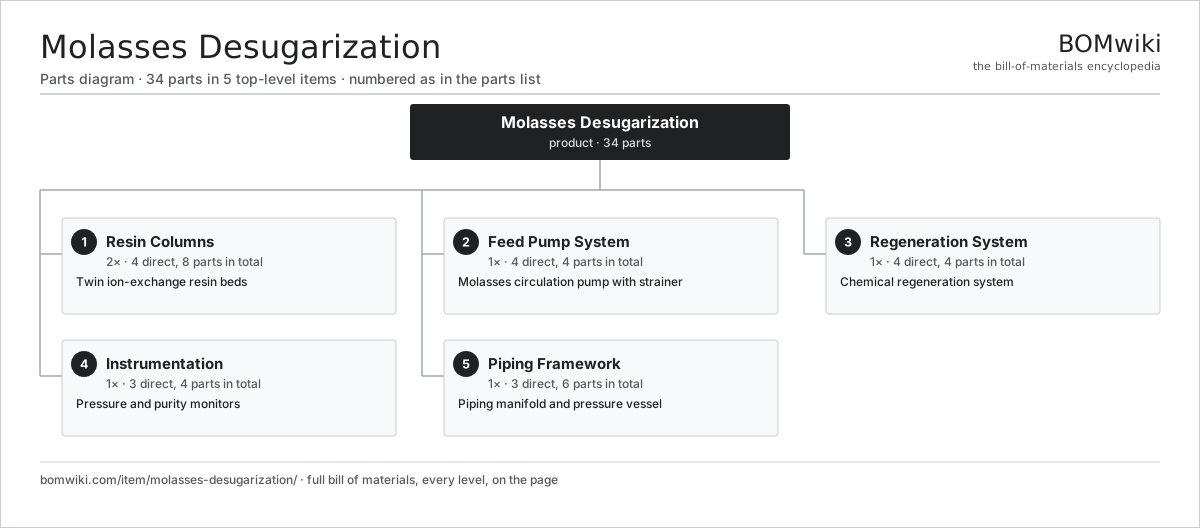
| # | Part | Qty | What it does |
|---|---|---|---|
| 1 | Resin Columns 4 parts | 2× | Twin ion-exchange resin beds |
| 2 | Feed Pump System 4 parts | 1× | Molasses circulation pump with strainer |
| 3 | Regeneration System 4 parts | 1× | Chemical regeneration system |
| 4 | Instrumentation 3 parts | 1× | Pressure and purity monitors |
| 5 | Piping Framework 3 parts | 1× | Piping manifold and pressure vessel |
3D model
No 3D model yet. Have a CAD file of this? Add a 3D model. STL renders right on this page; STEP, FreeCAD, and OpenSCAD sources are welcome too (openly licensed, like all 3D models on BOMwiki).
Build & assembly graph
expand / collapse · shared sub-assemblies converge · links to related products · est. labourTap an assembly to expand/collapse · tap a part to open it · use “Open page” for any node · drag to pan, scroll to zoom.
Bill of materials for Molasses Desugarization
5 top-level lines · 23 rows shown · 34 parts total · indented to 3 levels| # | Item / sub-assembly | Part no. | Qty/assy | Ext. qty | Parts | Type |
|---|---|---|---|---|---|---|
| 1 | Resin Columns 4 parts | molasses-desugarization-columns | 2× | 2 | 8 | assembly |
| 1.1 | Column Vessel | molasses-desugarization-column-vessel | 2× | 4 | · | part |
| 1.2 | Resin Bed | molasses-desugarization-resin-bed | 2× | 4 | · | part |
| 1.3 | Inlet Diffuser | molasses-desugarization-diffusers | 2× | 4 | · | part |
| 1.4 | Outlet Header | molasses-desugarization-drain-headers | 2× | 4 | · | part |
| 2 | Feed Pump System 4 parts | molasses-desugarization-feed-pump | 1× | 1 | 4 | assembly |
| 2.1 | Pump Motor | molasses-desugarization-feed-pump-motor | 1× | 1 | · | part |
| 2.2 | Pump Impeller | molasses-desugarization-feed-pump-impeller | 1× | 1 | · | part |
| 2.3 | Inlet Strainer | molasses-desugarization-inlet-strainer | 1× | 1 | · | part |
| 2.4 | Flow Valve | molasses-desugarization-flow-control | 1× | 1 | · | part |
| 3 | Regeneration System 4 parts | molasses-desugarization-regeneration | 1× | 1 | 4 | assembly |
| 3.1 | Regenerant Tank | molasses-desugarization-regenerant-tank | 1× | 1 | · | part |
| 3.2 | Regenerant Pump | molasses-desugarization-regenerant-pump | 1× | 1 | · | part |
| 3.3 | Backwash Valve | molasses-desugarization-backwash-valve | 1× | 1 | · | part |
| 3.4 | Eluate Tank | molasses-desugarization-eluate-recovery | 1× | 1 | · | part |
| 4 | Instrumentation 3 parts | molasses-desugarization-controls | 1× | 1 | 4 | assembly |
| 4.1 | Pressure Sensors | molasses-desugarization-pressure-sensor | 2× | 2 | · | part |
| 4.2 | Refractometer | molasses-desugarization-refractive-index | 1× | 1 | · | part |
| 4.3 | Conductivity Cell | molasses-desugarization-conductivity-cell | 1× | 1 | · | part |
| 5 | Piping Framework 3 parts | molasses-desugarization-frame | 1× | 1 | 6 | assembly |
| 5.1 | Manifold Block | molasses-desugarization-manifold-block | 1× | 1 | · | part |
| 5.2 | Relief Valve | molasses-desugarization-pressure-relief | 1× | 1 | · | part |
| 5.3 | Isolation Valves | molasses-desugarization-isolation-valves | 4× | 4 | · | part |
Something wrong in this list? Report a problem with this BOM.
Sourcing: possible vendors
Browse the supplier directory → Prices, MOQ, and lead times are algorithmic estimates, not quotes, and not claims about these companies. Company mappings are curated by keyword; est. price band $1k–$500k. How estimates work| Vendor | HQ | Specialty | MOQ | Lead time |
|---|---|---|---|---|
| gea.com ↗ | Düsseldorf, DE | Process technology | 20 units | 12–20 wks |
| buhlergroup.com ↗ | Uzwil, CH | Food & materials processing | 20 units | 12–20 wks |
| tetrapak.com ↗ | Pully, CH | Food packaging & processing | 20 units | 12–20 wks |
| jbtc.com ↗ | Chicago, US | Food processing equipment | 20 units | 12–20 wks |
| alfalaval.com ↗ | Lund, SE | Heat transfer & separation | 20 units | 12–20 wks |
713-word article