Movable Glass Wall
ProductOverview
A movable glass wall is a set of sliding glass panels suspended from a top aluminum track and guided by a floor track, enabling flexible space division in open-plan offices, conference areas, and retail environments. Unlike fixed walls (permanent) or curtain partitions (opaque), glass walls provide visual transparency while offering acoustic isolation and environmental separation.
Modern movable glass wall systems are engineered with ball-bearing carriers, soft-close hydraulic dampers, and high-precision tracks, allowing smooth, quiet operation even with 1-meter-tall panels weighing 100+ kg. Premium systems include electronic motorized operation for high-traffic areas or accessibility requirements.
Installation cost ranges from $400–800 per linear meter (including glass, frame, tracks, carriers, and labor), making them cost-effective for high-value commercial spaces where flexibility, transparency, and professional aesthetics are prioritized.
Mechanical Design
Top-Hung Suspension System
The top and bottom track system uses an aluminum T-slot suspension track mounted to the ceiling or structural beam above the opening. The top track is 40 mm × 40 mm T-slot extrusion, anodized for corrosion resistance and durability.
Ball-bearing carriers ride inside the top track, supporting the full panel weight. Each carrier contains dual ball-bearing wheels (50 mm diameter) rated 200 kg load capacity per wheel. For a typical 100 kg glass panel, each carrier experiences ~50 kg load (two carriers per panel), well within the 200 kg safety margin per carrier.
A floor guide track (aluminum U-channel, 50 mm deep) provides lateral guidance and prevents panels from swinging. The floor track has minimal load-bearing function; its primary role is to stabilize panel motion and prevent lateral drift under wind load.
Glass Panel Assembly
Each glass panel is a modular unit comprising a tempered low-iron glass pane (8 mm thick, 1000–1200 mm wide × 2400 mm tall) set within an aluminum stile frame (50 mm × 50 mm profile).
The glass is compressed into the stile via a resilient EPDM gasket, creating a pressure-fit assembly. The gasket allows thermal expansion (glass and aluminum have different expansion coefficients; aluminum expands 23 µm/m·°C, glass ~8 µm/m·°C) without inducing stress concentrations that could cause cracking.
Aluminum corner connectors join the four stile members (top, bottom, left, right) at 90° angles, forming a rectangular frame. Bolted connections allow disassembly for future modifications.
Carrier Technology
The carrier assembly is the mechanical heart of the system. Each carrier comprises:
- An aluminum or nylon body housing dual ball-bearing wheels.
- Two precision ball bearings (50 mm diameter, rated for 1000 rpm, 200 kg load per wheel).
- An anti-jump secondary roller on the underside, riding on the top-track bottom surface, preventing upward displacement under wind load.
- A soft-close hydraulic damper decelerating panel motion during the final 200 mm of closure.
Ball-bearing wheels are precision-engineered with sealed cartridges preventing water ingress and dust accumulation. Lubrication (sealed grease inside the bearing cartridge) is permanent; field re-lubrication is not required, extending maintenance intervals.
Soft-close dampers are velocity-controlled hydraulic cylinders (single-acting, spring-return design). As the panel approaches closure, a rotating cam on the panel stile gradually opens the damper's metering port, allowing pressurized oil to escape slowly. This dissipates kinetic energy smoothly, preventing impact at the closed position. Operating force remains <50 N throughout the stroke.
Locking & Hold-Open Mechanisms
Closed-position locking uses a neodymium magnetic latch embedded in the top track at the fully closed position. A ferrous keeper bolt mounted on the carrier is attracted to the magnet, providing ~100 kg holding force. This is sufficient to resist wind pressure (approximately 40 kg per m² at 100 mph), keeping the wall sealed during storms or high wind events.
For hold-open positioning, a spring-loaded ball detent drops into a groove in the top track at 90° (half-open position), allowing occupants to position the wall for partial room division without mechanical effort. A hook or bracket at the fully open position (typically 90° rotation) mechanically locks the panel, preventing accidental closure.
Gasket & Sealing System
Adjacent glass panels overlap when closed, with a panel-to-panel EPDM gasket sealing the overlap zone. Acoustic isolation is improved by gasket compression (typically 20–30 mm compression), creating a more complete seal.
A perimeter gasket seals the edge of the movable wall assembly against the fixed structural frame (ceiling header, floor sill, and adjacent walls). The perimeter gasket reduces sound transmission and air leakage.
Gasket compression is critical: under-compressed gaskets (<15 mm) leak air and sound; over-compressed gaskets (>40 mm) can create permanent set and require replacement within 5 years. Proper commissioning ensures gasket compression is within 25 ±5 mm.
Performance Characteristics
Acoustic Isolation
A typical 8 mm tempered glass panel with properly compressed EPDM gaskets achieves approximately 30–35 dB sound reduction index (Rw). This is equivalent to:
- Reducing office conversation (65–70 dB) to 30–40 dB (near whisper level).
- Reducing telephone/video conference clarity to ~90% (minimal acoustic leakage for confidential discussions).
Premium systems using 10 mm laminated glass (two 5 mm panes bonded with polyvinyl butyral interlayer) achieve 35–40 dB, suitable for high-privacy conference areas.
Thermal Performance
Tempered glass alone has minimal insulation value (U-value approximately 5.8 W/m²K for a single 8 mm pane, identical to single-pane window glass). The aluminum stile frame conducts heat efficiently (aluminum thermal conductivity ~200 W/m·K, compared to glass at 1 W/m·K), creating thermal bridges.
Overall system U-value is approximately 2.8–3.2 W/m²K (accounting for radiative and convective heat transfer across the panel assembly). This is suitable for office partitions but inferior to insulated windows (0.25–0.3 W/m²K). For climate-controlled office buildings, this is acceptable; for thermally sensitive applications, insulated glass units (IGUs) with low-E coatings can be specified at 30–50% cost premium.
Optical Properties
Low-iron borosilicate glass transmits approximately 91% of visible light (compared to 87% for standard soda-lime glass), providing near-transparent appearance and minimal color tint. Color rendering is excellent (CRI >95%), so visual communication across the partition is clear and natural.
Wind Resistance
In the fully closed position, the movable wall is laterally constrained by the floor track and top-track carriers, forming a structural sandwich. Wind load analysis shows that a 3.6 m wide × 2.4 m tall wall assembly (three 1.2 m panels) can withstand 100 mph (45 m/s) sustained wind without deflection exceeding 10 mm.
At higher wind speeds or in partially open configurations, deflection increases. Design standards (ASTM D2915, IBC 2021) specify that movable walls must withstand 200 lbf (0.9 kN) concentrated push load at mid-height without permanent deformation.
Installation Process
Site Preparation
- Building structure is assessed: ceiling height must accommodate top-track installation with clearance for carriers and access panels (typically 150 mm above finished ceiling).
- Floor surface is verified for flatness (±5 mm over the track span acceptable; larger variations require shims).
- The opening boundaries are marked with laser alignment tools; track positions are transferred to ceiling and floor.
Track Installation
- Top-track brackets are bolted to ceiling or structural beam using chemical anchors (concrete/masonry) or bolts through web stiffeners (steel structure). Spacing: 1 meter maximum between bracket supports.
- Top track is leveled within ±2 mm (exceeding this tolerance causes binding or misalignment of carriers).
- Bottom track is installed parallel to top track (±1 mm parallelism over 4 m span).
- Track end caps are installed, sealing open ends and preventing carrier rollout.
Glass Panel Preparation
Panels are fabricated off-site (controlled environment) or assembled on-site:
- Glass pane is cut to width and height (±2 mm tolerance).
- Aluminum stiles are extruded and cut to length; corner connectors are bolted at 90° angles.
- EPDM gasket is adhered to the stile interior using contact cement.
- Glass pane is carefully fitted into the stile channel, compressing the gasket uniformly.
- The assembled panel is lifted and its carriers are bolted to the top stile, carefully aligned in the top track.
Field Assembly
- First panel is lifted and suspended in the top track; carriers are rolled into position and clamped.
- Subsequent panels are installed similarly, positioned side-by-side in the top track.
- Gaskets between adjacent panels are compressed and verified for continuity.
- Perimeter gaskets are installed around the opening boundary.
- Bottom track is positioned and fastened, guiding the panel bases.
- All hardware is tightened; soft-close dampers are adjusted for smooth closure (typically 1–2 second deceleration for the final 200 mm).
- Operational tests are performed: panels slide smoothly, close without impact, and latch securely in all positions.
Maintenance & Service
Weekly/Monthly
- Visually inspect carriers for debris accumulation or misalignment.
- Manually cycle panels 2–3 times to verify smooth operation.
- Wipe glass surfaces with lint-free cloth (standard glass cleaner safe).
Annually
- Inspect all fasteners (M10 bolts) for loosening; retorque to 25 N⋅m.
- Check gasket compression; if compression set exceeds 50% of original thickness, plan gasket replacement.
- Test soft-close damper operation; damping should be smooth and progressive (no abrupt jerking).
- Inspect floor track for debris; vacuum and rinse with water if sediment accumulates.
Every 3–5 Years
- Replace EPDM gaskets (cost ~$500 per wall system, 1–2 days labor).
- Recalibrate top-track leveling if settlement has occurred (unlikely in modern buildings but possible in older structures).
- Inspect ball-bearing wheels for flat-spotting (uncommon but possible under heavy use); carriers are modular and easily swapped for new units (~$200 per carrier).
Specialized Variants
Motorized Operation
High-traffic areas (hospitals, airports, accessibility-required facilities) may specify electrically operated movable walls. A 24 VDC motor drives a screw or belt mechanism, opening/closing panels via push-button or motion sensor. Motor kits cost an additional $2,000–5,000 per wall system.
Sound-Insulated Glass
Laminated glass (two panes bonded with polyvinyl butyral interlayer) achieves 35–40 dB sound reduction. Laminated glass also provides:
- Security: Interlayer prevents shattering on impact.
- Blast resistance: Bonded panes contain shock waves from nearby explosions.
Cost: 40–60% premium over standard tempered glass.
Switchable (Smart) Glass
Electrochromic glass (electrochromic polymer film sandwiched between panes) transitions from clear to opaque when a low-voltage electric field is applied. Smart glass provides privacy on demand without closing the partition, maintaining sightlines for emergency egress and wayfinding. Cost: 3–5x standard glass (~$2000 per panel).
Standards & Compliance
- ASTM D2915: Standard practice for safety glazing for non-automotive glazing applications.
- ANSI 97.1: Safety glazing.
- IBC 2021 Section 2406: Glazing standards; movable partitions must meet impact safety criteria.
- ADA Accessibility Guidelines: Movable walls must have clear operation without pushing >5 lbf continuous force (achievable with soft-close dampers).
Economic Considerations
Initial cost: $400–800 per linear meter (glass, frame, track, carriers, labor).
For a 3.6 m wide × 2.4 m tall opening (typical office): $2,000–3,000 material + $1,500–2,000 labor = $3,500–5,000 total.
Long-term value:
- Flexibility: Wall configuration can be changed (panels removed, repositioned) within 1 year without full reinstallation.
- Transparency: Visual connection supports collaboration and emergency visibility.
- Professional appearance: Glass partitions convey openness and modernity, valued in luxury corporate and healthcare settings.
Payback: primarily intangible (occupant satisfaction, flexibility, aesthetics), but commercial properties with flexible layouts command 3–5% rent premiums, justifying installation.
Movable Glass Wall parts and their functions
6 top-level parts · 129 parts in total · full bill of materials below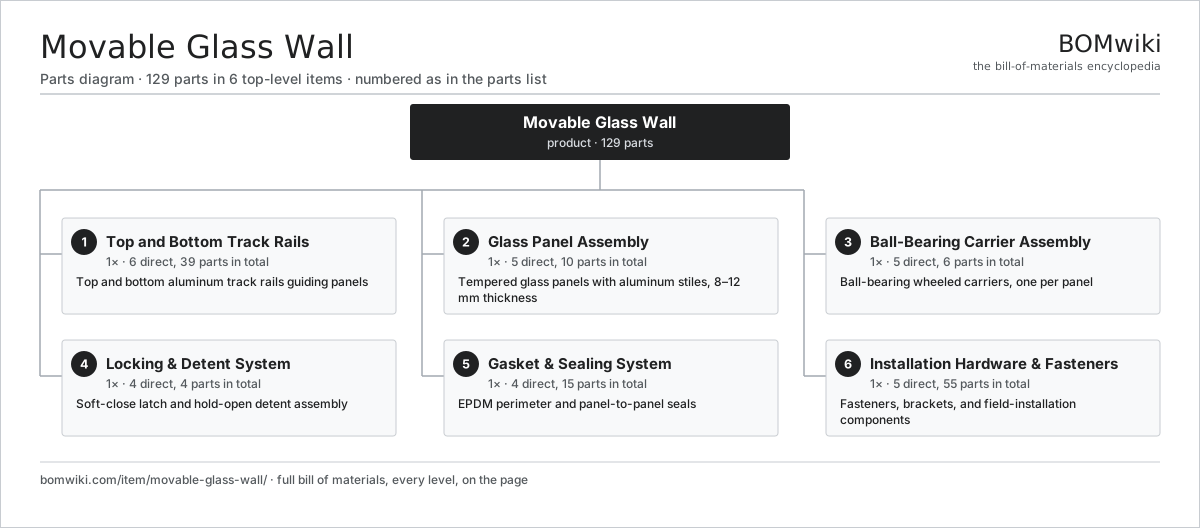
| # | Part | Qty | What it does |
|---|---|---|---|
| 1 | Top and Bottom Track Rails 6 parts | 1× | Top and bottom aluminum track rails guiding panels |
| 2 | Glass Panel Assembly 5 parts | 1× | Tempered glass panels with aluminum stiles, 8–12 mm thickness |
| 3 | Ball-Bearing Carrier Assembly 5 parts | 1× | Ball-bearing wheeled carriers, one per panel |
| 4 | Locking & Detent System 4 parts | 1× | Soft-close latch and hold-open detent assembly |
| 5 | Gasket & Sealing System 4 parts | 1× | EPDM perimeter and panel-to-panel seals |
| 6 | Installation Hardware & Fasteners 5 parts | 1× | Fasteners, brackets, and field-installation components |
3D model
No 3D model yet. Have a CAD file of this? Add a 3D model. STL renders right on this page; STEP, FreeCAD, and OpenSCAD sources are welcome too (openly licensed, like all 3D models on BOMwiki).
Build & assembly graph
expand / collapse · shared sub-assemblies converge · links to related products · est. labourTap an assembly to expand/collapse · tap a part to open it · use “Open page” for any node · drag to pan, scroll to zoom.
Bill of materials for Movable Glass Wall
6 top-level lines · 35 rows shown · 129 parts total · indented to 3 levels| # | Item / sub-assembly | Part no. | Qty/assy | Ext. qty | Parts | Type |
|---|---|---|---|---|---|---|
| 1 | Top and Bottom Track Rails 6 parts | movable-glass-wall-frame-perimeter | 1× | 1 | 39 | assembly |
| 1.1 | Top Suspension Track | movable-glass-wall-top-track | 1× | 1 | · | part |
| 1.2 | Floor Guide Track | movable-glass-wall-bottom-track | 1× | 1 | · | part |
| 1.3 | Track Mounting Bracket | movable-glass-wall-track-bracket | 8× | 8 | · | part |
| 1.4 | Track End Cap | movable-glass-wall-track-end-cap | 4× | 4 | · | part |
| 1.5 | Leveling Shim Pack | movable-glass-wall-leveling-shim-kit | 1× | 1 | · | part |
| 1.6 | Fastener Set | fastener-set | 24× | 24 | · | part |
| 2 | Glass Panel Assembly 5 parts | movable-glass-wall-glass-panels | 1× | 1 | 10 | assembly |
| 2.1 | Tempered Glass Pane | movable-glass-wall-glass-sheet | 3× | 3 | · | part |
| 2.2 | Aluminum Stile Extrusion | movable-glass-wall-aluminum-stile | 1× | 1 | · | part |
| 2.3 | Corner Stile Connector | movable-glass-wall-stile-connector | 4× | 4 | · | part |
| 2.4 | Glass-to-Stile Compression Gasket | movable-glass-wall-glass-gasket | 1× | 1 | · | part |
| 2.5 | Panel Splice Plate (Edge-to-Edge Join) | movable-glass-wall-panel-splice-plate | 1× | 1 | · | part |
| 3 | Ball-Bearing Carrier Assembly 5 parts | movable-glass-wall-carrier-assembly | 1× | 1 | 6 | assembly |
| 3.1 | Carrier Body Housing | movable-glass-wall-carrier-body | 1× | 1 | · | part |
| 3.2 | Precision Ball-Bearing Wheel | movable-glass-wall-wheel-bearing | 2× | 2 | · | part |
| 3.3 | Carrier-to-Panel Bracket | movable-glass-wall-carrier-bracket | 1× | 1 | · | part |
| 3.4 | Anti-Jump Secondary Roller | movable-glass-wall-anti-jump-roller | 1× | 1 | · | part |
| 3.5 | Soft-Close Hydraulic Damper | movable-glass-wall-soft-close-damper | 1× | 1 | · | part |
| 4 | Locking & Detent System 4 parts | movable-glass-wall-locking-mechanism | 1× | 1 | 4 | assembly |
| 4.1 | Magnetic Latch Block | movable-glass-wall-magnetic-latch | 1× | 1 | · | part |
| 4.2 | Ferrous Latch Keeper | movable-glass-wall-latch-keeper | 1× | 1 | · | part |
| 4.3 | Spring Detent Ball | movable-glass-wall-detent-mechanism | 1× | 1 | · | part |
| 4.4 | Hold-Open Bracket | movable-glass-wall-hold-open-bracket | 1× | 1 | · | part |
| 5 | Gasket & Sealing System 4 parts | movable-glass-wall-sealing-gasket | 1× | 1 | 15 | assembly |
| 5.1 | Perimeter Gasket Extrusion | movable-glass-wall-perimeter-gasket | 1× | 1 | · | part |
| 5.2 | Panel Splice Gasket | movable-glass-wall-panel-to-panel-gasket | 1× | 1 | · | part |
| 5.3 | Contact Cement for Gaskets | movable-glass-wall-gasket-adhesive | 1× | 1 | · | part |
| 5.4 | Gasket Retaining Clip | movable-glass-wall-gasket-clips | 12× | 12 | · | part |
| 6 | Installation Hardware & Fasteners 5 parts | movable-glass-wall-hardware-kit | 1× | 1 | 55 | assembly |
| 6.1 | Fastener Set | fastener-set | 48× | 48 | · | part |
| 6.2 | Alignment Shim Pack | movable-glass-wall-shim-kit | 1× | 1 | · | part |
| 6.3 | Carrier Access Panel | movable-glass-wall-access-panel | 1× | 1 | · | part |
| 6.4 | Protective Bumper Pad | movable-glass-wall-bumper-pad | 4× | 4 | · | part |
| 6.5 | Warning and Instructional Labels | movable-glass-wall-label-kit | 1× | 1 | · | part |
Something wrong in this list? Report a problem with this BOM.
Sourcing: possible vendors
Browse the supplier directory → Prices, MOQ, and lead times are algorithmic estimates, not quotes, and not claims about these companies. Company mappings are curated by keyword; est. price band $50–$10k. How estimates work| Vendor | HQ | Specialty | MOQ | Lead time |
|---|---|---|---|---|
| assaabloy.com ↗ | Stockholm, SE | Locks & access | 1,000 units | 8–12 wks |
|
🇺🇸Allegion
allegion.com ↗
|
Dublin, US | Security products (Schlage) | 1,000 units | 8–12 wks |
| dormakaba.com ↗ | Rümlang, CH | Access & door systems | 1,000 units | 8–12 wks |
| honeywell.com ↗ | Charlotte, US | Building & safety tech | 1,000 units | 8–12 wks |
| hikvision.com ↗ | Hangzhou, CN | Surveillance & security | 1,000 units | 8–12 wks |
2,004-word article