Air Quality Monitoring Station
ProductOverview
A municipal air quality monitoring station is a semi-automated instrument tower measuring pollutant concentrations and meteorological conditions to assess ambient air quality. These stations are deployed by environmental agencies in cities to meet regulatory requirements (e.g., EPA National Ambient Air Quality Standards) and to inform the public about air health. A typical city operates 5–20 stations distributed geographically; together they paint a picture of air quality across neighborhoods and seasons.
The Gas Analyzer Rack is the core: a suite of automated analyzers measuring nitrogen oxides (NOx), ozone, sulfur dioxide, and carbon monoxide. Each analyzer draws a continuous sample from the Sample Inlet System, conditions it (drying with the Desiccant Dryer and filtering with the Particle Filter), and measures the concentration via spectroscopy or chemiluminescence.
The Particulate Monitor measures airborne dust and soot. The Meteorological Sensors captures wind speed, direction, temperature, humidity, and solar radiation, data needed to explain why pollutant concentrations spike on some days (stagnant air, temperature inversions) versus others (windy conditions, atmospheric mixing).
All data is logged by the Data Logger and Communications and transmitted to a regional air quality database where the public can access real-time air quality indices and historical trends.
How it works
The Sample Inlet System is positioned 3–10 meters above ground, away from roof vents or other sources of local contamination. The inlet is a simple tube or open probe, often with a rain cap to prevent water intrusion. Air is continuously drawn through the inlet at 10–20 L/min by the Sample Air Pump, a diaphragm pump.
Before reaching the analyzers, the sample air is conditioned. The Inlet Heater warms the sample to ~30°C, preventing condensation of water vapor, which would interfere with measurements. The Desiccant Dryer uses silica gel or molecular sieve to further dry the air to <2% relative humidity. Finally, the Particle Filter (HEPA or glass fiber) removes particles larger than 1 micron, protecting the sensitive analyzer optical surfaces from soot and dust.
The dry, filtered air splits into parallel streams fed to each analyzer:
- The NOx Analyzer: Measures both NO and NO2 via chemiluminescence. NO and ozone react with a blue glow whose intensity is proportional to NO concentration. NO2 is first converted to NO using a molybdenum catalyst, then measured. From these two measurements, NO2 is inferred.
- The Ozone Analyzer: Uses UV light at 254 nm. Ozone absorbs this light; the analyzer measures attenuation and calculates concentration from Beer's law.
- The SO2 Analyzer: Uses UV fluorescence. SO2 is excited to a higher electronic state by UV light and emits fluorescent photons; the analyzer counts these photons.
- The CO Analyzer: Uses non-dispersive infrared (NDIR). CO absorbs infrared light around 4.7 microns. A reference gas cell and sample cell are alternately exposed to IR light, and the difference in absorption is measured.
All analyzers require regular calibration. The Zero/Span Gas Kit includes compressed gas cylinders: a zero gas (nitrogen) that produces no response, and a span gas at a known concentration (e.g., 50 ppb NO2). Quarterly, the system cycles through a zero check (verify baseline) and span check (verify sensitivity). If the analyzer drifts, the calibration offset is stored in the Data Logger and Communications and applied to all subsequent measurements.
The Particulate Monitor operates in parallel. The Beta Attenuation Monitor method measures PM by continuously collecting particles on a moving filter tape and measuring the attenuation of beta radiation (typically carbon-14) through the filter. As particles accumulate, more beta particles are absorbed; from the attenuation, mass is inferred. A separate Optical Particle Counter uses a laser to count particles between 0.3 and 10 microns, binning them by size. From size distribution and count, mass concentration is estimated.
The Meteorological Sensors is mounted on a mast above the cabinet:
- Temperature Probe: Platinum RTD in a radiation shield (white plastic) to prevent solar heating of the sensor.
- Humidity Sensor: Capacitive transducer co-located with the temperature probe.
- Anemometer: Three cups on a horizontal arm; as wind rotates the cup wheel, a proximity sensor counts pulses, yielding wind speed in m/s.
- Wind Vane: A tail fin with a potentiometer; as the vane aligns with wind direction, the pot outputs a voltage corresponding to degrees (0–360°).
- Pyranometer: A thermopile sensor under a dome. Solar radiation heats the thermopile; the temperature rise is proportional to solar irradiance (W/m²).
- Pressure Sensor: Measures absolute atmospheric pressure in millibars.
All analog sensor outputs (temperature 0–10 V, wind speed 0–5 V, pressure 4–20 mA, etc.) are digitized by the Data Logger and Communications, an industrial data acquisition system with a Data Storage (SD card or internal SSD) and a Cellular Modem (4G cellular) or Ethernet Module for network connection.
The Instrument Shelter houses all electronics and power supplies. The Cooling Fan and Temperature Controller maintain internal temperature between 15–30°C, essential for accurate analyzer operation. The Power System is 120/240 V AC line-powered, with a UPS Battery providing 4–8 hours of backup during outages.
Data is logged locally every minute, with 1-minute and 15-minute averages computed and stored. The Data Logger and Communications transmits to a regional database once per hour via cellular or Ethernet. The public accesses this data through air quality websites showing current conditions (AQI index) and historical graphs.
Maintenance is labor-intensive. Monthly, technicians visually inspect the station, check for water leaks, clean the sample inlet, and verify zero/span calibration. Quarterly, reference gas cylinders are changed. Annually, analyzers are sent to a certified lab for full calibration and the filter cartridge, desiccant, and pump diaphragm are replaced. Despite these costs, these stations are critical infrastructure for air quality management and public health.
Air Quality Monitoring Station parts and their functions
8 top-level parts · 58 parts in total · full bill of materials below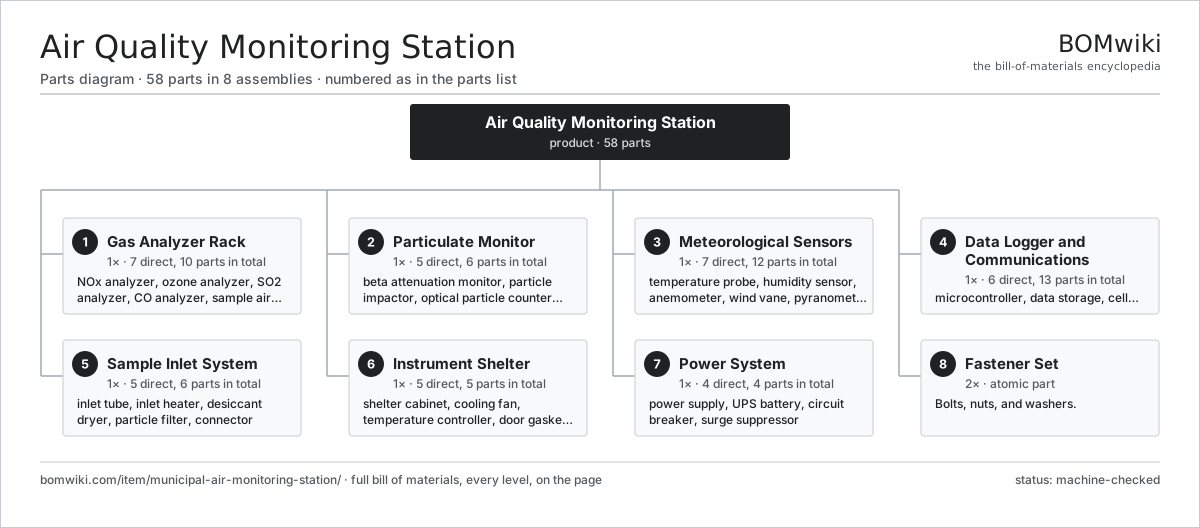
| # | Part | Qty | What it does |
|---|---|---|---|
| 1 | Gas Analyzer Rack 7 parts | 1× | Automated instruments measuring NO, NO2, O3, SO2, and CO. |
| 2 | Particulate Monitor 5 parts | 1× | Measures PM2.5 and PM10 airborne particle concentrations. |
| 3 | Meteorological Sensors 7 parts | 1× | Measures temperature, humidity, wind speed/direction, and solar radiation. |
| 4 | Data Logger and Communications 6 parts | 1× | Records all sensor data and transmits to remote server. |
| 5 | Sample Inlet System 5 parts | 1× | Air intake tower with heater and desiccant dryer conditioning air. |
| 6 | Instrument Shelter 5 parts | 1× | Weatherproof enclosure housing analyzers and data logger. |
| 7 | Power System 4 parts | 1× | Mains power with UPS battery backup. |
| 8 | Fastener Set | 2× | Bolts, nuts, and washers. |
3D model
No 3D model yet. Have a CAD file of this? Add a 3D model — STL renders right on this page; STEP, FreeCAD, and OpenSCAD sources are welcome too (openly licensed, like all 3D models on BOMwiki).
Build & assembly graph
expand / collapse · shared sub-assemblies converge · links to related products · est. labourTap an assembly to expand/collapse · tap a part to open it · use “Open page” for any node · drag to pan, scroll to zoom.
Bill of materials for Air Quality Monitoring Station
8 top-level lines · 47 rows shown · 58 parts total · indented to 3 levels| # | Item / sub-assembly | Part no. | Qty/assy | Ext. qty | Parts | Type |
|---|---|---|---|---|---|---|
| 1 | Gas Analyzer Rack 7 parts | municipal-air-monitoring-station-gas-analyzer-rack | 1× | 1 | 10 | assembly |
| 1.1 | NOx Analyzer | municipal-air-monitoring-station-nox-analyzer | 1× | 1 | · | part |
| 1.2 | Ozone Analyzer | municipal-air-monitoring-station-o3-analyzer | 1× | 1 | · | part |
| 1.3 | SO2 Analyzer | municipal-air-monitoring-station-so2-analyzer | 1× | 1 | · | part |
| 1.4 | CO Analyzer | municipal-air-monitoring-station-co-analyzer | 1× | 1 | · | part |
| 1.5 | Sample Air Pump | municipal-air-monitoring-station-sample-pump | 1× | 1 | · | part |
| 1.6 | Zero/Span Gas Kit | municipal-air-monitoring-station-zero-span-kit | 1× | 1 | · | part |
| 1.7 | Connector | connector | 4× | 4 | · | part |
| 2 | Particulate Monitor 5 parts | municipal-air-monitoring-station-particulate-monitor | 1× | 1 | 6 | assembly |
| 2.1 | Beta Attenuation Monitor | municipal-air-monitoring-station-beta-attenuation | 1× | 1 | · | part |
| 2.2 | Particle Impactor | municipal-air-monitoring-station-particle-impactor | 1× | 1 | · | part |
| 2.3 | Optical Particle Counter | municipal-air-monitoring-station-optical-counter | 1× | 1 | · | part |
| 2.4 | Sampling Inlet Head | municipal-air-monitoring-station-inlet-head | 1× | 1 | · | part |
| 2.5 | Connector | connector | 2× | 2 | · | part |
| 3 | Meteorological Sensors 7 parts | municipal-air-monitoring-station-met-sensor-suite | 1× | 1 | 12 | assembly |
| 3.1 | Temperature Probe | municipal-air-monitoring-station-temperature-probe | 1× | 1 | · | part |
| 3.2 | Humidity Sensor | municipal-air-monitoring-station-humidity-sensor | 1× | 1 | · | part |
| 3.3 | Anemometer | municipal-air-monitoring-station-anemometer | 1× | 1 | · | part |
| 3.4 | Wind Vane | municipal-air-monitoring-station-wind-vane | 1× | 1 | · | part |
| 3.5 | Pyranometer | municipal-air-monitoring-station-pyranometer | 1× | 1 | · | part |
| 3.6 | Pressure Sensor | municipal-air-monitoring-station-pressure-sensor | 1× | 1 | · | part |
| 3.7 | Connector | connector | 6× | 6 | · | part |
| 4 | Data Logger and Communications 6 parts | municipal-air-monitoring-station-data-logger | 1× | 1 | 13 | assembly |
| 4.1 | Microcontroller | mcu | 1× | 1 | · | part |
| 4.2 | Data Storage | municipal-air-monitoring-station-flash-storage | 1× | 1 | · | part |
| 4.3 | Cellular Modem | municipal-air-monitoring-station-modem | 1× | 1 | · | part |
| 4.4 | Ethernet Module | municipal-air-monitoring-station-ethernet | 1× | 1 | · | part |
| 4.5 | Power Supply | power-supply | 1× | 1 | · | part |
| 4.6 | Connector | connector | 8× | 8 | · | part |
| 5 | Sample Inlet System 5 parts | municipal-air-monitoring-station-sample-inlet | 1× | 1 | 6 | assembly |
| 5.1 | Inlet Tube | municipal-air-monitoring-station-inlet-tube | 1× | 1 | · | part |
| 5.2 | Inlet Heater | municipal-air-monitoring-station-inlet-heater | 1× | 1 | · | part |
| 5.3 | Desiccant Dryer | municipal-air-monitoring-station-desiccant-dryer | 1× | 1 | · | part |
| 5.4 | Particle Filter | municipal-air-monitoring-station-filter-cartridge | 1× | 1 | · | part |
| 5.5 | Connector | connector | 2× | 2 | · | part |
| 6 | Instrument Shelter 5 parts | municipal-air-monitoring-station-shelter | 1× | 1 | 5 | assembly |
| 6.1 | Shelter Cabinet | municipal-air-monitoring-station-shelter-cabinet | 1× | 1 | · | part |
| 6.2 | Cooling Fan | municipal-air-monitoring-station-cooling-fan | 1× | 1 | · | part |
| 6.3 | Temperature Controller | municipal-air-monitoring-station-thermostat | 1× | 1 | · | part |
| 6.4 | Door Gasket | municipal-air-monitoring-station-door-seal | 1× | 1 | · | part |
| 6.5 | Fastener Set | fastener-set | 1× | 1 | · | part |
| 7 | Power System 4 parts | municipal-air-monitoring-station-power-system | 1× | 1 | 4 | assembly |
| 7.1 | Power Supply | municipal-air-monitoring-station-power-supply | 1× | 1 | · | part |
| 7.2 | UPS Battery | municipal-air-monitoring-station-ups-battery | 1× | 1 | · | part |
| 7.3 | Circuit Breaker | municipal-air-monitoring-station-breaker | 1× | 1 | · | part |
| 7.4 | Surge Suppressor | municipal-air-monitoring-station-surge-suppressor | 1× | 1 | · | part |
| 8 | Fastener Set | fastener-set | 2× | 2 | · | part |
Related products
same domain, ranked by shared parts AAC Block Plant
155 parts · shares 1 with this page
AAC Block Plant
155 parts · shares 1 with this page
 Access Control Panel
52 parts · shares 1 with this page
Acoustic Banner Hoist
90 parts · shares 1 with this page
Access Control Panel
52 parts · shares 1 with this page
Acoustic Banner Hoist
90 parts · shares 1 with this page
 Air Dancer
46 parts · shares 1 with this page
Air Dancer
46 parts · shares 1 with this page
 Automated Parking System
58 parts · shares 1 with this page
Automated Parking System
58 parts · shares 1 with this page
 Automated Public Toilet
54 parts · shares 1 with this page
Automated Public Toilet
54 parts · shares 1 with this page
Sourcing: possible vendors
Prices, MOQ, and lead times are algorithmic estimates, not quotes, and not claims about these companies. Company mappings are curated by keyword; est. price band $50–$10k. How estimates work| Vendor | HQ | Specialty | MOQ | Lead time |
|---|---|---|---|---|
| assaabloy.com ↗ | Stockholm, SE | Locks & access | 1,000 units | 8–12 wks |
|
🇺🇸Allegion
allegion.com ↗
|
Dublin, US | Security products (Schlage) | 1,000 units | 8–12 wks |
| dormakaba.com ↗ | Rümlang, CH | Access & door systems | 1,000 units | 8–12 wks |
| honeywell.com ↗ | Charlotte, US | Building & safety tech | 1,000 units | 8–12 wks |
| hikvision.com ↗ | Hangzhou, CN | Surveillance & security | 1,000 units | 8–12 wks |
1,093-word article