Museum Display Case
ProductOverview
A museum display case is a specialized vitrine combining a glass enclosure, climate control, archival-quality interior, and precise lighting to protect and present artifacts, paintings, textiles, ceramics, or historic objects, from environmental and physical damage. The Frame Assembly is typically welded aluminum extrusion (corrosion-free, lightweight) or stainless steel, forming a rigid rectangular cage. Six tempered low-iron glass panels (front, left, right, back, top, and often a bottom shelf) are mounted in the frame using stainless-steel clips and sealed with neutral-cure silicone sealant, creating an airtight display volume.
Inside, a Climate Control Module continuously monitors and controls temperature (18–21°C ±1°) and relative humidity (45–55% ±3%), protecting organic materials (wood, textile, leather, paper) from swelling, shrinking, and decay. Precision LED lighting provides 300–500 lux of warm, UV-filtered illumination without heat or infrared radiation. The interior walls and floor are archival-grade materials, acid-free plywood, low-VOC paint, and reversible mounting adhesives, ensuring nothing chemically reactive comes into contact with artifacts. A keyed lock prevents unauthorized access or contamination. The entire case sits on an elevated Support Plinth with elastomer isolation pads, decoupling it from building vibration and footfall.
Museum-quality display cases are found in major cultural institutions, corporate headquarters, high-end retail, and private collections, anywhere artifacts of historical, artistic, or monetary value require protection and prestige presentation.
Glass and visibility
The Glass Panel Assembly are the most visible component. Low-iron tempered glass (8 mm minimum, often thicker for larger cases) is chosen over standard soda-lime glass because low-iron variants are nearly colorless, standard glass has a slight green tint at the edge, which distorts artifact colors. Tempering chemically hardens the glass, so a scratch or impact creates a stress release, shattering the entire panel into small cubes rather than jagged shards, safer and allowing quick replacement.
Anti-reflective (AR) coating, optionally applied, reduces glare and allows viewers to see the artifact without the reflection of the room. An uncoated low-iron glass at an 85% light-transmission baseline; AR coating increases this to 95%+, making the artifact appear to float. The glass is mounted in clips rather than glued or framed, allowing thermal expansion (glass expands and contracts slightly with temperature) and vibration isolation, the clips act as shock absorbers when the floor vibrates.
Climate control and artifact preservation
The Climate Control Module is the intellectual core of the case. Most organic artifacts, textiles, paper, wood, leather, are hygroscopic, meaning they absorb or release moisture as the air's relative humidity (RH) changes. Rapid RH swings cause fiber expansion and contraction, leading to warping (wood), creasing (paper and textile), and paint flaking. Museum conservation science specifies tight RH control: ±3% or better prevents visible damage over decades.
Two strategies exist:
Passive: A silica-gel cartridge inside the case absorbs excess humidity and releases it when the air is drier, buffering RH swings. The cartridge slowly saturates (over months or years) and must be replaced or regenerated by heating. Passive control is adequate for stable ambient environments (museums in temperate climates with HVAC) and has no moving parts, no noise, and no power consumption.
Active: An integrated humidity sensor and microcontroller drive a desiccant wheel or thermoelectric cooler, actively maintaining RH within ±1%. Active control is used in challenging climates (high-humidity tropics, seasonal extremes) and for irreplaceable artifacts. It adds cost and complexity but guarantees preservation.
Both strategies include temperature sensing and continuous data logging, recording the internal environment so conservators can assess aging risk. A data record showing stable 20°C, 50% RH for five years is powerful evidence of proper stewardship.
Lighting and artifact aging
Museum artifacts fade and degrade under light. The LED Lighting System system is engineered to minimize this. Warm-white LEDs (2700–3000 K) approximate incandescent color temperature, presenting artifact colors as intended by artists. A UV-blocking diffuser (acrylic or polycarbonate) removes wavelengths below 380 nm, where most fading occurs. The design delivers 300–500 lux at the artifact, the consensus standard for safe display: bright enough to see detail, but dim enough that a textile (red velvet, for instance) fades imperceptibly over a human lifetime.
A daylight sensor optionally dims the case at night or when the museum is closed, reducing energy consumption and total cumulative light exposure. LED efficiency (1–2 W per 100 lux) generates negligible heat, so the artifact experience is not compromised by thermal stress from the lighting.
Archival interior and mounting
The Interior Finish Assembly is uncompromising on materials. The backing panel is acid-free archival plywood or museum board, never standard plywood (which off-gases volatile organic compounds and is acidic). The paint is archival-grade, low-VOC and non-yellowing, in neutral colors (gray, taupe, black) so artifact colors dominate. All mounting hardware is brass or stainless steel, never ferrous steel, which rusts and stains nearby artifacts.
Artifacts are attached via reversible adhesive (Acryloid B-72, wheat paste, or museum-quality double-sided tape), allowing future removal or conservation work without permanent damage. For fragile items, custom [supports, custom-fabricated brass brackets, acrylic blocks, or niches, are designed specifically for the artifact's shape and weight distribution.
Security and access
The [museum-display-case-locking-system prevents unauthorized access or artifact theft. A mechanical high-security key lock (Medeco or equivalent) offers no moving parts, no batteries, and is very reliable. Electronic locks (solenoid-driven) add an audit trail (logging each access time) and allow time-based or role-based access (e.g., conservators can open between 9 AM–5 PM, docents cannot). The locking mechanism engages all glass panels, preventing removal from any angle.
Insurance companies often require demonstrable climate monitoring and locking for valuables over a certain threshold (e.g., >$50,000). A case with continuous data logging and a mechanical lock is insurable; a case with no locking or monitoring is effectively non-insurable against theft or environmental damage claims.
Vibration isolation and presentation
The Support Plinth elevates the case to eye level and provides isolation. Most building floors vibrate slightly (footsteps, HVAC equipment, traffic outside), and this vibration can cause artifacts inside an unsealed case to gradually migrate. Elastomer isolation pads (natural or synthetic rubber) damp these vibrations, allowing the case to sit serenely even in an active museum gallery.
The plinth also defines the visual presentation. A wood-veneered plinth in oak or walnut provides aesthetic gravitas; a simple powder-coated steel variant is minimal and modern. The height (typically 0.3–0.5 m) positions the artifact at eye level for comfortable viewing, a principle traceable to early 20th-century museum design.
Installation and ongoing care
Installation of a major display case is a multi-day process involving structural assessment (floor loading, vibration measurement), electrical integration (dedicated circuit for climate/lighting), and commissioning (sensor calibration, humidity stabilization). A 1.5 m tall, fully loaded case weighs 300–500 kg; floor loading and proper distribution are verified. The case must equilibrate for 24–48 hours after sealing before artifacts are installed, allowing the interior environment to stabilize.
Ongoing maintenance is minimal: quarterly silica-gel replacement (passive cases), annual HVAC filter changes (if active dehumidification), and visual inspection of seals for any signs of glass fogging (indicating a broken seal). The interior is never opened unnecessarily, as each opening introduces ambient air and resets the stabilization process.
Museum Display Case parts and their functions
9 top-level parts · 164 parts in total · full bill of materials below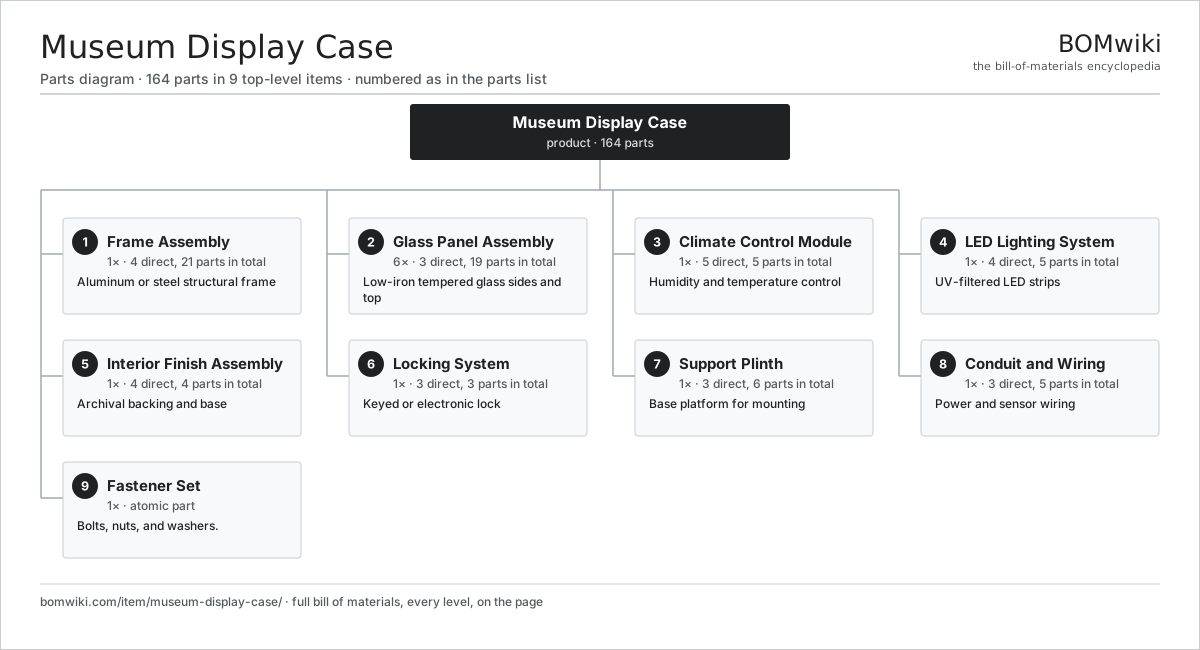
| # | Part | Qty | What it does |
|---|---|---|---|
| 1 | Frame Assembly 4 parts | 1× | Aluminum or steel structural frame |
| 2 | Glass Panel Assembly 3 parts | 6× | Low-iron tempered glass sides and top |
| 3 | Climate Control Module 5 parts | 1× | Humidity and temperature control |
| 4 | LED Lighting System 4 parts | 1× | UV-filtered LED strips |
| 5 | Interior Finish Assembly 4 parts | 1× | Archival backing and base |
| 6 | Locking System 3 parts | 1× | Keyed or electronic lock |
| 7 | Support Plinth 3 parts | 1× | Base platform for mounting |
| 8 | Conduit and Wiring 3 parts | 1× | Power and sensor wiring |
| 9 | Fastener Set | 1× | Bolts, nuts, and washers. |
3D model
No 3D model yet. Have a CAD file of this? Add a 3D model. STL renders right on this page; STEP, FreeCAD, and OpenSCAD sources are welcome too (openly licensed, like all 3D models on BOMwiki).
Build & assembly graph
expand / collapse · shared sub-assemblies converge · links to related products · est. labourTap an assembly to expand/collapse · tap a part to open it · use “Open page” for any node · drag to pan, scroll to zoom.
Bill of materials for Museum Display Case
9 top-level lines · 38 rows shown · 164 parts total · indented to 3 levels| # | Item / sub-assembly | Part no. | Qty/assy | Ext. qty | Parts | Type |
|---|---|---|---|---|---|---|
| 1 | Frame Assembly 4 parts | museum-display-case-frame | 1× | 1 | 21 | assembly |
| 1.1 | Vertical Post | museum-display-case-vertical-post | 4× | 4 | · | part |
| 1.2 | Horizontal Rail | museum-display-case-horizontal-rail | 8× | 8 | · | part |
| 1.3 | Corner Bracket | museum-display-case-corner-bracket | 8× | 8 | · | part |
| 1.4 | Frame Gasket | museum-display-case-frame-gasket | 1× | 1 | · | part |
| 2 | Glass Panel Assembly 3 parts | museum-display-case-glass-panels | 6× | 6 | 19 | assembly |
| 2.1 | Glass Sheet | museum-display-case-glass-sheet | 6× | 36 | · | part |
| 2.2 | Glass Sealant | museum-display-case-glass-edge-seal | 1× | 6 | · | part |
| 2.3 | Glass Clip | museum-display-case-glass-clip | 12× | 72 | · | part |
| 3 | Climate Control Module 5 parts | museum-display-case-climate-module | 1× | 1 | 5 | assembly |
| 3.1 | Humidity Sensor | museum-display-case-humidity-sensor | 1× | 1 | · | part |
| 3.2 | Temperature Sensor | museum-display-case-temperature-sensor | 1× | 1 | · | part |
| 3.3 | Climate Controller | museum-display-case-controller | 1× | 1 | · | part |
| 3.4 | Silica-Gel Pack | museum-display-case-silica-gel-pack | 1× | 1 | · | part |
| 3.5 | Data Logger | museum-display-case-data-logger | 1× | 1 | · | part |
| 4 | LED Lighting System 4 parts | museum-display-case-led-lighting | 1× | 1 | 5 | assembly |
| 4.1 | LED Strip | museum-display-case-led-strip | 2× | 2 | · | part |
| 4.2 | UV Filter Diffuser | museum-display-case-uv-filter | 1× | 1 | · | part |
| 4.3 | LED Driver | museum-display-case-led-driver | 1× | 1 | · | part |
| 4.4 | Light Sensor | museum-display-case-light-sensor | 1× | 1 | · | part |
| 5 | Interior Finish Assembly 4 parts | museum-display-case-interior-finish | 1× | 1 | 4 | assembly |
| 5.1 | Backing Board | museum-display-case-backing-board | 1× | 1 | · | part |
| 5.2 | Interior Paint | museum-display-case-interior-paint | 1× | 1 | · | part |
| 5.3 | Mounting Hardware | museum-display-case-mounting-hardware | 1× | 1 | · | part |
| 5.4 | Mounting Adhesive | museum-display-case-adhesive | 1× | 1 | · | part |
| 6 | Locking System 3 parts | museum-display-case-locking-system | 1× | 1 | 3 | assembly |
| 6.1 | Lock Type | museum-display-case-lock-type | 1× | 1 | · | part |
| 6.2 | Lock Cylinder | museum-display-case-lock-cylinder | 1× | 1 | · | part |
| 6.3 | Electronic Lock Battery | museum-display-case-electronic-lock-battery | 1× | 1 | · | part |
| 7 | Support Plinth 3 parts | museum-display-case-plinth | 1× | 1 | 6 | assembly |
| 7.1 | Plinth Frame | museum-display-case-plinth-frame | 1× | 1 | · | part |
| 7.2 | Plinth Cladding | museum-display-case-plinth-cladding | 1× | 1 | · | part |
| 7.3 | Vibration Isolator | museum-display-case-vibration-isolator | 4× | 4 | · | part |
| 8 | Conduit and Wiring 3 parts | museum-display-case-conduit-management | 1× | 1 | 5 | assembly |
| 8.1 | Power Cord | museum-display-case-power-cord | 1× | 1 | · | part |
| 8.2 | Cable Conduit | museum-display-case-cable-conduit | 1× | 1 | · | part |
| 8.3 | Sensor Cable | museum-display-case-sensor-cable | 3× | 3 | · | part |
| 9 | Fastener Set | fastener-set | 1× | 1 | · | part |
Something wrong in this list? Report a problem with this BOM.
Sourcing: possible vendors
Browse the supplier directory → Prices, MOQ, and lead times are algorithmic estimates, not quotes, and not claims about these companies. Company mappings are curated by keyword; est. price band $50–$3k. How estimates work| Vendor | HQ | Specialty | MOQ | Lead time |
|---|---|---|---|---|
| steelcase.com ↗ | Grand Rapids, US | Office furniture | 200 units | 6–12 wks |
| millerknoll.com ↗ | Zeeland, US | Furniture (Herman Miller) | 200 units | 6–12 wks |
|
🇺🇸Haworth
haworth.com ↗
|
Holland, US | Office furniture | 200 units | 6–12 wks |
|
🇺🇸HNI
hnicorp.com ↗
|
Muscatine, US | Furniture & hearth | 200 units | 6–12 wks |
| ikea.com ↗ | Älmhult, SE | Furniture manufacturing | 200 units | 6–12 wks |
1,362-word article