Cable Certifier
ProductOverview
A cable certifier is a portable field instrument for verifying the electrical performance of installed Ethernet cables and structured cabling systems. Unlike a cable tester that performs continuity and pin-out checks alone, a cable certifier measures frequency-dependent transmission line properties including return loss, insertion loss, and propagation delay. These measurements ensure the cable meets Category 5e, 6, or 6a performance standards over its entire bandwidth (1–100 MHz).
Network infrastructure installers use cable certifiers to verify installation quality after running cables through walls, conduit, and junction boxes. Factory defects in cable manufacturing are rare; problems arise from improper installation, excessive cable bending, crimping of connectors, or moisture intrusion. A certifier provides pass/fail results that protect the network operator against substandard infrastructure that would degrade Ethernet performance.
Transmission Line Measurement Principle
Ethernet cables are transmission lines characterized by a nominal impedance (typically 100 Ω differential mode for twisted-pair). The frequency sweep generator applies a low-level RF signal across 1–100 MHz and measures how the cable responds.
Return Loss quantifies reflections caused by impedance discontinuities at the cable connectors and along the conductor. Ideal cables have minimal return loss (high values, e.g., 40 dB means 99.99% of energy is transmitted). The directional coupler separates forward and reflected waves, and the return loss detector computes the ratio:
Return Loss (dB) = 20 log10(V_reflected / V_forward)
Poor connectors, damaged insulation, or moisture contamination show low return loss (e.g., 10–20 dB), indicating significant reflection.
Insertion Loss measures attenuation of the signal as it traverses the cable length. The forward detector measures signal strength at the main port, and comparison with a reference level reveals insertion loss:
Insertion Loss (dB) = 20 log10(V_output / V_reference)
Longer cables exhibit higher insertion loss; a 300 meter horizontal run of Category 6 cable at 100 MHz typically shows 15–20 dB insertion loss.
Two-Port Time-Domain Reflectometry
To measure cable length and detect faults, the certifier uses a two-port TDR (time-domain reflectometry) technique. The main unit applies a step pulse and measures the reflected energy arriving back at different times. By correlating round-trip propagation delay with the cable's velocity factor (typically 0.66 for twisted-pair Ethernet cable), the processor computes cable length.
The remote probe unit, stationed at the far end of the cable, applies a termination load (100 Ω, matching the cable characteristic impedance). The main unit observes how the reflected signal changes when the remote probe is connected versus disconnected, enabling computation of insertion loss independent of connector losses at the main unit.
Calibration and Environmental Factors
All RF measurements are sensitive to temperature, humidity, and connector quality. The calibration port allows the operator to measure reference standards:
- Open circuit: Simulates an unterminated cable (maximum reflection).
- Short circuit: Simulates a shorted cable (reflection with opposite polarity).
- 100 Ω load: Matched termination (minimal reflection).
The measurement processor applies these calibration points to derive correction coefficients stored in the calibration EEPROM. Periodic re-calibration (typically monthly) maintains measurement accuracy despite aging of internal components and connectors.
Field Operation and Test Procedures
The operator performs a typical certification test as follows:
- Connect the main unit (sweep generator) to one end of the installed cable via an RJ45 adapter.
- Connect the remote probe unit to the far end of the same cable.
- Select "Return Loss Measurement" on the color display.
- The instrument sweeps 1–100 MHz and plots return loss versus frequency on the LCD.
- The display shows pass/fail status: Category 6a certification requires return loss >10 dB at all frequencies.
If return loss fails, the certifier provides a clue to the location: a sudden return loss dip at a specific frequency suggests a localized impedance discontinuity (e.g., a pinched connector at 50 meters into the run). By measuring cable length via TDR, the operator can then physically inspect that location.
Insertion Loss Testing requires a temporary termination at the far end. The operator can optionally place a known resistance (e.g., 100 Ω in a small test fixture) instead of the remote probe, and re-measure insertion loss to isolate loss from the cable itself versus loss from the connectors.
Category Compliance Standards
The certification thresholds are defined by industry standards (TIA-568, ISO/IEC 11801):
- Category 5e (100 MHz): Return loss >10 dB, insertion loss <22 dB at 100 MHz for 100 meter cable.
- Category 6 (250 MHz): Return loss >10 dB, insertion loss <19.8 dB at 100 MHz.
- Category 6a (500 MHz): Return loss >12 dB, insertion loss <20.8 dB at 100 MHz.
The certifier displays measured values against these thresholds, immediately showing whether the cable passes. This prevents acceptance of marginal installations that might work initially but would fail under environmental stress (temperature extremes, humidity).
Battery Operation and Portability
The rechargeable lithium battery pack provides 4–6 hours of continuous operation, sufficient for certifying 20–30 cable runs per charge. The ruggedized polycarbonate enclosure with rubber bumpers survives drops from waist height typical in active job sites.
The 3.5-inch color touchscreen is large enough to interpret return loss curves in bright sunlight (manually adjusted backlight dims automatically indoors to conserve battery). Test results are stored in onboard flash memory with timestamps, creating a certification log. This documentation is required by network standards and audits to prove compliance.
Troubleshooting Cable Problems
Common failures revealed by cable certifier measurements:
- Low return loss everywhere: Damaged or pinched cable, insulation compromise, or connector manufacturing defect.
- Return loss dip at specific frequency: Localized impedance discontinuity, typically a poorly crimped connector or bent cable section.
- High insertion loss + low return loss: Conductor corrosion or moisture inside the cable, causing both attenuation and reflection.
- Cable length mismatch: Miswired cable run using different gauge or twisted-pair construction; can also indicate splices or poor terminations.
Diagnostics beyond the certifier's scope (e.g., detecting shorts or opens) require a dedicated continuity tester, but the certifier's frequency-domain measurements often point to the specific location of the fault, enabling rapid repair by network technicians.
Cable Certifier parts and their functions
7 top-level parts · 36 parts in total · full bill of materials below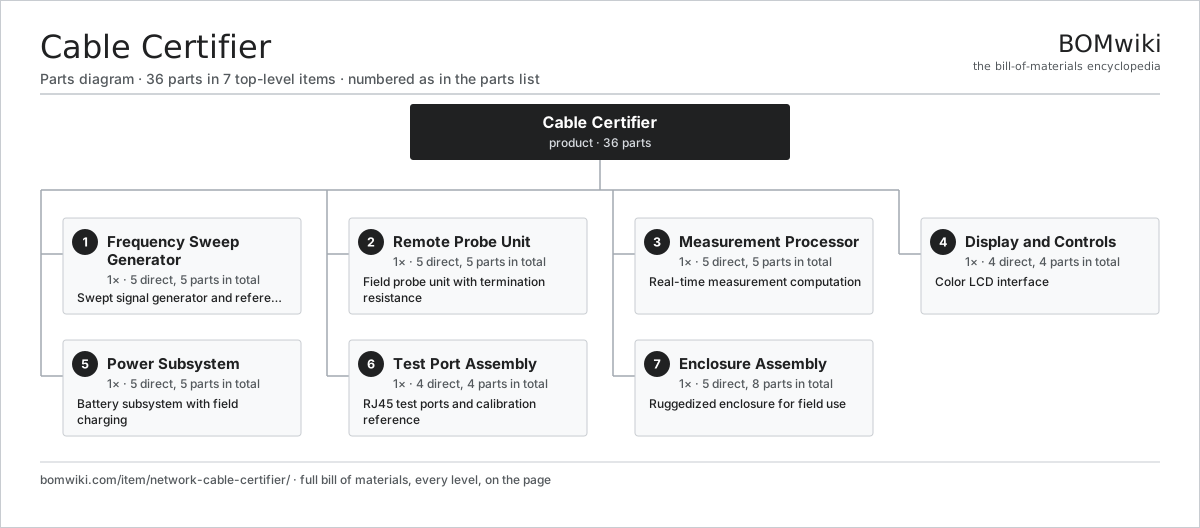
| # | Part | Qty | What it does |
|---|---|---|---|
| 1 | Frequency Sweep Generator 5 parts | 1× | Swept signal generator and reference receiver |
| 2 | Remote Probe Unit 5 parts | 1× | Field probe unit with termination resistance |
| 3 | Measurement Processor 5 parts | 1× | Real-time measurement computation |
| 4 | Display and Controls 4 parts | 1× | Color LCD interface |
| 5 | Power Subsystem 5 parts | 1× | Battery subsystem with field charging |
| 6 | Test Port Assembly 4 parts | 1× | RJ45 test ports and calibration reference |
| 7 | Enclosure Assembly 5 parts | 1× | Ruggedized enclosure for field use |
3D model
No 3D model yet. Have a CAD file of this? Add a 3D model. STL renders right on this page; STEP, FreeCAD, and OpenSCAD sources are welcome too (openly licensed, like all 3D models on BOMwiki).
Build & assembly graph
expand / collapse · shared sub-assemblies converge · links to related products · est. labourTap an assembly to expand/collapse · tap a part to open it · use “Open page” for any node · drag to pan, scroll to zoom.
Bill of materials for Cable Certifier
7 top-level lines · 40 rows shown · 36 parts total · indented to 3 levels| # | Item / sub-assembly | Part no. | Qty/assy | Ext. qty | Parts | Type |
|---|---|---|---|---|---|---|
| 1 | Frequency Sweep Generator 5 parts | network-cable-certifier-frequency-sweep | 1× | 1 | 5 | assembly |
| 1.1 | DDS Synthesizer | network-cable-certifier-dds | 1× | 1 | · | part |
| 1.2 | Signal Driver Amplifier | network-cable-certifier-driver | 1× | 1 | · | part |
| 1.3 | Directional Hybrid Coupler | network-cable-certifier-coupler | 1× | 1 | · | part |
| 1.4 | Forward Detector | network-cable-certifier-forward-receiver | 1× | 1 | · | part |
| 1.5 | Return Loss Detector | network-cable-certifier-return-receiver | 1× | 1 | · | part |
| 2 | Remote Probe Unit 5 parts | network-cable-certifier-remote-unit | 1× | 1 | 5 | assembly |
| 2.1 | Remote Probe Battery | network-cable-certifier-remote-battery | 1× | 1 | · | part |
| 2.2 | Remote Termination Network | network-cable-certifier-remote-terminator | 1× | 1 | · | part |
| 2.3 | Remote Signal Detector | network-cable-certifier-remote-detector | 1× | 1 | · | part |
| 2.4 | Remote RJ45 Port | network-cable-certifier-remote-connector | 1× | 1 | · | part |
| 2.5 | Remote Probe Enclosure | network-cable-certifier-remote-housing | 1× | 1 | · | part |
| 3 | Measurement Processor 5 parts | network-cable-certifier-processor | 1× | 1 | 5 | assembly |
| 3.1 | ARM Cortex-M4 Microcontroller | network-cable-certifier-mcu | 1× | 1 | · | part |
| 3.2 | Forward Path ADC | network-cable-certifier-adc-1 | 1× | 1 | · | part |
| 3.3 | Return Path ADC | network-cable-certifier-adc-2 | 1× | 1 | · | part |
| 3.4 | Flash Memory | network-cable-certifier-flash | 1× | 1 | · | part |
| 3.5 | Calibration EEPROM | network-cable-certifier-calibration-eeprom | 1× | 1 | · | part |
| 4 | Display and Controls 4 parts | network-cable-certifier-display | 1× | 1 | 4 | assembly |
| 4.1 | LCD Panel | lcd-panel | 1× | 1 | · | part |
| 4.2 | Touch Panel Controller | network-cable-certifier-touch-controller | 1× | 1 | · | part |
| 4.3 | LCD Backlight Module | network-cable-certifier-backlight | 1× | 1 | · | part |
| 4.4 | Display Interface Board | network-cable-certifier-display-board | 1× | 1 | · | part |
| 5 | Power Subsystem 5 parts | network-cable-certifier-power | 1× | 1 | 5 | assembly |
| 5.1 | Lithium-Ion Battery Pack | network-cable-certifier-battery-pack | 1× | 1 | · | part |
| 5.2 | Li-Ion Charging Controller | network-cable-certifier-charger-ic | 1× | 1 | · | part |
| 5.3 | Thermal Protection Fuse | network-cable-certifier-protection-fuse | 1× | 1 | · | part |
| 5.4 | 5V Boost Converter | network-cable-certifier-dcdc-5v | 1× | 1 | · | part |
| 5.5 | 3.3V Buck Regulator | network-cable-certifier-dcdc-3v3 | 1× | 1 | · | part |
| 6 | Test Port Assembly 4 parts | network-cable-certifier-connectors | 1× | 1 | 4 | assembly |
| 6.1 | Main RJ45 Jack | network-cable-certifier-rj45-main | 1× | 1 | · | part |
| 6.2 | Reference RJ45 Port | network-cable-certifier-rj45-reference | 1× | 1 | · | part |
| 6.3 | Precision 100Ω Reference | network-cable-certifier-100-ohm-standard | 1× | 1 | · | part |
| 6.4 | Connector Backshell Shield | network-cable-certifier-connector-shield | 1× | 1 | · | part |
| 7 | Enclosure Assembly 5 parts | network-cable-certifier-housing | 1× | 1 | 8 | assembly |
| 7.1 | Upper Case Shell | network-cable-certifier-case-upper | 1× | 1 | · | part |
| 7.2 | Lower Case Shell | network-cable-certifier-case-lower | 1× | 1 | · | part |
| 7.3 | Silicone Corner Bumper | network-cable-certifier-rubber-bumpers | 4× | 4 | · | part |
| 7.4 | Carrying Handle Strap | network-cable-certifier-handle | 1× | 1 | · | part |
| 7.5 | Fastener Set | fastener-set | 1× | 1 | · | part |
Something wrong in this list? Report a problem with this BOM.
Related products
same domain, ranked by shared parts Firewall Appliance
82 parts · shares 1 with this page
Load Balancer Appliance
911 parts · shares 1 with this page
Firewall Appliance
82 parts · shares 1 with this page
Load Balancer Appliance
911 parts · shares 1 with this page
 Network Switch
1,367 parts · shares 1 with this page
Network Switch
1,367 parts · shares 1 with this page
 OTDR Fiber Tester
393 parts · shares 1 with this page
OTDR Fiber Tester
393 parts · shares 1 with this page
Sourcing: possible vendors
Browse the supplier directory → Prices, MOQ, and lead times are algorithmic estimates, not quotes, and not claims about these companies. Company mappings are curated by keyword; est. price band $30–$50k. How estimates work| Vendor | HQ | Specialty | MOQ | Lead time |
|---|---|---|---|---|
|
🇺🇸Cisco
cisco.com ↗
|
San Jose, US | Networking | 500 units | 8–14 wks |
|
🇺🇸Juniper
juniper.net ↗
|
Sunnyvale, US | Networking | 500 units | 8–14 wks |
| arista.com ↗ | Santa Clara, US | Networking | 500 units | 8–14 wks |
|
🇫🇮Nokia
nokia.com ↗
|
Espoo, FI | Telecom equipment | 500 units | 8–14 wks |
|
🇨🇳Huawei
huawei.com ↗
|
Shenzhen, CN | Networking & telecom | 500 units | 8–14 wks |
1,082-word article