Network Video Recorder
ProductOverview
A network video recorder (NVR) is a specialized server appliance that ingests video streams from IP cameras, compresses them, stores them on large disk arrays, and allows operators to search, playback, and export recorded footage. Unlike a DVR (digital video recorder) which uses analog CCTV cameras, an NVR works purely with IP cameras (Ethernet-based), eliminating the need for separate coax cabling. The NVR is the central hub: it powers the cameras over PoE, records their H.264/H.265 streams, and provides a web interface for live and historical video access.
The architecture consists of a processing motherboard, a SATA/SAS disk enclosure for archival storage, a built-in PoE+ Ethernet switch to power and network the cameras, and redundant power supplies and cooling to ensure continuous 24/7 operation. The video output modules let an operator view live and recorded video on a local monitor.
Recording and compression pipeline
Each IP camera streams video over the network using RTSP (Real Time Streaming Protocol) or ONVIF (Open Network Video Interface Forum), a standard protocol stack. The CPU receives the stream via the Ethernet interface, reads frames (usually 1 to 30 fps), optionally re-encodes using a hardware codec engine (if available), and writes the compressed bitstream to disk.
Compression is critical to storage efficiency. A 1080p camera at 30 fps, uncompressed, produces roughly 3 Gbps (1920 × 1080 × 24 bpp × 30 fps). With H.264 compression at constant quality, the same stream occupies only 3–5 Mbps, a 1000× reduction. The NVR's CPU or a dedicated video codec card performs this encoding, trading compute time for storage savings.
Motion detection can further reduce storage: the NVR records at lower bitrate during idle (when there is no motion), then increases bitrate when motion triggers, capturing detail when it matters. This adaptive bitrate recording is standard in modern systems.
Storage hierarchy
The drive bay holds the primary archive, typically 8–16 hot-swappable SATA or SAS drives. The system usually implements RAID (Redundant Array of Independent Disks) for fault tolerance. RAID-5 uses one parity drive, so a 16-drive array can lose one drive and continue recording without data loss; a failing drive is hot-swapped while the array rebuilds in the background. RAID-6 tolerates loss of two drives.
The RAID controller orchestrates this. Modern controllers include battery-backed cache, allowing write-back caching to the cache DRAM. Incoming video frames are written to cache first (fast), and the RAID controller writes them to disk asynchronously, improving overall throughput.
The NVMe OS drive is separate from the archive storage, holding the Linux OS and database indexes. When searching 30 days of video, the database index (stored on the fast SSD) is consulted first, allowing sub-second searches even across terabytes of archive.
Video output and playback
The video output module can drive 1–4 monitors simultaneously. HDMI or DisplayPort outputs let an operator view live video from multiple cameras (tiled on the monitor) or full-screen historical playback. The web UI allows remote access: a manager can log in from anywhere, view live feeds, download clips, or export evidence.
Playback speed is adjustable: slow-motion to study an event, or fast-forward to scan hours of footage for a specific occurrence (e.g., a person in the lobby). The multi-core processor handles the decompression and display rendering, keeping up with real-time and accelerated playback.
PoE powering and networking
The integrated PoE+ switch provides both data and power to each camera on the same Ethernet cable (typically Cat5e or Cat6). Each port can supply up to 90 W, enough for a camera, pan-tilt-zoom motor, and IR illuminator. This simplifies installation: run one cable from the NVR to the camera, and it is both powered and networked.
With 8–16 camera ports, the NVR can support a small to mid-size facility. Larger deployments add a separate PoE switch (daisy-chained to the NVR via uplink) to accommodate more cameras.
Redundancy and uptime
Continuous surveillance systems often require five-nines availability (99.999% uptime). The dual power supplies with automatic switchover, redundant fans, and hot-swappable disks (via RAID) ensure the NVR survives component failures. If a drive fails, RAID rebuilds on a hot-spare, transparent to recording. If a fan fails, the other fan keeps the unit cool.
Software-level redundancy includes automated backups: recorded footage can be replicated to a secondary NVR or cloud storage, ensuring that even a catastrophic hardware failure does not lose evidence.
Scalability and features
Modern NVRs support dozens of features: motion detection, object detection (people, vehicles), anomaly alerts (lingering, loitering), license plate recognition, and heatmap analytics. Some of these compute-intensive tasks may use a separate GPU card plugged into the PCIe bus, offloading inference from the CPU.
The web UI and mobile app provide remote management. Multi-user access with role-based permissions ensures that security personnel can view certain cameras while management views others. All access is logged for compliance (e.g., GDPR data-access audits).
Network Video Recorder parts and their functions
8 top-level parts · 389 parts in total · full bill of materials below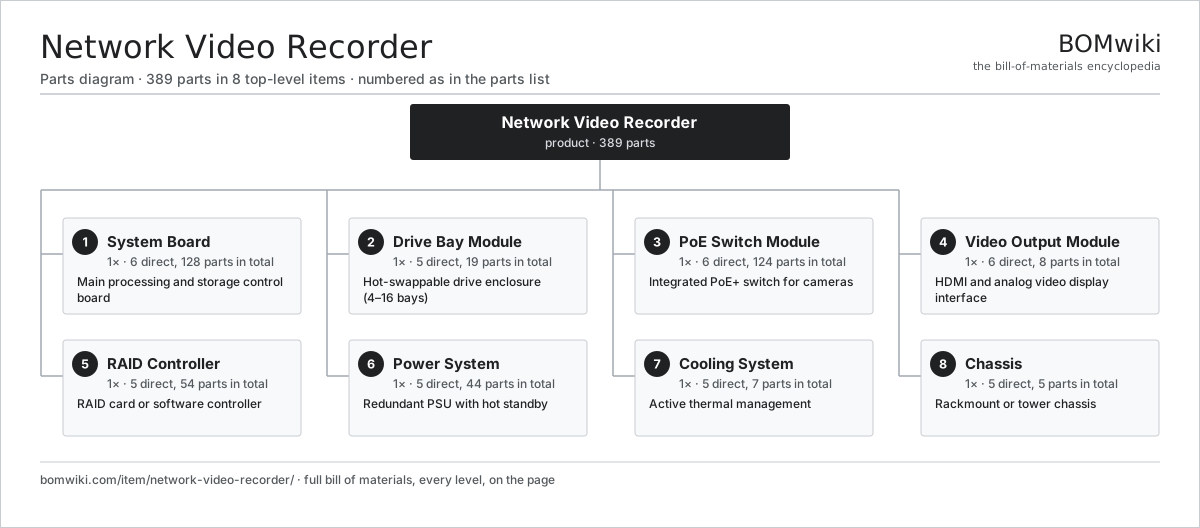
| # | Part | Qty | What it does |
|---|---|---|---|
| 1 | System Board 6 parts | 1× | Main processing and storage control board |
| 2 | Drive Bay Module 5 parts | 1× | Hot-swappable drive enclosure (4–16 bays) |
| 3 | PoE Switch Module 6 parts | 1× | Integrated PoE+ switch for cameras |
| 4 | Video Output Module 6 parts | 1× | HDMI and analog video display interface |
| 5 | RAID Controller 5 parts | 1× | RAID card or software controller |
| 6 | Power System 5 parts | 1× | Redundant PSU with hot standby |
| 7 | Cooling System 5 parts | 1× | Active thermal management |
| 8 | Chassis 5 parts | 1× | Rackmount or tower chassis |
3D model
No 3D model yet. Have a CAD file of this? Add a 3D model. STL renders right on this page; STEP, FreeCAD, and OpenSCAD sources are welcome too (openly licensed, like all 3D models on BOMwiki).
Build & assembly graph
expand / collapse · shared sub-assemblies converge · links to related products · est. labourTap an assembly to expand/collapse · tap a part to open it · use “Open page” for any node · drag to pan, scroll to zoom.
Bill of materials for Network Video Recorder
8 top-level lines · 51 rows shown · 389 parts total · indented to 3 levels| # | Item / sub-assembly | Part no. | Qty/assy | Ext. qty | Parts | Type |
|---|---|---|---|---|---|---|
| 1 | System Board 6 parts | nvr-system-board | 1× | 1 | 128 | assembly |
| 1.1 | Server CPU | nvr-cpu-socket | 1× | 1 | · | part |
| 1.2 | DDR4 ECC Memory | nvr-memory-dimm | 4× | 4 | · | part |
| 1.3 | PCIe Switch | nvr-pcie-switch | 1× | 1 | · | part |
| 1.4 | NVMe Boot Drive | nvr-nvme-ssd | 1× | 1 | · | part |
| 1.5 | BIOS Flash | nvr-bios-flash | 1× | 1 | · | part |
| 1.6 | SMD Passive (R/C/L) | smd-passives | 120× | 120 | · | part |
| 2 | Drive Bay Module 5 parts | nvr-drive-bay | 1× | 1 | 19 | assembly |
| 2.1 | Drive Tray | nvr-drive-tray | 8× | 8 | · | part |
| 2.2 | Drive Backplane | nvr-drive-backplane | 1× | 1 | · | part |
| 2.3 | Activity LED | nvr-drive-activity-led | 8× | 8 | · | part |
| 2.4 | Power Manifold | nvr-drive-power-rail | 1× | 1 | · | part |
| 2.5 | Thermal Interface | nvr-drive-thermal-spreader | 1× | 1 | · | part |
| 3 | PoE Switch Module 6 parts | nvr-poe-switch | 1× | 1 | 124 | assembly |
| 3.1 | Switch ASIC | nvr-switch-asic | 1× | 1 | · | part |
| 3.2 | Gigabit PHY | nvr-switch-phy | 12× | 12 | · | part |
| 3.3 | PoE Controller | nvr-switch-poe-controller | 8× | 8 | · | part |
| 3.4 | RJ45 Camera Port | nvr-switch-ports | 12× | 12 | · | part |
| 3.5 | Switch Memory | nvr-switch-memory | 1× | 1 | · | part |
| 3.6 | SMD Passive (R/C/L) | smd-passives | 90× | 90 | · | part |
| 4 | Video Output Module 6 parts | nvr-video-output | 1× | 1 | 8 | assembly |
| 4.1 | HDMI Transmitter | nvr-hdmi-controller | 1× | 1 | · | part |
| 4.2 | HDMI Jack | nvr-hdmi-port | 2× | 2 | · | part |
| 4.3 | DisplayPort TX | nvr-displayport-controller | 1× | 1 | · | part |
| 4.4 | DisplayPort Jack | nvr-displayport-port | 1× | 1 | · | part |
| 4.5 | Video DAC | nvr-analog-dac | 1× | 1 | · | part |
| 4.6 | Analog Port | nvr-analog-port | 2× | 2 | · | part |
| 5 | RAID Controller 5 parts | nvr-raid-controller | 1× | 1 | 54 | assembly |
| 5.1 | RAID Processor | nvr-raid-processor | 1× | 1 | · | part |
| 5.2 | RAID Cache | nvr-raid-memory | 1× | 1 | · | part |
| 5.3 | Cache Battery | nvr-raid-battery | 1× | 1 | · | part |
| 5.4 | RAID PCIe | nvr-raid-pcie-interface | 1× | 1 | · | part |
| 5.5 | SMD Passive (R/C/L) | smd-passives | 50× | 50 | · | part |
| 6 | Power System 5 parts | nvr-power-system | 1× | 1 | 44 | assembly |
| 6.1 | Primary PSU | nvr-psu-primary | 1× | 1 | · | part |
| 6.2 | Secondary PSU | nvr-psu-secondary | 1× | 1 | · | part |
| 6.3 | Power Controller | nvr-power-distribution | 1× | 1 | · | part |
| 6.4 | Power Plug | nvr-power-connector | 1× | 1 | · | part |
| 6.5 | SMD Passive (R/C/L) | smd-passives | 40× | 40 | · | part |
| 7 | Cooling System 5 parts | nvr-cooling-fans | 1× | 1 | 7 | assembly |
| 7.1 | Intake Fan | nvr-intake-fan | 2× | 2 | · | part |
| 7.2 | Exhaust Fan | nvr-exhaust-fan | 2× | 2 | · | part |
| 7.3 | Temperature Sensor | nvr-temperature-sensor | 1× | 1 | · | part |
| 7.4 | Fan Controller | nvr-fan-controller | 1× | 1 | · | part |
| 7.5 | Air Filter | nvr-filter-pad | 1× | 1 | · | part |
| 8 | Chassis 5 parts | nvr-chassis | 1× | 1 | 5 | assembly |
| 8.1 | Chassis Frame | nvr-frame-structure | 1× | 1 | · | part |
| 8.2 | Thermal Baffle | nvr-thermal-baffle | 1× | 1 | · | part |
| 8.3 | Cable Tray | nvr-cable-tray | 1× | 1 | · | part |
| 8.4 | Front Panel | nvr-front-bezel | 1× | 1 | · | part |
| 8.5 | Fastener Set | fastener-set | 1× | 1 | · | part |
Something wrong in this list? Report a problem with this BOM.
Sourcing: possible vendors
Browse the supplier directory → Prices, MOQ, and lead times are algorithmic estimates, not quotes, and not claims about these companies. Company mappings are curated by keyword; est. price band $30–$50k. How estimates work| Vendor | HQ | Specialty | MOQ | Lead time |
|---|---|---|---|---|
|
🇺🇸Cisco
cisco.com ↗
|
San Jose, US | Networking | 500 units | 8–14 wks |
|
🇺🇸Juniper
juniper.net ↗
|
Sunnyvale, US | Networking | 500 units | 8–14 wks |
| arista.com ↗ | Santa Clara, US | Networking | 500 units | 8–14 wks |
|
🇫🇮Nokia
nokia.com ↗
|
Espoo, FI | Telecom equipment | 500 units | 8–14 wks |
|
🇨🇳Huawei
huawei.com ↗
|
Shenzhen, CN | Networking & telecom | 500 units | 8–14 wks |
899-word article