Ninja Course System
ProductOverview
A ninja course system is a structured progression of obstacles designed to develop balance, strength, agility, and fearlessness in participants. Unlike formal gymnastics equipment or playgrounds, ninja courses challenge participants to traverse a varied series of obstacles, rails, hanging elements, ropes, and platforms, requiring problem-solving and body control.
Courses are commonly found in training facilities, theme parks, and recreation centers. They range from beginner-friendly (low height, wide obstacles) to advanced (high elements, narrow grips, dynamic transitions). The sport draws from parkour (fluid movement over urban obstacles), gymnastics (strength and control), and ninja-warrior competitions.
How it works
Course Layout and Progression. The Frame Structure provides the structural backbone: main beams at 8–20 feet height, cross-braced and anchored to resist sideways and torsional forces. Obstacles are arranged in a logical flow, typically arranged in increasing difficulty or organized into separate beginner, intermediate, and advanced tracks.
Participants begin at a staging platform and traverse from obstacle to obstacle, moving across Rail System elements (narrow balance rails, angled rails for increased difficulty), gripping Obstacle Elements (hanging rings, pull-up bars, knotted ropes), and leaping to balance beams or platforms. Some obstacles are static (fixed rails, bolted beams); others are dynamic (hanging rings that swing, suspension bridges that sway).
Rail and Grip Mechanics. Horizontal Rail and Slant Rail elements challenge balance and grip strength. Participants walk or shuffle across, or swing from rail to rail. The 1–1.5 inch diameter is sized for comfortable grip without strain; narrower rails (0.75 inch) are used for advanced courses to increase difficulty. The rail surface is typically powder-coated steel, providing consistent grip in dry conditions; outdoor courses may have textured coating or slip-resistant surface treatment.
Hanging and Suspension Elements. Hanging Rings provide dynamic instability; the participant grasps the rings and swings or transitions to an adjacent obstacle. Rope Assembly allows climbing and rappelling. Transitions between obstacles require controlled movement to avoid falls.
Landing and Fall Protection. The entire course is surrounded and underlaid with a continuous Landing Zone: EVA foam or engineered rubber tiles, 12–24 inches thick, glued or interlocked. This absorbs impact from participant falls from typical course heights (6–20 feet). Outdoor courses often use engineered rubber (made from recycled tire material) for durability and drainage. Tiles are typically 2×2 feet per section, interlocking with tongue-and-groove edges.
Stability and Tensioning. Tensioning Hardware hardware allows adjustment of cable tension in suspended elements. Tighter cables mean stiffer behavior; looser cables create more swing. Over time, cables stretch and settle, requiring periodic re-tensioning using ratchets and turnbuckles. Ground Anchors (ground-driven corkscrew anchors and guy-line cables) prevent the entire frame from tipping or shifting. Ground anchors are installed at 45-degree angles to provide optimal load distribution.
Design Principles
Progressive Difficulty. Course design typically follows a skill progression: basic balance (wide rails), simple transitions (nearby platforms), grip strength (bars and rings), and finally dynamic movement (swinging elements, narrow rails, height). Participants succeed on early obstacles, building confidence before advancing to harder elements.
Failure Margins. Obstacles are positioned above landing zones so that falls from any point land on padded surface. Some facilities add optional spotting harnesses for very advanced participants attempting difficult jumps or inversions.
Maintenance and Wear. Rails develop flat spots and corrosion from constant gripping and weather exposure. Inspection every 3–6 months includes checking for cracks, loose bolts, and frayed rope ends. Landing mats degrade from UV exposure and compression; tiles typically last 5–7 years before replacement. Ropes are replaced every 2–3 years due to abrasion.
Safety Considerations
Courses are designed for participants aged 8+ without prior training required, though instruction and spotting improve safety during early sessions. Common injuries are minor (sprains, bruises from falls) rather than serious, due to continuous landing mat coverage.
Standard safety guidelines include:
- Participants should be dry (wet conditions reduce grip and increase slips).
- Footwear with good ankle support is recommended.
- Instructors circulate and observe, ready to assist with spotting or guidance.
- Participants are taught proper falling technique (rolling, distributing impact across mat).
Outdoor courses installed in public parks often add boundary fencing and directional signage to prevent accidental interference from bystanders.
Commercial Variations
Commercial training facilities often install multiple courses at graduated difficulty levels or customize layouts to emphasize specific sports (parkour, stunt training, military fitness). Some advanced facilities integrate wearable sensor tracking to record completion times and movement analytics.
Rope elements sometimes use dynamic climbing rope (9–11 mm diameter) rated for fall arrest, allowing optional full-body spotting harnesses for advanced techniques. This setup enables training of dynamic swinging motions and inversions safely.
Ninja Course System parts and their functions
7 top-level parts · 86 parts in total · full bill of materials below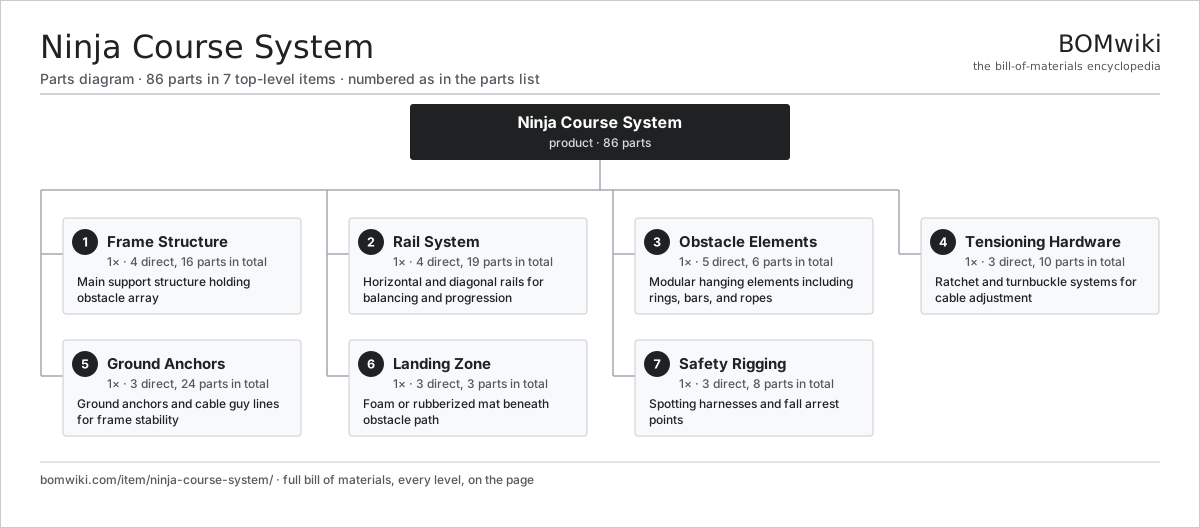
| # | Part | Qty | What it does |
|---|---|---|---|
| 1 | Frame Structure 4 parts | 1× | Main support structure holding obstacle array |
| 2 | Rail System 4 parts | 1× | Horizontal and diagonal rails for balancing and progression |
| 3 | Obstacle Elements 5 parts | 1× | Modular hanging elements including rings, bars, and ropes |
| 4 | Tensioning Hardware 3 parts | 1× | Ratchet and turnbuckle systems for cable adjustment |
| 5 | Ground Anchors 3 parts | 1× | Ground anchors and cable guy lines for frame stability |
| 6 | Landing Zone 3 parts | 1× | Foam or rubberized mat beneath obstacle path |
| 7 | Safety Rigging 3 parts | 1× | Spotting harnesses and fall arrest points |
3D model
No 3D model yet. Have a CAD file of this? Add a 3D model. STL renders right on this page; STEP, FreeCAD, and OpenSCAD sources are welcome too (openly licensed, like all 3D models on BOMwiki).
Build & assembly graph
expand / collapse · shared sub-assemblies converge · links to related products · est. labourTap an assembly to expand/collapse · tap a part to open it · use “Open page” for any node · drag to pan, scroll to zoom.
Bill of materials for Ninja Course System
7 top-level lines · 32 rows shown · 86 parts total · indented to 3 levels| # | Item / sub-assembly | Part no. | Qty/assy | Ext. qty | Parts | Type |
|---|---|---|---|---|---|---|
| 1 | Frame Structure 4 parts | ninja-course-system-frame | 1× | 1 | 16 | assembly |
| 1.1 | Main Beam | ninja-course-system-main-beam | 2× | 2 | · | part |
| 1.2 | Vertical Post | ninja-course-system-vertical-post | 4× | 4 | · | part |
| 1.3 | Cross Brace | ninja-course-system-cross-brace | 4× | 4 | · | part |
| 1.4 | Fastener Set | fastener-set | 6× | 6 | · | part |
| 2 | Rail System 4 parts | ninja-course-system-rail-system | 1× | 1 | 19 | assembly |
| 2.1 | Horizontal Rail | ninja-course-system-horizontal-rail | 3× | 3 | · | part |
| 2.2 | Slant Rail | ninja-course-system-slant-rail | 2× | 2 | · | part |
| 2.3 | Rail Mount | ninja-course-system-rail-mount | 8× | 8 | · | part |
| 2.4 | Rail Cap | ninja-course-system-rail-cap | 6× | 6 | · | part |
| 3 | Obstacle Elements 5 parts | ninja-course-system-obstacles | 1× | 1 | 6 | assembly |
| 3.1 | Hanging Rings | ninja-course-system-hanging-rings | 1× | 1 | · | part |
| 3.2 | Bar Assembly | ninja-course-system-bar-assembly | 1× | 1 | · | part |
| 3.3 | Rope Assembly | ninja-course-system-rope-assembly | 2× | 2 | · | part |
| 3.4 | Balance Beam | ninja-course-system-balance-beam | 1× | 1 | · | part |
| 3.5 | Platform Module | ninja-course-system-platform-module | 1× | 1 | · | part |
| 4 | Tensioning Hardware 3 parts | ninja-course-system-tensioning | 1× | 1 | 10 | assembly |
| 4.1 | Ratchet Set | ninja-course-system-ratchet-set | 2× | 2 | · | part |
| 4.2 | Turnbuckle Set | ninja-course-system-turnbuckle-set | 4× | 4 | · | part |
| 4.3 | Cable Segment | ninja-course-system-cable-segment | 4× | 4 | · | part |
| 5 | Ground Anchors 3 parts | ninja-course-system-anchors | 1× | 1 | 24 | assembly |
| 5.1 | Ground Anchor | ninja-course-system-ground-anchor | 6× | 6 | · | part |
| 5.2 | Anchor Cable | ninja-course-system-anchor-cable | 6× | 6 | · | part |
| 5.3 | Anchor Shackle | ninja-course-system-anchor-shackle | 12× | 12 | · | part |
| 6 | Landing Zone 3 parts | ninja-course-system-landing-zone | 1× | 1 | 3 | assembly |
| 6.1 | Landing Mat | ninja-course-system-landing-mat | 1× | 1 | · | part |
| 6.2 | Mat Edging | ninja-course-system-mat-edging | 1× | 1 | · | part |
| 6.3 | Mat Underlayment | ninja-course-system-mat-underlayment | 1× | 1 | · | part |
| 7 | Safety Rigging 3 parts | ninja-course-system-safety-rigging | 1× | 1 | 8 | assembly |
| 7.1 | Spotting Harness | ninja-course-system-spotting-harness | 2× | 2 | · | part |
| 7.2 | Belay Line | ninja-course-system-belay-line | 2× | 2 | · | part |
| 7.3 | Fall Arrest Point | ninja-course-system-fall-arrest-point | 4× | 4 | · | part |
Something wrong in this list? Report a problem with this BOM.
Sourcing: possible vendors
Browse the supplier directory → Prices, MOQ, and lead times are algorithmic estimates, not quotes, and not claims about these companies. Company mappings are curated by keyword; est. price band $20–$3k. How estimates work| Vendor | HQ | Specialty | MOQ | Lead time |
|---|---|---|---|---|
|
🇩🇰LEGO
lego.com ↗
|
Billund, DK | Construction toys | 2,000 units | 6–10 wks |
|
🇺🇸Mattel
mattel.com ↗
|
El Segundo, US | Toys | 2,000 units | 6–10 wks |
|
🇺🇸Hasbro
hasbro.com ↗
|
Pawtucket, US | Toys & games | 2,000 units | 6–10 wks |
| bandainamco.co.jp ↗ | Tokyo, JP | Toys & amusement | 2,000 units | 6–10 wks |
| spinmaster.com ↗ | Toronto, CA | Toys | 2,000 units | 6–10 wks |
800-word article