Lab Nitrogen Generator
ProductOverview
A laboratory nitrogen generator is a self-contained system that produces high-purity nitrogen (>99.5%) from compressed air using pressure-swing-adsorption (PSA) technology. Compressed air is filtered, dried, and passed through twin zeolite columns operating in alternating cycles: one column adsorbs oxygen, argon, and CO₂ at high pressure (5–10 bar), while the other is simultaneously vented to atmospheric pressure and regenerated. The product gas (nitrogen-rich) exits at 6 bar into a buffer tank; a pressure-reducing valve adjusts output to 0–6 bar for lab applications. An oxygen sensor continuously monitors purity and triggers alarms if purity drops below 98%. This on-site nitrogen generation eliminates recurring cylinder costs, reduces supply chain dependency, and provides consistent pressure-regulated gas for GC/MS instrumentation, mass spectrometry, inerting glove boxes, and pneumatic lab equipment. Compact models fit on benchtops; larger floor-mounted versions serve entire departments.
PSA Operational Principle
Cycle Timing: The system alternates between two zeolite columns on a 2–10 second half-period timer (adjustable for flow optimization).
Adsorption Phase (Column 1 at high pressure):
- Compressed air (5–10 bar) enters the zeolite-packed column.
- Zeolite 5A preferentially adsorbs O₂ (0.73 Å kinetic diameter) and Ar (3.4 Å) over N₂ (3.6 Å).
- N₂-rich gas exits (>99.5% purity) to the buffer tank.
- Heat of adsorption slightly raises column temperature (ΔT ~10°C).
Desorption Phase (Column 1 at atmospheric pressure):
- Inlet solenoid closes; vent solenoid opens.
- Accumulated oxygen and argon escape to the atmosphere as pressure drops from 10 to 0 bar.
- Zeolite releases its load, regenerating over 4–8 seconds.
- A small fraction of product N₂ from the other column can "purge" this column, reducing regeneration time (hybrid PSA design).
Simultaneous Cycling: While Column 1 desorbs, Column 2 adsorbs, maintaining continuous N₂ output. Solenoid switching is timer-driven or microcontroller-based for precise phase management.
Air Preparation and Compression
Oil-Free Compressor: A two-stage reciprocating unit with Teflon rod seals and intake filtration (5 μm) delivers clean air free of compressor oil residues, critical for zeolite longevity.
Filtration Train:
- Pre-filter (10 μm): Removes dust, pollen, water droplets.
- Activated carbon (1 μm): Removes oil vapor, odors, residual moisture.
- Desiccant dryer: Silica-gel or molecular sieve cartridge reduces dew point to -40°C, protecting zeolite columns from water vapor (zeolites are hydrophilic and lose efficiency when saturated with H₂O).
Check Valves: One-way valves prevent back-flow into the compressor or between columns, ensuring unidirectional gas flow.
Buffer Tank and Pressure Regulation
The 30 L stainless receiver acts as a surge tank, smoothing pressure fluctuations during PSA cycling and providing bulk storage for intermittent high-demand uses. A spring-loaded relief valve (8 bar setpoint) prevents over-pressurization. An adjustable reducing valve at the outlet allows users to dial in 0–6 bar for specific instruments; for example, GC instruments typically operate at 0.5–1.5 bar, while pneumatic lab equipment may require 4–6 bar.
Purity Monitoring and Alarms
A zirconia electrochemical oxygen sensor continuously samples output gas (0.5 L/min bypass flow) and measures O₂ concentration with ±2% accuracy. A digital meter displays purity as 0–100% N₂ (or inverse: 0–100% impurity %). If purity falls below 98% (i.e., >2% O₂), a relay alarm triggers, alerting the operator to potential zeolite saturation or column breakthrough. Common causes of low purity are:
- Zeolite saturation from high ambient humidity
- Desiccant cartridge exhaustion
- Vent solenoid leakage (allowing back-diffusion)
- Cycle timer malfunction (columns not switching properly)
Pressure Decay Analysis
As zeolite approaches saturation, the PSA cycle becomes less efficient and product pressure gradually drops. Users can observe this decline via the tank gauge; a ~10% pressure drop from nominal setpoint indicates need for service (zeolite replacement or desiccant cartridge change).
Zeolite Regeneration and Lifetime
Zeolite 5A has a theoretical lifetime of 5–10 years if properly maintained (clean air, low humidity). Practical lab usage yields 3–5 years due to micro-contamination and water uptake. Cartridge replacement (2 × 1 L columns @ ~$800–1200 per set) is straightforward; the operator depressurizes, unbolts the columns, installs new cartridges, and pressurizes to test. No lab downtime if a backup cylinder is available.
Performance Curves
Flow vs. Purity Trade-off:
- At 5 L/min: >99.7% purity (most efficient)
- At 15 L/min: 99.5% purity (balanced)
- At 30 L/min: 99.0% purity (approaching saturation at cycle end)
Higher flow rates reduce residence time in the zeolite bed, lowering adsorption efficiency.
Pressure vs. Efficiency: PSA efficiency peaks at 6–8 bar input; above 10 bar, gains are marginal and compressor energy cost rises exponentially.
Cost Analysis
Operating Cost:
- Electrical: 2 kW compressor × 24 hr/day × 365 days × $0.12/kWh ≈ $2100/year (~$0.24/hour)
- Maintenance: Desiccant cartridge ~$30 every 1000 hrs; zeolite replacement $800–1200 every 3–5 years
- Total: ~$0.8–1.2 per hour including amortized capital ($8–12k purchase price)
vs. Cylinder Supply:
- Liquid nitrogen cylinder rental: $120–200/month + 2–3 deliveries/month ($30–50 each)
- Typical lab usage: 1–2 cylinders/month = $250–400/month = $3–5 per hour
- Payback period: 2–3 years for labs using >20 L/day
Applications
- Gas Chromatography: GC carrier gas (H₂, He, N₂ makeup gas)
- Mass Spectrometry: Collision gas (MS/MS), atmospheric ionization gas
- Glove Box Inerting: N₂ purge for anaerobic chemistry, argon-less dry-box alternative
- Pneumatic Lab Equipment: Vacuums, pipettors, peristaltic pumps
- Buffer Gas: MS ion source nebulization assist
- Sample Preparation: Evaporation assist, freeze-dry inert blanket
Safety and Regulatory
- Pressure vessel rating: Buffer tank and columns ASME/PED certified for 10 bar
- Electrical safety: Compressor motor 3-phase 380–415 V or single-phase 120–240 V options
- Noise level: ~75 dB at 1 m (compressor dominant); locating in separate room recommended
- Ventilation: Vent discharge from desorption columns (atmospheric air + trace O₂ + Ar) into lab; no special hood required
Troubleshooting
| Symptom | Cause | Fix |
|---|---|---|
| Pressure drops after 30 min | Zeolite saturated | Replace zeolite cartridges |
| Purity <98% from startup | Desiccant exhausted | Replace desiccant cartridge |
| Compressor noise increases | Inlet filter clogged | Replace 5 μm pre-filter |
| No gas output | Solenoid stuck | Tap solenoid or replace |
| Slow cycle (>15 sec) | Vent solenoid partially blocked | Clean or replace vent valve |
Related Equipment
Downstream nitrogen consumers:
- Gel Documentation System: UV darkroom purge
- GC/MS: Carrier gas supply
- Anaerobic incubators: Anaerobic atmosphere maintenance
Lab Nitrogen Generator parts and their functions
6 top-level parts · 33 parts in total · full bill of materials below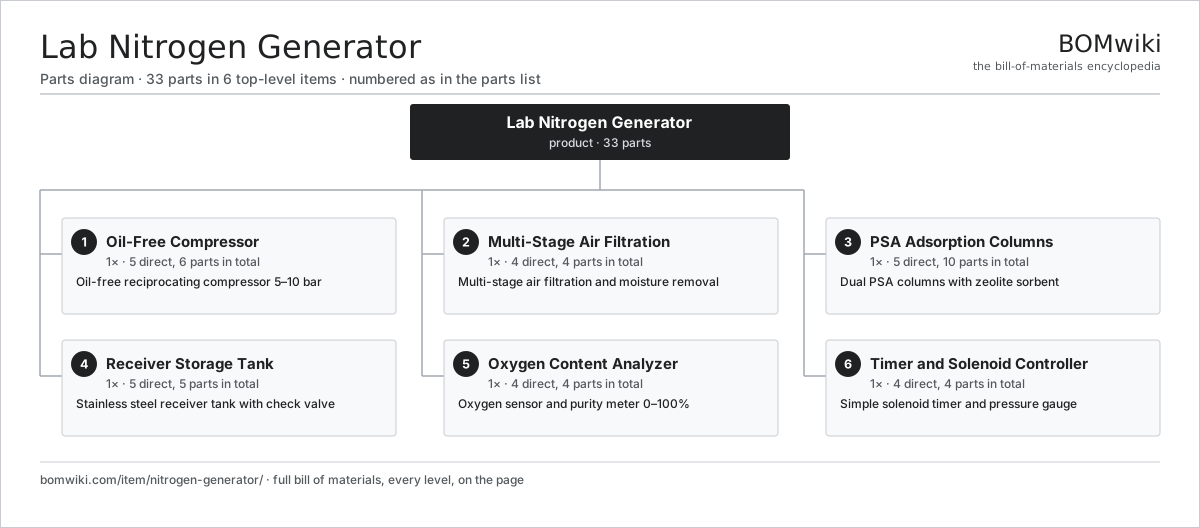
| # | Part | Qty | What it does |
|---|---|---|---|
| 1 | Oil-Free Compressor 5 parts | 1× | Oil-free reciprocating compressor 5–10 bar |
| 2 | Multi-Stage Air Filtration 4 parts | 1× | Multi-stage air filtration and moisture removal |
| 3 | PSA Adsorption Columns 5 parts | 1× | Dual PSA columns with zeolite sorbent |
| 4 | Receiver Storage Tank 5 parts | 1× | Stainless steel receiver tank with check valve |
| 5 | Oxygen Content Analyzer 4 parts | 1× | Oxygen sensor and purity meter 0–100% |
| 6 | Timer and Solenoid Controller 4 parts | 1× | Simple solenoid timer and pressure gauge |
3D model
No 3D model yet. Have a CAD file of this? Add a 3D model. STL renders right on this page; STEP, FreeCAD, and OpenSCAD sources are welcome too (openly licensed, like all 3D models on BOMwiki).
Build & assembly graph
expand / collapse · shared sub-assemblies converge · links to related products · est. labourTap an assembly to expand/collapse · tap a part to open it · use “Open page” for any node · drag to pan, scroll to zoom.
Bill of materials for Lab Nitrogen Generator
6 top-level lines · 33 rows shown · 33 parts total · indented to 3 levels| # | Item / sub-assembly | Part no. | Qty/assy | Ext. qty | Parts | Type |
|---|---|---|---|---|---|---|
| 1 | Oil-Free Compressor 5 parts | nitrogen-compressor-stage | 1× | 1 | 6 | assembly |
| 1.1 | Electric Drive Motor | nitrogen-main-motor | 1× | 1 | · | part |
| 1.2 | Two-Stage Piston Head | nitrogen-compressor-head | 1× | 1 | · | part |
| 1.3 | Intake Air Filter | nitrogen-intake-filter | 1× | 1 | · | part |
| 1.4 | One-Way Check Valve | nitrogen-check-valve | 2× | 2 | · | part |
| 1.5 | Unload Idle Solenoid Valve | nitrogen-unload-solenoid | 1× | 1 | · | part |
| 2 | Multi-Stage Air Filtration 4 parts | nitrogen-filter-stage | 1× | 1 | 4 | assembly |
| 2.1 | Pre-Filter Cartridge | nitrogen-pre-filter | 1× | 1 | · | part |
| 2.2 | Activated Carbon Filter | nitrogen-carbon-filter | 1× | 1 | · | part |
| 2.3 | Silica-Gel Desiccant Cartridge | nitrogen-desiccant-dryer | 1× | 1 | · | part |
| 2.4 | Desiccant Color Indicator | nitrogen-desiccant-indicator | 1× | 1 | · | part |
| 3 | PSA Adsorption Columns 5 parts | nitrogen-membrane-columns | 1× | 1 | 10 | assembly |
| 3.1 | Pressure Vessel Column | nitrogen-column-housing | 2× | 2 | · | part |
| 3.2 | Zeolite 5A Adsorbent | nitrogen-zeolite-sorbent | 2× | 2 | · | part |
| 3.3 | Inlet Switching Solenoid | nitrogen-inlet-solenoid | 2× | 2 | · | part |
| 3.4 | Vent Solenoid Valve | nitrogen-vent-solenoid | 2× | 2 | · | part |
| 3.5 | Column Outlet Check Valve | nitrogen-column-check-valve | 2× | 2 | · | part |
| 4 | Receiver Storage Tank 5 parts | nitrogen-buffer-tank | 1× | 1 | 5 | assembly |
| 4.1 | Stainless Steel Receiver | nitrogen-tank-vessel | 1× | 1 | · | part |
| 4.2 | Pressure Gauge 0–10 bar | nitrogen-tank-gauge | 1× | 1 | · | part |
| 4.3 | Relief Safety Valve | nitrogen-tank-relief-valve | 1× | 1 | · | part |
| 4.4 | Manual Drain Valve | nitrogen-tank-drain-valve | 1× | 1 | · | part |
| 4.5 | Outlet Pressure Regulator | nitrogen-tank-outlet-regulator | 1× | 1 | · | part |
| 5 | Oxygen Content Analyzer 4 parts | nitrogen-purity-monitor | 1× | 1 | 4 | assembly |
| 5.1 | Zirconia O₂ Sensor | nitrogen-oxygen-sensor | 1× | 1 | · | part |
| 5.2 | Sensor Flow Chamber | nitrogen-sensor-housing | 1× | 1 | · | part |
| 5.3 | Digital Purity Display | nitrogen-purity-meter | 1× | 1 | · | part |
| 5.4 | Low-Purity Alarm Relay | nitrogen-alarm-relay | 1× | 1 | · | part |
| 6 | Timer and Solenoid Controller 4 parts | nitrogen-control-unit | 1× | 1 | 4 | assembly |
| 6.1 | Programmable Cycle Timer | nitrogen-timer-relay | 1× | 1 | · | part |
| 6.2 | 24 VDC Solenoid Relay Module | nitrogen-solenoid-driver | 1× | 1 | · | part |
| 6.3 | 24 VDC Power Supply | nitrogen-power-supply | 1× | 1 | · | part |
| 6.4 | Minimum Pressure Safety Switch | nitrogen-safety-switch | 1× | 1 | · | part |
Something wrong in this list? Report a problem with this BOM.
Sourcing: possible vendors
Browse the supplier directory → Prices, MOQ, and lead times are algorithmic estimates, not quotes, and not claims about these companies. Company mappings are curated by keyword; est. price band $1k–$500k. How estimates work| Vendor | HQ | Specialty | MOQ | Lead time |
|---|---|---|---|---|
| thermofisher.com ↗ | Waltham, US | Lab instruments | 100 units | 10–18 wks |
|
🇺🇸Agilent
agilent.com ↗
|
Santa Clara, US | Analytical instruments | 100 units | 10–18 wks |
|
🇺🇸Bruker
bruker.com ↗
|
Billerica, US | Scientific instruments | 100 units | 10–18 wks |
|
🇯🇵Shimadzu
shimadzu.com ↗
|
Kyoto, JP | Analytical instruments | 100 units | 10–18 wks |
|
🇺🇸Waters
waters.com ↗
|
Milford, US | Chromatography & MS | 100 units | 10–18 wks |
1,060-word article