Spunbond Nonwoven Line
ProductOverview
A spunbond nonwoven line is an integrated production system that manufactures nonwoven fabric directly from polymer resin without traditional fiber preparation, spinning, or weaving steps. The process melts polymer pellets, extrudes them through thousands of tiny holes into fine filaments, quenches and orients the filaments, collects them into a random web, and then heat-bonds the web into a cohesive fabric. This one-step production is significantly faster and more cost-effective than conventional fiber-to-fabric manufacturing.
Spunbond nonwoven dominates production of geotextiles, medical gowns, hygiene products (diapers, wipes), protective apparel, and filtration media. The most common polymer is polypropylene (PP) due to its low cost, good melt-flow properties, and adequate strength.
How It Works
The process begins with virgin or recycled polymer pellets fed into an industrial extruder. The rotating screw barrel melts and mixes the resin, while heating zones maintain the melt at 260–290°C. An optimum displacement pump advances the molten resin at constant flow rate (100–1000 kg/hour), overcoming backpressure from the extrusion process. A filter pack removes contaminants.
The spinneret is a precision-drilled steel block with 500–3000 capillary holes (each 0.05–0.1 mm diameter). Molten polymer is forced through these holes, extruding thousands of fine filaments (1–5 microns diameter) simultaneously. The spinneret is heated to prevent premature solidification.
Freshly extruded filaments are immediately quenched (cooled) by a quench air blower supplying 10,000–50,000 m³/hour of cooled air at 20–100°C. This rapid cooling solidifies the filaments before they stretch. The filaments then pass through draw rollers rotating at different speeds. The speed ratio (typically 2–5:1) stretches filaments, orienting polymer chains and increasing strength and shrinkage resistance. This is the "draw" phase of spunbond: faster draw creates stronger filaments but requires higher extruder pressure.
The drawn filaments are then deposited onto a moving forming belt traveling at 1–5 m/second. As filaments land, they intertwine and form a random web. An optional electrostatic assistant applies charge to filaments, aiding deflection and deposition. An air suction box below the belt may assist fiber collection.
The web then passes through calender bonding rollers, which apply heat (120–200°C) and pressure (100–500 kN). The rollers can have embossed patterns (creating point bonding) or smooth surfaces (creating through-bonding). Heat softens filament surfaces where they contact, creating fusion bonds at fiber-to-fiber junctions without melting the entire filament. The result is a cohesive, integrated nonwoven fabric ready for winding.
Finally, the finished fabric is wound onto rolls at production speed.
Extruder and Melt System
The extruder is the most critical subsystem. It must produce consistent melt flow, maintain temperature within ±2°C across the spinneret, and tolerate occasional polymer variations. Most spunbond lines use twin-screw or single-screw extruders with L/D (length-to-diameter) ratio of 25–30, allowing sufficient residence time for melting and mixing.
The melt gear pump downstream of the extruder is essential: it decouples extruder screw speed (which varies with polymer viscosity) from spinneret flow rate, ensuring constant filament extrusion and filament diameter consistency.
Filament Formation and Draw
Filament diameter is determined by:
- Spinneret hole diameter
- Melt flow rate
- Quench air velocity (cooling rate)
- Draw ratio (stretching)
Smaller filaments (<1 micron) create smoother, finer nonwoven but are mechanically weaker. Coarser filaments (>3 micron) create higher-strength fabric but reduced softness. Most spunbond targets 2–3 micron filaments.
Draw is critical for strength. A 3:1 draw ratio increases filament tenacity roughly 2.5–3 times compared to un-drawn filaments. However, higher draw requires higher melt pressure, consuming more power. Draw also increases shrinkage; drawn filaments will shrink 5–20% if reheated above the glass transition temperature.
Web Formation
The forming belt collects filaments in random orientation, avoiding any directional fiber alignment. This randomness gives spunbond its isotropic (equal strength in all directions) properties. The forming belt is typically a permeable fabric that allows air suction from below to assist fiber collection without restricting the molten filament spray.
Filament deposition density (basis weight) is controlled by:
- Extruder flow rate (kg/hour)
- Line speed (m/minute)
- Spinneret hole count
- Draw ratio
Basis weight = (Flow rate [kg/h] × 60 [min/h]) / (Line speed [m/min] × Fabric width [m])
Calender Bonding
Heat and pressure bonding is crucial for fabric integrity. Too little bonding creates a loose, weak fabric; excessive bonding creates a stiff, plastic-like fabric with reduced flexibility.
The calender rollers can be:
- Embossed/pattern rollers: Creating point bonds (fibers bond only at compressed areas), maintaining softness.
- Smooth rollers: Creating through-bonds (entire cross-section bonds), creating stiffer but stronger fabric.
- Combination: Hybrid patterns balancing strength and hand-feel.
Calender temperature depends on polymer melting point (PP: ~160°C, PE: ~130°C) and desired bonding depth. Most spunbond runs at 120–200°C for PP.
Production Rates and Economics
Spunbond economics depend heavily on line speed and efficiency:
- Low-speed lines (50 m/min, light basis weight 20 g/m²): ~50 kg/hour, suitable for specialty applications.
- Standard speed (200 m/min, medium basis weight 50–100 g/m²): ~200 kg/hour, mainstream production.
- High-speed lines (500 m/min, basis weight 50 g/m²): ~500 kg/hour, commodity production (geotextile, packaging).
Gross margin is sensitive to raw material cost (PP prices fluctuate 30–50% year-to-year), line utilization, and energy costs (spunbond is energy-intensive: 2–5 kWh per kg of nonwoven).
Polymer Types
Although PP dominates, spunbond can process other polymers:
- Polypropylene (PP): Most common, 80–90% of spunbond production.
- Polyethylene (PE): Lower melting point (~130°C), softer nonwoven.
- Polyester (PET): Higher melting point (~270°C), better thermal and strength properties, higher cost.
- Biopolymers (PLA, PBS): Emerging, requiring special processing.
Multi-component spinnerets (core-shell, side-by-side) can extrude different polymers from different holes simultaneously, creating composite filaments with tailored properties.
Quality Control
Key quality parameters monitored by the control system:
- Basis weight: Target ±5% via online sensor adjusting line speed or extruder flow.
- Calender temperature: ±2°C via feedback controllers.
- Line speed consistency: Via encoder feedback.
- Tensile strength: Off-line testing (periodic samples).
Variations in melt temperature, draw ratio, or bonding pressure create corresponding fabric property variations, directly affecting customer acceptability (medical gowns, filters) or performance (geotextile, reinforcement).
Environmental Considerations
Spunbond production is relatively clean: minimal water use, no chemical effluent (unlike wet-laid or chemical-bonded nonwoven). Challenges include:
- Energy consumption: 2–5 kWh per kg, primarily heating extruder and calender.
- Recycling: Post-consumer spunbond is difficult to recycle (mixed fibers, complex bonding); being addressed by design-for-recycling initiatives and chemical recycling technologies.
- Raw material sourcing: Most spunbond uses virgin PP; increasing shift to recycled content (rPP).
Some manufacturers achieve carbon-neutral production via renewable electricity and offset programs.
Line Variants and Custom Configurations
- Single-layer spunbond: Simplest; 20–100 g/m² light nonwoven.
- Multi-layer (SMS, SMMS): Spunbond-meltblown-spunbond composites combining strength (spunbond) and filtration (meltblown); widely used in medical/hygiene.
- In-line coating: Adding polymer coating or adhesive during production.
- Perforated spunbond: Embossing patterns post-bonding for enhanced softness.
Most modern lines are modular, allowing quick reconfiguration between products (geotextile → hygiene → apparel → filtration) by changing spinneret, adjusting speeds, and selecting calender patterns.
Spunbond Nonwoven Line parts and their functions
8 top-level parts · 2,062 parts in total · full bill of materials below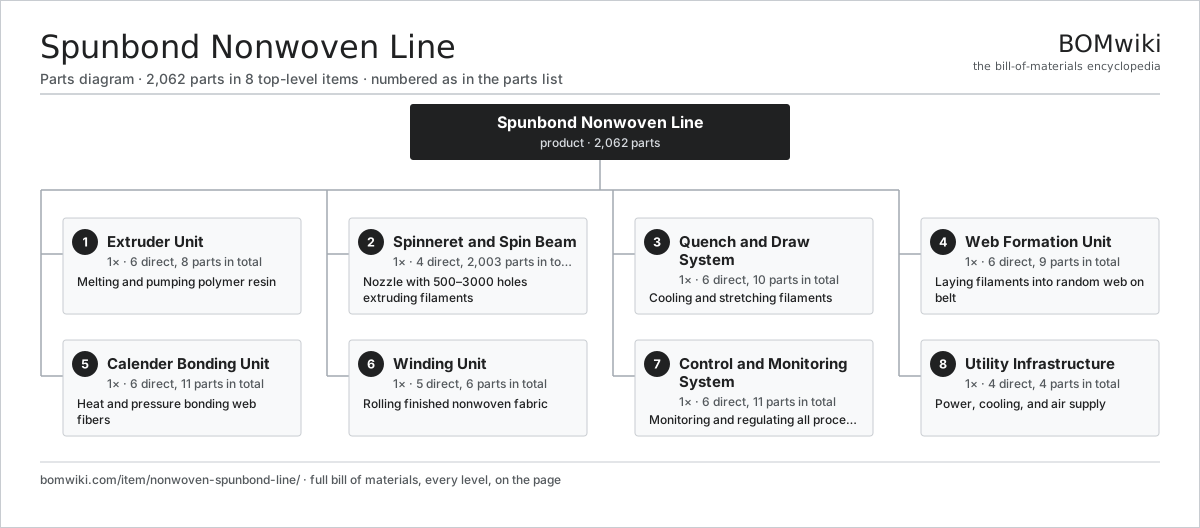
| # | Part | Qty | What it does |
|---|---|---|---|
| 1 | Extruder Unit 6 parts | 1× | Melting and pumping polymer resin |
| 2 | Spinneret and Spin Beam 4 parts | 1× | Nozzle with 500–3000 holes extruding filaments |
| 3 | Quench and Draw System 6 parts | 1× | Cooling and stretching filaments |
| 4 | Web Formation Unit 6 parts | 1× | Laying filaments into random web on belt |
| 5 | Calender Bonding Unit 6 parts | 1× | Heat and pressure bonding web fibers |
| 6 | Winding Unit 5 parts | 1× | Rolling finished nonwoven fabric |
| 7 | Control and Monitoring System 6 parts | 1× | Monitoring and regulating all processes |
| 8 | Utility Infrastructure 4 parts | 1× | Power, cooling, and air supply |
3D model
No 3D model yet. Have a CAD file of this? Add a 3D model. STL renders right on this page; STEP, FreeCAD, and OpenSCAD sources are welcome too (openly licensed, like all 3D models on BOMwiki).
Build & assembly graph
expand / collapse · shared sub-assemblies converge · links to related products · est. labourTap an assembly to expand/collapse · tap a part to open it · use “Open page” for any node · drag to pan, scroll to zoom.
Bill of materials for Spunbond Nonwoven Line
8 top-level lines · 51 rows shown · 2,062 parts total · indented to 3 levels| # | Item / sub-assembly | Part no. | Qty/assy | Ext. qty | Parts | Type |
|---|---|---|---|---|---|---|
| 1 | Extruder Unit 6 parts | nonwoven-spunbond-line-extruder | 1× | 1 | 8 | assembly |
| 1.1 | Material Hopper | nonwoven-spunbond-line-hopper | 1× | 1 | · | part |
| 1.2 | Extruder Screw and Barrel | nonwoven-spunbond-line-screw-barrel | 1× | 1 | · | part |
| 1.3 | Heating Element | nonwoven-spunbond-line-heater-zones | 3× | 3 | · | part |
| 1.4 | Melt Gear Pump | nonwoven-spunbond-line-melt-pump | 1× | 1 | · | part |
| 1.5 | Filter Pack | nonwoven-spunbond-line-filter-pack | 1× | 1 | · | part |
| 1.6 | Extruder Drive Motor | nonwoven-spunbond-line-extruder-motor | 1× | 1 | · | part |
| 2 | Spinneret and Spin Beam 4 parts | nonwoven-spunbond-line-spinneret | 1× | 1 | 2,003 | assembly |
| 2.1 | Spinneret Block | nonwoven-spunbond-line-spinneret-block | 1× | 1 | · | part |
| 2.2 | Spinneret Capillary | nonwoven-spunbond-line-capillary-holes | 2000× | 2,000 | · | part |
| 2.3 | Spinneret Heater | nonwoven-spunbond-line-spin-beam-heater | 1× | 1 | · | part |
| 2.4 | Spin Beam Frame | nonwoven-spunbond-line-spin-beam-frame | 1× | 1 | · | part |
| 3 | Quench and Draw System 6 parts | nonwoven-spunbond-line-quench-drawing | 1× | 1 | 10 | assembly |
| 3.1 | Quench Chamber | nonwoven-spunbond-line-quench-chamber | 1× | 1 | · | part |
| 3.2 | Quench Air Blower | nonwoven-spunbond-line-quench-fan | 1× | 1 | · | part |
| 3.3 | Draw Roller | nonwoven-spunbond-line-draw-rollers | 2× | 2 | · | part |
| 3.4 | Draw Motor | nonwoven-spunbond-line-draw-motor | 1× | 1 | · | part |
| 3.5 | Draw Ratio Controller | nonwoven-spunbond-line-draw-ratio-control | 1× | 1 | · | part |
| 3.6 | Ball Bearing | ball-bearing | 4× | 4 | · | part |
| 4 | Web Formation Unit 6 parts | nonwoven-spunbond-line-web-formation | 1× | 1 | 9 | assembly |
| 4.1 | Forming Belt | nonwoven-spunbond-line-forming-belt | 1× | 1 | · | part |
| 4.2 | Electrostatic Assistant | nonwoven-spunbond-line-electrostatic-assist | 1× | 1 | · | part |
| 4.3 | Belt Drive Motor | nonwoven-spunbond-line-belt-drive-motor | 1× | 1 | · | part |
| 4.4 | Belt Tensioner | nonwoven-spunbond-line-belt-tension-roller | 1× | 1 | · | part |
| 4.5 | Suction Box | nonwoven-spunbond-line-air-suction-box | 1× | 1 | · | part |
| 4.6 | Ball Bearing | ball-bearing | 4× | 4 | · | part |
| 5 | Calender Bonding Unit 6 parts | nonwoven-spunbond-line-calender-bonding | 1× | 1 | 11 | assembly |
| 5.1 | Calender Top Roller | nonwoven-spunbond-line-calender-top-roller | 1× | 1 | · | part |
| 5.2 | Calender Bottom Roller | nonwoven-spunbond-line-calender-bottom-roller | 1× | 1 | · | part |
| 5.3 | Calender Heater | nonwoven-spunbond-line-calender-heating-element | 2× | 2 | · | part |
| 5.4 | Nip Pressure System | nonwoven-spunbond-line-calender-pressure-system | 1× | 1 | · | part |
| 5.5 | Calender Roller Shaft | nonwoven-spunbond-line-calender-roller-shaft | 2× | 2 | · | part |
| 5.6 | Ball Bearing | ball-bearing | 4× | 4 | · | part |
| 6 | Winding Unit 5 parts | nonwoven-spunbond-line-winder | 1× | 1 | 6 | assembly |
| 6.1 | Wind Shaft | nonwoven-spunbond-line-wind-shaft | 1× | 1 | · | part |
| 6.2 | Wind Motor | nonwoven-spunbond-line-wind-motor | 1× | 1 | · | part |
| 6.3 | Wind Nip Roller | nonwoven-spunbond-line-wind-nip-roller | 1× | 1 | · | part |
| 6.4 | Wind Tension Arm | nonwoven-spunbond-line-wind-tension-arm | 1× | 1 | · | part |
| 6.5 | Ball Bearing | ball-bearing | 2× | 2 | · | part |
| 7 | Control and Monitoring System 6 parts | nonwoven-spunbond-line-control-system | 1× | 1 | 11 | assembly |
| 7.1 | Microcontroller | mcu | 1× | 1 | · | part |
| 7.2 | Temperature Sensor | nonwoven-spunbond-line-temperature-sensors | 4× | 4 | · | part |
| 7.3 | Pressure Transducer | nonwoven-spunbond-line-pressure-transducers | 3× | 3 | · | part |
| 7.4 | Speed Encoder | nonwoven-spunbond-line-speed-encoder | 1× | 1 | · | part |
| 7.5 | Basis Weight Sensor | nonwoven-spunbond-line-basis-weight-sensor | 1× | 1 | · | part |
| 7.6 | LCD Panel | lcd-panel | 1× | 1 | · | part |
| 8 | Utility Infrastructure 4 parts | nonwoven-spunbond-line-utility-systems | 1× | 1 | 4 | assembly |
| 8.1 | Main Power Panel | nonwoven-spunbond-line-main-power-panel | 1× | 1 | · | part |
| 8.2 | Cooling Tower | nonwoven-spunbond-line-cooling-tower | 1× | 1 | · | part |
| 8.3 | Air Compressor | nonwoven-spunbond-line-compressor | 1× | 1 | · | part |
| 8.4 | Total System Power | nonwoven-spunbond-line-power-supply-total | 1× | 1 | · | part |
Something wrong in this list? Report a problem with this BOM.
Sourcing: possible vendors
Browse the supplier directory → Prices, MOQ, and lead times are algorithmic estimates, not quotes, and not claims about these companies. Company mappings are curated by keyword; est. price band $10k–$1M. How estimates work| Vendor | HQ | Specialty | MOQ | Lead time |
|---|---|---|---|---|
|
🇨🇭Rieter
rieter.com ↗
|
Winterthur, CH | Spinning machinery | 10 units | 14–24 wks |
| truetzschler.com ↗ | Mönchengladbach, DE | Textile machinery | 10 units | 14–24 wks |
|
🇧🇪Picanol
picanol.be ↗
|
Ypres, BE | Weaving machines | 10 units | 14–24 wks |
| karlmayer.com ↗ | Obertshausen, DE | Warp knitting machines | 10 units | 14–24 wks |
|
🇨🇭Saurer
saurer.com ↗
|
Arbon, CH | Spinning & embroidery | 10 units | 14–24 wks |
1,319-word article