Oil Deodorizer
ProductOverview
Oil deodorization is the final purification step in edible oil refining. The product of Oil Bleaching Vessel still contains volatile off-flavors, primarily hexanal and other aldehydes that form during pressing and extraction, plus residual phenolics and sulfur compounds. These compounds are odorous, taste unpleasant, and worsen flavor stability during product shelf life.
The Oil Deodorizer removes these volatiles via vacuum steam distillation. Bleached oil is heated to 180–220°C under deep vacuum (2–5 mbar absolute), where steam is bubbled through the oil. The volatile compounds partition into the steam phase and are carried overhead as vapor. Condensation and liquid-liquid separation returns stripped steam to the reboiler; the volatile fraction is discharged or incinerated.
The result is a neutral-tasting, stable oil ready for packaging.
Distillation principle
At atmospheric pressure, oil boils at > 300°C, and beneficial polyunsaturated fatty acids begin to isomerize and polymerize. At 2–5 mbar absolute, the vapor pressure of both water and volatile compounds drops dramatically. Steam at only 180–220°C provides stripping energy.
The Distillation Column is a tall vertical vessel with internal Column Trays. Hot oil enters at mid-height and flows downward through contact with rising steam. Volatile compounds (with boiling points 40–100°C at atmospheric pressure) evaporate into the steam at the reduced pressure and are swept upward and overhead.
Essential fatty acids (linoleic, linolenic) have boiling points > 200°C at 2–5 mbar and remain in the liquid phase, exiting at the column base as deodorized oil.
Column design and operation
The Column Vessel is 4–8 m tall, typically 0.8–1.5 m diameter, made of stainless 304/316. Internal Column Trays (bubble cap or sieve type) number 6–12 depending on desired separation efficiency. Each tray provides a stage of contact; more trays = better separation but higher cost and pressure drop.
Alternatively, structured Column Packing (Mellapak, Intalox) can replace trays, offering even higher surface area and lower pressure drop.
Heater and steam generation
The Reboiler and Steam Injection at the column base is a tube-in-shell or fired-tube reboiler heated by high-pressure steam (8–15 bar). Oil circulated through the reboiler is heated to 180–220°C. A Steam Sparge Ring at the column base sparges live steam directly into the oil for stripping.
Steam requirement is typically 100–200 kg per ton of oil processed, depending on the extent of deodorization desired.
Vapor handling
Overhead vapors, a mixture of water and light volatiles, flow into the Vapor Condenser, a water-cooled heat exchanger. Condensation occurs at around 40–50°C. The liquid outlet of the condenser goes to a Condenser Separator, which settles the two liquid phases: water (bottom) and any entrained oil (top).
The Condensate Pump returns hot condensate to the reboiler base, closing the steam loop. Water and off-flavors are drained as distillate, typically a waste stream or burned for energy recovery.
Vacuum system
Achieving 2–5 mbar absolute requires robust equipment. The Vacuum Generation and Control typically comprises a Vacuum Pump, a rotary vane or liquid-ring pump rated 50–200 m³/h. For the deepest vacuum, a Vacuum Booster ejector or booster pump may be added.
An Intercooler (intercooler) between stages removes condensable vapors, protecting pump efficiency.
A Pressure Sensor on the column monitors absolute pressure. Vacuum controller adjusts pump speed or bypass valve opening to hold setpoint.
Cooling and finishing
Deodorized oil exits the column at 180–220°C. The Final Cooler is a high-duty heat exchanger that cools it to 40–50°C using cooling water or air. A Cooling Water Pump and optional Cooler Fan manage flow and temperature.
Optional: a Heat Economizer uses waste heat from the overhead condenser to preheat incoming feed, reducing reboiler duty and energy cost.
Quality outcomes
Properly deodorized oil exhibits:
- Odor: bland, without off-notes (sensory evaluation)
- Flavor: neutral taste
- FFA (free fatty acid): unchanged by deodorization
- Fatty acid composition: retention > 98% (minimal loss of essential polyunsaturates)
- Peroxide value: often reduced by decomposition of unstable peroxides
- Smoke point: improved due to removal of volatile aldehydes
Food-grade oils typically undergo deodorization before bottling or industrial sale.
Integration
The full refining sequence is:
Crude Oil → Oil Degumming System → Oil Bleaching Vessel → Oil Deodorizer → Storage/Packaging
Some refineries combine stages (e.g., degumming + bleaching in one vessel) for economy, but deodorization is always separate due to its unique vacuum and high-temperature requirements.
Energy and economics
Steam and vacuum pump electricity are the primary operating costs. A modern deodorizer processes 5–20 tons/h with energy cost of 30–80 €/ton depending on steam availability and vacuum depth. Capital equipment cost is high (€500k–€2M) but is amortized over high-capacity operation.
Oil Deodorizer parts and their functions
8 top-level parts · 43 parts in total · full bill of materials below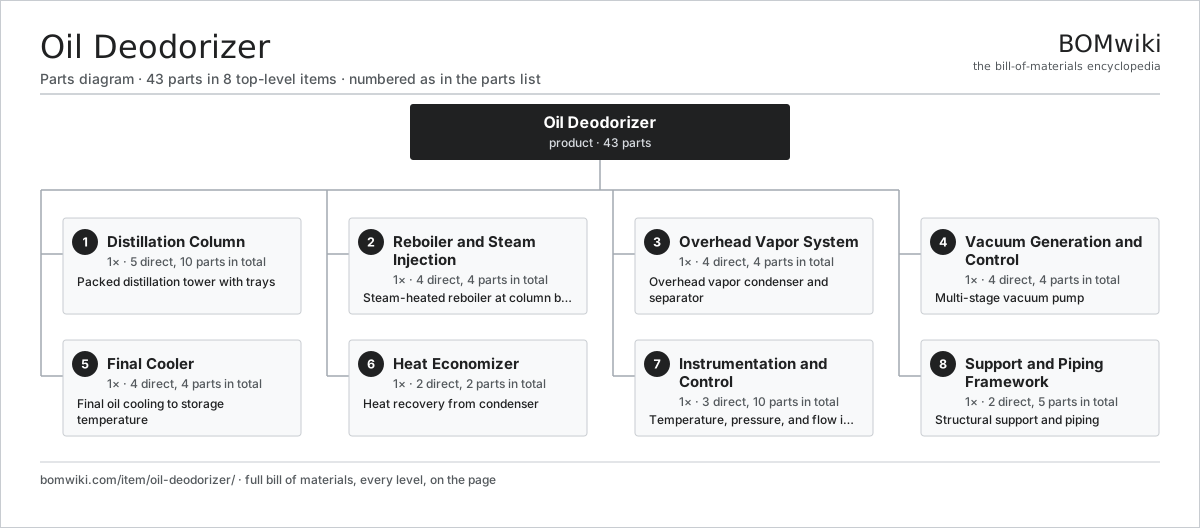
| # | Part | Qty | What it does |
|---|---|---|---|
| 1 | Distillation Column 5 parts | 1× | Packed distillation tower with trays |
| 2 | Reboiler and Steam Injection 4 parts | 1× | Steam-heated reboiler at column base |
| 3 | Overhead Vapor System 4 parts | 1× | Overhead vapor condenser and separator |
| 4 | Vacuum Generation and Control 4 parts | 1× | Multi-stage vacuum pump |
| 5 | Final Cooler 4 parts | 1× | Final oil cooling to storage temperature |
| 6 | Heat Economizer 2 parts | 1× | Heat recovery from condenser |
| 7 | Instrumentation and Control 3 parts | 1× | Temperature, pressure, and flow instrumentation |
| 8 | Support and Piping Framework 2 parts | 1× | Structural support and piping |
3D model
No 3D model yet. Have a CAD file of this? Add a 3D model. STL renders right on this page; STEP, FreeCAD, and OpenSCAD sources are welcome too (openly licensed, like all 3D models on BOMwiki).
Build & assembly graph
expand / collapse · shared sub-assemblies converge · links to related products · est. labourTap an assembly to expand/collapse · tap a part to open it · use “Open page” for any node · drag to pan, scroll to zoom.
Bill of materials for Oil Deodorizer
8 top-level lines · 36 rows shown · 43 parts total · indented to 3 levels| # | Item / sub-assembly | Part no. | Qty/assy | Ext. qty | Parts | Type |
|---|---|---|---|---|---|---|
| 1 | Distillation Column 5 parts | oil-deodorizer-column | 1× | 1 | 10 | assembly |
| 1.1 | Column Vessel | oil-deodorizer-column-shell | 1× | 1 | · | part |
| 1.2 | Column Trays | oil-deodorizer-trays | 6× | 6 | · | part |
| 1.3 | Feed Distributor | oil-deodorizer-column-feed | 1× | 1 | · | part |
| 1.4 | Column Packing | oil-deodorizer-column-packing | 1× | 1 | · | part |
| 1.5 | Fastener Set | fastener-set | 1× | 1 | · | part |
| 2 | Reboiler and Steam Injection 4 parts | oil-deodorizer-heater | 1× | 1 | 4 | assembly |
| 2.1 | Heater Exchanger | oil-deodorizer-heater-exchanger | 1× | 1 | · | part |
| 2.2 | Steam Sparge Ring | oil-deodorizer-steam-injector | 1× | 1 | · | part |
| 2.3 | Heating Element | heating-element | 1× | 1 | · | part |
| 2.4 | Fastener Set | fastener-set | 1× | 1 | · | part |
| 3 | Overhead Vapor System 4 parts | oil-deodorizer-vapor-line | 1× | 1 | 4 | assembly |
| 3.1 | Vapor Condenser | oil-deodorizer-vapor-condenser | 1× | 1 | · | part |
| 3.2 | Condenser Separator | oil-deodorizer-vapor-separator | 1× | 1 | · | part |
| 3.3 | Condensate Pump | oil-deodorizer-condenser-pump | 1× | 1 | · | part |
| 3.4 | Pressure Sensor | pressure-sensor | 1× | 1 | · | part |
| 4 | Vacuum Generation and Control 4 parts | oil-deodorizer-vacuum-system | 1× | 1 | 4 | assembly |
| 4.1 | Vacuum Pump | oil-deodorizer-vacuum-pump-primary | 1× | 1 | · | part |
| 4.2 | Vacuum Booster | oil-deodorizer-vacuum-pump-secondary | 1× | 1 | · | part |
| 4.3 | Intercooler | oil-deodorizer-vacuum-condenser | 1× | 1 | · | part |
| 4.4 | Pressure Sensor | pressure-sensor | 1× | 1 | · | part |
| 5 | Final Cooler 4 parts | oil-deodorizer-cooler | 1× | 1 | 4 | assembly |
| 5.1 | Final Cooler Unit | oil-deodorizer-cooler-unit | 1× | 1 | · | part |
| 5.2 | Cooling Water Pump | oil-deodorizer-cooler-pump | 1× | 1 | · | part |
| 5.3 | Cooler Fan | oil-deodorizer-cooler-fan | 1× | 1 | · | part |
| 5.4 | Pressure Sensor | pressure-sensor | 1× | 1 | · | part |
| 6 | Heat Economizer 2 parts | oil-deodorizer-condenser-economizer | 1× | 1 | 2 | assembly |
| 6.1 | Economizer Exchanger | oil-deodorizer-economizer-unit | 1× | 1 | · | part |
| 6.2 | Fastener Set | fastener-set | 1× | 1 | · | part |
| 7 | Instrumentation and Control 3 parts | oil-deodorizer-controls | 1× | 1 | 10 | assembly |
| 7.1 | Temperature Sensor | oil-deodorizer-thermostat | 3× | 3 | · | part |
| 7.2 | Pressure Sensor | pressure-sensor | 3× | 3 | · | part |
| 7.3 | Relay | relay | 4× | 4 | · | part |
| 8 | Support and Piping Framework 2 parts | oil-deodorizer-frame | 1× | 1 | 5 | assembly |
| 8.1 | Sheet Metal Panel | sheet-panel | 2× | 2 | · | part |
| 8.2 | Fastener Set | fastener-set | 3× | 3 | · | part |
Something wrong in this list? Report a problem with this BOM.
Related products
same domain, ranked by shared parts Bakery Deck Oven
44 parts · shares 3 with this page
Blood Coagulator/Dryer
38 parts · shares 3 with this page
Continuous Frying System
118 parts · shares 3 with this page
Dough Rounding Machine
212 parts · shares 3 with this page
Bakery Deck Oven
44 parts · shares 3 with this page
Blood Coagulator/Dryer
38 parts · shares 3 with this page
Continuous Frying System
118 parts · shares 3 with this page
Dough Rounding Machine
212 parts · shares 3 with this page
 Edible Oil Refining Line
3,224 parts · shares 3 with this page
Edible Oil Refining Line
3,224 parts · shares 3 with this page
Sourcing: possible vendors
Browse the supplier directory → Prices, MOQ, and lead times are algorithmic estimates, not quotes, and not claims about these companies. Company mappings are curated by keyword; est. price band $1k–$500k. How estimates work| Vendor | HQ | Specialty | MOQ | Lead time |
|---|---|---|---|---|
| gea.com ↗ | Düsseldorf, DE | Process technology | 20 units | 12–20 wks |
| buhlergroup.com ↗ | Uzwil, CH | Food & materials processing | 20 units | 12–20 wks |
| tetrapak.com ↗ | Pully, CH | Food packaging & processing | 20 units | 12–20 wks |
| jbtc.com ↗ | Chicago, US | Food processing equipment | 20 units | 12–20 wks |
| alfalaval.com ↗ | Lund, SE | Heat transfer & separation | 20 units | 12–20 wks |
816-word article