Oil-Fired Boiler
ProductOverview
An oil-fired boiler heats water using pressurized combustion of No. 2 heating oil (essentially diesel). The boiler comprises three functional subsystems: the Oil Burner Assembly (combustion head), the Combustion Chamber (where oil mist ignites), and the Heat Exchanger (where hot gases transfer energy to boiler water).
Oil-fired boilers were the dominant heating technology in the eastern United States from the 1950s through the 2000s, before natural gas infrastructure became widespread. They remain common in rural areas without gas service and in regions where oil prices are competitive. The advantages are energy density (oil contains ~20% more BTU per unit volume than natural gas), no requirement for a gas supply line, and decades of engineering refinement. The disadvantages are annual tank maintenance (sediment removal), higher carbon intensity (more CO₂ per BTU than gas), and volatile commodity pricing.
Modern oil boilers operate at 80–90% thermal efficiency, comparable to high-efficiency gas furnaces, through the use of condensing flue passages and secondary heat exchanger sections. The Oil Burner Assembly operates only on demand, there is no continuous pilot light, so off-cycle losses are minimal. A bimetallic Aquastat Control senses water temperature and energizes or de-energizes the burner motor.
How it works
The cycle begins when the Aquastat Control detects that boiler water has cooled below setpoint (typically 60–80°C). The aquastat energizes a relay that starts the Oil Burner Assembly motor. This AC motor drives two devices: the Fuel Pump (pressurizing oil to 100 psi) and a centrifugal blower (forcing combustion air into the chamber).
Oil under 100 psi is forced through a precision Burner Nozzle, a small orifice that atomizes the liquid into a fine mist. This mist is directed into the hot Combustion Chamber. Simultaneously, a high-voltage Ignition Transformer generates 10,000+ volts across a pair of Spark Electrodes positioned in the combustion zone. The spark ignites the oil mist, establishing a luminous flame of orange and yellow burning at ~1,200°C.
The Flame Sensor continuously monitors the combustion zone, detecting either the UV radiation or infrared radiation of the active flame. As long as the sensor sees flame, it feeds a high-impedance signal back to the control circuit. If flame is lost for more than 15 seconds (oil line blockage, air accumulation, electrode fouling), the signal drops, and a Lockout Relay latches off the burner motor circuit. The operator must manually press a reset button to attempt re-ignition.
Hot combustion gases (~1,200°C at peak, cooling as they travel) flow backward through the Heat Exchanger. The Combustion Chamber itself acts as the primary heat source, with its Refractory Lining radiating and conducting heat into the boiler water surrounding it. As gases exit the chamber into the secondary heat-exchanger tubes, their temperature drops to 200–300°C. The Exchanger Core is typically a series of horizontal cast-iron pipes (in older units) or welded steel tubes in modern units. Boiler water circulates around these tubes via the Circulator Pump.
A modern feature is the Tankless Coil Assembly, a tightly wound copper coil submerged in the boiler water. When a hot-water tap is opened, cold domestic water flows through this coil and is heated to boiler temperature (instantly in theory, though in practice subject to mixing-valve control to prevent scalding). The Coil Check Valve prevents cold water from backflowing into the boiler, and a Mixing/Tempering Valve thermostatic valve blends hot coil output with cold supply to maintain a safe delivery temperature.
Once the boiler reaches setpoint (sensed by the Aquastat Control), the aquastat de-energizes the burner motor. The oil pump and blower stop, and combustion ceases. Residual heat in the heat exchanger continues to warm boiler water for a few minutes, and the Circulator Pump continues running until boiler water cools slightly (via a cycling control or separate off-delay timer).
Safety is provided by two independent mechanisms: the Stack Switch is a bimetallic element clamped to the flue pipe downstream of the heat exchanger. If combustion ceases and stack temperature drops below ~150°C, the switch opens and de-energizes the control circuit, preventing continuous oil injection without flame. The Lockout Relay is a secondary safeguard that latches off if the Flame Sensor signal drops for >15 seconds at any point during a burn.
The Pressure Relief Valve is set to open (typically 25–30 psi) if system pressure exceeds safe limits, venting excess pressure to the return line via an internal bypass.
Maintenance and operation
Annual service by a licensed technician is essential for reliable, safe operation:
- Nozzle cleaning and replacement: The Burner Nozzle is a wear item (~$20) that should be inspected annually and replaced if spray pattern is distorted. A degraded nozzle produces uneven combustion and reduced efficiency.
- Electrode cleaning: The Spark Electrodes accumulate carbon soot if combustion is incomplete. Gentle abrasion with fine sandpaper restores spark quality.
- Stack temperature check: Flue gas temperature should be 300–400°C; if hotter, the heat exchanger may be fouled with soot. A soot layer insulates boiler water from hot gases and reduces efficiency markedly. Soot blowing (mechanical or acoustic) may be required.
- Fuel filter and strainer: The oil supply line includes a Fuel Pump inlet strainer and often a replaceable cartridge filter. Water accumulation or sediment in the tank can block these.
- Combustion analysis: Modern service includes a flue gas analysis (CO, CO₂, O₂) to verify efficient burn. Excess CO indicates incomplete combustion and potential safety hazard.
Oil tanks are typically either above-ground (outdoor, protected) or buried below-ground (more common, less visible but risk of leakage). Over decades, tanks develop internal rust and sediment. If a boiler develops clogging or won't start, tank cleaning (suction truck to remove sludge) is often needed.
The Tankless Coil Assembly is convenient for domestic hot water but adds complexity. An alternative is a separate indirect storage tank heated by a heat exchanger loop from the boiler. The storage tank provides hot water on demand without the high standby heat loss of the tankless coil.
Efficiency and upgrades
Modern condensing boilers achieve 85–90% efficiency by cooling flue gases to 120–150°C (in excess of the 80°C boiler water setpoint) and capturing latent heat from moisture in the exhaust. This requires a stainless-steel or corrosion-resistant heat exchanger (regular cast iron corrodes in acidic condensate). A drain line removes the condensate water to a laundry drain or treated sump.
Older non-condensing boilers operated at 70–80% efficiency; if a unit is older than 20 years, a replacement may pay for itself through fuel savings over 5–10 years, depending on the price of oil and the availability of alternative fuels (natural gas, pellets, etc.).
Oil-Fired Boiler parts and their functions
8 top-level parts · 22 parts in total · full bill of materials below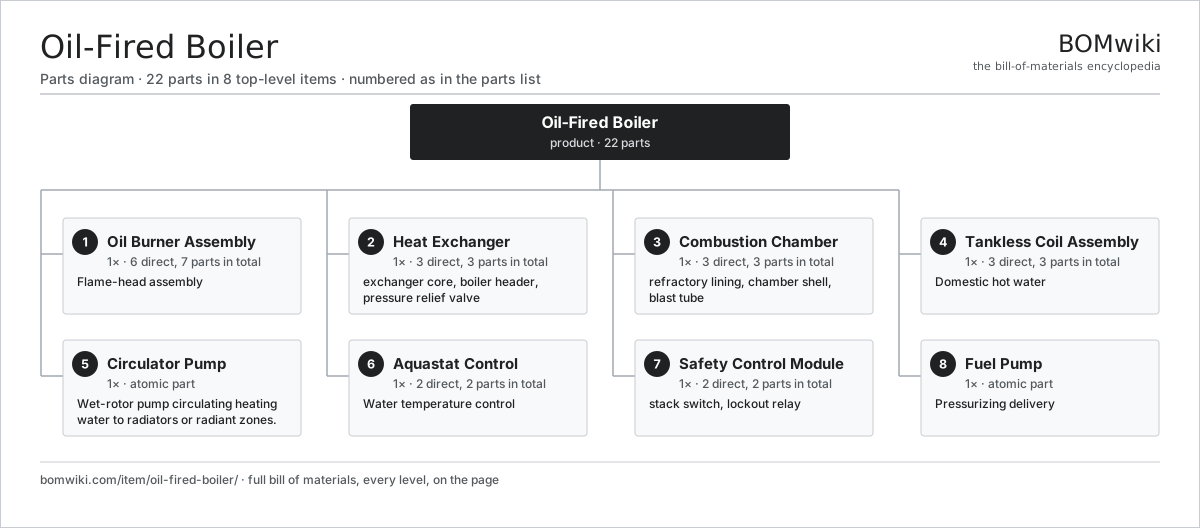
| # | Part | Qty | What it does |
|---|---|---|---|
| 1 | Oil Burner Assembly 6 parts | 1× | Flame-head assembly |
| 2 | Heat Exchanger 3 parts | 1× | Sectional cast-iron or tube-and-shell design transferring combustion heat to boiler water. |
| 3 | Combustion Chamber 3 parts | 1× | Refractory-lined steel chamber where oil spray ignites and burns. |
| 4 | Tankless Coil Assembly 3 parts | 1× | Domestic hot water |
| 5 | Circulator Pump | 1× | Wet-rotor pump circulating heating water to radiators or radiant zones. |
| 6 | Aquastat Control 2 parts | 1× | Water temperature control |
| 7 | Safety Control Module 2 parts | 1× | Stack switch and lockout relay that shut down burner if flame is lost. |
| 8 | Fuel Pump | 1× | Pressurizing delivery |
3D model
No 3D model yet. Have a CAD file of this? Add a 3D model. STL renders right on this page; STEP, FreeCAD, and OpenSCAD sources are welcome too (openly licensed, like all 3D models on BOMwiki).
Build & assembly graph
expand / collapse · shared sub-assemblies converge · links to related products · est. labourTap an assembly to expand/collapse · tap a part to open it · use “Open page” for any node · drag to pan, scroll to zoom.
Bill of materials for Oil-Fired Boiler
8 top-level lines · 27 rows shown · 22 parts total · indented to 3 levels| # | Item / sub-assembly | Part no. | Qty/assy | Ext. qty | Parts | Type |
|---|---|---|---|---|---|---|
| 1 | Oil Burner Assembly 6 parts | oil-fired-boiler-oil-burner | 1× | 1 | 7 | assembly |
| 1.1 | Burner Nozzle | oil-fired-boiler-burner-nozzle | 1× | 1 | · | part |
| 1.2 | Ignition Transformer | oil-fired-boiler-ignition-transformer | 1× | 1 | · | part |
| 1.3 | Spark Electrode | oil-fired-boiler-ignition-electrode | 2× | 2 | · | part |
| 1.4 | Flame Sensor | oil-fired-boiler-flame-sensor | 1× | 1 | · | part |
| 1.5 | Burner Motor | oil-fired-boiler-burner-motor | 1× | 1 | · | part |
| 1.6 | Combustion Head | oil-fired-boiler-combustion-head | 1× | 1 | · | part |
| 2 | Heat Exchanger 3 parts | oil-fired-boiler-heat-exchanger | 1× | 1 | 3 | assembly |
| 2.1 | Exchanger Core | oil-fired-boiler-exchanger-core | 1× | 1 | · | part |
| 2.2 | Boiler Header | oil-fired-boiler-exchanger-header | 1× | 1 | · | part |
| 2.3 | Pressure Relief Valve | oil-fired-boiler-pressure-relief | 1× | 1 | · | part |
| 3 | Combustion Chamber 3 parts | oil-fired-boiler-combustion-chamber | 1× | 1 | 3 | assembly |
| 3.1 | Refractory Lining | oil-fired-boiler-chamber-liner | 1× | 1 | · | part |
| 3.2 | Chamber Shell | oil-fired-boiler-chamber-shell | 1× | 1 | · | part |
| 3.3 | Blast Tube | oil-fired-boiler-blast-tube | 1× | 1 | · | part |
| 4 | Tankless Coil Assembly 3 parts | oil-fired-boiler-tankless-coil | 1× | 1 | 3 | assembly |
| 4.1 | Coil Tube Bundle | oil-fired-boiler-tankless-coil-tube | 1× | 1 | · | part |
| 4.2 | Coil Check Valve | oil-fired-boiler-coil-check-valve | 1× | 1 | · | part |
| 4.3 | Mixing/Tempering Valve | oil-fired-boiler-mixing-valve | 1× | 1 | · | part |
| 5 | Circulator Pump | oil-fired-boiler-circulation-pump | 1× | 1 | · | part |
| 6 | Aquastat Control 2 parts | oil-fired-boiler-aquastat | 1× | 1 | 2 | assembly |
| 6.1 | Aquastat Bulb Sensor | oil-fired-boiler-aquastat-sensor | 1× | 1 | · | part |
| 6.2 | Aquastat Switch | oil-fired-boiler-aquastat-switch | 1× | 1 | · | part |
| 7 | Safety Control Module 2 parts | oil-fired-boiler-safety-control | 1× | 1 | 2 | assembly |
| 7.1 | Stack Switch | oil-fired-boiler-stack-switch | 1× | 1 | · | part |
| 7.2 | Lockout Relay | oil-fired-boiler-lockout-relay | 1× | 1 | · | part |
| 8 | Fuel Pump | oil-fired-boiler-fuel-pump | 1× | 1 | · | part |
Something wrong in this list? Report a problem with this BOM.
Sourcing: possible vendors
Browse the supplier directory → Prices, MOQ, and lead times are algorithmic estimates, not quotes, and not claims about these companies. Company mappings are curated by keyword; est. price band $100–$20k. How estimates work| Vendor | HQ | Specialty | MOQ | Lead time |
|---|---|---|---|---|
|
🇺🇸Carrier
carrier.com ↗
|
Palm Beach Gardens, US | HVAC | 500 units | 8–14 wks |
| tranetechnologies.com ↗ | Davidson, US | HVAC | 500 units | 8–14 wks |
|
🇯🇵Daikin
daikin.com ↗
|
Osaka, JP | HVAC | 500 units | 8–14 wks |
|
🇺🇸Lennox
lennox.com ↗
|
Richardson, US | HVAC | 500 units | 8–14 wks |
| johnsoncontrols.com ↗ | Milwaukee, US | Building systems | 500 units | 8–14 wks |
1,216-word article