Opaque Projector
ProductOverview
An opaque projector is a classroom or presentation tool that magnifies and projects the image of any opaque object, a photograph, printed page, handwritten note, three-dimensional small object, or magazine clipping, directly onto a screen or wall. Unlike a slide projector (which requires transparent film) or an overhead projector (which requires transparent acetate sheets), an opaque projector illuminates the object's surface directly, captures the reflected light, and magnifies it through a projection lens.
The Lamphouse Assembly contains a bright 250–500 W halogen lamp. Light travels via the Mirror System to the Copy Stage Assembly, a glass platen where the opaque object rests. A Condenser Lens directs light evenly onto the object. The light reflects off the object's surface and is gathered by the Projection Lens Assembly, a multi-element objective that projects a magnified image onto a distant screen.
The Blower and Cooling System system forces air through the Lamphouse Assembly to prevent overheating. The Focus Adjustment Mechanism adjusts the distance between the projection lens and the object stage, allowing sharp focus at any magnification level.
How it works
The Halogen Lamp, typically a halogen lamp rated 250–500 W, emits intense white light. This light is concentrated by the Lamp Reflector, a parabolic or ellipsoidal aluminum mirror, directing the bulk of radiant energy toward the Copy Stage Assembly.
The light path travels through the Mirror System, typically a single plane mirror or dichroic surface, which routes the light bundle toward the Condenser Lens. This condenser (an aspheric or plano-convex lens with a focal length of 2–3 inches) spreads the concentrated lamp light evenly across the entire Stage Glass Platen.
The object to be projected rests on the stage glass platen, held in place by the Stage Surround Mask, a mask limiting the field of view. Light illuminates the object's surface, scattering and reflecting diffusely. The reflecting light is gathered by the Projection Lens Assembly, a multi-element objective lens with a focal length of 4–6 inches.
The objective collects the diverging light from the object and converges it at a real image plane located at a distance that depends on the object distance and lens focal length. By varying the distance between the lens and the object stage (using the Focus Adjustment Mechanism), the magnification and focus point shift. The projected real image, formed at the screen plane, is typically 2× to 10× larger than the object.
The magnification is governed by the simple lens equation: magnification = v / u, where u is the object distance and v is the image distance. A distant screen (e.g., 10 feet away) corresponds to v = 10 feet; moving the Focus Adjustment Mechanism adjusts u (via focus helicoid motion), varying magnification proportionally.
Cooling and Thermal Management
The Blower and Cooling System is essential. A 250–500 W lamp generates substantial heat, most of which must be dissipated to prevent damage to the lamp, optical elements, and the object on the stage. An AC motor drives a Fan Blade that moves 250–500 cubic feet per minute (CFM) of air through the Lamphouse Assembly.
The Air Inlet Filter traps dust and debris, preventing accumulation on the mirror and condenser lens surfaces. Hot air is exhausted away from the projector chassis. A Thermal Control Sensor (bimetallic strip or resistive thermistor) continuously monitors temperature; if the Lamphouse Assembly exceeds ~140 °C, the blower speed increases or the lamp is automatically shut down to prevent thermal damage.
A Thermal Cutoff Fuse fuse (single-use thermal element or resettable thermal protection switch) acts as a final safety; if the temperature exceeds ~160 °C, it opens the lamp power circuit, preventing fire risk.
Optical Design
The projection lens assembly is carefully corrected for the opaque projection application. At short object distances (a few inches), significant spherical aberration and field curvature are introduced. The Primary Projection Lens is a relatively short focal-length (4–6 inch) element providing strong convergence. The Secondary Projection Lens (corrector lens) and Field Flattener (field flattener) reduce aberrations and ensure edge-to-edge sharpness across the projected image.
The Iris Diaphragm, an adjustable iris, controls the effective f-number of the system. A wider aperture (low f-number) brightens the image but reduces depth of field and increases aberrations; a narrower aperture (high f-number) dims the image but improves sharpness. The operator adjusts this for balance.
Stage and Object Support
The Copy Stage Assembly is typically a flat glass platen (borosilicate or optical glass, heat-resistant to ~200 °C). The platen is held in a metal frame or Stage Surround Mask that can be adjusted vertically using Stage Level Adjustment Screws. This allows the stage to be perfectly parallel to the lens focal plane, ensuring even focus across the entire projected image.
Three-dimensional objects (coins, artifacts, small models) can be placed directly on the stage. The Condenser Lens illuminates the object's surface, and the projection lens captures the reflected detail and magnifies it. This three-dimensional projection capability distinguishes the opaque projector from slide or overhead projectors.
Historical and Educational Use
Opaque projectors were standard in schools and presentation venues from the 1920s through the late 1990s, before digital projectors became affordable. They were particularly valuable for displaying:
- Photographs and magazine illustrations without requiring slides.
- Handwritten notes or diagrams (drawn on paper and placed on the stage).
- Textbook pages and printed materials for large-classroom discussion.
- Three-dimensional artifacts and artwork.
Teachers often used opaque projectors for live drawing, tracing projected images onto large paper or canvas for art instruction. The projector's ability to magnify any flat or shallow object made it versatile and accessible.
Modern opaque projectors have largely been replaced by document cameras (a camera above the stage feeding to a digital projector) or tablet/laptop projection. However, opaque projectors remain valued in art studios, museums, and specialized applications where a simple, mechanical, non-electrical optical system is preferred.
Brightness and Screen Size
A typical 250 W opaque projector in a dark classroom can project a clear 4-foot image at 8 feet screen distance. Increasing the screen distance (to 15 or 20 feet) dramatically reduces brightness due to the inverse-square law. Brighter images require higher lamp power (500 W halogen) or shorter projection distances.
The brightness of the projected image is limited by the efficiency of light collection and projection. Opaque projection is inherently less bright than slide projection (which transmits light through the slide) because only the reflected light from the object is captured. Modern document cameras and digital projectors have largely superseded opaque projectors for this reason.
Physical Characteristics
A typical educational opaque projector weighs 25–40 pounds and measures approximately 12×16×14 inches. It sits on a cart or table and projects upward at an angle (often ~45 degrees) toward a ceiling-mounted screen or wall. The entire assembly is housed in a metal chassis (Body Housing), with removable side panels (Side Panels) for maintenance access to the lamp and cooling fan.
Opaque Projector parts and their functions
7 top-level parts · 36 parts in total · full bill of materials below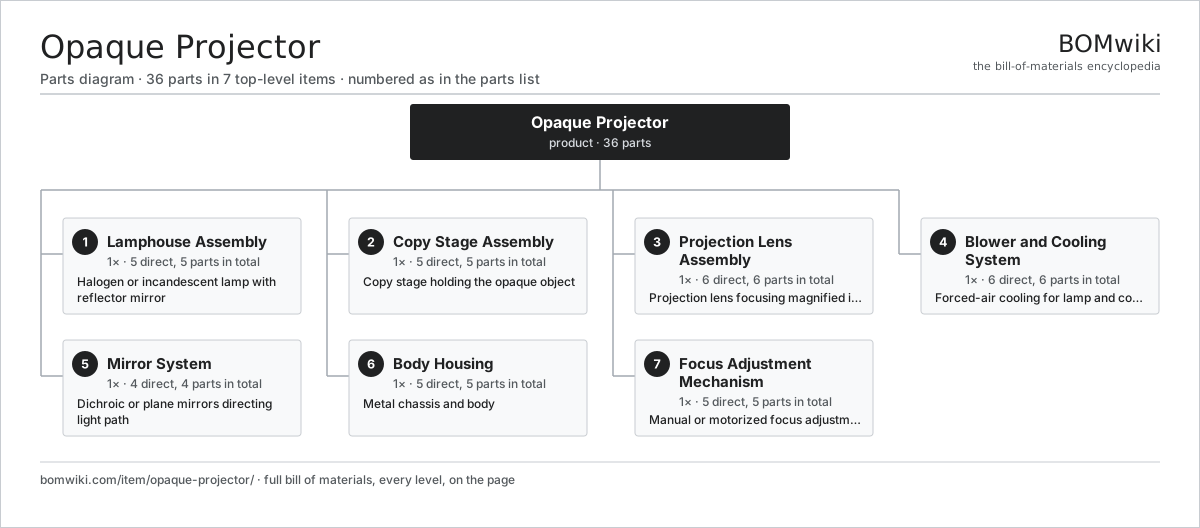
| # | Part | Qty | What it does |
|---|---|---|---|
| 1 | Lamphouse Assembly 5 parts | 1× | Halogen or incandescent lamp with reflector mirror |
| 2 | Copy Stage Assembly 5 parts | 1× | Copy stage holding the opaque object |
| 3 | Projection Lens Assembly 6 parts | 1× | Projection lens focusing magnified image on screen |
| 4 | Blower and Cooling System 6 parts | 1× | Forced-air cooling for lamp and condenser |
| 5 | Mirror System 4 parts | 1× | Dichroic or plane mirrors directing light path |
| 6 | Body Housing 5 parts | 1× | Metal chassis and body |
| 7 | Focus Adjustment Mechanism 5 parts | 1× | Manual or motorized focus adjustment |
3D model
No 3D model yet. Have a CAD file of this? Add a 3D model. STL renders right on this page; STEP, FreeCAD, and OpenSCAD sources are welcome too (openly licensed, like all 3D models on BOMwiki).
Build & assembly graph
expand / collapse · shared sub-assemblies converge · links to related products · est. labourTap an assembly to expand/collapse · tap a part to open it · use “Open page” for any node · drag to pan, scroll to zoom.
Bill of materials for Opaque Projector
7 top-level lines · 43 rows shown · 36 parts total · indented to 3 levels| # | Item / sub-assembly | Part no. | Qty/assy | Ext. qty | Parts | Type |
|---|---|---|---|---|---|---|
| 1 | Lamphouse Assembly 5 parts | opaque-projector-lamphouse | 1× | 1 | 5 | assembly |
| 1.1 | Halogen Lamp | opaque-projector-lamp | 1× | 1 | · | part |
| 1.2 | Lamp Reflector | opaque-projector-lamp-reflector | 1× | 1 | · | part |
| 1.3 | Lamp Housing | opaque-projector-lamp-housing | 1× | 1 | · | part |
| 1.4 | Thermal Cutoff Fuse | opaque-projector-thermal-cutoff | 1× | 1 | · | part |
| 1.5 | Fastener Set | fastener-set | 1× | 1 | · | part |
| 2 | Copy Stage Assembly 5 parts | opaque-projector-stage | 1× | 1 | 5 | assembly |
| 2.1 | Stage Glass Platen | opaque-projector-stage-glass-plate | 1× | 1 | · | part |
| 2.2 | Stage Surround Mask | opaque-projector-stage-surround | 1× | 1 | · | part |
| 2.3 | Condenser Lens | opaque-projector-condenser-lens | 1× | 1 | · | part |
| 2.4 | Stage Level Adjustment Screws | opaque-projector-stage-adjustment-screws | 1× | 1 | · | part |
| 2.5 | Fastener Set | fastener-set | 1× | 1 | · | part |
| 3 | Projection Lens Assembly 6 parts | opaque-projector-lens-assembly | 1× | 1 | 6 | assembly |
| 3.1 | Primary Projection Lens | opaque-projector-lens-primary | 1× | 1 | · | part |
| 3.2 | Secondary Projection Lens | opaque-projector-lens-secondary | 1× | 1 | · | part |
| 3.3 | Field Flattener | opaque-projector-lens-tertiary | 1× | 1 | · | part |
| 3.4 | Lens Barrel | opaque-projector-lens-barrel | 1× | 1 | · | part |
| 3.5 | Iris Diaphragm | opaque-projector-lens-diaphragm | 1× | 1 | · | part |
| 3.6 | Focus Helicoid | opaque-projector-focus-helicoid | 1× | 1 | · | part |
| 4 | Blower and Cooling System 6 parts | opaque-projector-blower-cooling | 1× | 1 | 6 | assembly |
| 4.1 | Blower Motor | opaque-projector-blower-motor | 1× | 1 | · | part |
| 4.2 | Fan Blade | opaque-projector-fan-blade | 1× | 1 | · | part |
| 4.3 | Air Inlet Filter | opaque-projector-air-inlet-filter | 1× | 1 | · | part |
| 4.4 | Air Duct | opaque-projector-air-duct | 1× | 1 | · | part |
| 4.5 | Thermal Control Sensor | opaque-projector-thermal-sensor | 1× | 1 | · | part |
| 4.6 | Fastener Set | fastener-set | 1× | 1 | · | part |
| 5 | Mirror System 4 parts | opaque-projector-mirror-system | 1× | 1 | 4 | assembly |
| 5.1 | Primary Optical Mirror | opaque-projector-mirror-primary | 1× | 1 | · | part |
| 5.2 | Secondary Optical Mirror | opaque-projector-mirror-secondary | 1× | 1 | · | part |
| 5.3 | Mirror Adjustment Mount | opaque-projector-mirror-mount | 1× | 1 | · | part |
| 5.4 | Fastener Set | fastener-set | 1× | 1 | · | part |
| 6 | Body Housing 5 parts | opaque-projector-body-housing | 1× | 1 | 5 | assembly |
| 6.1 | Base Plate | opaque-projector-base-plate | 1× | 1 | · | part |
| 6.2 | Side Panels | opaque-projector-side-panels | 1× | 1 | · | part |
| 6.3 | Top Cover | opaque-projector-top-cover | 1× | 1 | · | part |
| 6.4 | Power Cord Inlet | opaque-projector-power-cord-inlet | 1× | 1 | · | part |
| 6.5 | Fastener Set | fastener-set | 1× | 1 | · | part |
| 7 | Focus Adjustment Mechanism 5 parts | opaque-projector-focus-mechanism | 1× | 1 | 5 | assembly |
| 7.1 | Focus Rack-and-Pinion | opaque-projector-focus-gear | 1× | 1 | · | part |
| 7.2 | Focus Control Knob | opaque-projector-focus-knob | 1× | 1 | · | part |
| 7.3 | Focus Distance Scale | opaque-projector-focus-scale | 1× | 1 | · | part |
| 7.4 | Focus Travel Stop | opaque-projector-focus-stop | 1× | 1 | · | part |
| 7.5 | Fastener Set | fastener-set | 1× | 1 | · | part |
Something wrong in this list? Report a problem with this BOM.
Sourcing: possible vendors
Browse the supplier directory → Prices, MOQ, and lead times are algorithmic estimates, not quotes, and not claims about these companies. Company mappings are curated by keyword; est. price band $100–$8k. How estimates work| Vendor | HQ | Specialty | MOQ | Lead time |
|---|---|---|---|---|
|
🇯🇵Canon
canon.com ↗
|
Tokyo, JP | Imaging & optics | 500 units | 10–16 wks |
|
🇯🇵Nikon
nikon.com ↗
|
Tokyo, JP | Imaging & optics | 500 units | 10–16 wks |
|
🇩🇪ZEISS
zeiss.com ↗
|
Oberkochen, DE | Optics & optoelectronics | 500 units | 10–16 wks |
| leica-camera.com ↗ | Wetzlar, DE | Cameras & optics | 500 units | 10–16 wks |
| flir.com ↗ | Wilsonville, US | Thermal imaging | 500 units | 10–16 wks |
1,211-word article