Operable Partition Wall
ProductOverview
Hotels sell the same ballroom three times a day by splitting it; schools turn a gym into classrooms. The operable partition is the machine that makes this work acoustically: a train of Acoustic Panels, each about 1.2 m wide and weighing up to 350 kg, hung from an Overhead Track above the ceiling. Stored, the panels nest in a closet-sized pocket off the room. Deployed, they interlock edge-to-edge and clamp between ceiling and floor to form a wall rated STC 50–56, comparable to a permanent double-stud partition, with no floor track to trip over.
The individual-panel top-hung type described here dominates large venues. Paired and continuously-hinged variants trade stacking flexibility for faster setup, and vertically-folding versions lift the wall into the ceiling for spaces that cannot spare a pocket.
Acoustics is the whole game
A movable wall is judged almost entirely on sound. Each panel is a mass-spring-mass sandwich: steel face skins and a bonded Gypsum Skin on each side provide mass, the Insulation Core of mineral wool damps the cavity, and the welded Panel Frame holds it rigid. But panel STC is the easy part; the rating of the installed wall is set by its joints. Every path is sealed mechanically. Vertical joints close through the Panel Interlock: a Male Astragal tongue on one edge enters the Female Astragal groove of the next, compressing Joint Gaskets and breaking line-of-sight through the joint.
Top and bottom are closed by the Retractable Seals. Turning the Seal Operator crank drives the Bottom Seal down as much as 50 mm onto the floor and the Top Seal up against the track soffit; the same stroke jacks the panel slightly so its weight loads the floor seal. Field performance (NIC) still lands 5–10 points below the lab STC, and the difference is usually flanking, sound sneaking over the track through an unsealed ceiling plenum, which is why specifications require a full-height acoustic barrier above the track line.
Suspension and operation
Each panel hangs from two Trolley Carrier carriers whose four wheels ride inside the Track Extrusion. All-directional trolleys swivel through Track Switch turnouts, letting panels leave the operating line and park in a remote pocket in any orientation. Track is hung from building steel on Hanger Rods at roughly 1.2 m centers, the structure above must be designed for the wall, since a 12-panel run concentrates 3–4 tonnes along one line, and ASTM E557 makes deflection limits at the track the installer's first checkpoint. Track Splices align rail joints within half a millimetre; a misaligned splice telegraphs as a clunk in every setup for the life of the building.
Setting the wall is a one-person job. Panels are walked out of the pocket one at a time (under 60 N of push), steered along the track, and pressed together so the astragals engage. The last panel is the Expanding Closure Panel: its Jack Screw, driven by the removable Crank Handle, telescopes the Closure Jamb about 100 mm into the wall-mounted Wall Jamb, compressing every gasket in the train at once. Electric self-driving versions motorize the trolleys and seals so the wall deploys from a key switch.
Pass doors and details
A Pass Door built into one panel lets staff and students cross without breaking the wall down; its Door Leaf matches the host panel construction and an automatic Drop Seal closes the threshold, though a door panel still costs the wall several STC points and is placed away from the most sound-critical bays. Faces take Fabric Finish in fabric, vinyl, markerboard, or veneer, and edge wear is carried by the aluminum Edge Rails rather than the finish.
Maintenance is mostly discipline: seals operated before anyone leans on the wall, trolleys kept clean, and track alignment checked annually. The dominant failure mode is not acoustic decay but abuse, panels slammed into the pocket, or seals dragged extended, which is why venues assign wall setup to trained staff rather than leaving the crank in the room.
Operable Partition Wall parts and their functions
7 top-level parts · 298 parts in total · full bill of materials below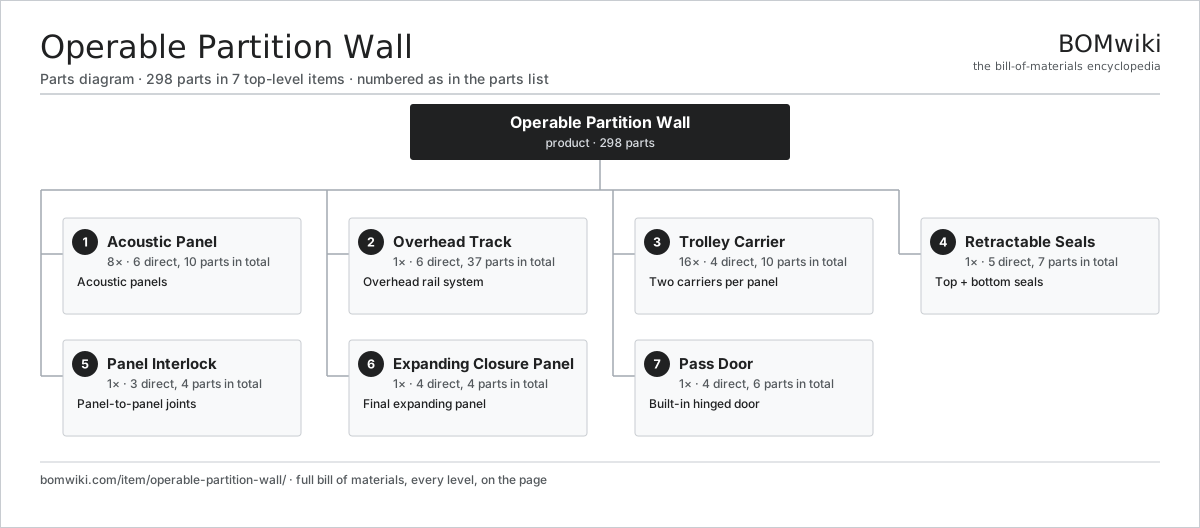
| # | Part | Qty | What it does |
|---|---|---|---|
| 1 | Acoustic Panel 6 parts | 8× | Acoustic panels |
| 2 | Overhead Track 6 parts | 1× | Overhead rail system |
| 3 | Trolley Carrier 4 parts | 16× | Two carriers per panel |
| 4 | Retractable Seals 5 parts | 1× | Top + bottom seals |
| 5 | Panel Interlock 3 parts | 1× | Panel-to-panel joints |
| 6 | Expanding Closure Panel 4 parts | 1× | Final expanding panel |
| 7 | Pass Door 4 parts | 1× | Built-in hinged door |
3D model
No 3D model yet. Have a CAD file of this? Add a 3D model. STL renders right on this page; STEP, FreeCAD, and OpenSCAD sources are welcome too (openly licensed, like all 3D models on BOMwiki).
Build & assembly graph
expand / collapse · shared sub-assemblies converge · links to related products · est. labourTap an assembly to expand/collapse · tap a part to open it · use “Open page” for any node · drag to pan, scroll to zoom.
Bill of materials for Operable Partition Wall
7 top-level lines · 39 rows shown · 298 parts total · indented to 3 levels| # | Item / sub-assembly | Part no. | Qty/assy | Ext. qty | Parts | Type |
|---|---|---|---|---|---|---|
| 1 | Acoustic Panel 6 parts | operable-partition-wall-panel | 8× | 8 | 10 | assembly |
| 1.1 | Panel Frame | operable-partition-wall-panel-frame | 1× | 8 | · | part |
| 1.2 | Gypsum Skin | operable-partition-wall-gypsum-skin | 2× | 16 | · | part |
| 1.3 | Sheet Metal Panel | sheet-panel | 2× | 16 | · | part |
| 1.4 | Insulation Core | operable-partition-wall-insulation-core | 1× | 8 | · | part |
| 1.5 | Fabric Finish | operable-partition-wall-fabric-finish | 2× | 16 | · | part |
| 1.6 | Edge Rail | operable-partition-wall-edge-rail | 2× | 16 | · | part |
| 2 | Overhead Track 6 parts | operable-partition-wall-track | 1× | 1 | 37 | assembly |
| 2.1 | Track Extrusion | operable-partition-wall-track-extrusion | 6× | 6 | · | part |
| 2.2 | Track Splice | operable-partition-wall-track-splice | 5× | 5 | · | part |
| 2.3 | Support Bracket | operable-partition-wall-support-bracket | 12× | 12 | · | part |
| 2.4 | Hanger Rod | operable-partition-wall-hanger-rod | 12× | 12 | · | part |
| 2.5 | Track Switch | operable-partition-wall-track-switch | 1× | 1 | · | part |
| 2.6 | Fastener Set | fastener-set | 1× | 1 | · | part |
| 3 | Trolley Carrier 4 parts | operable-partition-wall-trolley | 16× | 16 | 10 | assembly |
| 3.1 | Trolley Body | operable-partition-wall-trolley-body | 1× | 16 | · | part |
| 3.2 | Trolley Wheel | operable-partition-wall-trolley-wheel | 4× | 64 | · | part |
| 3.3 | Ball Bearing | ball-bearing | 4× | 64 | · | part |
| 3.4 | Pendant Bolt | operable-partition-wall-pendant-bolt | 1× | 16 | · | part |
| 4 | Retractable Seals 5 parts | operable-partition-wall-seals | 1× | 1 | 7 | assembly |
| 4.1 | Top Seal | operable-partition-wall-top-seal | 1× | 1 | · | part |
| 4.2 | Bottom Seal | operable-partition-wall-bottom-seal | 1× | 1 | · | part |
| 4.3 | Seal Operator | operable-partition-wall-seal-operator | 1× | 1 | · | part |
| 4.4 | Coil Spring | coil-spring | 2× | 2 | · | part |
| 4.5 | Sweep Strip | operable-partition-wall-sweep-strip | 2× | 2 | · | part |
| 5 | Panel Interlock 3 parts | operable-partition-wall-interlock | 1× | 1 | 4 | assembly |
| 5.1 | Male Astragal | operable-partition-wall-astragal-male | 1× | 1 | · | part |
| 5.2 | Female Astragal | operable-partition-wall-astragal-female | 1× | 1 | · | part |
| 5.3 | Joint Gasket | operable-partition-wall-joint-gasket | 2× | 2 | · | part |
| 6 | Expanding Closure Panel 4 parts | operable-partition-wall-closure | 1× | 1 | 4 | assembly |
| 6.1 | Jack Screw | operable-partition-wall-jack-screw | 1× | 1 | · | part |
| 6.2 | Crank Handle | operable-partition-wall-crank-handle | 1× | 1 | · | part |
| 6.3 | Closure Jamb | operable-partition-wall-closure-jamb | 1× | 1 | · | part |
| 6.4 | Wall Jamb | operable-partition-wall-wall-jamb | 1× | 1 | · | part |
| 7 | Pass Door 4 parts | operable-partition-wall-pass-door | 1× | 1 | 6 | assembly |
| 7.1 | Door Leaf | operable-partition-wall-door-leaf | 1× | 1 | · | part |
| 7.2 | Door Hinge | operable-partition-wall-door-hinge | 3× | 3 | · | part |
| 7.3 | Door Latch | operable-partition-wall-door-latch | 1× | 1 | · | part |
| 7.4 | Drop Seal | operable-partition-wall-drop-seal | 1× | 1 | · | part |
Something wrong in this list? Report a problem with this BOM.
Related products
same domain, ranked by shared parts Automatic Swing Door Operator
43 parts · shares 3 with this page
Automatic Swing Door Operator
43 parts · shares 3 with this page
 Formwork Table System
449 parts · shares 3 with this page
Formwork Table System
449 parts · shares 3 with this page
 Tunnel Form System
559 parts · shares 3 with this page
Tunnel Form System
559 parts · shares 3 with this page
 Vault Door
60 parts · shares 3 with this page
Vault Door
60 parts · shares 3 with this page
 Access Control Panel
52 parts · shares 2 with this page
Automatic Smoke Vent
60 parts · shares 2 with this page
Access Control Panel
52 parts · shares 2 with this page
Automatic Smoke Vent
60 parts · shares 2 with this page
Sourcing: possible vendors
Browse the supplier directory → Prices, MOQ, and lead times are algorithmic estimates, not quotes, and not claims about these companies. Company mappings are curated by keyword; est. price band $50–$10k. How estimates work| Vendor | HQ | Specialty | MOQ | Lead time |
|---|---|---|---|---|
| assaabloy.com ↗ | Stockholm, SE | Locks & access | 1,000 units | 8–12 wks |
|
🇺🇸Allegion
allegion.com ↗
|
Dublin, US | Security products (Schlage) | 1,000 units | 8–12 wks |
| dormakaba.com ↗ | Rümlang, CH | Access & door systems | 1,000 units | 8–12 wks |
| honeywell.com ↗ | Charlotte, US | Building & safety tech | 1,000 units | 8–12 wks |
| hikvision.com ↗ | Hangzhou, CN | Surveillance & security | 1,000 units | 8–12 wks |
768-word article