Optical Level
ProductOverview
An optical level is a non-electronic precision instrument that measures vertical height differences and horizontal angles by sighting through a collimated telescope with an internal automatic compensator. Unlike transit theodolites or total stations, optical levels lack servo motors and electronic encoders, relying instead on the observer's manual aiming skill and a mechanical pendulum-suspended prism that self-levels the optical axis. This simplicity makes optical levels rugged, require no batteries, and immune to electronic drift, ideal for long-term deformation monitoring, dam safety inspection, and classical leveling networks where centimeter-scale accuracy over kilometers is paramount.
Optical levels remain the standard in civil engineering survey, especially in countries with mature leveling datum networks (Europe, Japan) where legal requirements mandate precise vertical control. They excel at establishing elevation contours, guiding foundation excavation, and detecting structural settlement.
How it works
The observer positions the level on a tripod, uses three leveling screws to center a bubble in the spirit level vial, and sights through the Telescope Assembly. Targets are typically graduated leveling staffs (rods marked in decimeters and centimeters) held vertically on points of interest. The crosshair and stadia hairs in the eyepiece are aligned on the target rod, and the reading is recorded. The key advantage: the instrument's internal automatic compensator ensures the line of sight is truly horizontal regardless of small tripod tilt or uneven ground. This passive self-leveling is performed by the Pendulum Wedge, a suspended optical wedge that gravitationally aligns itself; damping is provided by a magnetic fluid damper to suppress oscillations.
The horizontal circle allows the operator to measure horizontal angles between points, although this is a secondary function; the instrument's primary purpose is vertical leveling.
Optical path and magnification
Light from the staff enters the objective lens (50 mm, 50 mm focal length, f/1 design). The objective forms an inverted real image at an intermediate focal plane where the Reticle Pattern is located. The internal prism train (roof, Porro, and diagonal prisms) erects this image so that the observer sees a normal, upright view of the rod. The Eyepiece Lens provides 32× magnification and a wide apparent field (50°), allowing easy location of distant staffs and fine targeting. Total optical path length is about 180 mm, enabling compact instrument design.
Stadia distances can be estimated: the distance between the upper and lower stadia hairs subtends 1° at the objective, so the distance d = 100 × (upper reading − lower reading) in meters. This allows rough distances without a rangefinder, useful for contour mapping and checking sight distance limitations in leveling runs.
Automatic pendulum compensator
The Automatic Compensator is the heart of the level. A glass Pendulum Wedge (a precision-ground wedge, 5–8 mm thick) is suspended by thin steel wires or springs inside the instrument body, just above the prism train. If the instrument tips ±0.3° from horizontal, gravity causes the wedge to rotate relative to the fixed prisms, bending light rays to correct the optical axis back to horizontal. The magnetic damper (fixed magnet + conductive fluid) prevents the wedge from oscillating; settling time is <1 second.
This passive, gravity-driven compensation tolerates tripod leveling errors of a few millimeters over 30–50 meters, eliminating the need for electronic servo correction. Disadvantages: the compensator does not function outside the ±0.3° range, so rough leveling with the bubble vial is still required. Cold temperatures (below −10 °C) increase damper viscosity and slow settling; high temperatures can decrease damping efficiency. Most survey teams avoid using optical levels in extreme cold or heat.
Leveling accuracy and network design
Classical leveling achieves ±2–3 mm per kilometer (one direction) through repeated backsight/foresight measurements:
- Set instrument at midpoint between two staffs, A (backsight) and B (foresight).
- Read A, then B; the difference is elevation change (B − A).
- Move forward, repeat.
By double-running (forward and reverse direction), and using careful staff techniques (staff bubbles, foot-plates, temperature corrections), surveyors achieve ±1–2 mm per km. Leveling loops that return to a known benchmark can be closed to ±5–10 mm over 5–10 km routes, suitable for precise datum establishment.
The horizontal circle is graduated in 1° increments with a 5-minute vernier (12 marks spanning 1°), readable to ±5 arcminutes. This is sufficient for mapping angles in detail surveys but not precision angle work; theodolites are preferred for high-angle accuracy.
Leveling staffs and field procedure
Staffs (rods) are typically 4 meters long, graduated in decimeters (0.1 m) with bold numerals every 0.5 m. The staff holder wears a shoe-plate and uses a bubble level to keep the staff vertical. The instrument operator reads the center hair against the graduated face; upper and lower stadia hairs give distance. Readings are to the nearest 1 mm. Typical fore/backsight distances are 30–50 meters, limited by staff visibility; longer sights (100 m) are possible in clear light but degrade accuracy due to atmospheric refraction. High-precision work limits sights to <30 m.
Practical deployment
Field teams consist of two people: an instrument operator and a rod person. Setup (tripod, rough leveling, plummeting over benchmark) takes 5 minutes. Measurement cycles are manual, sighting and recording, so experienced crews run 10–20 stations per hour. Battery-free operation is a major advantage in remote areas and long-term monitoring installations (permanent benchmarks on dams, buildings, bridges). An optical level can run for decades without electronic repair. Disadvantages: no real-time display of computed elevation (the operator must post-process readings), slower than electronic levels in built-up areas, and total stations are now preferred when angle and distance are needed simultaneously. However, when the task is purely vertical accuracy over long baselines (profiling a 100 km pipeline corridor, checking dam settlement trends over years), optical levels remain the standard.
Optical Level parts and their functions
6 top-level parts · 25 parts in total · full bill of materials below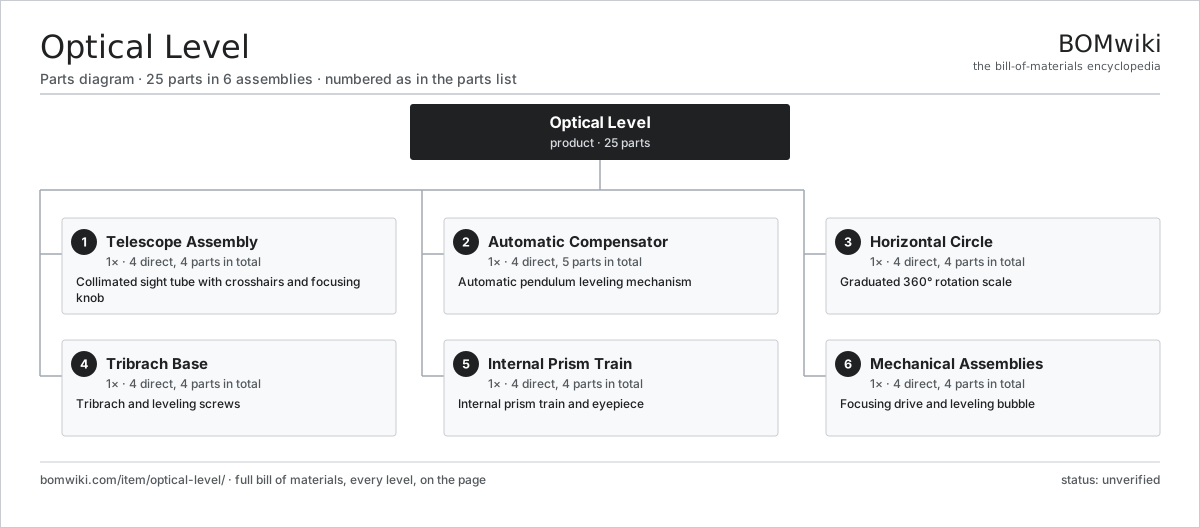
| # | Part | Qty | What it does |
|---|---|---|---|
| 1 | Telescope Assembly 4 parts | 1× | Collimated sight tube with crosshairs and focusing knob |
| 2 | Automatic Compensator 4 parts | 1× | Automatic pendulum leveling mechanism |
| 3 | Horizontal Circle 4 parts | 1× | Graduated 360° rotation scale |
| 4 | Tribrach Base 4 parts | 1× | Tribrach and leveling screws |
| 5 | Internal Prism Train 4 parts | 1× | Internal prism train and eyepiece |
| 6 | Mechanical Assemblies 4 parts | 1× | Focusing drive and leveling bubble |
3D model
No 3D model yet. Have a CAD file of this? Add a 3D model — STL renders right on this page; STEP, FreeCAD, and OpenSCAD sources are welcome too (openly licensed, like all 3D models on BOMwiki).
Build & assembly graph
expand / collapse · shared sub-assemblies converge · links to related products · est. labourTap an assembly to expand/collapse · tap a part to open it · use “Open page” for any node · drag to pan, scroll to zoom.
Bill of materials for Optical Level
6 top-level lines · 30 rows shown · 25 parts total · indented to 3 levels| # | Item / sub-assembly | Part no. | Qty/assy | Ext. qty | Parts | Type |
|---|---|---|---|---|---|---|
| 1 | Telescope Assembly 4 parts | optical-level-telescope | 1× | 1 | 4 | assembly |
| 1.1 | Lens Assembly | camera-lens | 1× | 1 | · | part |
| 1.2 | Reticle Pattern | optical-level-reticle | 1× | 1 | · | part |
| 1.3 | Eyepiece Lens | optical-level-eyepiece | 1× | 1 | · | part |
| 1.4 | Coil Spring | coil-spring | 1× | 1 | · | part |
| 2 | Automatic Compensator 4 parts | optical-level-compensator | 1× | 1 | 5 | assembly |
| 2.1 | Pendulum Wedge | optical-level-pendulum-prism | 1× | 1 | · | part |
| 2.2 | Coil Spring | coil-spring | 2× | 2 | · | part |
| 2.3 | Magnetic Damper | optical-level-damper | 1× | 1 | · | part |
| 2.4 | Neodymium Magnet | neodymium-magnet | 1× | 1 | · | part |
| 3 | Horizontal Circle 4 parts | optical-level-horizontal-circle | 1× | 1 | 4 | assembly |
| 3.1 | Horizontal Scale | optical-level-circle-glass | 1× | 1 | · | part |
| 3.2 | Vernier Index | optical-level-index-glass | 1× | 1 | · | part |
| 3.3 | Encoder | encoder | 1× | 1 | · | part |
| 3.4 | Fastener Set | fastener-set | 1× | 1 | · | part |
| 4 | Tribrach Base 4 parts | optical-level-base | 1× | 1 | 4 | assembly |
| 4.1 | Tribrach Casting | optical-level-tribrach-body | 1× | 1 | · | part |
| 4.2 | Leveling Thumb Screws | optical-level-level-screws | 1× | 1 | · | part |
| 4.3 | Optical Plummet | optical-level-plummet-lens | 1× | 1 | · | part |
| 4.4 | Fastener Set | fastener-set | 1× | 1 | · | part |
| 5 | Internal Prism Train 4 parts | optical-level-optics | 1× | 1 | 4 | assembly |
| 5.1 | Roof Prism | optical-level-prism-1 | 1× | 1 | · | part |
| 5.2 | Porro Prism | optical-level-prism-2 | 1× | 1 | · | part |
| 5.3 | Diagonal Prism | optical-level-prism-3 | 1× | 1 | · | part |
| 5.4 | SMD Passive (R/C/L) | smd-passives | 1× | 1 | · | part |
| 6 | Mechanical Assemblies 4 parts | optical-level-mechanical | 1× | 1 | 4 | assembly |
| 6.1 | Focusing Helical | optical-level-focus-helical | 1× | 1 | · | part |
| 6.2 | Spirit Level Vial | optical-level-bubble-vial | 1× | 1 | · | part |
| 6.3 | Instrument Barrel | optical-level-body-tube | 1× | 1 | · | part |
| 6.4 | Fastener Set | fastener-set | 1× | 1 | · | part |
Related products
same domain, ranked by shared parts Digital Theodolite
26 parts · shares 3 with this page
Digital Theodolite
26 parts · shares 3 with this page
 Scanning Electron Microscope
1,000 parts · shares 3 with this page
Scanning Electron Microscope
1,000 parts · shares 3 with this page
 Analytical Balance
54 parts · shares 2 with this page
Analytical Balance
54 parts · shares 2 with this page
 Fatigue Testing Rig
412 parts · shares 2 with this page
Fatigue Testing Rig
412 parts · shares 2 with this page
Sourcing: possible vendors
Prices, MOQ, and lead times are algorithmic estimates, not quotes, and not claims about these companies. Company mappings are curated by keyword; est. price band $1k–$500k. How estimates work| Vendor | HQ | Specialty | MOQ | Lead time |
|---|---|---|---|---|
| thermofisher.com ↗ | Waltham, US | Lab instruments | 100 units | 10–18 wks |
|
🇺🇸Agilent
agilent.com ↗
|
Santa Clara, US | Analytical instruments | 100 units | 10–18 wks |
|
🇺🇸Bruker
bruker.com ↗
|
Billerica, US | Scientific instruments | 100 units | 10–18 wks |
|
🇯🇵Shimadzu
shimadzu.com ↗
|
Kyoto, JP | Analytical instruments | 100 units | 10–18 wks |
|
🇺🇸Waters
waters.com ↗
|
Milford, US | Chromatography & MS | 100 units | 10–18 wks |
1,012-word article