Orbital Shaker
ProductOverview
An orbital shaker is a laboratory mixing device that imparts rapid circular motion to culture flasks, reagent bottles, or sample containers. A motorized eccentric cam on the shaker's mainshaft drives a cast-iron platform up/down and side-to-side in a small circular orbit (10–20 mm diameter). Flasks mounted on the platform via spring-loaded clamps follow this orbital motion, creating turbulent mixing without active mechanical stirring (impellers). This gentle mixing is ideal for bacterial culture aeration, enzyme reactions, immunoassays, and particle suspension. Speed is continuously variable from 20 to 500 rpm via a potentiometer dial or digital interface driving a variable-frequency AC/DC motor. Smaller benchtop models (35–50 kg) fit on lab benches; larger floor-mounted versions (200+ kg) serve high-throughput applications with 8–16 flasks simultaneously. Orbital shakers are workhorses in microbiology, biotechnology, and analytical labs wherever gentle, scalable mixing is needed without contamination risk (no seals, no stirring shaft).
Eccentric Cam Drive Principle
The shaker operates via a rotating eccentric offset on the motor shaft. As the mainshaft spins at 20–500 rpm, the offset eccentric (10–20 mm radius) traces a circle, causing the deck to orbit at the same frequency. This circular motion is fundamentally different from linear reciprocating (to-and-fro) motion: an orbital shaker creates distributed acceleration vectors acting simultaneously in horizontal and vertical planes, inducing both axial mixing (vertical sloshing) and radial mixing (swirling).
Platform Orbit Trajectory: At 200 rpm with a 15 mm offset, a point on the platform traces a circle:
- Frequency: 200 rpm = 3.33 Hz
- Centripetal acceleration: a = ω²r = (3.33 × 2π)² × 0.015 = ~5.2 m/s² ≈ 0.5 g
This acceleration is sufficient to suspend particles, maintain cell suspension, and aerate aerobic cultures without violent sloshing that would damage fragile cells.
Motor and Speed Control
The motor is a brushless EC (electronically commuted) motor operating at 0.5–1 kW continuous power. EC motors offer advantages over brushed DC:
- Low noise: ~65–75 dB at 500 rpm (vs. 85+ dB brush noise)
- Long life: No brush wear (3000+ hr MTBF)
- Smooth torque: Hall-effect commutation at 1 ms intervals
- Variable speed: External VFD (variable-frequency drive) adjusts 0.1–100 Hz PWM to control motor speed from 20 to 500 rpm continuously
A potentiometer dial (or digital touchscreen on advanced models) inputs a 0–10 V command voltage to the VFD, which adjusts motor speed proportionally. An optional countdown timer (1 min to 999 hr) auto-stops the shaker when the experiment duration elapses.
Speed Selection for Applications:
- 50–100 rpm: Mammalian cell cultures, gentle mixing of viscous samples
- 200–250 rpm: Bacterial cultures (E. coli, yeast), routine incubations
- 300–400 rpm: High-aeration applications (Bacillus spore cultures), immunoassay incubations
- 450–500 rpm: Particle resuspension, dissolution testing, aggregation studies
Coupling and Torque Transmission
A flexible elastomeric coupling connects the motor to the drive pulley, accommodating minor shaft misalignment and reducing shock loads. A HTD (High Torque Drive) belt with a 10:1 speed reduction gear ratio steps down the motor shaft speed, increasing torque available to drive the heavy cast-iron deck smoothly at high acceleration.
Example: Motor running 5000 rpm reduced 10:1 = 500 rpm deck speed, with belt tension maintaining constant power transmission.
Flask Mounting and Clamps
The platform has 4 spring-loaded flask clamps positioned symmetrically around the deck corners. Each clamp consists of a lever arm with neoprene-padded jaws that grip the flask neck (typical 30–50 mm diameter). The clamps:
- Allow quick one-handed flask insertion/removal
- Prevent flask migration during rapid orbital motion
- Distribute clamping force uniformly to avoid flask breakage
- Accommodate various flask sizes and shapes (Erlenmeyer, baffled, square bottles)
Typical flask loads:
- 4 × 1 L Erlenmeyer = 4 kg liquid + 0.6 kg flask = 4.6 kg total
- 2 × 2 L baffled flask = 4 kg liquid + 1 kg flask = 5 kg total
- Maximum safe load: ~8–10 kg (checked by motor torque curve)
Vibration Isolation
The shaker is mounted on four rubber isolator pads positioned at each corner of the base frame. These elastomeric pads (natural rubber or silicone, Shore A 50) have a tuned natural frequency of ~50 Hz, matching the eccentric cam frequency range (200 rpm = 3.33 Hz is well below isolation threshold). At low frequencies, the isolators remain stiff (little isolation), but they prevent high-frequency vibration (mechanical resonances at 500+ Hz) from transmitting to the lab bench, reducing noise and protecting sensitive equipment nearby.
Bench Vibration: A shaker on an unpadded bench at 500 rpm can transmit ~0.2–0.5 mm vibration amplitude to the bench surface. With isolators, vibration is reduced 3–5×, keeping the bench quiet and stable for microscopy or balances nearby.
Heat Dissipation and Cooling
The motor dissipates heat via the metal frame and natural convection. At 1 kW continuous operation, typical waste heat is 150–250 W (efficiency ~75–85%). For continuous operation >8 hours, a small axial fan (optional accessory) can be mounted on the motor to improve cooling. Most benchtop installations don't require forced cooling due to intermittent use cycles (incubations typically run 6–24 hours, then cool down).
Mixing Efficiency and Oxygen Transfer
Aerobic Culture Aeration: An orbital shaker is highly effective for aerobic cultures:
- The continuous orbital motion creates a vortex at the flask bottom and splashing at the liquid surface, maximizing air-liquid interfacial area.
- Oxygen transfer rate (KLa) for a 1 L unbaffled Erlenmeyer at 200 rpm ≈ 20–30 h⁻¹, compared to static incubation (KLa ≈ 1–2 h⁻¹).
- Baffled flasks (with internal ribs) increase KLa by 50–100%, reaching 40–60 h⁻¹ at 300 rpm.
Cell Viability: Unlike high-shear centrifuges or sonication, the low-acceleration (~0.5 g) orbital motion is gentle on cells:
- Bacterial growth rate at 200 rpm is 90–95% of shaker-flask standard conditions.
- Mammalian cells in suspension show <5% damage at 100 rpm, 15–20% damage at 300 rpm.
Operational Modes
Incubation Mode: Continuous shaking at constant rpm (e.g., 200 rpm for 24 hours). Timer auto-stops the motor.
Pulse Mode (advanced models): Shake 30 sec, rest 10 sec, repeat. Reduces drying of samples and is gentler for sensitive cultures.
Temperature Control (with incubator accessory): Shaking chamber mounted in insulated enclosure with heating/cooling jacket (15–40°C typical range).
Maintenance and Troubleshooting
Weekly:
- Wipe platform and clamps of dust and spilled media.
- Listen for abnormal noise; check clamp tightness.
Monthly:
- Inspect HTD belt for wear (should be taut, no visible cracks).
- Test timer function and speed control dial.
- Lubricate the eccentric cam mainshaft with light machine oil (3–4 drops into oil-port).
Quarterly:
- Replace HTD belt if worn (typical 2–3 year life).
- Check motor bearing temperature (should be <60°C at continuous 500 rpm).
- Recalibrate potentiometer if speed drifts significantly.
Common Issues:
| Problem | Cause | Solution |
|---|---|---|
| Vibration or noise at 200+ rpm | Eccentric cam unbalanced | Factory rebalancing required (~$200) |
| Speed doesn't reach 500 rpm | VFD output limited | Check potentiometer calibration; reset to max |
| Flask falls off at high speed | Worn clamp pads | Replace neoprene pads (~$20 kit) |
| Motor stutters at startup | Coupling misalignment | Loosen motor bolts, realign, retighten |
| Excessive heat from motor | Continuous 1 kW operation | Install optional cooling fan |
Related Applications
The orbital shaker integrates into:
- Bioreactor workflows: Upstream to fermentation in controlled tanks
- Immunoassay automation: Shake wells during enzyme/antibody incubations
- Dissolution testing (pharmaceuticals): Shake USP tablets in dissolution media
- Bacterial culture: Routine lab strain maintenance at 200 rpm
- Yeasts and fungi: Aerobic shaking at 250 rpm, 15–25°C
Orbital Shaker parts and their functions
5 top-level parts · 36 parts in total · full bill of materials below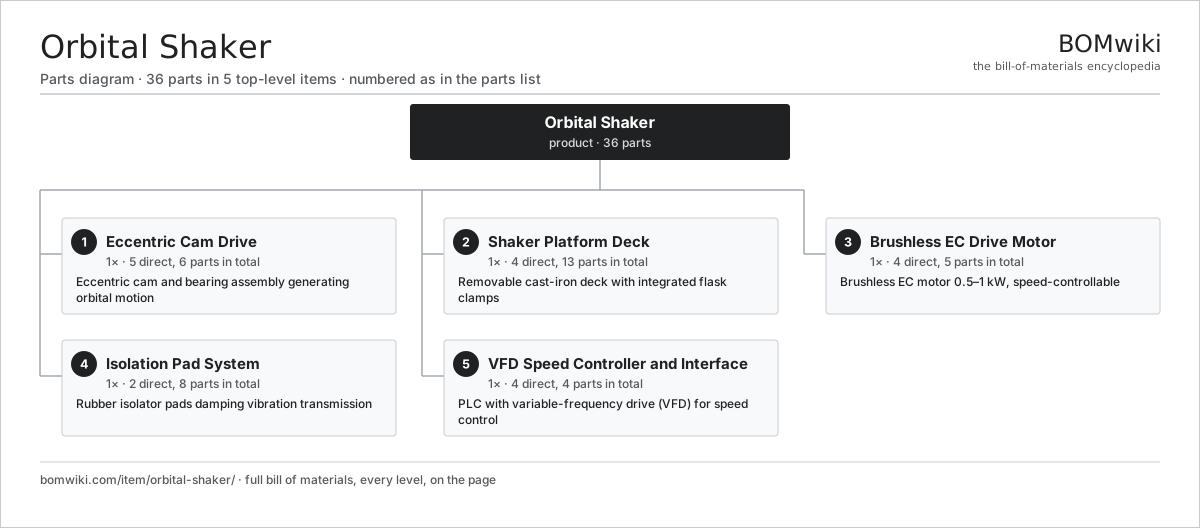
| # | Part | Qty | What it does |
|---|---|---|---|
| 1 | Eccentric Cam Drive 5 parts | 1× | Eccentric cam and bearing assembly generating orbital motion |
| 2 | Shaker Platform Deck 4 parts | 1× | Removable cast-iron deck with integrated flask clamps |
| 3 | Brushless EC Drive Motor 4 parts | 1× | Brushless EC motor 0.5–1 kW, speed-controllable |
| 4 | Isolation Pad System 2 parts | 1× | Rubber isolator pads damping vibration transmission |
| 5 | VFD Speed Controller and Interface 4 parts | 1× | PLC with variable-frequency drive (VFD) for speed control |
3D model
No 3D model yet. Have a CAD file of this? Add a 3D model. STL renders right on this page; STEP, FreeCAD, and OpenSCAD sources are welcome too (openly licensed, like all 3D models on BOMwiki).
Build & assembly graph
expand / collapse · shared sub-assemblies converge · links to related products · est. labourTap an assembly to expand/collapse · tap a part to open it · use “Open page” for any node · drag to pan, scroll to zoom.
Bill of materials for Orbital Shaker
5 top-level lines · 24 rows shown · 36 parts total · indented to 3 levels| # | Item / sub-assembly | Part no. | Qty/assy | Ext. qty | Parts | Type |
|---|---|---|---|---|---|---|
| 1 | Eccentric Cam Drive 5 parts | orbital-drive-mechanism | 1× | 1 | 6 | assembly |
| 1.1 | Eccentric Main Shaft | orbital-mainshaft | 1× | 1 | · | part |
| 1.2 | Hardened Eccentric Cam | orbital-cam-offset | 1× | 1 | · | part |
| 1.3 | Deep-Groove Ball Bearing | orbital-bearing-set | 2× | 2 | · | part |
| 1.4 | HTD Belt and Pulley Reduction | orbital-belt-drive | 1× | 1 | · | part |
| 1.5 | Flexible Motor Coupling | orbital-motor-coupling | 1× | 1 | · | part |
| 2 | Shaker Platform Deck 4 parts | orbital-platform | 1× | 1 | 13 | assembly |
| 2.1 | Cast-Iron Platform | orbital-deck-casting | 1× | 1 | · | part |
| 2.2 | Clamp Post Column | orbital-clamp-post | 4× | 4 | · | part |
| 2.3 | Spring-Loaded Flask Clamp | orbital-flask-clamp | 4× | 4 | · | part |
| 2.4 | Rubber Isolation Mount | orbital-deck-mounting-boss | 4× | 4 | · | part |
| 3 | Brushless EC Drive Motor 4 parts | orbital-motor | 1× | 1 | 5 | assembly |
| 3.1 | Motor Stator Assembly | orbital-motor-stator | 1× | 1 | · | part |
| 3.2 | Permanent Magnet Rotor | orbital-motor-rotor | 1× | 1 | · | part |
| 3.3 | Motor Deep-Groove Bearings | orbital-motor-bearings | 2× | 2 | · | part |
| 3.4 | Hall-Effect Commutation Module | orbital-motor-controller | 1× | 1 | · | part |
| 4 | Isolation Pad System 2 parts | orbital-vibration-isolation | 1× | 1 | 8 | assembly |
| 4.1 | Vibration Isolator Pad | orbital-isolator-pad | 4× | 4 | · | part |
| 4.2 | Isolation Stud Mount | orbital-isolator-stud | 4× | 4 | · | part |
| 5 | VFD Speed Controller and Interface 4 parts | orbital-control-unit | 1× | 1 | 4 | assembly |
| 5.1 | Variable Frequency Drive | orbital-vfd-drive | 1× | 1 | · | part |
| 5.2 | Speed Potentiometer Dial | orbital-speed-dial | 1× | 1 | · | part |
| 5.3 | Countdown Timer Module | orbital-timer-relay | 1× | 1 | · | part |
| 5.4 | Mains Power Input Module | orbital-power-supply | 1× | 1 | · | part |
Something wrong in this list? Report a problem with this BOM.
Sourcing: possible vendors
Browse the supplier directory → Prices, MOQ, and lead times are algorithmic estimates, not quotes, and not claims about these companies. Company mappings are curated by keyword; est. price band $1k–$500k. How estimates work| Vendor | HQ | Specialty | MOQ | Lead time |
|---|---|---|---|---|
| thermofisher.com ↗ | Waltham, US | Lab instruments | 100 units | 10–18 wks |
|
🇺🇸Agilent
agilent.com ↗
|
Santa Clara, US | Analytical instruments | 100 units | 10–18 wks |
|
🇺🇸Bruker
bruker.com ↗
|
Billerica, US | Scientific instruments | 100 units | 10–18 wks |
|
🇯🇵Shimadzu
shimadzu.com ↗
|
Kyoto, JP | Analytical instruments | 100 units | 10–18 wks |
|
🇺🇸Waters
waters.com ↗
|
Milford, US | Chromatography & MS | 100 units | 10–18 wks |
1,259-word article