Orchestra Pit Lift
ProductOverview
An orchestra pit lift is a specialized large-scale vertical elevator designed to raise and lower an entire orchestra platform between a sunken pit and the main stage of a theatre, concert hall, or opera house. Unlike standard industrial goods lifts, orchestra pit lifts prioritize smooth, synchronized motion over multiple lift points to ensure that 100–150 musicians and their instruments experience imperceptible tilting or vibration. The platform is typically 12×8 m or larger, weighing 5000–15000 kg including the orchestra.
The lift is driven by hydraulic cylinders (typically four, one at each corner) powered by a variable-displacement pump and controlled by a PLC that continuously monitors the height of each cylinder via position transducers, adjusting flow to maintain perfect synchronization. Modern systems can hold the platform level within ±5 mm across the entire span, even as individual musicians move or instruments are rearranged.
Orchestra pit lifts are found in major performance venues worldwide, from the Metropolitan Opera House in New York to the Sydney Opera House to the Bayreuth Festival Theatre. They enable rapid scene transitions between musical and theatrical performances, allowing the orchestra pit to serve as additional stage space when needed.
How it Works
Before performance, the orchestra pit lift is typically at its lowest position, with the platform flush with the pit floor. Musicians and their instruments are loaded onto the platform, and the conductor signals readiness. A stage manager or technician presses a raise button; the PLC energizes the main pump, which begins delivering pressurized hydraulic oil to the proportional directional valve.
The proportional valve routes flow to the lift cylinders (typically four, one at each corner of the platform). All cylinders are identical, and their rod-end pressures are equalized via a load-sensing synchronizer valve mounted in the manifold. This synchronizer is the key to smooth, level motion: it continuously compares the extension rate of each cylinder and adjusts the proportional valve spools to ensure that all cylinders extend at exactly the same rate.
Four position transducers, one mounted on each cylinder, feed real-time height information to the PLC. The PLC calculates the average height and checks that no cylinder has drifted more than ±5 mm from that average. If one cylinder lags slightly (due to a load imbalance or a microscopic seal drag), the PLC increases the proportional valve opening for that cylinder, delivering slightly more flow and bringing it back into synchronization within seconds.
As the platform rises, load increases gradually. The synchronizer maintains constant pressure across all cylinder rod-ends; the variable pump automatically compensates, adjusting its displacement to maintain the load-sensing pressure margin (typically 20–30 bar above the highest load pressure). This load-compensated design maintains smooth, constant-speed lifting regardless of load variations as musicians shift positions.
When the PLC detects that the platform has reached the desired stage level (via a fixed pressure-switch or a preset position count from the transducers), it signals the proportional valve to neutral. The pilot-operated relief valve in the manifold closes, trapping pressure in the cylinder rod-ends and holding the platform suspended indefinitely. The platform is now at stage level, level to within a few millimeters.
During the performance, the platform remains stationary. Once the performance segment is complete and the platform is ready to descend back to pit level, the operator presses the lower button. The proportional valve reverses, and a pilot-operated check valve (integral to the manifold) allows controlled return flow from the cylinder rod-ends back to the tank. The PLC modulates this return flow, maintaining constant descent speed (typically 0.1–0.3 m/s, slow enough to be imperceptible to seated musicians).
The position transducers continuously feed height data to the PLC; if one cylinder descends faster than the others (due to leakage or load shift), the PLC increases back-pressure on that cylinder, slowing its descent and maintaining synchronization.
When the platform reaches the pit floor level (detected by a zero-pressure transducer reading or a lower limit switch), the proportional valve returns to neutral, trapping the cylinders at full retraction. The lift is now ready for the next cycle.
Synchronization Technology
Perfect synchronization across multiple lift points is achieved through load-sensing hydraulics, where the pump adjusts its output pressure and displacement to match the actual load demand. The key component is the proportional load-sensing synchronizer, which compares the load pressure from each cylinder and automatically adjusts proportional valve openings to equalize flow to each cylinder.
In some systems, especially for larger platforms or specialized venues, electro-hydraulic proportional valves are replaced with advanced pilot-operated proportional spool valves that achieve even finer control. The PLC can adjust each valve independently at millisecond intervals based on transducer feedback, enabling synchronization to within ±1–2 mm.
For exceptional smoothness, some installations use accumulator-buffered descent systems: as the platform lowers, return flow is first routed through a nitrogen-charged accumulator before returning to the tank. The accumulator absorbs small pressure spikes and oscillations, further smoothing the motion and reducing perceptible jerking or vibration.
Safety and Emergency Operation
Orchestra pit lifts incorporate multiple safety features:
Mechanical Load-Holding: Each cylinder is a double-acting design with an integral pilot-operated check valve. If pump power is lost, the check valve traps fluid in the cylinder rod-ends, preventing uncontrolled descent. The platform will hold at any intermediate height indefinitely without power.
Pressure-Sensitive Edge: A continuous pressure-sensitive edge strip runs around the platform perimeter. If an obstruction contacts the platform during motion, the edge is compressed, triggering a safety relay that immediately de-energizes the proportional valve, halting the platform.
Position Monitoring: The position transducers provide continuous feedback. If one transducer indicates a position deviation of more than ±20 mm, the PLC triggers an audible alarm and stops the lift, alerting technicians to a potential issue.
Emergency Lower: If the main pump fails or power is lost, an auxiliary manual hydraulic pump (hand-cranked or air-powered) can be connected to the manifold, allowing technicians to slowly lower the platform to the pit floor without electrical power.
Redundant Relief Valves: The manifold contains both a main relief valve and secondary relief valves on individual cylinder circuits, protecting each lift point from overpressure.
Performance in Practice
A typical orchestra pit lift cycle (raise from pit to stage and lower back) takes 60–80 seconds. The smooth motion is typically imperceptible to seated musicians; speed is set to 0.15–0.25 m/s, corresponding to vertical accelerations of less than 0.01 g (10 mm/s²), well below the threshold for human perception (approximately 0.01–0.05 g).
Maintenance is straightforward: hydraulic fluid is changed every 2000–3000 operating hours (typically annually for busy theatres). Seal kits for cylinders are replaced during major servicing (every 5–10 years). The PLC and proportional valve electronics are solid-state with no moving parts and typically require no maintenance beyond visual inspection.
Noise during operation is minimal: the cooler fan may run during extended cycles, producing 70–75 dB, but this is generally not heard during performances. The hydraulic pump itself, running at moderate speed and pressure with load-sensing compensation, produces minimal noise.
Comparison with Alternative Systems
Scissor lifts (as in dock lifts) are mechanically simpler but require larger floor space and have shorter lift heights; they are rarely used for orchestra pits. Spiral screw lifts (using synchronized motor-driven screws) are an alternative to hydraulics but are more complex mechanically and less smooth in operation. Individual stage platforms on vertical rails can replace a large orchestra pit lift for smaller venues but lack the unified, symmetrical appearance of a single large platform.
For comparison, other large-scale platform lifts in theatres (such as stage elevators lifting entire set pieces) often use the same load-sensing synchronization technology but with different safety requirements (larger load capacities, different descent rates).
Orchestra Pit Lift parts and their functions
8 top-level parts · 955 parts in total · full bill of materials below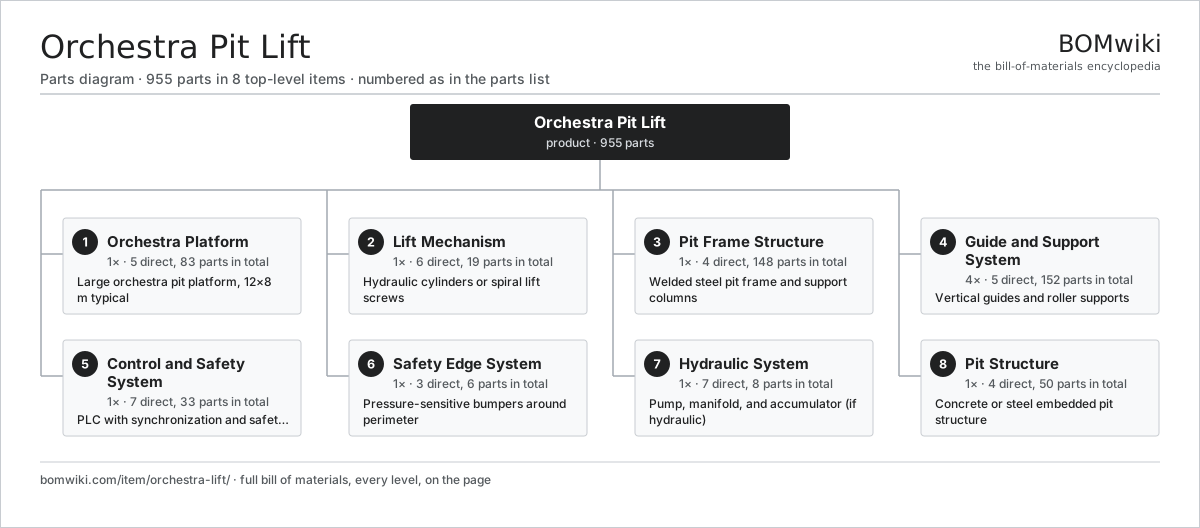
| # | Part | Qty | What it does |
|---|---|---|---|
| 1 | Orchestra Platform 5 parts | 1× | Large orchestra pit platform, 12×8 m typical |
| 2 | Lift Mechanism 6 parts | 1× | Hydraulic cylinders or spiral lift screws |
| 3 | Pit Frame Structure 4 parts | 1× | Welded steel pit frame and support columns |
| 4 | Guide and Support System 5 parts | 4× | Vertical guides and roller supports |
| 5 | Control and Safety System 7 parts | 1× | PLC with synchronization and safety interlocks |
| 6 | Safety Edge System 3 parts | 1× | Pressure-sensitive bumpers around perimeter |
| 7 | Hydraulic System 7 parts | 1× | Pump, manifold, and accumulator (if hydraulic) |
| 8 | Pit Structure 4 parts | 1× | Concrete or steel embedded pit structure |
3D model
No 3D model yet. Have a CAD file of this? Add a 3D model. STL renders right on this page; STEP, FreeCAD, and OpenSCAD sources are welcome too (openly licensed, like all 3D models on BOMwiki).
Build & assembly graph
expand / collapse · shared sub-assemblies converge · links to related products · est. labourTap an assembly to expand/collapse · tap a part to open it · use “Open page” for any node · drag to pan, scroll to zoom.
Bill of materials for Orchestra Pit Lift
8 top-level lines · 49 rows shown · 955 parts total · indented to 3 levels| # | Item / sub-assembly | Part no. | Qty/assy | Ext. qty | Parts | Type |
|---|---|---|---|---|---|---|
| 1 | Orchestra Platform 5 parts | orchestra-lift-platform | 1× | 1 | 83 | assembly |
| 1.1 | Platform Steel Frame | orchestra-lift-deck-subframe | 1× | 1 | · | part |
| 1.2 | Deck Panels | orchestra-lift-deck-panels | 1× | 1 | · | part |
| 1.3 | Railing | orchestra-lift-railing-system | 1× | 1 | · | part |
| 1.4 | Attachment Point | orchestra-lift-cable-attachment | 16× | 16 | · | part |
| 1.5 | Fastener Set | fastener-set | 64× | 64 | · | part |
| 2 | Lift Mechanism 6 parts | orchestra-lift-lift-mechanism | 1× | 1 | 19 | assembly |
| 2.1 | Hydraulic Cylinder | orchestra-lift-hydraulic-cylinder | 4× | 4 | · | part |
| 2.2 | Drive Motor | orchestra-lift-motor-drive | 1× | 1 | · | part |
| 2.3 | Spiral Lift Screw | orchestra-lift-spiral-screw | 4× | 4 | · | part |
| 2.4 | Accumulator | orchestra-lift-accumulator | 1× | 1 | · | part |
| 2.5 | Load-Sensing Synchronizer | orchestra-lift-synchronization-valve | 1× | 1 | · | part |
| 2.6 | O-Ring Set | oring-set | 8× | 8 | · | part |
| 3 | Pit Frame Structure 4 parts | orchestra-lift-frame-structure | 1× | 1 | 148 | assembly |
| 3.1 | Support Column | orchestra-lift-column | 4× | 4 | · | part |
| 3.2 | Cross-Brace | orchestra-lift-cross-brace | 12× | 12 | · | part |
| 3.3 | Load Spreader Plate | orchestra-lift-spreader-plate | 4× | 4 | · | part |
| 3.4 | Fastener Set | fastener-set | 128× | 128 | · | part |
| 4 | Guide and Support System 5 parts | orchestra-lift-guide-system | 4× | 4 | 152 | assembly |
| 4.1 | Vertical Guide Rail | orchestra-lift-guide-rail | 4× | 16 | · | part |
| 4.2 | Guide Roller | orchestra-lift-guide-roller | 16× | 64 | · | part |
| 4.3 | Guide Bracket | orchestra-lift-guide-bracket | 20× | 80 | · | part |
| 4.4 | Ball Bearing | ball-bearing | 32× | 128 | · | part |
| 4.5 | Fastener Set | fastener-set | 80× | 320 | · | part |
| 5 | Control and Safety System 7 parts | orchestra-lift-control-system | 1× | 1 | 33 | assembly |
| 5.1 | PLC Cabinet | orchestra-lift-plc-cabinet | 1× | 1 | · | part |
| 5.2 | Position Transducer | orchestra-lift-position-transducer | 4× | 4 | · | part |
| 5.3 | Pressure Transducer | orchestra-lift-pressure-monitor | 2× | 2 | · | part |
| 5.4 | Soft-Starter | orchestra-lift-motor-soft-starter | 1× | 1 | · | part |
| 5.5 | Proportional Valve | orchestra-lift-proportional-valve | 1× | 1 | · | part |
| 5.6 | Relay | relay | 8× | 8 | · | part |
| 5.7 | Connector | connector | 16× | 16 | · | part |
| 6 | Safety Edge System 3 parts | orchestra-lift-safety-edges | 1× | 1 | 6 | assembly |
| 6.1 | Pressure-Sensitive Strip | orchestra-lift-edge-sensor | 1× | 1 | · | part |
| 6.2 | Edge Sensor Relay | orchestra-lift-edge-relay | 1× | 1 | · | part |
| 6.3 | Connector | connector | 4× | 4 | · | part |
| 7 | Hydraulic System 7 parts | orchestra-lift-hydraulic-system | 1× | 1 | 8 | assembly |
| 7.1 | Hydraulic Pump | orchestra-lift-hydraulic-pump | 1× | 1 | · | part |
| 7.2 | Hydraulic Tank | orchestra-lift-hydraulic-tank | 1× | 1 | · | part |
| 7.3 | Manifold Block | orchestra-lift-manifold-block | 1× | 1 | · | part |
| 7.4 | High-Pressure Hose | orchestra-lift-hose-bundle | 2× | 2 | · | part |
| 7.5 | Hydraulic Cooler | orchestra-lift-cooler | 1× | 1 | · | part |
| 7.6 | Return-Line Filter | orchestra-lift-filter | 1× | 1 | · | part |
| 7.7 | Relief Valve | orchestra-lift-pressure-relief | 1× | 1 | · | part |
| 8 | Pit Structure 4 parts | orchestra-lift-pit-frame | 1× | 1 | 50 | assembly |
| 8.1 | Concrete Pit | orchestra-lift-concrete-base | 1× | 1 | · | part |
| 8.2 | Anchor Bolt | orchestra-lift-pit-anchor-bolts | 16× | 16 | · | part |
| 8.3 | Drain Sump | orchestra-lift-drain-sump | 1× | 1 | · | part |
| 8.4 | Fastener Set | fastener-set | 32× | 32 | · | part |
Something wrong in this list? Report a problem with this BOM.
Related products
same domain, ranked by shared parts


Sourcing: possible vendors
Browse the supplier directory → Prices, MOQ, and lead times are algorithmic estimates, not quotes, and not claims about these companies. Company mappings are curated by keyword; est. price band $10k–$200k. How estimates work| Vendor | HQ | Specialty | MOQ | Lead time |
|---|---|---|---|---|
|
🇺🇸Otis
otis.com ↗
|
Farmington, US | Elevators & escalators | 20 units | 14–24 wks |
| schindler.com ↗ | Ebikon, CH | Elevators & escalators | 20 units | 14–24 wks |
|
🇫🇮KONE
kone.com ↗
|
Espoo, FI | Elevators & escalators | 20 units | 14–24 wks |
| tkelevator.com ↗ | Düsseldorf, DE | Elevators | 20 units | 14–24 wks |
| mitsubishielectric.com ↗ | Tokyo, JP | Elevators & electronics | 20 units | 14–24 wks |
1,447-word article