Freezing-Point Osmometer
ProductOverview
A freezing-point osmometer measures the osmolality (osmotic pressure) of a solution by determining its freezing point. Osmolality is the number of osmotically active solute particles per kilogram of solvent; it is expressed in milliosmoles per kilogram (mOsm/kg) and directly relates to colligative properties (freezing point depression, boiling point elevation, vapor pressure lowering, osmotic pressure).
In clinical medicine, osmolality measurement is critical in nephrology (renal function, SIADH diagnosis), endocrinology (hypernatremia, hyponatremia assessment), and toxicology (osmolar gap indicating intoxication). In pharmaceutical manufacturing, osmolality defines tonicity of injectable and ophthalmic solutions. In research, osmolality calibrates cell culture media and maintains cell viability.
Freezing-Point Depression
The freezing-point depression (ΔT_f) is a colligative property: ΔT_f = K_f × m
where K_f is the freezing-point depression constant (for water, ~1.86 °C·kg/mol) and m is molality (moles solute per kg solvent).
For an ideal solution at equilibrium: osmolality (mOsm/kg) = −1000 × ΔT_f / K_f
Pure water freezes at 0 °C. A 1 mOsm/kg solution freezes at approximately −0.002 °C. Normal blood plasma (~300 mOsm/kg) freezes at approximately −0.56 °C. This small difference requires precision temperature measurement (~millidegree accuracy).
Measurement Process
A sample (~50 µL) is placed in a Sample Vial seated in the Vial Holder inside the Cooling Well, which is maintained at −7 °C by a Peltier Module.
The sample initially cools below its freezing point (supercooled state). A Stirrer Mechanism (motorized wire loop) gently introduces vibration, inducing nucleation and ice crystal formation. As ice forms, the sample temperature rises sharply to its equilibrium freezing point (latent heat of crystallization released).
A Thermistor Probe (NTC thermistor with resistance ~10 kΩ at 25 °C) measures temperature. The thermistor is integrated into a Precision Bridge (Wheatstone configuration) where resistance changes are amplified by an Instrumentation Amplifier (100x gain).
The Detection Circuit monitors the thermistor bridge output. During phase change (solid ice forming), the temperature stabilizes; a Phase-Change Comparator detects the inflection point (zero first derivative of temperature vs. time). This point is recorded and related to osmolality via a calibration curve.
The Microcontroller calculates osmolality from the measured freezing-point temperature: osmolality (mOsm/kg) = slope × (T_sample − T_reference) + intercept
Calibration coefficients (slope, intercept) are determined from three-point calibration using known reference solutions.
Calibration
Three-point calibration establishes a linear relationship between measured temperature and known osmolality:
- 0 mOsm/kg: Distilled water, T_f = 0.000 °C (reference)
- 300 mOsm/kg: NaCl solution, T_f = −0.560 °C (typical plasma osmolality)
- 1000 mOsm/kg: Concentrated NaCl solution, T_f = −1.863 °C
The instrument computes calibration coefficients to fit a linear model. A two-point calibration (0 and 300) is acceptable but less robust to non-linearity at extremes.
Calibration drifts with time due to:
- Thermistor aging and self-heating
- Peltier module efficiency changes
- Reference thermistor temperature stability
- Ambient temperature fluctuations
Most labs recalibrate daily before use; many instruments flag a "calibration overdue" warning after 24 hours.
Thermistor Bridge and Detection
The Thermistor Sensor is a negative temperature coefficient (NTC) thermistor with resistance: R(T) = R_0 × exp(β × (1/T − 1/T_0))
where β ~3000 K for typical glass-bead NTC thermistors, R_0 is the resistance at reference temperature T_0.
The Wheatstone bridge compares Thermistor Sensor (in the sample well) against a Reference Thermistor (at constant temperature, ~25 °C). Bridge output voltage: V_out ∝ (R_sample − R_reference) / (R_sample + R_reference)
An Instrumentation Amplifier amplifies this to millivolt-scale, feeding a Analog Filter (lowpass, ~1 Hz) to smooth high-frequency noise from vibration and electrical noise. A Phase-Change Comparator detects the peak (maximum dV/dt) indicating phase transition.
Peltier Cooling and Thermal Control
The Peltier Module (thermoelectric cooler) consumes ~10–50 W to maintain −7 °C. A Cooling Controller uses PID control to regulate Peltier voltage:
- If T > −6 °C, increase Peltier power (cool more).
- If T < −8 °C, decrease Peltier power (allow warming).
Thermal time constant is typically 5–10 minutes for the well to stabilize after power-on. Ambient temperature fluctuations (seasonal, room air conditioning) cause baseline drift; daily calibration compensates.
Stirrer Design and Crystallization Induction
The Stirrer Mechanism consists of a Stepper Motor rotating a Stirrer Shaft with a small wire loop at the tip. Stirring speed is ~1–5 Hz (slow, to avoid mechanical heating). Stirring introduces disturbance that triggers ice nucleation; without stirring, solutions remain supercooled indefinitely.
Timing is critical: stirring begins only after sample has cooled sufficiently (typically 2–3 °C below expected freezing point). Early stirring causes nucleation at artificially low temperature; late stirring may fail to trigger freezing.
Accuracy and Precision
Accuracy is ±5–10 mOsm/kg across the range, primarily limited by:
- Thermistor linearity: NTC thermistors exhibit logarithmic resistance-temperature relationship; polynomial correction improves accuracy.
- Calibration quality: Three-point calibration assumes linearity; non-ideal solutions may have slight curvature.
- Temperature stability: ±0.1 °C drift in the reference thermistor translates to ±0.05–0.10 mOsm/kg error.
- Sample purity: Dissolved gases (oxygen, CO2) affect freezing point; degassing samples improves reproducibility.
Precision (repeatability) is typically ±2–3 mOsm/kg, limited by thermistor resolution (~1 mΩ = 0.001 °C equivalent).
Applications
Clinical: Serum and urine osmolality (diagnosis of diabetes insipidus, SIADH, hypernatremia, hyponatremia).
Pharmaceutical: Injectable solution tonicity verification, ophthalmic drop osmolality.
Research: Fermentation media osmolality, cell culture tonicity, osmotic stress studies.
Toxicology: Osmolar gap calculation (serum osmolality measured vs. calculated from electrolytes) as screening for methanol, ethylene glycol, or other osmotically active toxins.
Advantages and Limitations
Advantages: Direct measurement of colligative property (independent of solute identity), rapid (~30–60 seconds), small sample volume (50 µL).
Limitations: Sample must be liquid (solids must be dissolved); gases must be expelled (osmolality measures solute in solvent, not gas); temperature-sensitive calibration requires frequent recalibration; Peltier cooling uses modest power continuously.
Alternative Methods
Vapor pressure osmometry: Measures relative vapor pressure depression; similar accuracy, slower (5–10 minutes), requires 2–5 µL sample.
Colligative property calculations: Osmolality calculated from electrolyte concentrations using formula: osmolality (calc) ≈ 2[Na+] + 2[K+] + [glucose]/18 + [BUN]/2.8
Discrepancy between measured and calculated (osmolar gap >10) suggests presence of unmeasured osmotically active substance (alcohol, toxin, or error).
Osmole-meter (electrical conductivity): Not a standard colligative method; conductivity-based meters measure ion concentration, not osmolality.
Maintenance
- Daily: Calibration with three-point standards
- Weekly: Clean Sample Vial with DI water; inspect Stirrer Shaft for crystal deposits
- Monthly: Check Peltier Module performance (cooling time to −7 °C should be <5 min); verify Heatsink fan operation if active cooling used
- Annually: Service Peltier module and thermal sensor; replace thermistor if drift exceeds calibration span
Osmometer longevity is typically 5–7 years before Peltier module degradation requires replacement ($1500–$3000 service).
Freezing-Point Osmometer parts and their functions
8 top-level parts · 48 parts in total · full bill of materials below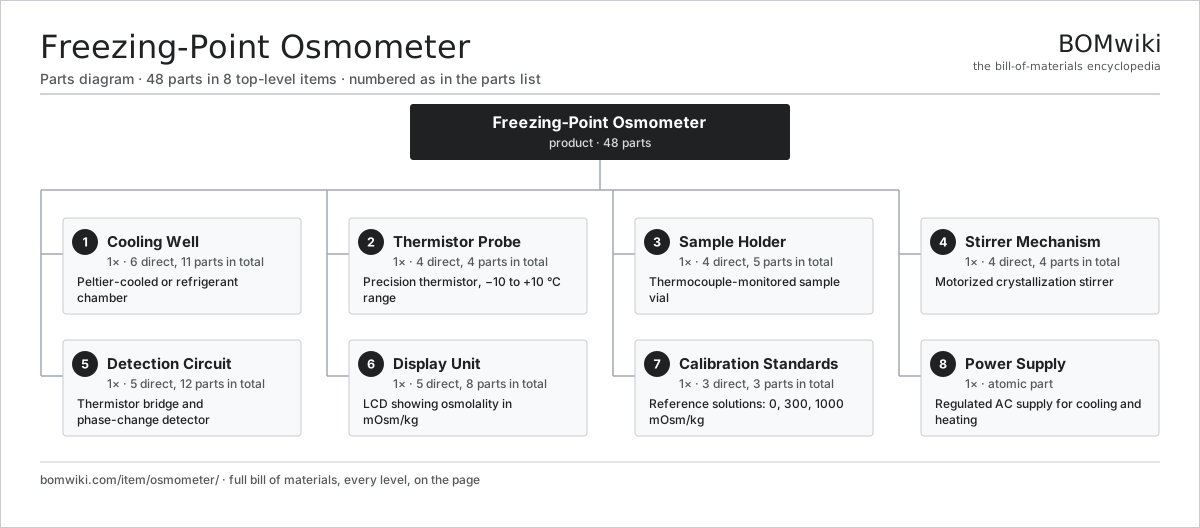
| # | Part | Qty | What it does |
|---|---|---|---|
| 1 | Cooling Well 6 parts | 1× | Peltier-cooled or refrigerant chamber |
| 2 | Thermistor Probe 4 parts | 1× | Precision thermistor, −10 to +10 °C range |
| 3 | Sample Holder 4 parts | 1× | Thermocouple-monitored sample vial |
| 4 | Stirrer Mechanism 4 parts | 1× | Motorized crystallization stirrer |
| 5 | Detection Circuit 5 parts | 1× | Thermistor bridge and phase-change detector |
| 6 | Display Unit 5 parts | 1× | LCD showing osmolality in mOsm/kg |
| 7 | Calibration Standards 3 parts | 1× | Reference solutions: 0, 300, 1000 mOsm/kg |
| 8 | Power Supply | 1× | Regulated AC supply for cooling and heating |
3D model
No 3D model yet. Have a CAD file of this? Add a 3D model. STL renders right on this page; STEP, FreeCAD, and OpenSCAD sources are welcome too (openly licensed, like all 3D models on BOMwiki).
Build & assembly graph
expand / collapse · shared sub-assemblies converge · links to related products · est. labourTap an assembly to expand/collapse · tap a part to open it · use “Open page” for any node · drag to pan, scroll to zoom.
Bill of materials for Freezing-Point Osmometer
8 top-level lines · 39 rows shown · 48 parts total · indented to 3 levels| # | Item / sub-assembly | Part no. | Qty/assy | Ext. qty | Parts | Type |
|---|---|---|---|---|---|---|
| 1 | Cooling Well 6 parts | osmometer-cooling-well | 1× | 1 | 11 | assembly |
| 1.1 | Peltier Module | osmometer-peltier-module | 1× | 1 | · | part |
| 1.2 | Heatsink | osmometer-heatsink | 1× | 1 | · | part |
| 1.3 | Well Chamber | osmometer-well-chamber | 1× | 1 | · | part |
| 1.4 | Thermal Sensor | osmometer-thermal-sensor | 1× | 1 | · | part |
| 1.5 | Cooling Controller | osmometer-cooling-controller | 1× | 1 | · | part |
| 1.6 | SMD Passive (R/C/L) | smd-passives | 6× | 6 | · | part |
| 2 | Thermistor Probe 4 parts | osmometer-thermistor-probe | 1× | 1 | 4 | assembly |
| 2.1 | Thermistor Sensor | osmometer-thermistor-sensor | 1× | 1 | · | part |
| 2.2 | Reference Thermistor | osmometer-reference-thermistor | 1× | 1 | · | part |
| 2.3 | Probe Sheath | osmometer-probe-sheath | 1× | 1 | · | part |
| 2.4 | Thermistor Bridge | osmometer-thermistor-bridge | 1× | 1 | · | part |
| 3 | Sample Holder 4 parts | osmometer-sample-holder | 1× | 1 | 5 | assembly |
| 3.1 | Sample Vial | osmometer-sample-vial | 1× | 1 | · | part |
| 3.2 | Vial Holder | osmometer-vial-holder | 1× | 1 | · | part |
| 3.3 | Sealing Cap | osmometer-sealing-cap | 1× | 1 | · | part |
| 3.4 | SMD Passive (R/C/L) | smd-passives | 2× | 2 | · | part |
| 4 | Stirrer Mechanism 4 parts | osmometer-stirrer-mechanism | 1× | 1 | 4 | assembly |
| 4.1 | Stepper Motor | osmometer-stepper-motor | 1× | 1 | · | part |
| 4.2 | Stirrer Shaft | osmometer-stirrer-shaft | 1× | 1 | · | part |
| 4.3 | Motor Clutch | osmometer-motor-clutch | 1× | 1 | · | part |
| 4.4 | Motor Driver | osmometer-motor-driver | 1× | 1 | · | part |
| 5 | Detection Circuit 5 parts | osmometer-detection-circuit | 1× | 1 | 12 | assembly |
| 5.1 | Precision Bridge | osmometer-precision-bridge | 1× | 1 | · | part |
| 5.2 | Instrumentation Amplifier | osmometer-amplifier | 1× | 1 | · | part |
| 5.3 | Phase-Change Comparator | osmometer-comparator | 1× | 1 | · | part |
| 5.4 | Analog Filter | osmometer-analog-filter | 1× | 1 | · | part |
| 5.5 | SMD Passive (R/C/L) | smd-passives | 8× | 8 | · | part |
| 6 | Display Unit 5 parts | osmometer-display-unit | 1× | 1 | 8 | assembly |
| 6.1 | Microcontroller | osmometer-microcontroller | 1× | 1 | · | part |
| 6.2 | LCD Display | osmometer-lcd-display | 1× | 1 | · | part |
| 6.3 | Keyboard | osmometer-keyboard | 1× | 1 | · | part |
| 6.4 | EEPROM Memory | osmometer-memory | 1× | 1 | · | part |
| 6.5 | SMD Passive (R/C/L) | smd-passives | 4× | 4 | · | part |
| 7 | Calibration Standards 3 parts | osmometer-calibration-standards | 1× | 1 | 3 | assembly |
| 7.1 | Standard 0 mOsm/kg | osmometer-standard-0 | 1× | 1 | · | part |
| 7.2 | Standard 300 mOsm/kg | osmometer-standard-300 | 1× | 1 | · | part |
| 7.3 | Standard 1000 mOsm/kg | osmometer-standard-1000 | 1× | 1 | · | part |
| 8 | Power Supply | power-supply | 1× | 1 | · | part |
Something wrong in this list? Report a problem with this BOM.
Related products
same domain, ranked by shared parts Analytical Balance
54 parts · shares 1 with this page
Analytical Balance
54 parts · shares 1 with this page
 Atomic Absorption Spectrometer
648 parts · shares 1 with this page
Autoclave Sterilizer
282 parts · shares 1 with this page
Atomic Absorption Spectrometer
648 parts · shares 1 with this page
Autoclave Sterilizer
282 parts · shares 1 with this page
 Automated Cell Counter
54 parts · shares 1 with this page
Automated Colony Counter
322 parts · shares 1 with this page
Automated Cell Counter
54 parts · shares 1 with this page
Automated Colony Counter
322 parts · shares 1 with this page
 Automated Liquid Handler
817 parts · shares 1 with this page
Automated Liquid Handler
817 parts · shares 1 with this page
Sourcing: possible vendors
Browse the supplier directory → Prices, MOQ, and lead times are algorithmic estimates, not quotes, and not claims about these companies. Company mappings are curated by keyword; est. price band $1k–$500k. How estimates work| Vendor | HQ | Specialty | MOQ | Lead time |
|---|---|---|---|---|
| thermofisher.com ↗ | Waltham, US | Lab instruments | 100 units | 10–18 wks |
|
🇺🇸Agilent
agilent.com ↗
|
Santa Clara, US | Analytical instruments | 100 units | 10–18 wks |
|
🇺🇸Bruker
bruker.com ↗
|
Billerica, US | Scientific instruments | 100 units | 10–18 wks |
|
🇯🇵Shimadzu
shimadzu.com ↗
|
Kyoto, JP | Analytical instruments | 100 units | 10–18 wks |
|
🇺🇸Waters
waters.com ↗
|
Milford, US | Chromatography & MS | 100 units | 10–18 wks |
1,122-word article