Overhead Projector
ProductOverview
The overhead projector (OHP) is a light-based optical system designed to project a magnified image of a printed or hand-drawn transparency (acetate sheet) onto a wall screen visible to an audience. Unlike a slide projector, which uses small 35mm film, the overhead projector accepts large 8.5×11-inch or 10×10-inch transparencies that can be written on in real time with markers, making it ideal for interactive presentations in classrooms, boardrooms, and training centers. The light path flows upward: a powerful lamp is collimated by a condenser lens, passes through the transparency on the fresnel stage, is then redirected by a mirror upward through a projection lens, and onto the screen.
The overhead projector became ubiquitous in educational and corporate settings from the 1960s through the early 2000s, before being displaced by digital projectors. However, many institutions retain them for their simplicity, reliability, and ability to function without computers or networks.
How it works
Light Path: The halogen or tungsten lamp burns at extreme brightness (250–1000 W) inside a parabolic reflector that collects divergent rays. The reflected light is further concentrated by the condenser lens, a multi-element fresnel or meniscus optic that focuses the rays into a parallel bundle. This beam is directed upward through the stage glass.
Stage Illumination: The fresnel plate on the stage is a tempered glass disc etched with concentric micro-grooves. These grooves scatter the incoming parallel light and redirect it diffusely upward, ensuring even illumination across the entire stage regardless of whether a transparency is present. The grooves also act as prisms, bending off-axis rays back toward the optical axis, maximizing collection by the projection lens.
Transparency Projection: A transparency (a thin acetate or polyester film printed or hand-drawn with black or colored inks) is placed on the stage. Light passing through dark areas is blocked; light passing through clear areas is transmitted. The image of the transparency is formed in the projection head, where a high-aperture lens (typically f/8 to f/12) gathers the diverging rays from the stage and focuses them to create a real, inverted image on a screen.
Mirror Redirection: A first-surface mirror mounted at 45° in the projection head redirects the light path from vertical to horizontal (or vertical to vertical, depending on head orientation), allowing the image to be projected onto a wall-mounted or ceiling-mounted screen positioned conveniently for viewing.
Focus and Magnification: The focus drive moves the projection lens assembly vertically along a focus column to adjust image sharpness. The lens turret typically holds 2–4 lenses of different focal lengths, providing magnification choices of 1×, 1.5×, 2×, or 4×, allowing the operator to fill the screen with an appropriately sized image regardless of room distance.
Thermal Management: Overhead projectors generate significant heat, especially in the lamp housing. A cooling blower draws ambient air through an intake filter, directs it across the lamp and stage via ducting, and exhausts hot air to the rear or side. A thermal switch monitors temperature and cuts off the lamp if limits are exceeded, preventing transparency damage or component failure.
Real-Time Annotation: A key advantage of the overhead projector is the ability to place a transparency on the stage and annotate it during the presentation using dry-erase or permanent markers. The image updates instantly on the screen, enabling dynamic interaction with audiences.
Optical Performance
The optical quality of an overhead projector is characterized by resolution (typically 1000 lines ANSI or better), color accuracy (limited by transparency and light source, but adequate for charts and diagrams), and contrast. High-end models feature improved condenser designs and projection lenses with multi-element corrected optics to minimize aberrations at the edges of the projected image. The fresnel stage itself contributes some diffraction noise, but this is usually imperceptible to the eye at normal screen distances.
Maintenance and Reliability
Overhead projectors are mechanically robust because they rely primarily on thermal optics and simple electrical switching. Regular maintenance includes:
- Lamp replacement every 50–100 hours of use
- Cleaning the condenser and fresnel glass with soft cloths and lens cleaner
- Cleaning or replacing the air filter to prevent dust accumulation
- Checking the mirror for dust or degradation
- Adjusting leveling feet if the projector sits on an uneven surface
The blower is the most wear-prone component due to continuous operation; bearings may accumulate dust and eventually require replacement or lubrication. The thermal cutoff ensures protection if airflow is blocked.
Legacy and Modern Context
Though largely replaced by digital LCD and LED projectors in recent years, overhead projectors remain valued in environments where downtime must be avoided, where passive operation (no computers to crash) is preferred, or where legacy transparencies are archived. Many educational institutions maintain fleets of overhead projectors as backup systems. Refurbished units are readily available at reasonable cost, and replacement lamps and filters are still manufactured and widely stocked.
Overhead Projector parts and their functions
6 top-level parts · 34 parts in total · full bill of materials below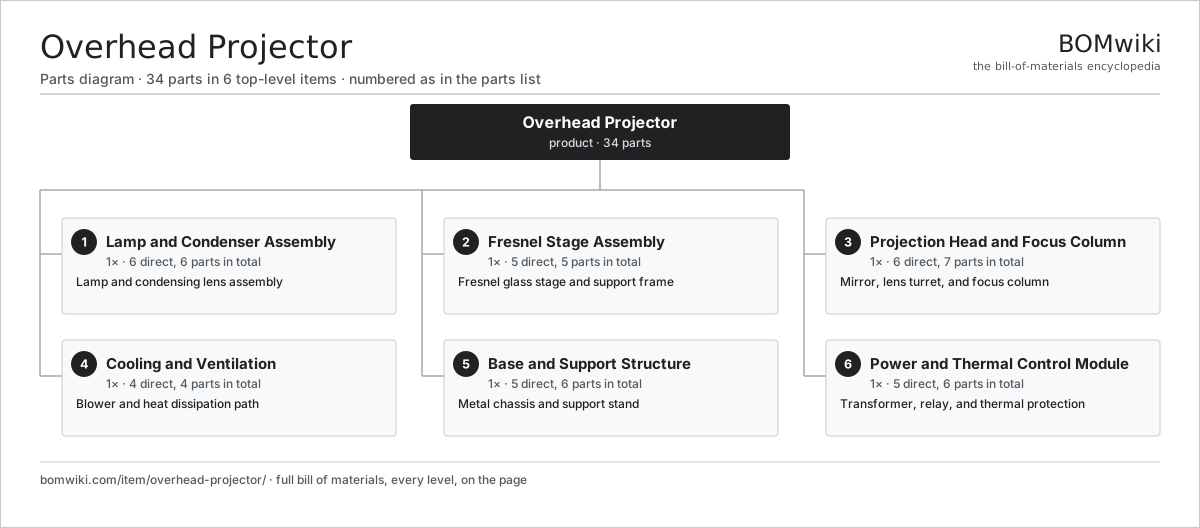
| # | Part | Qty | What it does |
|---|---|---|---|
| 1 | Lamp and Condenser Assembly 6 parts | 1× | Lamp and condensing lens assembly |
| 2 | Fresnel Stage Assembly 5 parts | 1× | Fresnel glass stage and support frame |
| 3 | Projection Head and Focus Column 6 parts | 1× | Mirror, lens turret, and focus column |
| 4 | Cooling and Ventilation 4 parts | 1× | Blower and heat dissipation path |
| 5 | Base and Support Structure 5 parts | 1× | Metal chassis and support stand |
| 6 | Power and Thermal Control Module 5 parts | 1× | Transformer, relay, and thermal protection |
3D model
No 3D model yet. Have a CAD file of this? Add a 3D model. STL renders right on this page; STEP, FreeCAD, and OpenSCAD sources are welcome too (openly licensed, like all 3D models on BOMwiki).
Build & assembly graph
expand / collapse · shared sub-assemblies converge · links to related products · est. labourTap an assembly to expand/collapse · tap a part to open it · use “Open page” for any node · drag to pan, scroll to zoom.
Bill of materials for Overhead Projector
6 top-level lines · 37 rows shown · 34 parts total · indented to 3 levels| # | Item / sub-assembly | Part no. | Qty/assy | Ext. qty | Parts | Type |
|---|---|---|---|---|---|---|
| 1 | Lamp and Condenser Assembly 6 parts | overhead-projector-lamp-condenser | 1× | 1 | 6 | assembly |
| 1.1 | Projection Lamp | overhead-projector-lamp | 1× | 1 | · | part |
| 1.2 | Parabolic Reflector | overhead-projector-reflector | 1× | 1 | · | part |
| 1.3 | Condenser Lens Assembly | overhead-projector-condenser-lens | 1× | 1 | · | part |
| 1.4 | Thermal Heat Shield | overhead-projector-heat-shield | 1× | 1 | · | part |
| 1.5 | Fastener Set | fastener-set | 1× | 1 | · | part |
| 1.6 | Connector | connector | 1× | 1 | · | part |
| 2 | Fresnel Stage Assembly 5 parts | overhead-projector-stage | 1× | 1 | 5 | assembly |
| 2.1 | Fresnel Glass Plate | overhead-projector-fresnel-glass | 1× | 1 | · | part |
| 2.2 | Stage Border Frame | overhead-projector-stage-frame | 1× | 1 | · | part |
| 2.3 | Vibration Isolators | overhead-projector-glass-support | 1× | 1 | · | part |
| 2.4 | Sheet Metal Panel | sheet-panel | 1× | 1 | · | part |
| 2.5 | Fastener Set | fastener-set | 1× | 1 | · | part |
| 3 | Projection Head and Focus Column 6 parts | overhead-projector-projection-head | 1× | 1 | 7 | assembly |
| 3.1 | Projection Lens | overhead-projector-primary-lens | 1× | 1 | · | part |
| 3.2 | First-Surface Mirror | overhead-projector-mirror | 1× | 1 | · | part |
| 3.3 | Lens Turret | overhead-projector-lens-turret | 1× | 1 | · | part |
| 3.4 | Focus Drive | overhead-projector-focus-mechanism | 1× | 1 | · | part |
| 3.5 | Ball Bearing | ball-bearing | 2× | 2 | · | part |
| 3.6 | Fastener Set | fastener-set | 1× | 1 | · | part |
| 4 | Cooling and Ventilation 4 parts | overhead-projector-cooling-system | 1× | 1 | 4 | assembly |
| 4.1 | Blower Motor | blower-motor | 1× | 1 | · | part |
| 4.2 | Air Cooling Duct | overhead-projector-air-duct | 1× | 1 | · | part |
| 4.3 | Air Intake Filter | overhead-projector-intake-filter | 1× | 1 | · | part |
| 4.4 | Fastener Set | fastener-set | 1× | 1 | · | part |
| 5 | Base and Support Structure 5 parts | overhead-projector-base-frame | 1× | 1 | 6 | assembly |
| 5.1 | Main Chassis Casting | overhead-projector-main-chassis | 1× | 1 | · | part |
| 5.2 | Adjustable Arm Assembly | overhead-projector-arm | 1× | 1 | · | part |
| 5.3 | Leg and Leveling Kit | overhead-projector-leg-assembly | 1× | 1 | · | part |
| 5.4 | Fastener Set | fastener-set | 2× | 2 | · | part |
| 5.5 | Sheet Metal Panel | sheet-panel | 1× | 1 | · | part |
| 6 | Power and Thermal Control Module 5 parts | overhead-projector-power-control | 1× | 1 | 6 | assembly |
| 6.1 | Power Supply | power-supply | 1× | 1 | · | part |
| 6.2 | Thermal Cutoff Switch | overhead-projector-thermal-switch | 1× | 1 | · | part |
| 6.3 | Relay | relay | 2× | 2 | · | part |
| 6.4 | Connector | connector | 1× | 1 | · | part |
| 6.5 | Fastener Set | fastener-set | 1× | 1 | · | part |
Something wrong in this list? Report a problem with this BOM.
Related products
same domain, ranked by shared parts Photocopier (MFP)
210 parts · shares 2 with this page
Photocopier (MFP)
210 parts · shares 2 with this page
 Electric Typewriter
47 parts · shares 3 with this page
Electric Typewriter
47 parts · shares 3 with this page
 Pneumatic Tube Station
201 parts · shares 3 with this page
Produce Misting System
137 parts · shares 3 with this page
Queue Ticket Dispenser
307 parts · shares 3 with this page
Pneumatic Tube Station
201 parts · shares 3 with this page
Produce Misting System
137 parts · shares 3 with this page
Queue Ticket Dispenser
307 parts · shares 3 with this page
 Guillotine Paper Cutter
261 parts · shares 2 with this page
Guillotine Paper Cutter
261 parts · shares 2 with this page
Sourcing: possible vendors
Browse the supplier directory → Prices, MOQ, and lead times are algorithmic estimates, not quotes, and not claims about these companies. Company mappings are curated by keyword; est. price band $50–$15k. How estimates work| Vendor | HQ | Specialty | MOQ | Lead time |
|---|---|---|---|---|
|
🇯🇵Canon
canon.com ↗
|
Tokyo, JP | Imaging & optics | 500 units | 8–12 wks |
|
🇯🇵Ricoh
ricoh.com ↗
|
Tokyo, JP | Office imaging | 500 units | 8–12 wks |
|
🇺🇸Xerox
xerox.com ↗
|
Norwalk, US | Printers & copiers | 500 units | 8–12 wks |
|
🇯🇵Epson
epson.com ↗
|
Suwa, JP | Printers & projectors | 500 units | 8–12 wks |
|
🇯🇵Brother
brother.com ↗
|
Nagoya, JP | Printers & sewing | 500 units | 8–12 wks |
921-word article