Overland Conveyor
ProductOverview
An overland conveyor is a long-distance bulk material transport system spanning hundreds to thousands of meters across pit topography or processing areas. Unlike short platform conveyors (5–30 meters), overland systems are engineered for durability over 20–50 year service lives, handling millions of tonnes of rock, ore, or aggregate. They replace truck haulage in fixed routes, eliminating vehicle wear, fuel consumption, and dust generation. Belt speeds are optimized for energy efficiency (2–4 m/second), and the system can climb modest slopes (up to 20 degrees) using multiple drive drums or counter-weighted take-up systems.
Overland conveyors are economical when:
- Haul distance exceeds 500 meters (truck operating cost becomes prohibitive)
- Daily throughput is 200+ tonnes per day
- Long-term demand is certain (20+ year mining plan)
- Pit layout supports belt routing above accessible terrain
Design and Layout
Conveyor Profile and Supports
Overland conveyors follow the pit topography, rising and falling with grade changes. The support structure consists of welded steel trestle frames spaced every 30–50 meters, with driven piles or drilled anchors set into bedrock or competent soil. On steep slopes, cantilever or inverted design minimizes column height and foundation cost.
The entire belt path is enclosed in spillage skirts (3–4 meters tall) preventing material loss. The skirt is lined with rubber or polyurethane to reduce dust and noise. Material bouncing out of the belt at transfer points is captured and returned via a secondary conveyor or falling back to an ore body.
Belt Configuration
The conveyor belt is a continuous loop joining the drive drum at one end to the tail drum at the other. The loaded belt (carrying material) is on top; the return belt (empty) runs underneath, supported by return rollers spaced further apart (2–3 meters vs. 1.5–2 meters for loaded rollers).
For 500+ meter conveyors, field splicing is required. The splice is made using either mechanical fasteners (40–80 bolts, requiring fastener replacement every 1–2 years) or hot vulcanization (heating and curing rubber at the splice, creating a permanent bond lasting 5–7 years). Vulcanized splices are preferred for long-life systems but require an onsite vulcanizing crew during installation.
Belt cross-section is typically 3–8 ply reinforcement (textile or steel wire) depending on tension demands. Long inclined conveyors operate at higher tensions (200–400 kN) to prevent slipping, requiring stronger belts and larger drums.
Drive System
The motor (30–150 kW) is step-reduced by a gearbox (10:1 to 50:1 ratio) to drive the head drum at 40–120 rpm, translating to belt speeds of 2–4 m/second. A soft-start drive limits inrush current during motor start, protecting the electrical supply.
For inclined conveyors gaining elevation, multiple motors can be used:
- Head drive only: Motor at top, pulling empty belt down. Simple but limited to modest inclines (5–10 degrees).
- Head and booster drives: Additional motor 25–75% along the conveyor climbing the slope. Common for 10–20 degree inclines.
- Multiple distributed drives: Three or more motors spaced along the conveyor, each handling its local grade. Used for steep or very long conveyors (>2 km).
Belt Tensioning
Proper belt tension is critical: too slack, and the belt slips on the drums; too tight, and bearing and splice stress increases dramatically. The tail assembly includes a hydraulic cylinder that maintains constant tension. A pressure gauge or load cell feedback indicates actual tension, allowing operators to adjust take-up position monthly or quarterly.
Tension-take-up range is typically 0.5–2 meters of travel, allowing belt stretch compensation over the system's life. As belts age and creep, the take-up gradually extends; once fully extended, the belt requires splicing to restore length.
Material Flow and Component Interaction
Material is fed onto the head of the belt at a transfer tower with impact absorbers reducing shock from falling material. The belt accelerates the material to belt speed (2–4 m/s) in about 50 meters, then transports it at constant speed.
Idler rollers spaced 1.5–2 meters apart on the carrying side support the loaded belt and material. Return-side rollers are spaced 2–3 meters apart, supporting only the belt weight. As the belt traverses slopes, rollers on inclines are mounted at slight angles (1–3 degrees) to prevent material roll-off.
At the tail drum, the belt reverses direction. Material is discharged via chute into secondary conveyors, processing equipment, or stockpiles. The tail drum is idler-only (no motor drive); the belt's forward motion causes it to rotate. The tail assembly can be adjusted forward or backward via the take-up hydraulic cylinder to maintain belt tension.
Operational Characteristics
Loading and Speed Control
Material arrival rate varies with upstream processes. A load sensor on the belt detects sudden surges (e.g., 500 tonnes arriving in 30 minutes). If conveyor speed is fixed, overload can cause belt slip, material rollback, or belt damage. Modern conveyors use VFD drives allowing motor speed adjustment from 30–100% of nominal. On overload, the VFD reduces speed to 50–75%, spreading the load over time without stopping the system.
Misalignment Monitoring
As the belt oscillates with material imbalance, it can drift toward one edge, causing material spillage and premature wear. A belt misalignment sensor (typically an ultrasonic or mechanical switch) detects edge deviation of 10–20 mm and triggers an alarm. The operator can adjust idler vertical positions (bolt packs on idler frames) to restore centering.
Emergency Shutdown
Emergency stop buttons are positioned every 100 meters along the conveyor access walkway. Pressing any button simultaneously cuts power to the motor and engages hydraulic brakes (if installed) stopping the belt within 30 seconds, critical if a person falls onto the moving belt or material becomes lodged.
Maintenance and Durability
Overland conveyors are designed for 20–50 year service lives with proper maintenance:
Belt Wear
The belt cover (rubber coating) gradually abrades from material friction and exposure. Wear rate is typically 0.5–2 mm per million tonnes transported. A 3–4 mm original cover lasts 5–10 years for 50–100 million tonnes capacity. Once cover depth drops below 1 mm, the reinforcement fabric is exposed to moisture and deteriorates rapidly; belt replacement is then necessary.
Roller Bearing Wear
Sealed bearings last 3–7 years in dusty pit conditions. Grease re-supply (every 6 months), bearing temperature monitoring (infrared gun checks), and vibration analysis extend bearing life. Bearing failure is indicated by mounting temperature exceeding 80°C; replacement takes 1–2 hours per roller.
Splice Degradation
Mechanical splices loosen over time, requiring bolt retensioning every 1–3 months and fastener replacement every 1–2 years. Vulcanized splices are permanent but occasionally re-splice due to material defects or damage.
Drive System Maintenance
The gearbox requires oil level checks monthly and full oil change every 2 years or 10,000 operating hours. Motor bearings are re-greased every 500 operating hours.
Slope Limitations and Design Trade-offs
Uphill Conveyors (Head Drive)
Head drums can pull a belt upslope to ~17 degrees using friction alone. Steeper angles require:
- Cleated or rough belts increasing friction (reduces speed, increases wear)
- Booster drives along the slope (every 200–400 meters)
- Counter-weighted take-up reducing net tension required
- Steeper inclines (>25 degrees) typically use bucket elevators or skip hoists instead of belts
Downhill Conveyors
Gravity assists downslope movement, reducing motor power by 50% or more. However, belt speed control becomes critical: allowing unrestricted downslope acceleration causes material to surge and spill. Loaded downhill conveyors require:
- Speed control via VFD reducing to 50–75% of nominal speed
- Magnetic or friction brakes holding belt if motor failure occurs
- Dedicated brake motor test once per week
Economic Lifecycle
A 1 km overland conveyor costs $2–5 million installed (including drives, structure, engineering). Operating cost is $0.01–0.03 per tonne transported (electricity and maintenance), vs. $0.05–0.15 per tonne for truck haulage. Payback occurs within 3–5 years for high-tonnage mines, making overland conveyors attractive for any long-term operation hauling 100+ tonnes per day.
Total lifecycle cost for 30-year mining plan is often 40–50% lower than equivalent truck haulage, justifying the large capital expenditure.
Overland Conveyor parts and their functions
10 top-level parts · 73 parts in total · full bill of materials below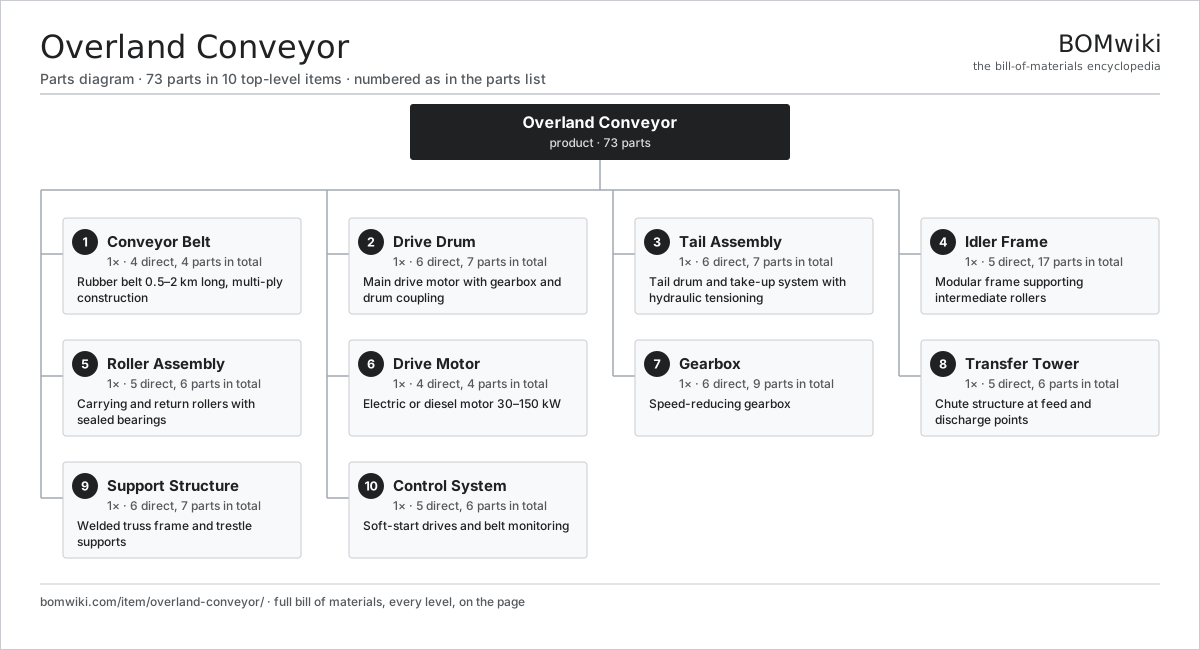
| # | Part | Qty | What it does |
|---|---|---|---|
| 1 | Conveyor Belt 4 parts | 1× | Rubber belt 0.5–2 km long, multi-ply construction |
| 2 | Drive Drum 6 parts | 1× | Main drive motor with gearbox and drum coupling |
| 3 | Tail Assembly 6 parts | 1× | Tail drum and take-up system with hydraulic tensioning |
| 4 | Idler Frame 5 parts | 1× | Modular frame supporting intermediate rollers |
| 5 | Roller Assembly 5 parts | 1× | Carrying and return rollers with sealed bearings |
| 6 | Drive Motor 4 parts | 1× | Electric or diesel motor 30–150 kW |
| 7 | Gearbox 6 parts | 1× | Speed-reducing gearbox |
| 8 | Transfer Tower 5 parts | 1× | Chute structure at feed and discharge points |
| 9 | Support Structure 6 parts | 1× | Welded truss frame and trestle supports |
| 10 | Control System 5 parts | 1× | Soft-start drives and belt monitoring |
3D model
No 3D model yet. Have a CAD file of this? Add a 3D model. STL renders right on this page; STEP, FreeCAD, and OpenSCAD sources are welcome too (openly licensed, like all 3D models on BOMwiki).
Build & assembly graph
expand / collapse · shared sub-assemblies converge · links to related products · est. labourTap an assembly to expand/collapse · tap a part to open it · use “Open page” for any node · drag to pan, scroll to zoom.
Bill of materials for Overland Conveyor
10 top-level lines · 62 rows shown · 73 parts total · indented to 3 levels| # | Item / sub-assembly | Part no. | Qty/assy | Ext. qty | Parts | Type |
|---|---|---|---|---|---|---|
| 1 | Conveyor Belt 4 parts | overland-conveyor-belt | 1× | 1 | 4 | assembly |
| 1.1 | Belt Carcass | overland-conveyor-belt-ply | 1× | 1 | · | part |
| 1.2 | Belt Cover | overland-conveyor-belt-cover | 1× | 1 | · | part |
| 1.3 | Belt Splice | overland-conveyor-belt-splice | 1× | 1 | · | part |
| 1.4 | Edge Seal | overland-conveyor-belt-edge-seal | 1× | 1 | · | part |
| 2 | Drive Drum 6 parts | overland-conveyor-drum-drive | 1× | 1 | 7 | assembly |
| 2.1 | Drum Shell | overland-conveyor-drum-shell | 1× | 1 | · | part |
| 2.2 | Drum Hub | overland-conveyor-drum-hub | 1× | 1 | · | part |
| 2.3 | Drum Shaft | overland-conveyor-drum-shaft | 1× | 1 | · | part |
| 2.4 | Drum Bearing | overland-conveyor-drum-bearing | 2× | 2 | · | part |
| 2.5 | Drum Coupling | overland-conveyor-drum-coupling | 1× | 1 | · | part |
| 2.6 | Drum Lagging | overland-conveyor-lagging | 1× | 1 | · | part |
| 3 | Tail Assembly 6 parts | overland-conveyor-drum-tail | 1× | 1 | 7 | assembly |
| 3.1 | Tail Drum | overland-conveyor-tail-drum | 1× | 1 | · | part |
| 3.2 | Tail Bearing | overland-conveyor-tail-bearing | 2× | 2 | · | part |
| 3.3 | Tail Mounting Frame | overland-conveyor-tail-mounting | 1× | 1 | · | part |
| 3.4 | Take-Up Cylinder | overland-conveyor-take-up-cylinder | 1× | 1 | · | part |
| 3.5 | Tension Gauge | overland-conveyor-tension-gauge | 1× | 1 | · | part |
| 3.6 | O-Ring Set | oring-set | 1× | 1 | · | part |
| 4 | Idler Frame 5 parts | overland-conveyor-idler-frame | 1× | 1 | 17 | assembly |
| 4.1 | Idler Bracket | overland-conveyor-idler-bracket | 1× | 1 | · | part |
| 4.2 | Carrying Roller | overland-conveyor-idler-carrying-roller | 3× | 3 | · | part |
| 4.3 | Return Roller | overland-conveyor-idler-return-roller | 2× | 2 | · | part |
| 4.4 | Roller Bearing | overland-conveyor-roller-bearing | 10× | 10 | · | part |
| 4.5 | Roller Shaft | overland-conveyor-roller-shaft | 1× | 1 | · | part |
| 5 | Roller Assembly 5 parts | overland-conveyor-roller-set | 1× | 1 | 6 | assembly |
| 5.1 | Roller Barrel | overland-conveyor-roller-barrel | 1× | 1 | · | part |
| 5.2 | Roller Shaft | overland-conveyor-roller-shaft | 1× | 1 | · | part |
| 5.3 | Roller Bearing | overland-conveyor-roller-bearing | 2× | 2 | · | part |
| 5.4 | Roller Seal | overland-conveyor-roller-seal | 1× | 1 | · | part |
| 5.5 | Roller Bushing | overland-conveyor-roller-bushing | 1× | 1 | · | part |
| 6 | Drive Motor 4 parts | overland-conveyor-drive-motor | 1× | 1 | 4 | assembly |
| 6.1 | Motor | overland-conveyor-motor | 1× | 1 | · | part |
| 6.2 | Soft-Start Drive | overland-conveyor-motor-soft-start | 1× | 1 | · | part |
| 6.3 | Motor Coupling | overland-conveyor-motor-coupling | 1× | 1 | · | part |
| 6.4 | Motor Mount | overland-conveyor-motor-mount | 1× | 1 | · | part |
| 7 | Gearbox 6 parts | overland-conveyor-gearbox | 1× | 1 | 9 | assembly |
| 7.1 | Gearbox Housing | overland-conveyor-gearbox-housing | 1× | 1 | · | part |
| 7.2 | Pinion Gear | overland-conveyor-gearbox-pinion | 1× | 1 | · | part |
| 7.3 | Output Gear | overland-conveyor-gearbox-gear | 1× | 1 | · | part |
| 7.4 | Gearbox Shaft | overland-conveyor-gearbox-shaft | 1× | 1 | · | part |
| 7.5 | Gearbox Bearing | overland-conveyor-gearbox-bearing | 4× | 4 | · | part |
| 7.6 | Gearbox Seal | overland-conveyor-gearbox-seal | 1× | 1 | · | part |
| 8 | Transfer Tower 5 parts | overland-conveyor-transfer-tower | 1× | 1 | 6 | assembly |
| 8.1 | Tower Frame | overland-conveyor-tower-frame | 1× | 1 | · | part |
| 8.2 | Chute Panel | overland-conveyor-chute-panel | 2× | 2 | · | part |
| 8.3 | Chute Liner | overland-conveyor-chute-liner | 1× | 1 | · | part |
| 8.4 | Tower Stairs | overland-conveyor-tower-stairs | 1× | 1 | · | part |
| 8.5 | Spillage Skirt | overland-conveyor-spillage-skirt | 1× | 1 | · | part |
| 9 | Support Structure 6 parts | overland-conveyor-support-structure | 1× | 1 | 7 | assembly |
| 9.1 | Main Beam | overland-conveyor-main-beam | 2× | 2 | · | part |
| 9.2 | Cross Member | overland-conveyor-cross-member | 1× | 1 | · | part |
| 9.3 | Diagonal Brace | overland-conveyor-diagonal-brace | 1× | 1 | · | part |
| 9.4 | Support Column | overland-conveyor-column | 1× | 1 | · | part |
| 9.5 | Foundation Pile | overland-conveyor-foundation-pile | 1× | 1 | · | part |
| 9.6 | Access Platform | overland-conveyor-platform | 1× | 1 | · | part |
| 10 | Control System 5 parts | overland-conveyor-controls | 1× | 1 | 6 | assembly |
| 10.1 | Control Panel | overland-conveyor-control-panel | 1× | 1 | · | part |
| 10.2 | Soft-Start Unit | overland-conveyor-soft-start | 1× | 1 | · | part |
| 10.3 | Emergency Stop | overland-conveyor-emergency-stop | 1× | 1 | · | part |
| 10.4 | Belt Sensor | overland-conveyor-belt-sensor | 2× | 2 | · | part |
| 10.5 | Thermal Relay | overland-conveyor-thermal-relay | 1× | 1 | · | part |
Something wrong in this list? Report a problem with this BOM.
Related products
same domain, ranked by shared parts Baghouse Dust Collector
246 parts · shares 1 with this page
Baghouse Dust Collector
246 parts · shares 1 with this page
 Ball Mill
165 parts · shares 1 with this page
Ball Mill
165 parts · shares 1 with this page
 Continuous Miner
425 parts · shares 1 with this page
Continuous Miner
425 parts · shares 1 with this page
 Drill Core Orientation Tool
46 parts · shares 1 with this page
Drill Core Orientation Tool
46 parts · shares 1 with this page
 Drilling Jumbo
175 parts · shares 1 with this page
Drilling Jumbo
175 parts · shares 1 with this page
 Electrowinning Cell
347 parts · shares 1 with this page
Electrowinning Cell
347 parts · shares 1 with this page
Sourcing: possible vendors
Browse the supplier directory → Prices, MOQ, and lead times are algorithmic estimates, not quotes, and not claims about these companies. Company mappings are curated by keyword; est. price band $200k–$5M. How estimates work| Vendor | HQ | Specialty | MOQ | Lead time |
|---|---|---|---|---|
| caterpillar.com ↗ | Irving, US | Construction & mining equipment | made to order | 20–36 wks |
|
🇯🇵Komatsu
komatsu.com ↗
|
Tokyo, JP | Construction & mining equipment | made to order | 20–36 wks |
|
🇸🇪Sandvik
rocktechnology.sandvik ↗
|
Stockholm, SE | Mining & rock technology | made to order | 20–36 wks |
|
🇸🇪Epiroc
epiroc.com ↗
|
Stockholm, SE | Mining & drilling equipment | made to order | 20–36 wks |
|
🇫🇮Metso
metso.com ↗
|
Helsinki, FI | Crushing & minerals processing | made to order | 20–36 wks |
1,469-word article