Drop Tester
ProductOverview
A drop tester (package drop testing machine) performs standardized free-fall drop tests on packaged products, assessing packaging robustness and product damage resistance per ISTA (International Safe Transit Association) 1A or ASTM D5276 specifications. The machine comprises a vertical lift platform (motorized to ≤0.5 m/s), precision height measurement (laser or potentiometric), a solenoid-actuated quick-release clamp, and a heavy impact base with interchangeable surfaces (concrete, steel, plywood). A microcontroller-driven control panel automates multi-drop test sequences, typically running six drops per package at various orientations (right-side-up, four edges, one corner) to simulate real-world shipping damage.
Drop testing is mandatory for consumer electronics, medical devices, food products, and hazardous materials packaging to ensure contents survive distribution hazards (trucking, conveyor impacts, warehouse handling). A single ISTA 1A test (six drops from 76 cm height per NIST design) correlates to typical package-sorting machinery impact loads.
How it works
The operator loads a test package onto the Lifting Platform, a motorized steel platform powered by a Lift Motor (2–5 kW AC motor) and Lift Cylinder (hydraulic or electromechanical actuator). The motor raises the platform at <0.5 m/s (slow speed avoids dynamic shock during lift) to the target height (e.g., 76 cm for ISTA 1A).
Height is measured continuously by a Laser Height Sensor (laser distance sensor or potentiometric transducer) and displayed on the Height Display mounted on the control panel. The operator confirms the height matches the test specification, then presses the release button.
The Quick Release Mechanism solenoid energizes, retracting the Clamp Jaw pads. The package drops under gravity (0 m/s initial velocity ensures repeatable impact energy). A hardened-steel or concrete Base Impact Platform impact surface arrests the package fall over <10 mm, generating a sharp deceleration peak (typically 20–100 g depending on drop height and package stiffness).
Post-impact, the package is inspected for damage (dent, crush, internal product fracture, liquid leakage) according to the test standard. Modern systems photograph the impact via high-speed camera mounted at the base, capturing container deformation.
The Control Panel PLC controller tracks drop count and can execute automated multi-drop sequences: drop 1 (right-side-up), rotate package 90°, drop 2 (edge 1), rotate, drop 3 (edge 2), etc., cycling through all required orientations.
Test standards and protocols
ISTA 1A (Assurance Level 1, Shipment Type A) is the most common lab test, defining:
- Six drops from 76 cm height
- One right-side-up, four edge drops, one corner drop
- Concrete impact surface
- Test package must not be damaged
ISTA 2A adds environmental conditioning (temperature, humidity cycle) before drop testing. ISTA 3A includes pre-compression (vertical stacking weight) and drop. Hazardous-material shipments require DOT 49 CFR 178 certification, which mandates specific drop heights, stacking tests, and vibration protocols validated by third-party labs.
ASTM D5276 (freight and handling). defines impact severity by package weight and freefalls (up to 1.2 m for >50 kg packages). Custom test sequences are common: e.g., automotive suppliers may mandate a 1.5 m drop onto concrete for underbody components to simulate truck loading.
Impact measurement and data logging
Early drop testers relied on operator visual inspection post-impact. Modern systems integrate high-speed video (500–2000 fps) and triaxial accelerometers mounted inside the package to measure peak deceleration during impact. A Control Panel PLC logs drop sequence, height, timestamp, and triggered alarm signals (e.g., if temperature drift during a multi-day test campaign occurs).
Post-test, the operator measures dent depth (plastic calipers), internal product damage (weight loss for liquids, continuity test for electronics), and photographs damage zones. Results are tabulated in a test report per ISTA 1A format: "No damage observed" (pass) or detailed damage description and ISTA severity rating (fail).
Installation and maintenance
Drop testers are floor-mounted with anchoring bolts driven into concrete to prevent base movement during impact. The Main Support Frame rigid steel structure is designed for ≥2× drop-load safety factor. The Linear Rail precision rails require annual lube with light machine oil; the Lift Motor and Lift Cylinder are serviced per motor/hydraulic OEM schedules.
The Concrete Impact Surface impact slab will develop surface spalling after thousands of high-velocity impacts; it is periodically replaced or resurfaced (grinding) per lab maintenance procedure. The Steel Impact Surface hardened plate is resurfaced less frequently (every 5000+ drops) but must be checked for cracking via magnetic-particle inspection annually.
Many labs operate multiple drop testers in parallel to handle high-volume testing (500+ packages/month for consumer electronics suppliers). Automation includes barcode scanning to log specimen ID, automated height preset, and email reports summarizing pass/fail statistics.
Drop Tester parts and their functions
6 top-level parts · 31 parts in total · full bill of materials below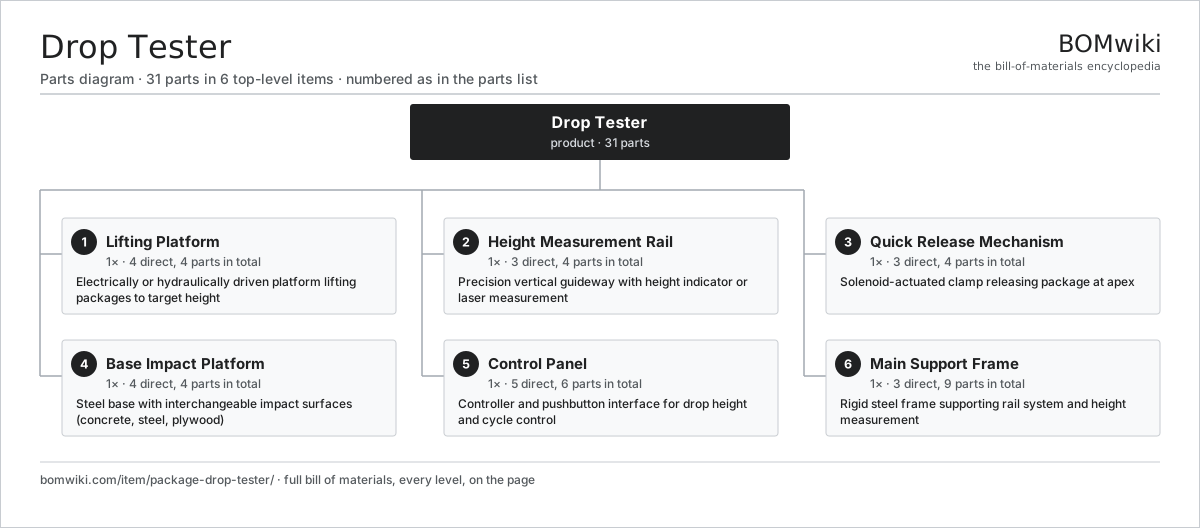
| # | Part | Qty | What it does |
|---|---|---|---|
| 1 | Lifting Platform 4 parts | 1× | Electrically or hydraulically driven platform lifting packages to target height |
| 2 | Height Measurement Rail 3 parts | 1× | Precision vertical guideway with height indicator or laser measurement |
| 3 | Quick Release Mechanism 3 parts | 1× | Solenoid-actuated clamp releasing package at apex |
| 4 | Base Impact Platform 4 parts | 1× | Steel base with interchangeable impact surfaces (concrete, steel, plywood) |
| 5 | Control Panel 5 parts | 1× | Controller and pushbutton interface for drop height and cycle control |
| 6 | Main Support Frame 3 parts | 1× | Rigid steel frame supporting rail system and height measurement |
3D model
No 3D model yet. Have a CAD file of this? Add a 3D model. STL renders right on this page; STEP, FreeCAD, and OpenSCAD sources are welcome too (openly licensed, like all 3D models on BOMwiki).
Build & assembly graph
expand / collapse · shared sub-assemblies converge · links to related products · est. labourTap an assembly to expand/collapse · tap a part to open it · use “Open page” for any node · drag to pan, scroll to zoom.
Bill of materials for Drop Tester
6 top-level lines · 28 rows shown · 31 parts total · indented to 3 levels| # | Item / sub-assembly | Part no. | Qty/assy | Ext. qty | Parts | Type |
|---|---|---|---|---|---|---|
| 1 | Lifting Platform 4 parts | package-drop-tester-lifting-platform | 1× | 1 | 4 | assembly |
| 1.1 | Lift Motor | package-drop-tester-lift-motor | 1× | 1 | · | part |
| 1.2 | Lift Cylinder | package-drop-tester-lift-cylinder | 1× | 1 | · | part |
| 1.3 | Platform Plate | package-drop-tester-platform-plate | 1× | 1 | · | part |
| 1.4 | Ball Screw | ball-screw | 1× | 1 | · | part |
| 2 | Height Measurement Rail 3 parts | package-drop-tester-height-rail | 1× | 1 | 4 | assembly |
| 2.1 | Linear Rail | package-drop-tester-linear-rail | 2× | 2 | · | part |
| 2.2 | Laser Height Sensor | package-drop-tester-laser-measure | 1× | 1 | · | part |
| 2.3 | Height Display | package-drop-tester-height-display | 1× | 1 | · | part |
| 3 | Quick Release Mechanism 3 parts | package-drop-tester-quick-release | 1× | 1 | 4 | assembly |
| 3.1 | Release Solenoid | package-drop-tester-release-solenoid | 1× | 1 | · | part |
| 3.2 | Clamp Jaw | package-drop-tester-clamp-jaw | 2× | 2 | · | part |
| 3.3 | Release Spring | package-drop-tester-solenoid-spring | 1× | 1 | · | part |
| 4 | Base Impact Platform 4 parts | package-drop-tester-base-platform | 1× | 1 | 4 | assembly |
| 4.1 | Base Frame | package-drop-tester-base-frame | 1× | 1 | · | part |
| 4.2 | Concrete Impact Surface | package-drop-tester-concrete-surface | 1× | 1 | · | part |
| 4.3 | Steel Impact Surface | package-drop-tester-steel-surface | 1× | 1 | · | part |
| 4.4 | Plywood Impact Surface | package-drop-tester-plywood-surface | 1× | 1 | · | part |
| 5 | Control Panel 5 parts | package-drop-tester-control-panel | 1× | 1 | 6 | assembly |
| 5.1 | PLC Module | package-drop-tester-plc | 1× | 1 | · | part |
| 5.2 | Motor Contactor | package-drop-tester-contactor | 1× | 1 | · | part |
| 5.3 | Solenoid Driver | package-drop-tester-solenoid-driver | 1× | 1 | · | part |
| 5.4 | Control Pushbutton | package-drop-tester-pushbutton | 2× | 2 | · | part |
| 5.5 | LCD Panel | lcd-panel | 1× | 1 | · | part |
| 6 | Main Support Frame 3 parts | package-drop-tester-frame | 1× | 1 | 9 | assembly |
| 6.1 | Frame Column | package-drop-tester-frame-column | 4× | 4 | · | part |
| 6.2 | Frame Beam | package-drop-tester-frame-beam | 4× | 4 | · | part |
| 6.3 | Fastener Set | fastener-set | 1× | 1 | · | part |
Something wrong in this list? Report a problem with this BOM.
Related products
same domain, ranked by shared parts Atomic Absorption Spectrometer
648 parts · shares 2 with this page
Atomic Absorption Spectrometer
648 parts · shares 2 with this page
 Automated Liquid Handler
817 parts · shares 2 with this page
Automatic Titrator
65 parts · shares 2 with this page
Automated Liquid Handler
817 parts · shares 2 with this page
Automatic Titrator
65 parts · shares 2 with this page
 Confocal Microscope
745 parts · shares 2 with this page
Dissolution Tester
370 parts · shares 2 with this page
Confocal Microscope
745 parts · shares 2 with this page
Dissolution Tester
370 parts · shares 2 with this page
 Fraction Collector
269 parts · shares 2 with this page
Fraction Collector
269 parts · shares 2 with this page
Sourcing: possible vendors
Browse the supplier directory → Prices, MOQ, and lead times are algorithmic estimates, not quotes, and not claims about these companies. Company mappings are curated by keyword; est. price band $1k–$500k. How estimates work| Vendor | HQ | Specialty | MOQ | Lead time |
|---|---|---|---|---|
| thermofisher.com ↗ | Waltham, US | Lab instruments | 100 units | 10–18 wks |
|
🇺🇸Agilent
agilent.com ↗
|
Santa Clara, US | Analytical instruments | 100 units | 10–18 wks |
|
🇺🇸Bruker
bruker.com ↗
|
Billerica, US | Scientific instruments | 100 units | 10–18 wks |
|
🇯🇵Shimadzu
shimadzu.com ↗
|
Kyoto, JP | Analytical instruments | 100 units | 10–18 wks |
|
🇺🇸Waters
waters.com ↗
|
Milford, US | Chromatography & MS | 100 units | 10–18 wks |
821-word article