Packraft
ProductOverview
A packraft is an ultralight, collapsible inflatable boat engineered for rapid river travel, backcountry expedition support, and quick water crossing in wilderness environments. Designed as an alternative to traditional hard-hulled kayaks, packrafts sacrifice some performance rigidity for unmatched portability, they pack down to the size of a camping pillow, fit within a standard backpack, and weigh only 4–6 pounds fully assembled.
The core design consists of two parallel TPU (thermoplastic polyurethane) tubes separated by webbing bracing. TPU is chosen for its balance of durability, UV resistance, chemical compatibility, and repairability. The dual-tube configuration provides redundant buoyancy: even if one chamber is breached and deflates, the vessel remains safely afloat. This inherent fail-safe architecture makes packrafts popular in expedition medicine and rescue contexts.
How it Works
The Hull Tubes consists of two parallel inflatable chambers connected by nylon webbing splice bands. Each tube is filled via a single Main Valve to 2.5–3 psi (17–21 kPa), creating a buoyant platform. The tubes are thin-wall (typically 0.4–0.6 mm TPU), allowing the vessel to conform somewhat to water surface irregularities while maintaining structural integrity.
Paddler weight is distributed across a Seat Assembly assembly suspended between the tubes. The seat is fabricated from closed-cell EVA or polyethylene foam (2 inches thick) wrapped in nylon fabric with drainage holes. This foam is buoyant itself and reduces the effective load on the tubes. The seat is not rigidly fixed; it flexes with water dynamics, absorbing impact energy from waves and rocks.
The Spray Deck is a critical component in class I–II river environments. This is a fabric skirt that covers the open interior and sheds water away from the paddler. A reinforced nylon collar surrounds the opening, with an elasticized shock cord cinching the neck around the paddler's waist. The shock cord has a quick-release feature for bailout safety.
Propulsion is achieved with a two-piece Paddle System. The paddle shaft is hollow aluminum (6061-T6), typically 200–220 cm in length, splitting into two sections joined by a plastic ferrule. The blades are molded nylon, designed with a narrow throat cut to reduce drag during the recovery stroke. Most packraft paddlers use a single-bladed canoe paddle rather than a double-bladed kayak paddle, which is more efficient in tight technical sections.
Control and rescue are enabled by the Rigging & Handles system. Nylon grab loops at bow and stern provide bailout handles. Three aluminum cleats (stern, midship, and bow) serve as anchor points for carabiners and safety ropes. These allow the vessel to be tied off in eddies, attached to tow systems, or secured to a shore anchor during camp setup.
Field durability is assured by the Repair Kit, which accompanies every vessel. TPU patches are adhesive-backed and pre-cut in assorted sizes (2x2, 3x4, 4x6 inches). A polyurethane contact cement cures in 12–24 hours and creates a bond stronger than the base material. Patches adhere to both TPU and nylon fabric, so repairs are reversible and field-serviceable. Many paddlers carry a repair kit weighing under 200 grams on every expedition.
Deflation and storage use the Storage Bags: large 30-liter roll-top dry sack for the hull and a 5-liter zippered pouch for paddle and repair kit. Packrafts are manually deflated by opening the valve, folding the tubes, and pressing air out, no pump needed. Deflation takes 3–5 minutes.
River Classification & Performance
Packrafts are rated for Class I–III (and occasionally Class IV) water. Stability is adequate for flat water and gentle rapids but not comparable to a rigid kayak in high-consequence whitewater. The flexible hull absorbs lateral forces poorly, and the open design (without a cockpit) leaves the paddler exposed to splashing in moving water. Performance is best in current, the boat planes readily and has minimal draft (4–6 inches fully loaded), excelling in shallow creeks and braided sections where hard boats ground out.
Materials & Durability
TPU is hydrolysis-resistant and UV-stable for 8–12 years with proper storage (cool, dark, dry). UV exposure degrades TPU; boats left outside without cover degrade faster. Nylon webbing is susceptible to UV damage and fungal rot if stored damp. Most manufacturers recommend rinsing the boat in fresh water after saltwater use and air-drying before storage. Adhesive bonds in patches remain flexible and do not embrittle over time, unlike epoxy, making TPU repair more forgiving than fiberglass.
Applications
Packrafts are used by:
- Expedition paddlers supporting multi-week backcountry treks (PCT, CDT, AZT resupply).
- Ski mountaineers crossing meltwater lakes or braided glacier-fed rivers.
- Hunting guides crossing rivers to access remote basins.
- Military and rescue units deploying quickly in flood or river-extraction scenarios.
- Kayak fishing enthusiasts who hike to remote lakes.
The combination of ultralight weight, packability, and sufficient capacity makes packrafts the optimal tool for water crossings in gear-heavy expeditions where a packraft adds under 7 pounds but solves logistical bottlenecks.
Packraft parts and their functions
8 top-level parts · 32 parts in total · full bill of materials below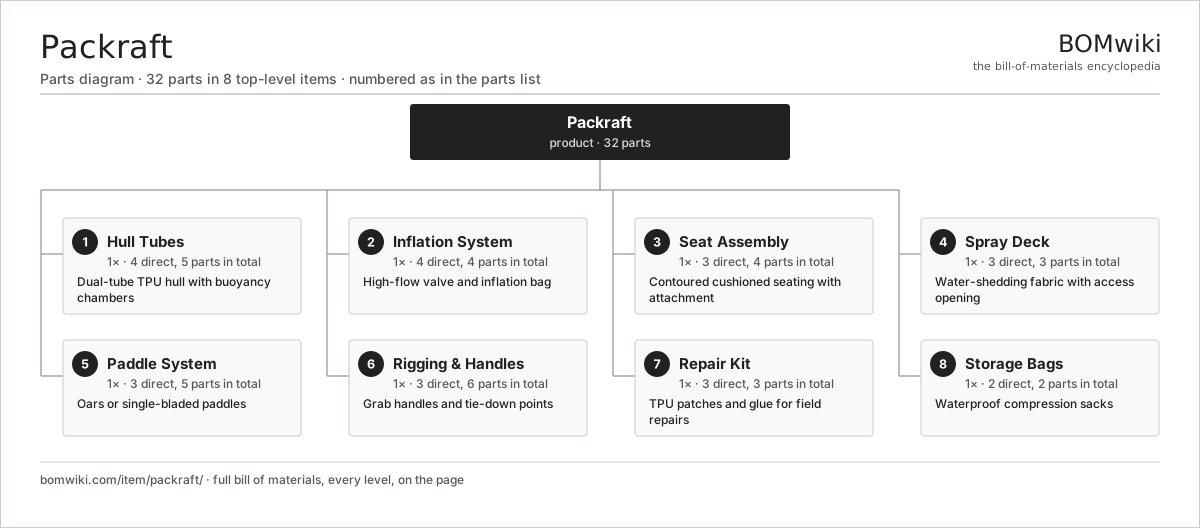
| # | Part | Qty | What it does |
|---|---|---|---|
| 1 | Hull Tubes 4 parts | 1× | Dual-tube TPU hull with buoyancy chambers |
| 2 | Inflation System 4 parts | 1× | High-flow valve and inflation bag |
| 3 | Seat Assembly 3 parts | 1× | Contoured cushioned seating with attachment |
| 4 | Spray Deck 3 parts | 1× | Water-shedding fabric with access opening |
| 5 | Paddle System 3 parts | 1× | Oars or single-bladed paddles |
| 6 | Rigging & Handles 3 parts | 1× | Grab handles and tie-down points |
| 7 | Repair Kit 3 parts | 1× | TPU patches and glue for field repairs |
| 8 | Storage Bags 2 parts | 1× | Waterproof compression sacks |
3D model
No 3D model yet. Have a CAD file of this? Add a 3D model. STL renders right on this page; STEP, FreeCAD, and OpenSCAD sources are welcome too (openly licensed, like all 3D models on BOMwiki).
Build & assembly graph
expand / collapse · shared sub-assemblies converge · links to related products · est. labourTap an assembly to expand/collapse · tap a part to open it · use “Open page” for any node · drag to pan, scroll to zoom.
Bill of materials for Packraft
8 top-level lines · 33 rows shown · 32 parts total · indented to 3 levels| # | Item / sub-assembly | Part no. | Qty/assy | Ext. qty | Parts | Type |
|---|---|---|---|---|---|---|
| 1 | Hull Tubes 4 parts | packraft-hull | 1× | 1 | 5 | assembly |
| 1.1 | Left TPU Tube | packraft-tpu-tube-left | 1× | 1 | · | part |
| 1.2 | Right TPU Tube | packraft-tpu-tube-right | 1× | 1 | · | part |
| 1.3 | Tube Connector Band | packraft-tube-connector | 2× | 2 | · | part |
| 1.4 | O-Ring Set | oring-set | 1× | 1 | · | part |
| 2 | Inflation System 4 parts | packraft-inflation-system | 1× | 1 | 4 | assembly |
| 2.1 | Main Valve | packraft-main-valve | 1× | 1 | · | part |
| 2.2 | Inflation Bag | packraft-bellows-bag | 1× | 1 | · | part |
| 2.3 | Check Valve | packraft-check-valve | 1× | 1 | · | part |
| 2.4 | Fastener Set | fastener-set | 1× | 1 | · | part |
| 3 | Seat Assembly 3 parts | packraft-seat | 1× | 1 | 4 | assembly |
| 3.1 | Seat Foam | packraft-seat-foam | 1× | 1 | · | part |
| 3.2 | Seat Cover | packraft-seat-cover | 1× | 1 | · | part |
| 3.3 | Attachment Strap | packraft-seat-straps | 2× | 2 | · | part |
| 4 | Spray Deck 3 parts | packraft-spray-deck | 1× | 1 | 3 | assembly |
| 4.1 | Deck Fabric | packraft-deck-fabric | 1× | 1 | · | part |
| 4.2 | Deck Ring | packraft-deck-ring | 1× | 1 | · | part |
| 4.3 | Shock Cord | packraft-shock-cord | 1× | 1 | · | part |
| 5 | Paddle System 3 parts | packraft-paddle-system | 1× | 1 | 5 | assembly |
| 5.1 | Paddle Shaft | packraft-paddle-shaft | 2× | 2 | · | part |
| 5.2 | Paddle Blade | packraft-paddle-blade | 2× | 2 | · | part |
| 5.3 | Blade Coupling | packraft-blade-cup | 1× | 1 | · | part |
| 6 | Rigging & Handles 3 parts | packraft-rigging | 1× | 1 | 6 | assembly |
| 6.1 | Grab Loop | packraft-grab-loop | 2× | 2 | · | part |
| 6.2 | Tie-Down Cleat | packraft-cleat | 3× | 3 | · | part |
| 6.3 | Fastener Set | fastener-set | 1× | 1 | · | part |
| 7 | Repair Kit 3 parts | packraft-repair-kit | 1× | 1 | 3 | assembly |
| 7.1 | TPU Patch Pack | packraft-tpu-patches | 1× | 1 | · | part |
| 7.2 | Polyurethane Glue | packraft-glue-tube | 1× | 1 | · | part |
| 7.3 | Surface Primer | packraft-primer | 1× | 1 | · | part |
| 8 | Storage Bags 2 parts | packraft-storage-bags | 1× | 1 | 2 | assembly |
| 8.1 | Main Storage Sack | packraft-main-sack | 1× | 1 | · | part |
| 8.2 | Accessory Pouch | packraft-accessory-sack | 1× | 1 | · | part |
Something wrong in this list? Report a problem with this BOM.
Related products
same domain, ranked by shared parts Backpacking Stove
32 parts · shares 2 with this page
Backpacking Stove
32 parts · shares 2 with this page
 Inflatable Kayak
71 parts · shares 2 with this page
LED Headlamp
33 parts · shares 2 with this page
Inflatable Kayak
71 parts · shares 2 with this page
LED Headlamp
33 parts · shares 2 with this page
 Portable Gas Grill
44 parts · shares 2 with this page
Portable Gas Grill
44 parts · shares 2 with this page
 Portable Water Filter
23 parts · shares 2 with this page
Portable Water Filter
23 parts · shares 2 with this page
 Rappel Descender
26 parts · shares 2 with this page
Rappel Descender
26 parts · shares 2 with this page
Sourcing: possible vendors
Browse the supplier directory → Prices, MOQ, and lead times are algorithmic estimates, not quotes, and not claims about these companies. Company mappings are curated by keyword; est. price band $20–$2k. How estimates work| Vendor | HQ | Specialty | MOQ | Lead time |
|---|---|---|---|---|
|
🇺🇸Coleman
coleman.com ↗
|
Chicago, US | Camping gear | 1,000 units | 6–10 wks |
| thenorthface.com ↗ | Denver, US | Outdoor apparel & gear | 1,000 units | 6–10 wks |
|
🇺🇸YETI
yeti.com ↗
|
Austin, US | Coolers & drinkware | 1,000 units | 6–10 wks |
| decathlon.com ↗ | Villeneuve-d'Ascq, FR | Sporting goods | 1,000 units | 6–10 wks |
|
🇺🇸Garmin
garmin.com ↗
|
Olathe, US | GPS & wearables | 1,000 units | 6–10 wks |
835-word article