Paintball Marker
ProductOverview
A paintball marker is a pneumatic launcher firing gelatin capsules (paintballs) containing non-toxic dye at 250–300 feet per second (76–91 m/s). Used in sport competition and recreational scenario games, paintball is a low-velocity, high-impact sport where projectile hits eliminate players from the game. Unlike firearms (lethal force), paintballs inflict a visible mark and momentary pain (bruising) but are not dangerous if proper safety equipment (goggles, protective vest) is worn.
Modern paintball markers fall into two categories:
- Mechanical (simple, affordable): Manual trigger operates a sear mechanism releasing pressurized air. Semi-automatic only; cyclic rate depends on finger speed (5–10 shots per second typical).
- Electronic (advanced, feature-rich): Computer controls solenoid firing, enabling full-auto, burst modes, adjustable rate-of-fire, and electronic safety features.
Both types pressurize air using compressed nitrogen (HPA, high-pressure air, 4,500 psi) or CO2 (liquid under pressure, ~900 psi vapor pressure). Nitrogen is preferred for tournament play (consistent performance across temperature ranges); CO2 is cheaper but sensitive to ambient temperature variation.
Air Pressure Regulation
The Air Regulator Assembly reduces tank pressure (4,500 psi nitrogen or 900 psi CO2 vapor) to operating pressure (100–200 psi), providing consistent pressure to the Bolt & Valve Assembly across all shots:
Regulator function:
- High-pressure inlet from tank → regulator input port.
- Diaphragm (flexible membrane) senses output pressure.
- Spring maintains equilibrium; if output pressure rises, diaphragm flexes, restricting inlet.
- Output pressure stabilizes at the spring-set value (typically adjustable via screw, 120–160 psi range).
Why regulation matters:
- Without regulation: Tank pressure (4,500 psi) directly enters firing chamber → paintballs exit at extreme velocity (1000+ ft/s), hard as concrete, causing bruising and potential injury. Also inconsistent (as tank pressure drops with use, velocity drops).
- With regulation: All shots exit at controlled velocity (280 ft/s ±10 ft/s), ensuring consistent performance and safe impact.
Pressure drop across game:
- Nitrogen tank: Maintains nearly constant pressure until suddenly empty (ideal for tournament play).
- CO2 tank: Pressure drops gradually as liquid evaporates (thermal loss). Cold air causes further pressure drop. Result: First 10–15 minutes of shooting at 300 ft/s, last 30 minutes at 200 ft/s (velocity creep, requiring field adjustment).
Tournament-grade markers use nitrogen exclusively for this reason.
Bolt & Valve Mechanics
The Bolt & Valve Assembly is the core firing mechanism. When triggered:
Sequence:
- Trigger is pressed, disengaging the sear.
- Sear releases the shuttle valve/bolt.
- Compressed air from regulator rushes into the firing chamber.
- Air pushes the paintball forward through the barrel, accelerating it.
- Bolt return spring pushes the bolt back to rest.
- Cycle is complete; marker is ready for next shot (~0.1 seconds, enabling 10 shots/second).
Shuttle valve operation:
- When cocked (at rest), a small spring holds the shuttle valve closed, sealing the firing chamber.
- When trigger is pulled, air pressure behind the shuttle overcomes the spring, opening the valve.
- Air rushes past the shuttle into the barrel chamber, accelerating the paintball.
- Bolt return spring pushes the shuttle back closed.
- Cycle repeats.
O-ring seals (Oring Seals):
- Nitrile rubber O-rings create airtight seals at multiple points (bolt, shuttle, inlet).
- Over time (5–10 years), O-rings deteriorate (hardening, cracking, loss of elasticity).
- Leaking O-rings cause: Loss of pressure, inconsistent firing, or complete failure.
- O-ring replacement kits cost $10–30; professional service $30–60.
Trigger Mechanism
Mechanical trigger (Trigger & Grip Frame):
- Mechanical sear: Catch holding the shuttle valve closed until trigger is pulled.
- When trigger lever is squeezed, a linkage releases the sear.
- Sear disengages, allowing air to open the shuttle valve.
- Trigger spring resets the trigger position.
Firing rate (mechanical):
- Limited by hand speed and mechanical spring return.
- Skilled players achieve 5–8 shots per second (theoretical max ~15 with technique and springy trigger).
- For comparison, semi-automatic firearms can exceed 10 shots per second with trigger control.
Electronic trigger (electronic markers):
- Trigger switch (simple on/off) is detected by the microcontroller.
- Microcontroller logic determines firing mode (semi-auto: one shot per press; burst: 3 shots; full-auto: continuous while held).
- Solenoid is energized for precisely-timed pulses, controlling firing rate.
- Rate-of-fire adjustable via firmware: 5–15 rounds per second typical.
Safety modes:
- Mechanical markers: Safety lever blocking trigger movement (manual on/off).
- Electronic markers: Electronic safety (marker won't fire until safety is disengaged via button sequence), plus mechanical trigger lock.
Solenoid & Electronic Control (Advanced Markers)
Premium electronic markers use a Solenoid Valve (Electronic Only) for precise air valve control:
Solenoid operation:
- When energized, electromagnet creates magnetic field.
- Iron plunger is attracted to the field, moving ~1 inch.
- Plunger motion opens the solenoid valve, allowing air to fire the bolt.
- When de-energized, spring returns plunger and closes valve.
Advantages:
- Precise timing (millisecond control enables consistent velocity).
- Full-auto capability (solenoid pulses at precise 10 ms intervals for 100 rounds/minute).
- Programmable settings (different fire modes, adjustable rate-of-fire, electronic safety).
- Feedback: Advanced markers include velocity sensors reporting actual FPS, allowing automatic regulator adjustment to maintain consistency.
Disadvantages:
- Power consumption: Electronic control draws ~500 mA continuous, limiting battery life to 8–20 hours of play.
- Complexity: More failure modes; repair requires specialized knowledge.
- Cost: $300–1,500+ vs. $100–300 for mechanical.
Barrel & Projectile Acceleration
The Barrel Assembly accelerates the paintball from rest to 280 ft/s:
Acceleration chamber design:
- Barrel length: 10–16 inches (25–40 cm) typical.
- Bore diameter: 0.688 inches (17.5 mm), tight fit for 0.68 inch paintballs.
- Bore finish: Smooth aluminum or electroless nickel plating (reduces friction).
Projectile acceleration:
- Time to muzzle: ~0.003 seconds (3 milliseconds).
- Distance: 12 inches (0.305 m).
- Acceleration: a = v² / (2 × d) = (280 ft/s)² / (2 × 1 ft) ≈ 39,200 ft/s² ≈ 1,220 m/s².
- Force on paintball: F = m × a = 0.003 kg × 1,220 m/s² ≈ 3.7 Newtons (~0.8 lbf).
Bore diameter matching:
- Tight bore (0.6835–0.685″) matches premium paintballs closely → less air escape → more consistent velocity, lower noise.
- Loose bore (0.688–0.690″) allows cheaper paintballs with variable diameter → more air escape → less consistent, louder.
Porting (Barrel Porting Holes):
- Holes drilled along barrel length (6–12 holes, 3–5 mm diameter).
- Allow excess air to escape after paintball leaves barrel.
- Reduce back-pressure and recoil (makes marker feel less forceful to shooter).
- Reduce noise (from ~120 dB unported to ~100 dB ported).
Barrel length optimization:
- Longer barrel (16″) gives more acceleration time → higher velocity (but diminishing returns after ~14″).
- Shorter barrel (10″) reduces acceleration → lower velocity and accuracy loss.
- Optimal: 12–14 inches for most paintball markers.
Hopper Feed System
The Hopper & Feed System supplies paintballs to the barrel consistently:
Gravity-fed hoppers:
- Passive system relying on paintball weight to drop into barrel.
- Simple, reliable, no electricity.
- Limitation: Paintballs can bridge (jam against each other), stopping feed.
- Disadvantage: Can only feed as fast as gravity allows (~5 shots per second).
Motorized hoppers:
- Electric motor drives an agitator blade rotating inside hopper.
- Agitation prevents bridging and gravity-assists feed.
- Typical feed rate: 10–20 paintballs per second (faster than mechanical trigger rate).
- Used with electronic markers for full-auto capability.
High-speed electronic hoppers:
- Ultrasonic or infrared sensor detects paintball at feed tube.
- Motor pulses feed agitator in synchrony with marker firing.
- Perfect feed rate matching: one paintball feeds per trigger cycle, no overshoot or starvation.
- Premium feature on competition markers.
Hopper capacity:
- Gravity: 50–100 paintballs (small, lightweight, no batteries).
- Standard motorized: 150–200 paintballs.
- High-speed: 200+ paintballs (heavy, complex, $50–150 cost).
Air Tanks & Supply Systems
Nitrogen (HPA) tanks:
- Compressed inert gas (nitrogen), stored at 4,500 psi.
- Pressure remains nearly constant as gas is used (volume decreases, pressure stays high until depletion).
- Temperature stable (gas performance independent of ambient temperature).
- Refill: Specialized pump or dive shop ~$5–10 per refill.
- Lifespan: Steel tanks 15 years (require hydrostatic testing every 5 years); carbon fiber 10 years (no testing required).
CO2 tanks:
- Compressed liquid carbon dioxide (not vapor), ~900 psi liquid pressure.
- As liquid evaporates during use, pressure gradually drops (velocity creep).
- Temperature sensitive: Cold weather drops pressure further (velocity drops 10–20 ft/s in freezing conditions).
- Refill: Paintball fields and sporting goods stores, ~$3–5 per refill.
- Lifespan: 20+ years (CO2 does not corrode steel like water).
Practical impact:
- Tournament play (HPA): All players chrono (chronograph velocity check) consistently at 280 ft/s start to finish.
- Casual play (CO2): Early game fast shots, late game slower shots; fields usually cap velocity at 280 ft/s max (exceeding causes bunker bounces, unfair gameplay).
Accuracy & Ballistics
Paintball accuracy is limited by projectile quality, barrel condition, and wind:
Ballistic coefficient:
- Paintballs are spheres (worst ballistic shape) with low density (gel shell + dye filling).
- Ballistic coefficient C ≈ 0.01–0.02 (compare: rifle bullet 0.3–0.5).
- Result: Rapid deceleration; at 100 feet, velocity drops 30–40% from muzzle velocity.
Accuracy degradation with distance:
- 25 feet: ±6–8 inches typical (experienced player with quality barrel).
- 50 feet: ±12–18 inches (wind-sensitive, paint quality dependent).
- 100 feet: ±2–3 feet (practical limit; any accuracy beyond this is luck, not skill).
Paintball quality variation:
- Tournament-grade paint: Sorted by diameter (±0.002″), consistent weight, consistent paint viscosity → tight grouping (±4 inches at 25 feet).
- Budget paint: Tolerance ±0.010″, weight varies → loose grouping (±10+ inches at 25 feet).
Barrel match:
- Paintball diameter and barrel bore must match: loose tolerance → air leakage → velocity drop and wobble.
- Tight tolerance (precision paint + precision barrel) → velocity consistency ±3 ft/s, tight grouping.
Field Play & Safety
Paintball is a sport using elimination marking (hit = out of game). Safety is paramount:
Eye protection:
- Mandatory thermal goggles (prevents lens fogging from marker hot air).
- Impact-rated (withstand 280+ ft/s paintball at point-blank range).
- Paintball to bare eye at 280 ft/s = retinal damage risk. Goggles are non-negotiable.
Body protection:
- Paintball to bare skin: Bruising and minor bleeding at 280 ft/s.
- Light armor (tactical vest, sleeves) reduces impact severity.
- Headgear optional (bruising on scalp is minor, but protective).
Chronograph limits:
- Tournaments chrono all markers: Must not exceed 280 ft/s at measured temperature.
- If marker exceeds 280 ft/s, it is deemed unsafe and player sits out.
- Field enforcement: Chronograph stations at start of event.
Barrel condom:
- Fabric bag fitted over barrel when marker is not in active play.
- Prevents accidental muzzle contact with faces/eyes.
- Required in many tournament fields and recommended in all recreational play.
Maintenance & Reliability
Regular maintenance:
- Clean marker after each game (paintball breaks leave dye/gel residue).
- Oil O-ring seals weekly with silicone oil (prevents hardening).
- Replace O-rings annually (preventive, ~$20).
- Check regulator calibration (chrono test to verify output pressure).
Common failure modes:
- Slow leaks: O-ring degradation → loss of air over minutes or hours. Remedy: Replace all O-rings (~$30 parts, 30 min labor).
- No fire: Clogged solenoid or seized shuttle valve → marker won't shoot. Remedy: Disassembly and cleaning or component replacement ($50–200 parts/labor).
- Velocity drop: Air tank pressure loss → lower muzzle velocity. Remedy: Refill tank or replace regulator ($30–150).
- Electronic glitch: Microcontroller failure → inconsistent firing or non-response. Remedy: Replace circuit board ($50–150 parts/labor).
Lifespan:
- Mechanical markers: 10–20 years (simplicity ensures longevity).
- Electronic markers: 5–10 years (solenoid/electronics degrade faster).
Repair vs. replacement:
- Budget marker ($100): Repair cost often exceeds replacement; DIY or retire.
- Premium marker ($500+): Professional repair justified; parts availability and service quality matter.
Comparison to Alternatives
| Launcher | Velocity | Impact | Accuracy | Cost | Skill Barrier |
|---|---|---|---|---|---|
| Paintball marker | 250–300 ft/s | Bruising, mark | ±6–12″ at 25ft | $100–1,500 | Low (2–4 hours) |
| Airsoft AEG | 300–400 ft/s | Minimal impact | ±4–8″ at 25ft | $150–800 | Low–moderate |
| Airgun (.177) | 800–1,200 ft/s | Penetrating | ±2–4″ at 50ft | $150–500 | Moderate |
| Slingshot | 50–100 ft/s | Minor bruising | ±6–12″ at 20ft | $10–100 | Low |
| Archery bow | 200–300 ft/s | Penetrating | ±2–4″ at 30ft | $200–1,000 | High |
Paintball offers a unique balance: high fun factor (elimination games with team strategy), safe (low energy, broad impact), affordable (cheap ammunition, equipment rental available), and accessible (low skill barrier). It's the dominant recreational sport in this category.
Tournament vs. Recreational Play
Recreational:
- Rent-a-gun available ($30–50 for marker + air).
- No chrono requirement (field safety limit 280 ft/s enforced by field rules).
- Simple scenarios (elimination, capture-the-flag, woodsball free-for-all).
- Mix of skill levels; fun emphasis over competition.
Tournament:
- Own marker required (standard equipment).
- Chrono mandatory (280 ft/s limit strictly enforced, measured to ±1 ft/s).
- Advanced game modes (5-man teams, 10-minute match, 50+ matches per day).
- Sponsorships and travel; competitive emphasis.
Tournament paintball is a serious sport with professional circuits, sponsorships, and international competitions. Casual field play is accessible and fun for anyone.
Paintball Marker parts and their functions
8 top-level parts · 29 parts in total · full bill of materials below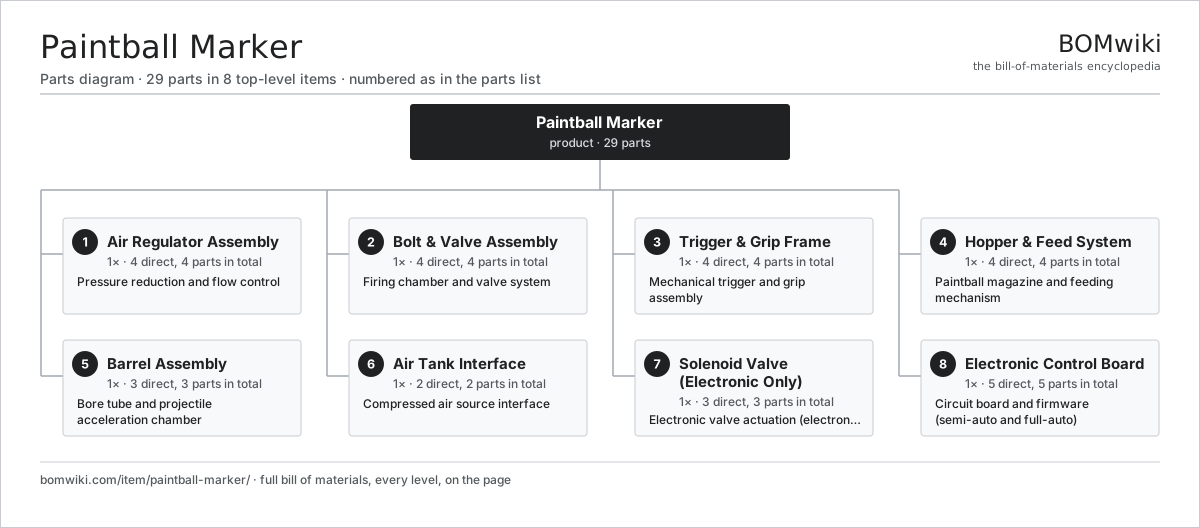
| # | Part | Qty | What it does |
|---|---|---|---|
| 1 | Air Regulator Assembly 4 parts | 1× | Pressure reduction and flow control |
| 2 | Bolt & Valve Assembly 4 parts | 1× | Firing chamber and valve system |
| 3 | Trigger & Grip Frame 4 parts | 1× | Mechanical trigger and grip assembly |
| 4 | Hopper & Feed System 4 parts | 1× | Paintball magazine and feeding mechanism |
| 5 | Barrel Assembly 3 parts | 1× | Bore tube and projectile acceleration chamber |
| 6 | Air Tank Interface 2 parts | 1× | Compressed air source interface |
| 7 | Solenoid Valve (Electronic Only) 3 parts | 1× | Electronic valve actuation (electronic markers) |
| 8 | Electronic Control Board 5 parts | 1× | Circuit board and firmware (semi-auto and full-auto) |
3D model
No 3D model yet. Have a CAD file of this? Add a 3D model. STL renders right on this page; STEP, FreeCAD, and OpenSCAD sources are welcome too (openly licensed, like all 3D models on BOMwiki).
Build & assembly graph
expand / collapse · shared sub-assemblies converge · links to related products · est. labourTap an assembly to expand/collapse · tap a part to open it · use “Open page” for any node · drag to pan, scroll to zoom.
Bill of materials for Paintball Marker
8 top-level lines · 37 rows shown · 29 parts total · indented to 3 levels| # | Item / sub-assembly | Part no. | Qty/assy | Ext. qty | Parts | Type |
|---|---|---|---|---|---|---|
| 1 | Air Regulator Assembly 4 parts | paintball-marker-air-regulator | 1× | 1 | 4 | assembly |
| 1.1 | Regulator Input Port | paintball-marker-reg-inlet | 1× | 1 | · | part |
| 1.2 | Pressure Balancing Diaphragm | paintball-marker-reg-diaphragm | 1× | 1 | · | part |
| 1.3 | Regulator Spring | paintball-marker-reg-spring | 1× | 1 | · | part |
| 1.4 | Regulated Output Port | paintball-marker-reg-outlet | 1× | 1 | · | part |
| 2 | Bolt & Valve Assembly 4 parts | paintball-marker-bolt-valve | 1× | 1 | 4 | assembly |
| 2.1 | Bolt Cylinder | paintball-marker-bolt-body | 1× | 1 | · | part |
| 2.2 | Shuttle Valve | paintball-marker-shuttle-valve | 1× | 1 | · | part |
| 2.3 | Bolt Return Spring | paintball-marker-return-spring | 1× | 1 | · | part |
| 2.4 | Oring Seals | paintball-marker-oring-seals | 1× | 1 | · | part |
| 3 | Trigger & Grip Frame 4 parts | paintball-marker-trigger-frame | 1× | 1 | 4 | assembly |
| 3.1 | Trigger Lever | paintball-marker-trigger-lever | 1× | 1 | · | part |
| 3.2 | Grip Handle | paintball-marker-grip-handle | 1× | 1 | · | part |
| 3.3 | Trigger Return Spring | paintball-marker-trigger-spring | 1× | 1 | · | part |
| 3.4 | Sear Release Mechanism | paintball-marker-sear-mechanism | 1× | 1 | · | part |
| 4 | Hopper & Feed System 4 parts | paintball-marker-hopper-feed | 1× | 1 | 4 | assembly |
| 4.1 | Hopper Shell | paintball-marker-hopper-shell | 1× | 1 | · | part |
| 4.2 | Feed Motor | paintball-marker-feed-motor | 1× | 1 | · | part |
| 4.3 | Agitator Blade | paintball-marker-feed-agitator | 1× | 1 | · | part |
| 4.4 | Drop Tube Feeder | paintball-marker-drop-tube | 1× | 1 | · | part |
| 5 | Barrel Assembly 3 parts | paintball-marker-barrel | 1× | 1 | 3 | assembly |
| 5.1 | Barrel Bore Tube | paintball-marker-barrel-tube | 1× | 1 | · | part |
| 5.2 | Barrel Porting Holes | paintball-marker-barrel-porting | 1× | 1 | · | part |
| 5.3 | Muzzle Thread | paintball-marker-barrel-threads | 1× | 1 | · | part |
| 6 | Air Tank Interface 2 parts | paintball-marker-air-tank-mount | 1× | 1 | 2 | assembly |
| 6.1 | QD Male Thread | paintball-marker-tank-qd-male | 1× | 1 | · | part |
| 6.2 | QD Coupling Line | paintball-marker-tank-qd-coupling | 1× | 1 | · | part |
| 7 | Solenoid Valve (Electronic Only) 3 parts | paintball-marker-firing-solenoid | 1× | 1 | 3 | assembly |
| 7.1 | Solenoid Electromagnet | paintball-marker-solenoid-coil | 1× | 1 | · | part |
| 7.2 | Solenoid Plunger | paintball-marker-solenoid-plunger | 1× | 1 | · | part |
| 7.3 | Solenoid Oring | paintball-marker-solenoid-oring | 1× | 1 | · | part |
| 8 | Electronic Control Board 5 parts | paintball-marker-electronics-module | 1× | 1 | 5 | assembly |
| 8.1 | Microcontroller | mcu | 1× | 1 | · | part |
| 8.2 | Battery Pack | paintball-marker-battery | 1× | 1 | · | part |
| 8.3 | Power MOSFET | paintball-marker-power-mosfet | 1× | 1 | · | part |
| 8.4 | Trigger Switch Sensor | paintball-marker-trigger-sensor | 1× | 1 | · | part |
| 8.5 | Connector | connector | 1× | 1 | · | part |
Something wrong in this list? Report a problem with this BOM.
Related products
same domain, ranked by shared parts Portable Power Station
94 parts · shares 2 with this page
Portable Power Station
94 parts · shares 2 with this page
 Rechargeable Camp Lantern
58 parts · shares 2 with this page
Rechargeable Camp Lantern
58 parts · shares 2 with this page
 Surfboard
18 parts · shares 1 with this page
Surfboard
18 parts · shares 1 with this page
 Avalanche Transceiver
35 parts · shares 1 with this page
Avalanche Transceiver
35 parts · shares 1 with this page
 Dive Computer
18 parts · shares 1 with this page
Dive Computer
18 parts · shares 1 with this page
Sourcing: possible vendors
Browse the supplier directory → Prices, MOQ, and lead times are algorithmic estimates, not quotes, and not claims about these companies. Company mappings are curated by keyword; est. price band $20–$2k. How estimates work| Vendor | HQ | Specialty | MOQ | Lead time |
|---|---|---|---|---|
|
🇺🇸Coleman
coleman.com ↗
|
Chicago, US | Camping gear | 1,000 units | 6–10 wks |
| thenorthface.com ↗ | Denver, US | Outdoor apparel & gear | 1,000 units | 6–10 wks |
|
🇺🇸YETI
yeti.com ↗
|
Austin, US | Coolers & drinkware | 1,000 units | 6–10 wks |
| decathlon.com ↗ | Villeneuve-d'Ascq, FR | Sporting goods | 1,000 units | 6–10 wks |
|
🇺🇸Garmin
garmin.com ↗
|
Olathe, US | GPS & wearables | 1,000 units | 6–10 wks |
2,158-word article