Cargo Parachute System
ProductOverview
The Cargo Parachute System is a triple-canopy heavy-drop platform designed to deliver supplies, ammunition, medical equipment, and other critical cargo to forward units and isolated locations inaccessible by road. The system uses three 26-meter-diameter circular parachutes deployed in sequence from a single bridle attachment, distributing the load across three suspension points to achieve stable descent and reliable impact performance.
Unlike personnel parachutes, which prioritize individual control and maneuverability, cargo chutes are optimized for reliable automatic deployment, stable descent in wind, and survivable landing of heavy, fragile loads. The triple-canopy configuration is mandatory for loads above 5,000 lbs because a single canopy would generate uncontrollable oscillation and dangerous landing impact velocities. Three canopies working in concert provide descent stability, load distribution, and redundancy: if one canopy is damaged or fails to deploy, the remaining two canopies still provide enough drag to land the cargo safely.
The deployment sequence is mechanical and requires no crew action once the pallet exits the aircraft. A Extraction Drogue pilot chute is deployed first from the static line anchor (a cable running the length of the cargo compartment), which creates drag and pulls the main Deployment Bag out of the aircraft. As the deployment bag trails behind, wind pressure ruptures the breakaway closures in sequence, allowing the three main canopies to extract from the bag and inflate. The entire process is timed so that full inflation occurs at least 200 feet above ground, allowing any oscillation to damp before impact.
The Pallet Interface bridle is designed to lock onto standard military pallets (equipped with corner castings) and suspends them from the Riser Bundle risers. Once the cargo touches down, a Release Mechanism (pneumatic or pyrotechnic) cuts the four riser attachments, allowing the parachutes to collapse and blow downwind, clear of the landed cargo.
How it works
Preparation begins the day before drop, when the parachute team inspects all three canopies for damage or loose stitching, repack the deployment bag with controlled bunching, and attach the pilot drogue using the static line. The pallet is loaded with cargo, weighed, and confirmed to fall within the approved weight envelope (typically 8,000–15,000 lbs depending on canopy configuration and deployment altitude). The bridle frame is bolted to the pallet corner castings using the four Corner Lock Pin shear pins, which will break cleanly during landing impact and allow safe separation.
The pallet is loaded into the aircraft (C-130 Hercules is typical), the static line anchor is hooked over the cargo compartment cable, and the system is armed. The aircraft navigates to the drop zone, flying at 1,200–1,500 feet altitude and 130 knots airspeed (conditions specified for the specific canopy set). The navigator plots the release point using GPS and wind speed readings, calculating where the pallet will drift during descent.
At the command, the cargo handler pulls the release pin, drops the pallet, and the static line immediately comes taut. The Extraction Drogue deploys, creating 80 pounds of drag and pulling the main deployment bag out of the aircraft. As the bag trails 50–100 feet behind the aircraft, wind pressure acts on the outer envelope, rupturing the first breakaway closure. The pressure increases as the bag falls and destabilizes, rupturing the second closure seconds later. The third closure breaks as the bag is nearly vertical, allowing the three Main Canopy canopies to extract and inflate.
The canopies begin opening at approximately 300 feet, with the first canopy fully inflated by 250 feet. The second and third canopies follow in quick succession, creating a vertical stack of three inflated parachutes with their risers converging at the Harness Assembly. The suspension webbing and Load Spreader Bar distribute the weight of the pallet to all three canopies, avoiding concentration of stress on any single attachment point.
As the pallet descends, residual horizontal velocity gradually decreases due to drag; by impact (50–100 feet remaining), the descent is nearly vertical. The four Main Canopy landing feet (weight of the pallet) compress into the ground, absorbing kinetic energy. Once all motion ceases, the cargo handler triggers the Release Mechanism: if pneumatic, a pressurized air bottle ruptures a seal, driving a piston that cuts the four riser attachment points; if pyrotechnic, a small linear shaped charge severs all four risers simultaneously. The Bridle Frame releases from the pallet, and the parachutes collapse and drift away, allowing recovery personnel access to the cargo.
Design rationale
The triple-canopy configuration was standardized in military logistics because it offers the best combination of reliability, stability, and survivability for cargo exceeding 5,000 lbs. A single canopy would oscillate with a period of 4–6 seconds (swinging 20–30 degrees side to side), creating violent oscillation during landing and risking tipping of fragile cargo or equipment damage. Two canopies partially damp this oscillation but leave some swinging; three canopies distribute the load and inertial forces sufficiently that oscillation amplitude drops below 5 degrees, ensuring stable vertical descent.
The 26-meter diameter was chosen as the largest canopy size that can be reliably packed in a standard deployment bag and deployed from a tactical transport aircraft. Larger canopies (30+ meters) offer lower descent rates but are difficult to pack, exceed aircraft door width constraints, and require longer deployment zones. The 26-meter canopies provide a descent rate of 14–18 ft/sec at maximum load, which is survivable for most cargo (ammunition, fuel containers, medical supplies, food) without requiring impact-absorbing skids.
The Extraction Drogue is essential because without it, the deployment bag would trail behind the aircraft indefinitely without opening. The drogue creates enough drag force to overcome aerodynamic stagnation pressure and rupture the first breakaway closure. The static line ensures that the drogue is deployed before the pallet exits the aircraft, guaranteeing an immediate opening shock that pulls the main canopies clear of the cargo and the aircraft.
The sequential breakaway closures in the deployment bag are timed so that the first canopy inflates fully before the second one is exposed to wind, preventing entanglement or asymmetrical deployment. If all three canopies inflated at once, they would tangle in the initial shock. The staggered inflation (first at 300 feet, second at 250 feet, third at 200 feet) allows each canopy to orient vertically before the next one begins opening, ensuring parallel suspension and balanced loading.
The Riser Bundle risers are polyester (not nylon) because they resist abrasion better during the violent deployment shock and maintain their strength when wet. Nylon risers lose 10–15% strength when saturated; polyester is less hygroscopic and maintains consistent performance in humid climates. The risers are relatively short (5 meters) compared to personnel parachutes because cargo drops occur at low altitude (400–1,000 feet), and longer risers would make the deployment bag too deep to fit in aircraft cargo compartments.
The Pallet Interface bridle is welded steel (not a knotted webbing net) because it must survive multiple drops without degradation. Nylon webbing becomes brittle with UV exposure over months of outdoor storage; welded steel is unaffected. The four Corner Lock Pin shear pins are critical design features: they allow the bridle to lock securely to the pallet during flight and acceleration, then shear cleanly during landing impact, allowing automatic separation without crew action.
The Release Mechanism severs all four riser attachments simultaneously (not sequentially) to prevent the bridle from tilting and snagging on cargo corners. A pyrotechnic system is more reliable than a pneumatic system in cold environments, where pneumatic seals may become brittle. However, military doctrine requires both systems: pneumatic systems are preferred in civilian logistics, where pyrotechnic discharge is restricted; pyrotechnic systems are used in wartime operations where reliability under all conditions is the primary concern.
Operational constraints
The system is designed for open-zone drops onto flat terrain (fields, parking areas, lake beds). Dense forest, urban areas, and mountains create hazards: parachutes tangling in trees, cargo drifting into buildings, or landing on uneven terrain with potential for tipping. Drop zones are carefully surveyed and cleared before operations; a 1,000 meter × 1,000 meter clear zone is typical.
Wind speed at drop altitude is critical. Maximum wind speed for safe drops is 20 knots; above this threshold, the pallet drifts beyond safe recovery range or becomes unstable during descent. Jump teams carry portable anemometers and measure wind speed at both release altitude and ground level before authorizing the drop. If wind exceeds limits, the drop is postponed.
Temperature and altitude affect canopy performance. At sea level in 20°C conditions, the system performs nominally. At 8,000 feet elevation in 0°C air, canopy density changes and descent rates increase 8–12%; minimum deployment altitude must be increased by 200 feet to ensure time for oscillation damping. High-altitude drops (above 10,000 feet) require oxygen systems for the aircrew and must use larger or additional canopies to achieve acceptable descent rates.
The deployment bag must be repacked every 30 days even if unused, because exposure to humidity and temperature cycles causes nylon fiber fatigue and eventual loss of strength. Repacking involves extracting the canopies, inspecting all suspension lines for chafing or cuts, re-stitching any damaged seams, refolding the canopies with a specific Z-fold pattern, and returning them to the deployment bag with breakaway closures re-installed. This task requires specialized training and is performed only by certified parachute riggers.
Recovery and reuse
After landing, the recovered canopies are inspected for tears, rips, or line damage. Minor tears (< 5 cm) are patched using ripstop repair tape and the chutes returned to service. Larger tears require hand stitching or complete panel replacement; severely damaged canopies are removed from service and sent to the parachute depot for major overhaul or disposal.
The risers are visually inspected for abrasion or UV damage, tested for tensile strength if damage is suspected, and reused if serviceable. The bridle frame is inspected for cracks in the welds; any cracked weld is cut out and re-welded by the maintenance team. The corner lock pins are examined for shear fracture; if they broke cleanly (as designed), they are replaced with new pins for the next drop. If pins bent rather than sheared (indicating a non-standard landing), the bridle may have sustained frame distortion and is removed from service for straightening or replacement.
With proper maintenance and limited repacks, a parachute system can achieve 200+ drops over 10–15 years before retirement. Lifespan is extended by storing canopies in cool, dry conditions away from direct sunlight and avoiding exposure to chemicals or oils that degrade nylon fabric.
Cargo Parachute System parts and their functions
7 top-level parts · 451 parts in total · full bill of materials below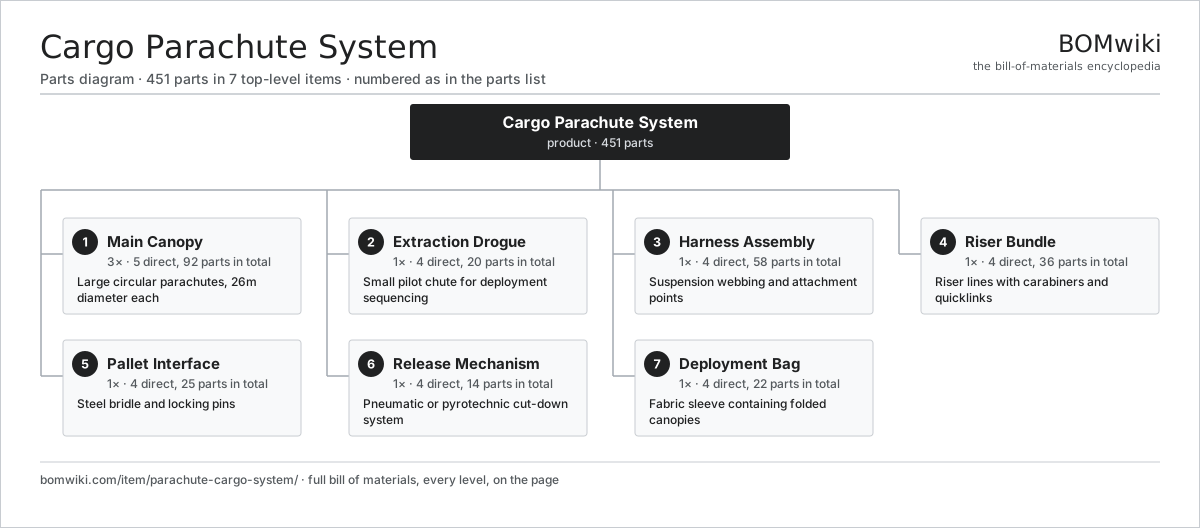
| # | Part | Qty | What it does |
|---|---|---|---|
| 1 | Main Canopy 5 parts | 3× | Large circular parachutes, 26m diameter each |
| 2 | Extraction Drogue 4 parts | 1× | Small pilot chute for deployment sequencing |
| 3 | Harness Assembly 4 parts | 1× | Suspension webbing and attachment points |
| 4 | Riser Bundle 4 parts | 1× | Riser lines with carabiners and quicklinks |
| 5 | Pallet Interface 4 parts | 1× | Steel bridle and locking pins |
| 6 | Release Mechanism 4 parts | 1× | Pneumatic or pyrotechnic cut-down system |
| 7 | Deployment Bag 4 parts | 1× | Fabric sleeve containing folded canopies |
3D model
No 3D model yet. Have a CAD file of this? Add a 3D model. STL renders right on this page; STEP, FreeCAD, and OpenSCAD sources are welcome too (openly licensed, like all 3D models on BOMwiki).
Build & assembly graph
expand / collapse · shared sub-assemblies converge · links to related products · est. labourTap an assembly to expand/collapse · tap a part to open it · use “Open page” for any node · drag to pan, scroll to zoom.
Bill of materials for Cargo Parachute System
7 top-level lines · 36 rows shown · 451 parts total · indented to 3 levels| # | Item / sub-assembly | Part no. | Qty/assy | Ext. qty | Parts | Type |
|---|---|---|---|---|---|---|
| 1 | Main Canopy 5 parts | parachute-cargo-system-main-canopy | 3× | 3 | 92 | assembly |
| 1.1 | Ripstop Nylon | parachute-cargo-system-nylon-fabric | 3× | 9 | · | part |
| 1.2 | Seam Tape | parachute-cargo-system-seam-tape | 1× | 3 | · | part |
| 1.3 | Suspension Line | parachute-cargo-system-suspension-line | 32× | 96 | · | part |
| 1.4 | Line Attachment Tape | parachute-cargo-system-line-attachment-tape | 32× | 96 | · | part |
| 1.5 | Fastener Set | fastener-set | 24× | 72 | · | part |
| 2 | Extraction Drogue 4 parts | parachute-cargo-system-extraction-drogue | 1× | 1 | 20 | assembly |
| 2.1 | Drogue Fabric | parachute-cargo-system-drogue-fabric | 1× | 1 | · | part |
| 2.2 | Drogue Line | parachute-cargo-system-drogue-line | 6× | 6 | · | part |
| 2.3 | Static Line | parachute-cargo-system-static-line | 1× | 1 | · | part |
| 2.4 | Fastener Set | fastener-set | 12× | 12 | · | part |
| 3 | Harness Assembly 4 parts | parachute-cargo-system-harness-assembly | 1× | 1 | 58 | assembly |
| 3.1 | Main Webbing | parachute-cargo-system-main-webbing | 20× | 20 | · | part |
| 3.2 | Corner Ring | parachute-cargo-system-corner-ring | 4× | 4 | · | part |
| 3.3 | Load Spreader Bar | parachute-cargo-system-load-spreader-bar | 2× | 2 | · | part |
| 3.4 | Fastener Set | fastener-set | 32× | 32 | · | part |
| 4 | Riser Bundle 4 parts | parachute-cargo-system-riser-bundle | 1× | 1 | 36 | assembly |
| 4.1 | Riser Line | parachute-cargo-system-riser-line | 12× | 12 | · | part |
| 4.2 | Carabiner | parachute-cargo-system-carabiner | 12× | 12 | · | part |
| 4.3 | Quicklink | parachute-cargo-system-quicklink | 4× | 4 | · | part |
| 4.4 | Fastener Set | fastener-set | 8× | 8 | · | part |
| 5 | Pallet Interface 4 parts | parachute-cargo-system-pallet-interface | 1× | 1 | 25 | assembly |
| 5.1 | Bridle Frame | parachute-cargo-system-bridle-frame | 1× | 1 | · | part |
| 5.2 | Corner Lock Pin | parachute-cargo-system-corner-lock-pin | 4× | 4 | · | part |
| 5.3 | Bridle Eye Fitting | parachute-cargo-system-bridle-eye-fitting | 4× | 4 | · | part |
| 5.4 | Fastener Set | fastener-set | 16× | 16 | · | part |
| 6 | Release Mechanism 4 parts | parachute-cargo-system-release-mechanism | 1× | 1 | 14 | assembly |
| 6.1 | Pyrotechnic Charge | parachute-cargo-system-pyrotechnic-charge | 1× | 1 | · | part |
| 6.2 | Cutting Shear | parachute-cargo-system-cutting-shear | 4× | 4 | · | part |
| 6.3 | Thermal Battery | parachute-cargo-system-thermal-battery | 1× | 1 | · | part |
| 6.4 | Fastener Set | fastener-set | 8× | 8 | · | part |
| 7 | Deployment Bag 4 parts | parachute-cargo-system-deployment-bag | 1× | 1 | 22 | assembly |
| 7.1 | Bag Fabric | parachute-cargo-system-bag-fabric | 1× | 1 | · | part |
| 7.2 | Bag Closure | parachute-cargo-system-bag-closure | 3× | 3 | · | part |
| 7.3 | Bag Elastic Tape | parachute-cargo-system-bag-elastic-tape | 2× | 2 | · | part |
| 7.4 | Fastener Set | fastener-set | 16× | 16 | · | part |
Something wrong in this list? Report a problem with this BOM.
Sourcing: possible vendors
Browse the supplier directory → Prices, MOQ, and lead times are algorithmic estimates, not quotes, and not claims about these companies. Company mappings are curated by keyword; est. price band $200–$100M. How estimates work| Vendor | HQ | Specialty | MOQ | Lead time |
|---|---|---|---|---|
| smithsdetection.com ↗ | London, GB | Security screening | made to order | 24–52 wks |
|
🇺🇸Leidos
leidos.com ↗
|
Reston, US | Security & screening | made to order | 24–52 wks |
|
🇺🇸Rapiscan
rapiscansystems.com ↗
|
Torrance, US | X-ray screening | made to order | 24–52 wks |
|
🇫🇷Thales
thalesgroup.com ↗
|
Paris, FR | Defense electronics | made to order | 24–52 wks |
| baesystems.com ↗ | London, GB | Defense | made to order | 24–52 wks |
1,821-word article