Paraglider
ProductOverview
A paraglider is the simplest powered aircraft in existence: a lightweight fabric wing suspended beneath the pilot via suspension lines, capable of sustained flight by riding thermal columns of rising air. Unlike hang gliders (which require a stiff frame) or parachutes (which descend), paragliders are purely aerodynamic devices deriving lift from the ram-air dynamic pressure distribution across a fabric airfoil.
The paraglider pilot walks off a hillside or is towed aloft, climbs in thermals (rising air currents warmed by sun-heated ground), and can remain aloft for hours, gaining altitude and cross-country distance. A typical recreational flight might be 1–2 hours and cover 10–50 km; an ambitious cross-country pilot might cover 200+ km in a day.
The wing: ram-air construction
The Ram-Air Wing is the core: a fabric canopy with two layers (top and bottom panels) made of Canopy Fabric ripstop nylon, connected by internal Cell Rib vertical partitions. This creates a honeycomb of ~25–35 cells, each forming a small airfoil cross-section.
Air enters the front of the canopy (the A-Level Lines attachment area) at dynamic pressure ~0.5 × ρ × V². This ram-air pressure fills the cells, maintaining the airfoil shape even during slow flight. The Cross Port small openings between cells allow air to flow and equalize pressure, stabilizing the wing in turbulence. The Vent Hole upper-surface openings manage inflation dynamics, preventing "over-pressurization" and controlling pitch.
The result is a flying wing: no fuselage, no frame, no control surfaces, just a shaped fabric that generates lift aerodynamically.
Suspension and control
The Suspension Lines connect canopy to pilot in four levels (A, B, C, D groups), each carrying ~25% of the total weight. The Riser Assemblies left and right straps bundle these lines and attach to the Pilot Harness via Carabiner Hardware.
Flight control is minimal: the Speed Control System uses two Brake Lever and Brake Lever Right hand-operated levers. Pulling either lever actuates a Brake Line or Brake Line Right that pulls the trailing edge down, increasing angle of attack. More angle of attack = slower flight, steeper descent. By pulling both levers symmetrically, the pilot slows down; pulling one lever turns the wing in that direction.
There are no other control inputs: no rudder, no ailerons, no pitch trim wheel. The paraglider is inherently stable, the center of gravity (pilot in harness) sits well below the center of pressure (wing), creating restoring moment. Coordinated control comes from subtle brake lever inputs and body movement in the harness.
Harness and comfort
The Pilot Harness is where the pilot sits during flight: a comfortable Harness Seat pod or fabric seat with Harness Back support (often thermal foam-padded). Leg loops (from the Harness Leg Loop) prevent the harness from rotating. The Reserve Pouch integrates an emergency parachute system.
Modern harnesses may include airbags (side-mounted inflatable compartments preventing roll-over during collapses) and back protectors. Comfort matters: a cross-country flight lasts 4–6 hours, so a well-designed harness reduces fatigue.
Emergency systems
The Emergency Parachute System is essential: if the wing collapses during turbulent air (rare but possible) or enters an uncontrollable spin, the pilot deploys the emergency parachute. A spring or pyrotechnic Ballistic Deployment launches a small Reserve Canopy (18–24 m²) away from the main wing, ensuring separation. The pilot then descends under the reserve to a safe landing.
Emergency-parachute deployment is certified for speeds up to 70 kts and altitudes as low as 200 m. A paraglider pilot with a deployed reserve can land safely in almost any conditions, paved road, rooftop, field.
Thermaling and climb
The paraglider's purpose is to exploit thermals, invisible columns of rising air, typically 2–3 m/s vertical velocity. When the pilot enters a thermal, the Brake Lever and Brake Lever Right are gradually released (reducing brake drag), and the paraglider climbs with the air mass. The pilot spirals tighter as the thermal narrows with altitude, staying in the strongest core.
Glide ratio is critical: a paraglider with 8:1 glide (8 meters of forward distance per 1 meter of descent) can reach the next thermal 200 m away even if sinking at 0.5 m/s. Cross-country flying is a puzzle of connecting thermals, with the paraglider serving as the vehicle for riding updrafts.
Design classes
Paragliders are certified in EN (European Norm) classes:
- EN-A: Beginner-friendly, docile handling, ~27 m² size.
- EN-B: Intermediate, more responsive, ~30 m².
- EN-C: Advanced, high performance, ~35 m².
- EN-D: Competition / extreme, demanding handling, ~40+ m².
Larger wings are more efficient (higher glide ratio) but less forgiving of pilot error; smaller wings are responsive and easier to manage but sink faster in weak conditions.
Takeoff and landing
Foot-launch: The pilot holds the canopy above and shifts to high brake (full pull on both levers), inflating the wing. As pressure builds, the wing rises. The pilot runs forward, releasing brakes as the canopy becomes overhead. Within ~20 m, airflow is sufficient to generate lift, and the pilot becomes airborne, feet leaving the ground as the wing climbs away.
Landing: The reverse, descending toward a field, the pilot reduces speed progressively with brake inputs, aiming for a gentle touchdown. At the last moment, a full flare (pulling both levers fully) generates maximum drag, decelerating to a walking speed. Landing is typically a walk-off: feet touch down at ~5 km/h, and the pilot walks a few meters as the wing loses lift and collapses.
Towed launch (alternative): Some sites use a winch or automobile to tow the paraglider to altitude (500–1000 m) to bypass the foot-launch effort or when wind conditions are marginal.
Regulations and culture
Paragliding is regulated under FISA (International Hang Gliding & Paragliding Commission) and national authorities. A license requires ground-school training, practical instruction, and solo flights under supervision. Most countries regulate altitude, airspace (avoiding airports), and pilot certification.
The paragliding community is global and collaborative: thousands of pilots share thermal reports, flight routes, and safety tips. Cross-country flying is both sport (time and distance contests) and personal achievement, a paraglider reaching 5000 m altitude on a thermal or covering 100 km in a single flight is an accomplishment reflecting skill and endurance.
Paraglider parts and their functions
8 top-level parts · 98 parts in total · full bill of materials below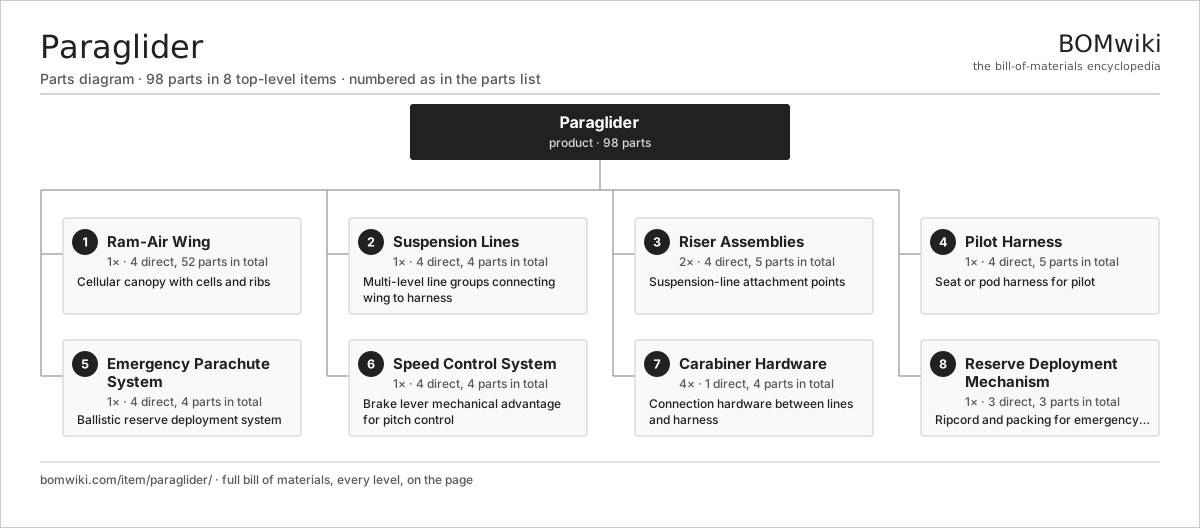
| # | Part | Qty | What it does |
|---|---|---|---|
| 1 | Ram-Air Wing 4 parts | 1× | Cellular canopy with cells and ribs |
| 2 | Suspension Lines 4 parts | 1× | Multi-level line groups connecting wing to harness |
| 3 | Riser Assemblies 4 parts | 2× | Suspension-line attachment points |
| 4 | Pilot Harness 4 parts | 1× | Seat or pod harness for pilot |
| 5 | Emergency Parachute System 4 parts | 1× | Ballistic reserve deployment system |
| 6 | Speed Control System 4 parts | 1× | Brake lever mechanical advantage for pitch control |
| 7 | Carabiner Hardware 1 parts | 4× | Connection hardware between lines and harness |
| 8 | Reserve Deployment Mechanism 3 parts | 1× | Ripcord and packing for emergency canopy |
3D model
No 3D model yet. Have a CAD file of this? Add a 3D model. STL renders right on this page; STEP, FreeCAD, and OpenSCAD sources are welcome too (openly licensed, like all 3D models on BOMwiki).
Build & assembly graph
expand / collapse · shared sub-assemblies converge · links to related products · est. labourTap an assembly to expand/collapse · tap a part to open it · use “Open page” for any node · drag to pan, scroll to zoom.
Bill of materials for Paraglider
8 top-level lines · 36 rows shown · 98 parts total · indented to 3 levels| # | Item / sub-assembly | Part no. | Qty/assy | Ext. qty | Parts | Type |
|---|---|---|---|---|---|---|
| 1 | Ram-Air Wing 4 parts | paraglider-ram-air-wing | 1× | 1 | 52 | assembly |
| 1.1 | Canopy Fabric | paraglider-canopy-fabric | 1× | 1 | · | part |
| 1.2 | Cell Rib | paraglider-cell-ribs | 30× | 30 | · | part |
| 1.3 | Cross Port | paraglider-cross-port | 20× | 20 | · | part |
| 1.4 | Vent Hole | paraglider-vent-holes | 1× | 1 | · | part |
| 2 | Suspension Lines 4 parts | paraglider-suspension-lines | 1× | 1 | 4 | assembly |
| 2.1 | A-Level Lines | paraglider-a-level-lines | 1× | 1 | · | part |
| 2.2 | B-Level Lines | paraglider-b-level-lines | 1× | 1 | · | part |
| 2.3 | C-Level Lines | paraglider-c-level-lines | 1× | 1 | · | part |
| 2.4 | D-Level Lines | paraglider-d-level-lines | 1× | 1 | · | part |
| 3 | Riser Assemblies 4 parts | paraglider-risers | 2× | 2 | 5 | assembly |
| 3.1 | Left Riser | paraglider-left-riser | 1× | 2 | · | part |
| 3.2 | Right Riser | paraglider-right-riser | 1× | 2 | · | part |
| 3.3 | Riser Connector | paraglider-riser-connector | 2× | 4 | · | part |
| 3.4 | Brake Line Routing | paraglider-brake-line-routing | 1× | 2 | · | part |
| 4 | Pilot Harness 4 parts | paraglider-harness | 1× | 1 | 5 | assembly |
| 4.1 | Harness Seat | paraglider-harness-seat | 1× | 1 | · | part |
| 4.2 | Harness Back | paraglider-harness-back | 1× | 1 | · | part |
| 4.3 | Harness Leg Loop | paraglider-harness-leg-loops | 2× | 2 | · | part |
| 4.4 | Reserve Pouch | paraglider-harness-reserve-pouch | 1× | 1 | · | part |
| 5 | Emergency Parachute System 4 parts | paraglider-emergency-parachute | 1× | 1 | 4 | assembly |
| 5.1 | Reserve Canopy | paraglider-reserve-canopy | 1× | 1 | · | part |
| 5.2 | Reserve Pack | paraglider-reserve-pack | 1× | 1 | · | part |
| 5.3 | Ballistic Deployment | paraglider-ballistic-deployment | 1× | 1 | · | part |
| 5.4 | Deployment Handle | paraglider-deployment-handle | 1× | 1 | · | part |
| 6 | Speed Control System 4 parts | paraglider-speed-system | 1× | 1 | 4 | assembly |
| 6.1 | Brake Lever | paraglider-brake-lever-left | 1× | 1 | · | part |
| 6.2 | Brake Lever Right | paraglider-brake-lever-right | 1× | 1 | · | part |
| 6.3 | Brake Line | paraglider-brake-line-left | 1× | 1 | · | part |
| 6.4 | Brake Line Right | paraglider-brake-line-right | 1× | 1 | · | part |
| 7 | Carabiner Hardware 1 parts | paraglider-carabiners | 4× | 4 | 4 | assembly |
| 7.1 | Riser Carabiner | paraglider-riser-carabiner | 4× | 16 | · | part |
| 8 | Reserve Deployment Mechanism 3 parts | paraglider-reserve-deployment | 1× | 1 | 3 | assembly |
| 8.1 | Deployment Slider | paraglider-deployment-slider | 1× | 1 | · | part |
| 8.2 | Deployment Bridle | paraglider-deployment-bridle | 1× | 1 | · | part |
| 8.3 | Packing Pin | paraglider-packing-pins | 1× | 1 | · | part |
Something wrong in this list? Report a problem with this BOM.
Sourcing: possible vendors
Browse the supplier directory → Prices, MOQ, and lead times are algorithmic estimates, not quotes, and not claims about these companies. Company mappings are curated by keyword; est. price band $50k–$300M. How estimates work| Vendor | HQ | Specialty | MOQ | Lead time |
|---|---|---|---|---|
|
🇺🇸Boeing
boeing.com ↗
|
Arlington, US | Aerospace OEM | made to order | 40–80 wks |
|
🇫🇷Airbus
airbus.com ↗
|
Toulouse, FR | Aerospace OEM | made to order | 40–80 wks |
| lockheedmartin.com ↗ | Bethesda, US | Aerospace & defense | made to order | 40–80 wks |
|
🇧🇷Embraer
embraer.com ↗
|
São José dos Campos, BR | Aircraft OEM | made to order | 40–80 wks |
| txtav.com ↗ | Wichita, US | Aircraft OEM | made to order | 40–80 wks |
1,069-word article