Paramotor
ProductOverview
A paramotor is a propulsion backpack for a paraglider: a small two-stroke engine, a belt reduction drive and a propeller inside a netted cage, all hung on a frame the pilot wears. With one strapped on, a paraglider pilot no longer needs a hill or a winch, a 10–20 m run on flat ground gets the wing flying, and roughly 75 kg of static thrust then climbs the aircraft at 1.5–2.5 m/s. The complete unit weighs about 26 kg dry and burns 3.5–4.5 litres of premixed gasoline per hour in cruise, giving three hours or more endurance from the 14 L Fuel Tank.
The aircraft as a whole is the combination of this unit and a conventional paraglider wing connected at two Riser Carabiner points. The wing provides all lift and control; the paramotor provides only thrust, which is why most national regulations treat the combination as an ultralight with minimal certification burden.
Engine and drive
The Two-Stroke Engine is the lightest practical way to make 19 kW: a single-cylinder air-cooled two-stroke of about 185 cc. Induction runs through a Reed Valve into the Crankcase, which acts as the scavenge pump; a diaphragm Carburetor meters fuel correctly in any attitude, which matters on an aircraft that launches tilted forward and lands tilted back. The Nikasil-plated Cylinder and single-ring Piston Kit are consumables on a roughly 300-hour replacement cycle, and lubrication comes entirely from oil mixed into the fuel at about 2%.
Two-strokes only make their rated power in a narrow rpm band, and the Tuned Exhaust is what puts the band where it is needed: the cone geometry of the Expansion Chamber reflects exhaust pressure waves back to the port timed to stuff escaping mixture back into the cylinder near 7800 rpm. Steel Exhaust Spring joints let the pipe shake with the engine without cracking.
A propeller spun at crankshaft speed would have supersonic tips, so the Reduction Drive gears it down by about 1:2.68 with a poly-V Drive Belt between the Drive Pulley and the large Propeller Pulley. A centrifugal Centrifugal Clutch disengages below roughly 2500 rpm so the engine idles with the propeller stopped, a significant safety feature during ground handling. The Propeller itself is a two-blade carbon unit of about 130 cm diameter, bolted through a Propeller Hub with torque-checked bolts.
Frame, cage and harness
The Frame and Cage does three jobs. The Chassis carries the engine on rubber Anti-Vibration Mount isolators and provides the structural path from propeller thrust to pilot. Four socketed Cage Section hoop quarters assemble into a ring just outside the propeller arc, and the Cage Netting stretched over it keeps brake lines, fingers and bystanders out of the disc, line-in-prop incidents are the most common paramotor accident class, and the cage is the primary defence.
Thrust reaches the pilot through pivoting Swing Arm bars. Their geometry matters: the thrust line passes well above the pilot's hang point, so the arms are angled to keep the torque from pitching the pilot face-down under full power, while still letting the pilot rotate from the running position to seated flight on the Seat Board and back upright for landing. The Harness also carries a Reserve Container for a hand-deployed emergency parachute.
Controls
Engine control is a hand-held Hand Throttle: a sprung Throttle Grip trigger strapped into one palm, leaving the fingers free to fly the wing's brake toggles. A Bowden Throttle Cable runs to the carburetor, a thumb Kill Switch grounds the ignition, and a friction Cruise Lock holds power on long transits. Releasing the trigger always returns the engine to idle.
Ignition needs no battery, the Flywheel Magneto generates spark energy directly and the CDI Ignition Coil fires the Spark Plug at fixed advance. Most current machines add an Electric Starter fed by a small three-cell pack of LiPo Cell batteries through a starter Relay, because in-flight restarts by pull cord, reaching backwards over the shoulder, are awkward enough that pilots otherwise avoid shutting down to thermal.
Operation
Launch is the critical phase. The pilot lays the wing out behind, inflates it overhead with a forward or reverse pull, checks it visually, then commits to full throttle and runs until flying speed, around 25 km/h relative wind. Propeller torque tries to yaw and roll the aircraft, so power is fed in progressively. Once climbing, the pilot settles onto the seat board and cruises at whatever speed the wing trims to, typically 35–60 km/h.
Landing is normally done with the engine at idle or stopped, flying the wing like an ordinary paraglider to a flare touchdown. Fuel state is managed visually, the translucent tank sits low on the frame where the pilot can see it, and the weighted clunk on the Fuel Line keeps the pickup submerged in any attitude. Routine maintenance is two-stroke routine: plug checks, belt tension, prop bolt torque, and decarbonising the exhaust.
Paramotor parts and their functions
9 top-level parts · 63 parts in total · full bill of materials below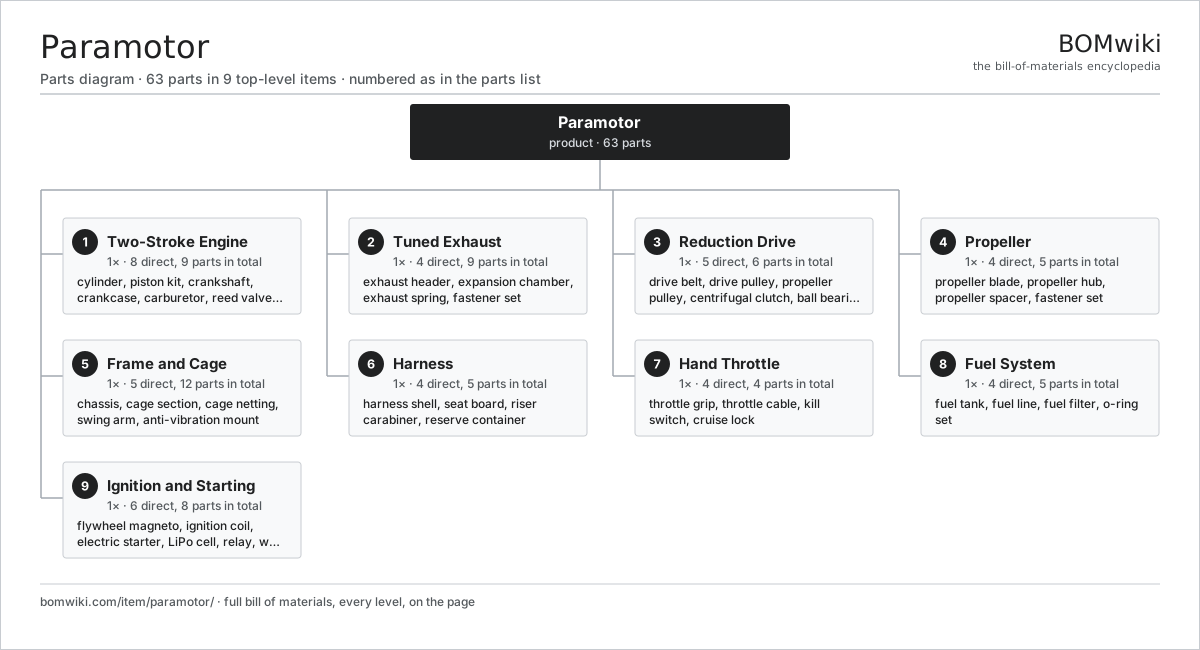
| # | Part | Qty | What it does |
|---|---|---|---|
| 1 | Two-Stroke Engine 8 parts | 1× | Single-cylinder 185 cc air-cooled two-stroke producing about 19 kW at 7800 rpm. |
| 2 | Tuned Exhaust 4 parts | 1× | Expansion-chamber exhaust whose pressure waves supercharge cylinder filling at the power-band rpm. |
| 3 | Reduction Drive 5 parts | 1× | Belt reduction gearing the 7800 rpm crankshaft down to about 2900 rpm at the propeller. |
| 4 | Propeller 4 parts | 1× | Two-blade 130 cm carbon propeller delivering about 75 kg static thrust. |
| 5 | Frame and Cage 5 parts | 1× | Chassis carrying the engine and a netted hoop that guards the propeller arc. |
| 6 | Harness 4 parts | 1× | Padded seat harness connecting pilot, motor unit and paraglider risers. |
| 7 | Hand Throttle 4 parts | 1× | Hand-held trigger controlling engine power while leaving fingers free for the brake toggles. |
| 8 | Fuel System 4 parts | 1× | Frame-mounted tank and lines feeding premixed two-stroke fuel to the carburetor. |
| 9 | Ignition and Starting 6 parts | 1× | Flywheel magneto ignition with electric or pull starting. |
3D model
No 3D model yet. Have a CAD file of this? Add a 3D model. STL renders right on this page; STEP, FreeCAD, and OpenSCAD sources are welcome too (openly licensed, like all 3D models on BOMwiki).
Build & assembly graph
expand / collapse · shared sub-assemblies converge · links to related products · est. labourTap an assembly to expand/collapse · tap a part to open it · use “Open page” for any node · drag to pan, scroll to zoom.
Bill of materials for Paramotor
9 top-level lines · 53 rows shown · 63 parts total · indented to 3 levels| # | Item / sub-assembly | Part no. | Qty/assy | Ext. qty | Parts | Type |
|---|---|---|---|---|---|---|
| 1 | Two-Stroke Engine 8 parts | paramotor-engine | 1× | 1 | 9 | assembly |
| 1.1 | Cylinder | paramotor-cylinder | 1× | 1 | · | part |
| 1.2 | Piston Kit | paramotor-piston-kit | 1× | 1 | · | part |
| 1.3 | Crankshaft | paramotor-crankshaft | 1× | 1 | · | part |
| 1.4 | Crankcase | paramotor-crankcase | 1× | 1 | · | part |
| 1.5 | Carburetor | paramotor-carburetor | 1× | 1 | · | part |
| 1.6 | Reed Valve | paramotor-reed-valve | 1× | 1 | · | part |
| 1.7 | Spark Plug | paramotor-spark-plug | 1× | 1 | · | part |
| 1.8 | Ball Bearing | ball-bearing | 2× | 2 | · | part |
| 2 | Tuned Exhaust 4 parts | paramotor-exhaust | 1× | 1 | 9 | assembly |
| 2.1 | Exhaust Header | paramotor-exhaust-header | 1× | 1 | · | part |
| 2.2 | Expansion Chamber | paramotor-expansion-chamber | 1× | 1 | · | part |
| 2.3 | Exhaust Spring | paramotor-exhaust-spring | 6× | 6 | · | part |
| 2.4 | Fastener Set | fastener-set | 1× | 1 | · | part |
| 3 | Reduction Drive 5 parts | paramotor-reduction-drive | 1× | 1 | 6 | assembly |
| 3.1 | Drive Belt | drive-belt | 1× | 1 | · | part |
| 3.2 | Drive Pulley | paramotor-drive-pulley | 1× | 1 | · | part |
| 3.3 | Propeller Pulley | paramotor-prop-pulley | 1× | 1 | · | part |
| 3.4 | Centrifugal Clutch | paramotor-clutch | 1× | 1 | · | part |
| 3.5 | Ball Bearing | ball-bearing | 2× | 2 | · | part |
| 4 | Propeller 4 parts | paramotor-propeller | 1× | 1 | 5 | assembly |
| 4.1 | Propeller Blade | paramotor-prop-blade | 2× | 2 | · | part |
| 4.2 | Propeller Hub | paramotor-prop-hub | 1× | 1 | · | part |
| 4.3 | Propeller Spacer | paramotor-prop-spacer | 1× | 1 | · | part |
| 4.4 | Fastener Set | fastener-set | 1× | 1 | · | part |
| 5 | Frame and Cage 5 parts | paramotor-frame-cage | 1× | 1 | 12 | assembly |
| 5.1 | Chassis | paramotor-chassis | 1× | 1 | · | part |
| 5.2 | Cage Section | paramotor-cage-section | 4× | 4 | · | part |
| 5.3 | Cage Netting | paramotor-cage-netting | 1× | 1 | · | part |
| 5.4 | Swing Arm | paramotor-swing-arm | 2× | 2 | · | part |
| 5.5 | Anti-Vibration Mount | paramotor-antivibration-mount | 4× | 4 | · | part |
| 6 | Harness 4 parts | paramotor-harness | 1× | 1 | 5 | assembly |
| 6.1 | Harness Shell | paramotor-harness-shell | 1× | 1 | · | part |
| 6.2 | Seat Board | paramotor-seat-board | 1× | 1 | · | part |
| 6.3 | Riser Carabiner | paramotor-riser-carabiner | 2× | 2 | · | part |
| 6.4 | Reserve Container | paramotor-reserve-container | 1× | 1 | · | part |
| 7 | Hand Throttle 4 parts | paramotor-throttle | 1× | 1 | 4 | assembly |
| 7.1 | Throttle Grip | paramotor-throttle-grip | 1× | 1 | · | part |
| 7.2 | Throttle Cable | paramotor-throttle-cable | 1× | 1 | · | part |
| 7.3 | Kill Switch | paramotor-kill-switch | 1× | 1 | · | part |
| 7.4 | Cruise Lock | paramotor-cruise-lock | 1× | 1 | · | part |
| 8 | Fuel System 4 parts | paramotor-fuel-system | 1× | 1 | 5 | assembly |
| 8.1 | Fuel Tank | paramotor-fuel-tank | 1× | 1 | · | part |
| 8.2 | Fuel Line | paramotor-fuel-line | 2× | 2 | · | part |
| 8.3 | Fuel Filter | paramotor-fuel-filter | 1× | 1 | · | part |
| 8.4 | O-Ring Set | oring-set | 1× | 1 | · | part |
| 9 | Ignition and Starting 6 parts | paramotor-electrical | 1× | 1 | 8 | assembly |
| 9.1 | Flywheel Magneto | paramotor-flywheel-magneto | 1× | 1 | · | part |
| 9.2 | Ignition Coil | paramotor-ignition-coil | 1× | 1 | · | part |
| 9.3 | Electric Starter | paramotor-electric-starter | 1× | 1 | · | part |
| 9.4 | LiPo Cell | lipo-cell | 3× | 3 | · | part |
| 9.5 | Relay | relay | 1× | 1 | · | part |
| 9.6 | Wire Bundle | wire-bundle | 1× | 1 | · | part |
Something wrong in this list? Report a problem with this BOM.
Related products
same domain, ranked by shared parts Floatplane
813 parts · shares 3 with this page
Floatplane
813 parts · shares 3 with this page
 Powered Paraglider
114 parts · shares 2 with this page
Powered Paraglider
114 parts · shares 2 with this page
 Agricultural Helicopter
133 parts · shares 1 with this page
Agricultural Helicopter
133 parts · shares 1 with this page
 Weather Balloon
216 parts · shares 3 with this page
Weather Balloon
216 parts · shares 3 with this page
 Hot Air Balloon
146 parts · shares 2 with this page
Hot Air Balloon
146 parts · shares 2 with this page
 Aircraft APU
106 parts · shares 2 with this page
Aircraft APU
106 parts · shares 2 with this page
Sourcing: possible vendors
Browse the supplier directory → Prices, MOQ, and lead times are algorithmic estimates, not quotes, and not claims about these companies. Company mappings are curated by keyword; est. price band $50k–$300M. How estimates work| Vendor | HQ | Specialty | MOQ | Lead time |
|---|---|---|---|---|
|
🇺🇸Boeing
boeing.com ↗
|
Arlington, US | Aerospace OEM | made to order | 40–80 wks |
|
🇫🇷Airbus
airbus.com ↗
|
Toulouse, FR | Aerospace OEM | made to order | 40–80 wks |
| lockheedmartin.com ↗ | Bethesda, US | Aerospace & defense | made to order | 40–80 wks |
|
🇧🇷Embraer
embraer.com ↗
|
São José dos Campos, BR | Aircraft OEM | made to order | 40–80 wks |
| txtav.com ↗ | Wichita, US | Aircraft OEM | made to order | 40–80 wks |
877-word article