Penny-Farthing
ProductOverview
A penny-farthing is a direct-drive pedal bicycle distinguished by a dramatically oversized front wheel (1.2–1.5 metres diameter) and a tiny rear wheel (0.3–0.4 metres). The rider pedals are mounted directly on the front wheel hub; one full rotation of the pedals spins the wheel once, giving the machine a very high top speed despite modest pedal cadence. The skeletal wrought-iron frame is barely more than a backbone; the large front wheel and small rear wheel provide most of the visual mass.
The design arose in the 1870s as a way to increase bicycle speed before pneumatic tyres and chain drives were common. The large wheel achieves higher speed with each pedal stroke, because its circumference is so large. The tiny rear wheel provides stability and braking; it cannot be pedalled (it is freely rotating), only steered and used as a brake surface.
The rider sits high above the frame on a leather saddle, positioned behind and above the large wheel's hub. This centre-of-gravity placement, directly over the pedal axis, minimises moment arm and allows the rider to input maximum torque. A fixed iron peg on the rear frame assists mounting the tall saddle.
Steering is pure mechanical: the rider pulls the handlebar, rotating the front fork and thus the front wheel, to steer. The single brake is a mechanical spoon (or pad) pressing onto the rear tyre, actuated by a handlebar lever.
How it works
The penny-farthing is mechanically simple: pedal cranks are integral to the large front wheel's hub. As the rider pushes the pedals (which are arms extending from the hub), the entire wheel rotates once per pedal cycle. Each complete pedal revolution advances the bicycle by the wheel's full circumference. A 1.4 metre diameter wheel has a circumference of roughly 4.4 metres, so a single 60 rpm pedal cadence propels the bicycle at approximately 4.4 metres/second or ~16 km/h.
This is the fundamental insight: larger wheels equal longer distance per pedal stroke. The trade-off is torque; a large direct-drive wheel offers almost no mechanical advantage. Climbing hills or accelerating from rest requires brute-force leg power.
The rider's pedal cranks are 200–250 mm long, mounted 180° apart on the wheel hub axle. As one crank comes up, the other goes down, allowing continuous pedalling without a dead-zone. The pedals themselves are flat or cage-style, secured to the crank arms with boot laces or straps to keep the foot in place during the pull-stroke (upstroke).
The frame backbone is a single large-diameter tube (wrought iron or steel) running from the steering head at the top down to the seat post, then bracing diagonally to the rear axle bosses. The pedal hub is integral to this backbone, welded or cast in place. The design is minimal: no gears, no chains, no derailleurs, just a direct mechanical link from legs to wheel.
Steering is direct and immediate: rotating the handlebar turns the fork steerer, which pivots the fork blade, rotating the front wheel. The steering axis is angled (typically 60–75° from vertical), providing trail geometry that helps the wheel self-centre after a turn. This is essential because, unlike modern bicycles, there is no chain or sprocket to stabilize the vehicle; stability comes purely from the steering axis geometry and the rider's balance.
The tiny rear wheel is not powered. It is a freely rotating axle carrying a simple wooden or steel rim with radial bracing. It trails behind the front wheel, providing a trailing-edge stability point and serving as the braking surface.
Braking is single-circuit and mechanical. The rider operates a handlebar brake lever, which pulls a rigid rod or cable-and-rod linkage downward. This linkage pivots a spoon or shoe bracket, pressing a metal or wood friction surface against the rear tyre (or rim). Friction slows the rear wheel, and since the rider is leaning over the front wheel (the large one), the moment distribution causes the bicycle to pitch slightly onto the front wheel, helping decelerate the front wheel as well through the rider's weight transfer.
The saddle is mounted on coil or leaf springs to absorb road shocks. The high seat position (1.2–1.5 metres above ground) means a fall is dramatic, but it provides leverage for pedalling the heavy, large wheel and maximises the mechanical advantage of the leg's power stroke.
Handling and riding characteristics
Penny-farthings are notorious for their unstable handling, especially at speed or on uneven ground. The front wheel is so large and the steering axis geometry so sensitive that small steering inputs can cause the bicycle to veer sharply. Additionally, if the front wheel hits an obstacle (a pothole or rock), the wheel can pitch the rider forward and over the handlebars in a spectacular over-end "header" or loss of control.
Acceleration is sluggish because there is no gear reduction. Starting from rest requires significant leg strength to spin the large wheel. Conversely, once rolling at speed, stopping is difficult; the rear spoon brake alone offers limited braking force, and the high momentum of the large wheel makes deceleration slow.
Despite these drawbacks, penny-farthings were competitive racing machines in the 1880s, and small communities of enthusiasts restore and ride them today. The experience offers a direct connection between human effort and motion, free from mechanical intermediaries.
Variants and evolution
Early penny-farthings (1870s) had completely solid rubber tyres and were very harsh on cobblestone roads. The introduction of pneumatic (air-filled) tyres in the 1880s dramatically improved ride quality. Some high-end versions featured a small chainring on the front wheel for modest gear reduction (1.2:1 to 1.5:1), traded at the cost of added complexity.
The tricycle variant used a similar large-wheel-plus-small-wheel layout but added a second rear wheel for stability, eliminating balance requirements entirely. By the 1890s, the modern chain-and-sprocket bicycle (with two same-size wheels and chain drive) made the penny-farthing obsolete, as it offered safer geometry and the ability to add multiple gears without increasing wheel diameter.
Penny-Farthing parts and their functions
7 top-level parts · 30 parts in total · full bill of materials below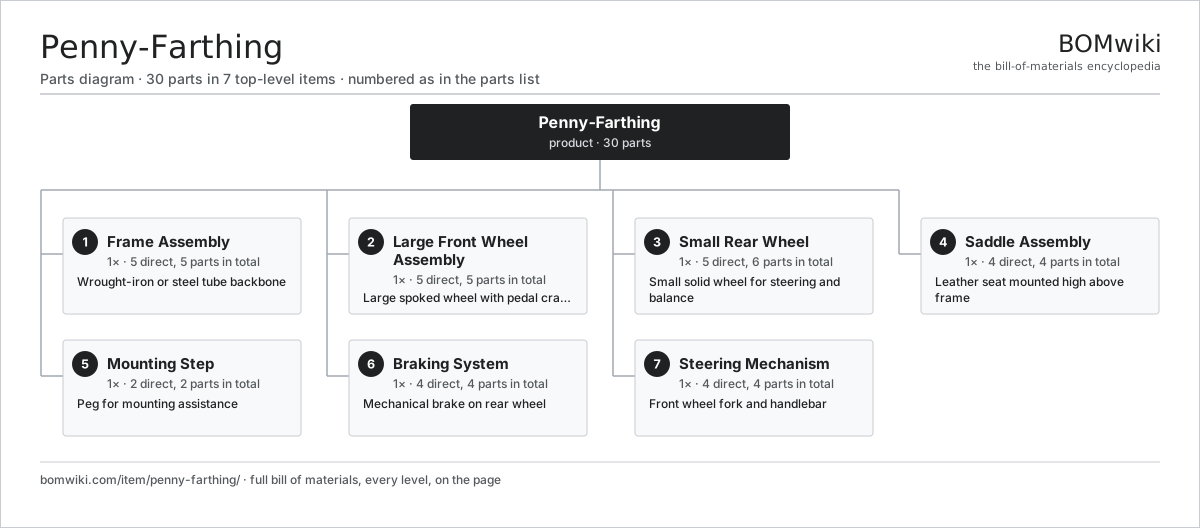
| # | Part | Qty | What it does |
|---|---|---|---|
| 1 | Frame Assembly 5 parts | 1× | Wrought-iron or steel tube backbone |
| 2 | Large Front Wheel Assembly 5 parts | 1× | Large spoked wheel with pedal cranks |
| 3 | Small Rear Wheel 5 parts | 1× | Small solid wheel for steering and balance |
| 4 | Saddle Assembly 4 parts | 1× | Leather seat mounted high above frame |
| 5 | Mounting Step 2 parts | 1× | Peg for mounting assistance |
| 6 | Braking System 4 parts | 1× | Mechanical brake on rear wheel |
| 7 | Steering Mechanism 4 parts | 1× | Front wheel fork and handlebar |
3D model
No 3D model yet. Have a CAD file of this? Add a 3D model. STL renders right on this page; STEP, FreeCAD, and OpenSCAD sources are welcome too (openly licensed, like all 3D models on BOMwiki).
Build & assembly graph
expand / collapse · shared sub-assemblies converge · links to related products · est. labourTap an assembly to expand/collapse · tap a part to open it · use “Open page” for any node · drag to pan, scroll to zoom.
Bill of materials for Penny-Farthing
7 top-level lines · 36 rows shown · 30 parts total · indented to 3 levels| # | Item / sub-assembly | Part no. | Qty/assy | Ext. qty | Parts | Type |
|---|---|---|---|---|---|---|
| 1 | Frame Assembly 5 parts | penny-farthing-frame-assembly | 1× | 1 | 5 | assembly |
| 1.1 | Main Backbone Tube | penny-farthing-main-backbone | 1× | 1 | · | part |
| 1.2 | Crank Hub | penny-farthing-crank-hub | 1× | 1 | · | part |
| 1.3 | Rear Triangle | penny-farthing-rear-triangle | 1× | 1 | · | part |
| 1.4 | Seat Post | penny-farthing-seat-post | 1× | 1 | · | part |
| 1.5 | Steering Head | penny-farthing-steering-head | 1× | 1 | · | part |
| 2 | Large Front Wheel Assembly 5 parts | penny-farthing-front-wheel-assembly | 1× | 1 | 5 | assembly |
| 2.1 | Large Rim Hoop | penny-farthing-large-rim | 1× | 1 | · | part |
| 2.2 | Wheel Spokes | penny-farthing-spokes | 1× | 1 | · | part |
| 2.3 | Pedal Cranks | penny-farthing-pedal-cranks | 1× | 1 | · | part |
| 2.4 | Crank Axle (Hub) | penny-farthing-crank-axle | 1× | 1 | · | part |
| 2.5 | Wheel Tyre | penny-farthing-tire-tread | 1× | 1 | · | part |
| 3 | Small Rear Wheel 5 parts | penny-farthing-rear-wheel-assembly | 1× | 1 | 6 | assembly |
| 3.1 | Small Rear Rim | penny-farthing-small-rim | 1× | 1 | · | part |
| 3.2 | Rear Axle | penny-farthing-rear-axle | 1× | 1 | · | part |
| 3.3 | Small Rear Spokes | penny-farthing-small-spokes | 1× | 1 | · | part |
| 3.4 | Small Rear Tyre | penny-farthing-small-tire | 1× | 1 | · | part |
| 3.5 | Axle Bearing | penny-farthing-axle-bearing | 2× | 2 | · | part |
| 4 | Saddle Assembly 4 parts | penny-farthing-saddle-assembly | 1× | 1 | 4 | assembly |
| 4.1 | Leather Saddle | penny-farthing-leather-saddle | 1× | 1 | · | part |
| 4.2 | Saddle Springs | penny-farthing-saddle-springs | 1× | 1 | · | part |
| 4.3 | Saddle Post | penny-farthing-saddle-post | 1× | 1 | · | part |
| 4.4 | Handlebar | penny-farthing-handlebar | 1× | 1 | · | part |
| 5 | Mounting Step 2 parts | penny-farthing-mounting-step | 1× | 1 | 2 | assembly |
| 5.1 | Step Peg | penny-farthing-step-peg | 1× | 1 | · | part |
| 5.2 | Step Bracket | penny-farthing-step-bracket | 1× | 1 | · | part |
| 6 | Braking System 4 parts | penny-farthing-braking-system | 1× | 1 | 4 | assembly |
| 6.1 | Brake Lever | penny-farthing-brake-lever | 1× | 1 | · | part |
| 6.2 | Brake Rod | penny-farthing-brake-rod | 1× | 1 | · | part |
| 6.3 | Brake Shoe or Spoon | penny-farthing-brake-shoe | 1× | 1 | · | part |
| 6.4 | Brake Cable or Rod | penny-farthing-brake-cable | 1× | 1 | · | part |
| 7 | Steering Mechanism 4 parts | penny-farthing-steering-mechanism | 1× | 1 | 4 | assembly |
| 7.1 | Fork Steerer Tube | penny-farthing-fork-steerer | 1× | 1 | · | part |
| 7.2 | Fork Blade | penny-farthing-fork-blade | 1× | 1 | · | part |
| 7.3 | Headset Bearing | penny-farthing-headset-bearing | 1× | 1 | · | part |
| 7.4 | Steering Axis | penny-farthing-steering-axis | 1× | 1 | · | part |
Something wrong in this list? Report a problem with this BOM.
Sourcing: possible vendors
Browse the supplier directory → Prices, MOQ, and lead times are algorithmic estimates, not quotes, and not claims about these companies. Company mappings are curated by keyword; est. price band $200–$12k. How estimates work| Vendor | HQ | Specialty | MOQ | Lead time |
|---|---|---|---|---|
|
🇹🇼Giant
giant-bicycles.com ↗
|
Taichung, TW | Bicycles | 500 units | 6–12 wks |
|
🇺🇸Trek
trekbikes.com ↗
|
Waterloo, US | Bicycles | 500 units | 6–12 wks |
| specialized.com ↗ | Morgan Hill, US | Bicycles | 500 units | 6–12 wks |
|
🇹🇼Merida
merida-bikes.com ↗
|
Yuanlin, TW | Bicycles | 500 units | 6–12 wks |
| cannondale.com ↗ | Wilton, US | Bicycles | 500 units | 6–12 wks |
1,146-word article