Perimeter Safety Net
ProductOverview
The perimeter safety net (or fall protection net) is a critical passive safety system deployed around building construction sites to catch falling objects and workers, preventing injuries and fatalities to workers below and protecting the public. A typical system consists of nylon or polyester mesh panels, 3.0–4.0 m tall and 10–20 m long, suspended by ropes from building facades and support masts, creating a protective curtain around the construction perimeter.
The net is designed to absorb the kinetic energy of falling objects and personnel by decelerating impact over a distance of 0.5–1.0 m, reducing the impact force to survivable levels. A 100 kg worker falling from a 10 m height (arriving at ~14 m/s) impacts the net with an energy of 10 kJ; the net decelerates the worker over 0.5 m, reducing the average deceleration to ~20 m/s², or roughly 2g, painful but survivable, versus the 10–15g experienced by hitting a hard surface (which is typically fatal).
Net Material & Design
The Nylon Mesh Fabric is the load-bearing component. High-tenacity nylon 6 or polyester yarn is woven into a mesh with 2–5 mm square openings. The opening size is critical: it must be small enough that fingers and limbs cannot penetrate deeply (reducing entanglement risk), yet large enough to maximize flexibility and energy absorption. A 2–3 mm mesh is typical for fall protection; larger openings (5 mm) allow water drainage but risk finger trapping.
Mesh strength is specified by single-yarn breaking strength (typically 1–2 kN per strand) and net edge rope breaking strength (15–20 kN per edge). For a standard 3 m × 20 m panel, the total edge rope length is ~46 m; the panel is designed to distribute impact load across this entire perimeter, resulting in relatively modest stresses on any single point.
The Reinforced Edge Webbing are critical for durability and load distribution. Heavy nylon webbing, 50–75 mm wide, is sewn around all four edges of the net panel, effectively doubling or tripling the mesh thickness at the edges. This webbing prevents tearing and distributes localized impact loads across a broader area, preventing the mesh from puncturing.
The Rope Connection Loops, reinforced fabric loops or grommets, are sewn at 0.3–0.5 m intervals around the perimeter. These loops provide attachment points for the suspension and tensioning ropes, ensuring load is distributed evenly rather than concentrated at corner points.
Impact Loading & Deceleration
The net's primary function is energy absorption through controlled deformation. When a falling object impacts the net:
- Initial contact (5–10 cm): The mesh stretches and decelerates the object.
- Deformation phase (20–50 cm): The net sags deeply, with both vertical and lateral displacement.
- Maximum deflection (50–100 cm): The object is moving at reduced velocity (typically 5–8 m/s by this point).
- Rebound (10–20 cm): The net returns toward its original position, ejecting the object upward or laterally.
Design standards (e.g., EN 1263-1) specify that a 5 kg rigid ball, dropped from 5 m height (arrival velocity ~10 m/s), should penetrate no more than 1.0 m through the net before being arrested. This corresponds to a deceleration of roughly 5–10 m/s², or 0.5–1.0g, which is survivable for people and safe for equipment.
For a human fall from height, the impact is less concentrated (body area ~0.5 m²) and the net has time to deform more gradually. A 100 kg person with 1.0 m net deformation experiences deceleration of ~10 m/s², or ~1.0g, equivalent to stepping off a chair and hitting the ground, unpleasant but typically survivable.
Suspension & Tensioning System
The Rope Suspension & Tensioning supports and tensions the net. Typical configurations include:
Support Ropes: Two main ropes, top and bottom edge, run the full length of the net panel (10–20 m), anchored at building brackets and mast tops. Each rope is typically 8–12 mm diameter steel wire (or synthetic climbing rope), rated for 30–50 kN tensile strength.
Rope path: The top edge rope is anchored high on the building facade (at roofline or parapet level). The bottom edge rope is anchored lower or to outrigger masts extending from the facade, creating a sloped plane for the net.
Turnbuckles & Tensioners: Turnbuckles or hydraulic tensioners allow field adjustment of rope tension, maintaining the net at the proper sag. Design sag is typically 0.3–0.5 m in the center of a span, creating a gentle catenary curve. Under-tensioned nets sag too much and reduce clearance for pedestrians below; over-tensioned nets place excessive stress on edge ropes and building anchors.
Lateral Guy-Rope Bracing: Lateral guy ropes at 45° angles prevent the net from swinging or billowing in wind, which can reduce impact-absorption performance and create uncontrolled movement.
Building Attachment & Support Structures
The Building-Side Anchor Brackets anchor the net suspension ropes to the building facade. Each bracket is a welded steel angle or U-shape, typically 100×100 mm or larger, bolted to columns or beams at 4–6 m horizontal spacing and 3–5 m vertical spacing.
Building bolts must be high-strength (M16 or larger, grade 8.8) and torqued to 150–200 Nm to resist the tensile and shear loads from the suspension ropes. A typical net panel generates total vertical load of 5–15 kN (depending on panel size and rope tension), distributed across 6–12 anchor points, resulting in 1–2 kN per anchor, moderate loads but concentrated at specific points.
For buildings without conveniently located attachment points (e.g., modern glass facades), Outrigger Support Masts extend outward from the base, creating independent support structures. These masts are typically steel tubes, 60–100 mm diameter, extending 1.0–3.0 m from the facade. The outrigger distance is important: greater distance reduces the moment arm on the base, requiring a more substantial foundation. Typical practice is to extend the net 1.5–2.0 m beyond the facade, creating a "catching envelope" for falling objects.
Mast Base Plate & Footing plates are large (300×300 mm to 500×500 mm) and either bolted to concrete or seated on ground. A 30 m span of net with 10 kN vertical load per mast creates an overturning moment; the base must provide sufficient weight (deadload) and anchor strength to resist tipping. Typical mast bases are either:
- Bolted to concrete slabs or foundation (preferred).
- Seated on 2–4 tonne concrete blocks or sandbags (for temporary installations).
- Guyed to additional anchors if outrigger distance is large.
Environmental Durability & Maintenance
Perimeter safety nets degrade due to UV exposure, which weakens the nylon or polyester fibers over time. Under continuous sun exposure (no covering), the mesh can lose 30–50% of its strength within 2–3 years. The edge ropes are similarly affected.
Maintenance includes:
Weekly visual inspection: Check for tears, fraying, or visible damage. A single 50 mm tear reduces impact-absorption performance significantly and requires immediate repair or replacement of the affected panel section.
Monthly detailed inspection: Remove the net, lay it flat, and visually inspect every meter of edge webbing and each rope. Look for UV degradation (color fading, brittleness), tears, stress cracks, or areas of wear at attachment points.
Rope tensioning: Check and adjust rope tension using a turnbuckle or tensioning device, maintaining design sag.
Anchor bolt inspection: Verify bolts are tight (torque check with wrench), with no evidence of corrosion or loosening.
Replacement: When degradation reaches a threshold (typically 30–40% strength loss, assessed by testing a sample), the entire net panel is replaced. Typical service life is 3–5 years under continuous outdoor exposure; nets can be stored indoors and reused indefinitely if properly cared for.
Installation & Deployment
Typical net installation on a building facade unfolds as follows:
Anchor bracket installation (2–3 hours): Bolts are drilled into the building facade or columns at the marked positions. Brackets are bolted and torqued.
Mast erection (1–2 hours): Outrigger masts are erected and secured. Lateral guy ropes are attached and tensioned.
Rope installation (2–3 hours): Top and bottom edge ropes are threaded through brackets and mast pulleys, run to full length, and terminated with shackles or swages.
Net panel attachment (1–2 hours): The net panel is hoisted into position and its attachment loops are connected to the suspension ropes via carabiners or shackles.
Tensioning & final adjustment (1–2 hours): Turnbuckles are adjusted to achieve design sag. Lateral guys are tensioned. Visual inspection confirms proper sag and alignment.
Total installation time for 100 m of perimeter is typically 6–10 hours with a small crew (3–4 workers).
Variants & Specialized Applications
- Debris containment nets: Finer mesh (1–2 mm), deployed to catch small debris and dust, reducing dust drift to the public realm.
- Fall arrest nets: Higher-spec nets with greater impact absorption, used for work areas where people regularly work near the net edge (e.g., fascia work, window cleaning).
- Tunnel safety nets: Horizontal nets protecting pedestrians passing under construction canopies, rated for concentrated dropped-object impact.
- Reusable/portable nets: Modular systems with quick-connect rope systems, allowing relocation without complete disassembly.
Perimeter safety nets have become mandatory on most jurisdictions' high-rise construction sites, with building codes specifying that nets must be installed before any work at height begins. The investment in nets (typically USD 5,000–20,000 per project) is minimal compared to the cost of a single serious injury or fatality, making them one of construction's highest-return safety investments.
Perimeter Safety Net parts and their functions
6 top-level parts · 19 parts in total · full bill of materials below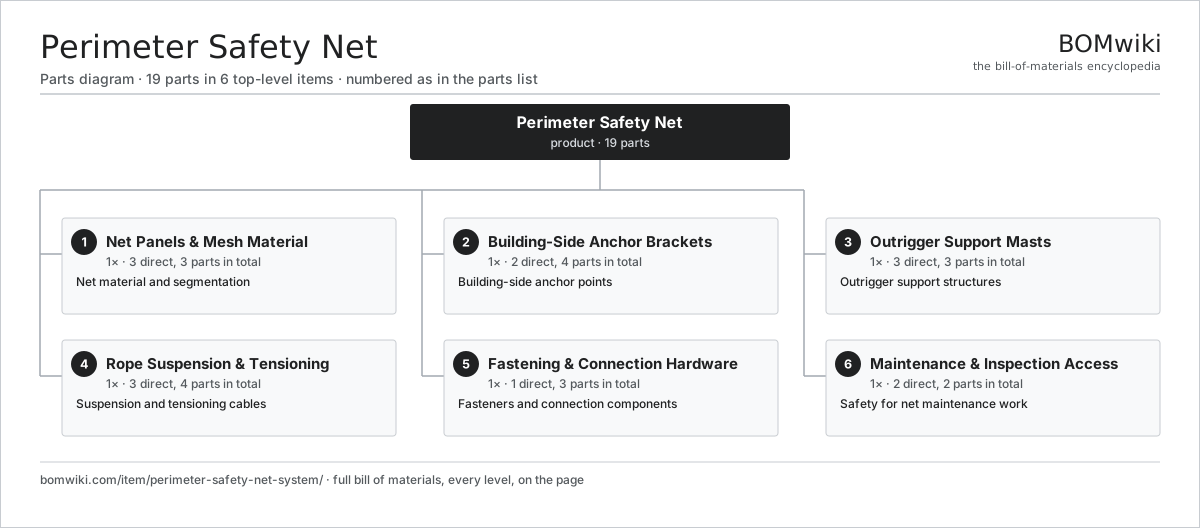
| # | Part | Qty | What it does |
|---|---|---|---|
| 1 | Net Panels & Mesh Material 3 parts | 1× | Net material and segmentation |
| 2 | Building-Side Anchor Brackets 2 parts | 1× | Building-side anchor points |
| 3 | Outrigger Support Masts 3 parts | 1× | Outrigger support structures |
| 4 | Rope Suspension & Tensioning 3 parts | 1× | Suspension and tensioning cables |
| 5 | Fastening & Connection Hardware 1 parts | 1× | Fasteners and connection components |
| 6 | Maintenance & Inspection Access 2 parts | 1× | Safety for net maintenance work |
3D model
No 3D model yet. Have a CAD file of this? Add a 3D model. STL renders right on this page; STEP, FreeCAD, and OpenSCAD sources are welcome too (openly licensed, like all 3D models on BOMwiki).
Build & assembly graph
expand / collapse · shared sub-assemblies converge · links to related products · est. labourTap an assembly to expand/collapse · tap a part to open it · use “Open page” for any node · drag to pan, scroll to zoom.
Bill of materials for Perimeter Safety Net
6 top-level lines · 20 rows shown · 19 parts total · indented to 3 levels| # | Item / sub-assembly | Part no. | Qty/assy | Ext. qty | Parts | Type |
|---|---|---|---|---|---|---|
| 1 | Net Panels & Mesh Material 3 parts | perimeter-safety-net-panels | 1× | 1 | 3 | assembly |
| 1.1 | Nylon Mesh Fabric | perimeter-safety-net-nylon-mesh | 1× | 1 | · | part |
| 1.2 | Reinforced Edge Webbing | perimeter-safety-net-reinforced-edges | 1× | 1 | · | part |
| 1.3 | Rope Connection Loops | perimeter-safety-net-connection-loops | 1× | 1 | · | part |
| 2 | Building-Side Anchor Brackets 2 parts | perimeter-safety-net-support-brackets | 1× | 1 | 4 | assembly |
| 2.1 | Facade Anchor Bracket | perimeter-safety-net-bracket-assembly | 2× | 2 | · | part |
| 2.2 | Fastener Set | fastener-set | 2× | 2 | · | part |
| 3 | Outrigger Support Masts 3 parts | perimeter-safety-net-mast-poles | 1× | 1 | 3 | assembly |
| 3.1 | Mast Support Tubes | perimeter-safety-net-mast-tubes | 1× | 1 | · | part |
| 3.2 | Mast Base Plate & Footing | perimeter-safety-net-mast-base | 1× | 1 | · | part |
| 3.3 | Top Pulley & Anchor | perimeter-safety-net-mast-top-pulley | 1× | 1 | · | part |
| 4 | Rope Suspension & Tensioning 3 parts | perimeter-safety-net-rope-system | 1× | 1 | 4 | assembly |
| 4.1 | Support Ropes | perimeter-safety-net-suspension-rope | 2× | 2 | · | part |
| 4.2 | Turnbuckles & Tensioners | perimeter-safety-net-tension-adjusters | 1× | 1 | · | part |
| 4.3 | Lateral Guy-Rope Bracing | perimeter-safety-net-guy-lines | 1× | 1 | · | part |
| 5 | Fastening & Connection Hardware 1 parts | perimeter-safety-net-hardware | 1× | 1 | 3 | assembly |
| 5.1 | Fastener Set | fastener-set | 3× | 3 | · | part |
| 6 | Maintenance & Inspection Access 2 parts | perimeter-safety-net-inspection-access | 1× | 1 | 2 | assembly |
| 6.1 | Harness Tie-Off Points | perimeter-safety-net-tie-off-cleats | 1× | 1 | · | part |
| 6.2 | Inspection Access Ladder | perimeter-safety-net-inspection-ladder | 1× | 1 | · | part |
Something wrong in this list? Report a problem with this BOM.
Sourcing: possible vendors
Browse the supplier directory → Prices, MOQ, and lead times are algorithmic estimates, not quotes, and not claims about these companies. Company mappings are curated by keyword; est. price band $15k–$2M. How estimates work| Vendor | HQ | Specialty | MOQ | Lead time |
|---|---|---|---|---|
| caterpillar.com ↗ | Irving, US | Construction & mining equipment | made to order | 16–28 wks |
|
🇯🇵Komatsu
komatsu.com ↗
|
Tokyo, JP | Construction & mining equipment | made to order | 16–28 wks |
|
🇸🇪Volvo CE
volvoce.com ↗
|
Gothenburg, SE | Construction equipment | made to order | 16–28 wks |
|
🇨🇭Liebherr
liebherr.com ↗
|
Bulle, CH | Cranes & heavy equipment | made to order | 16–28 wks |
|
🇨🇳XCMG
xcmg.com ↗
|
Xuzhou, CN | Construction machinery | made to order | 16–28 wks |
1,632-word article