Periscope
ProductOverview
A periscope is an optical instrument that allows an observer to view objects at a higher elevation or beyond a direct line of sight while remaining concealed. Military submarines, tanks, and stationary observation posts employ periscopes to extend the observer's visual awareness without exposing themselves to enemy fire.
The fundamental principle is simple: light from the target enters an objective prism in the Head Assembly, travels downward through a sealed Tube Body containing Relay Lens Stack elements, and exits through a second prism in the Eyepiece Assembly at eye level. The Traverse (Rotation) Mechanism allows the head to rotate independently, scanning a wide azimuth while the observer remains stationary. A Graticule and Reticle System at the eyepiece focal plane provides range-finding marks or targeting references.
How it works
Light from the target strikes the Head Protective Window, a protective optical flat, and passes into the Objective Prism System. A 45-degree prism, typically a right-angle or Porro prism with multi-coated surfaces, deflects the incoming light 90 degrees downward into the tube. The Cemented Corrector Lens element bonded to the prism surface corrects chromatic aberration, ensuring that red, green, and blue wavelengths converge at the same focal point.
The light path then enters the Relay Lens Stack, a series of four or more lens elements that maintain image brightness and magnification over the length of the tube. The Front Relay Lens acts as a field lens, collecting light from the objective prism. The Field Lens provides magnification. The Intermediate Focusing Lens serves as an intermediate focusing element, allowing the operator to adjust optical focus to suit eyesight or range. The Exit Relay Lens expands the light cone toward the eyepiece.
At the bottom of the tube, the light strikes the Eyepiece Prism, another 45-degree prism that redirects the light horizontally to eye level. The Primary Eyepiece Lens and Field Correction Lens form the eyepiece, magnifying the intermediate image and projecting a virtual image at infinity. The Eyecup minimizes stray light at the observer's eye, improving contrast in bright conditions.
Traverse and Rotation
Most periscopes allow 360-degree rotation of the Head Assembly around a central axis supported by the Traverse Bearing Assembly, usually a ball or roller bearing preloaded for smooth, friction-free motion. A Traverse Drive Gear and Traverse Handwheel allow the operator to rotate the head manually via a hand-crank mechanism. In submarine applications, motorized drives (electric motors with gear reduction) may power the traverse mechanism, allowing rapid scanning and lock-on to targets.
The Tube Body remains fixed while the head rotates, isolating vibration from the rotation bearing to the eyepiece via Vibration Damping Inserts elastomer inserts. This reduces shimmer and fatigue in extended observation.
Sealing and Pressure
The Tube Body is a seamless aluminum or steel cylinder pressurized with dry nitrogen at 1–2 psi above atmospheric. This sealing prevents moisture from condensing on internal optical surfaces, fogging the view during rapid temperature or depth changes. The O-Ring Set at the head and eyepiece couplings (Upper Tube Coupling and Lower Tube Coupling) form the pressure boundary.
Submarine periscopes are subjected to high external water pressure (e.g., 1,000 psi at 700-foot depth). The tube walls and couplings are designed to withstand this differential; typically, the tube is made of high-strength alloy steel, and the couplings are forged or ductile iron.
Optical Design
Relay periscopes (which use intermediate lens stacks) are standard for military instruments. A ''straight'' optical path would require a very long, high-power objective lens and eyepiece pair, introducing aberrations and requiring significant magnification that limits field of view. By using relay lenses, the optical system can be modular: objectives and eyepieces of moderate power, with intermediate lenses managing magnification and image correction over the full tube length.
The magnification of a relay periscope is typically fixed (e.g., 6× or 10×) or variable within a narrow range (6–12×) via rotating lens turrets or a zooming mechanism.
Graticules and Reticles
The Graticule and Reticle System mounted at the eyepiece focal plane may feature:
- Mil-dot reticles: Small dots spaced one milliradian apart for distance estimation by target size.
- Rangefinding scales: Horizontal lines calibrated for standard naval target heights (e.g., destroyer smokestacks) at various ranges.
- Crosshairs with rangefinding marks: A primary aim point with secondary marks for wind and range holds.
Illuminated reticles use a red or green LED powered by a small battery, with a rheostat for brightness control. Submarine periscopes historically employed illuminated reticles for night targeting before the advent of thermal imaging.
Historical Development
Early periscopes, invented in the 1850s, were simple: two mirrors at 45 degrees connected by a tube. Modern military periscopes evolved in World War I to equip submarines; optical relay systems were developed in the 1920s–1930s to provide clearer, higher-magnification views over longer distances. Cold War submarines employed high-magnification periscopes (10–20×) with wide fields of view, infrared filtering, and motorized traverse systems.
Modern tank periscopes integrate night vision (infrared or image-intensified) alongside optical day channels, allowing the commander to observe in low light without moving the turret.
Operational Use
A periscope's primary advantage is concealment: the observer's eyes need not be exposed to enemy observation or fire. In a submarine, the periscope remains retracted below the hull until needed. In a tank, the periscope allows the commander to survey the battlefield from inside an armored compartment. In a stationary trench periscope, the observer remains below ground level.
The narrow field of view (typically 6–9° at high magnification) is the trade-off; the operator scans by rotating the head azimuth, building a mental map of the surrounding area over seconds or minutes.
Periscope parts and their functions
7 top-level parts · 35 parts in total · full bill of materials below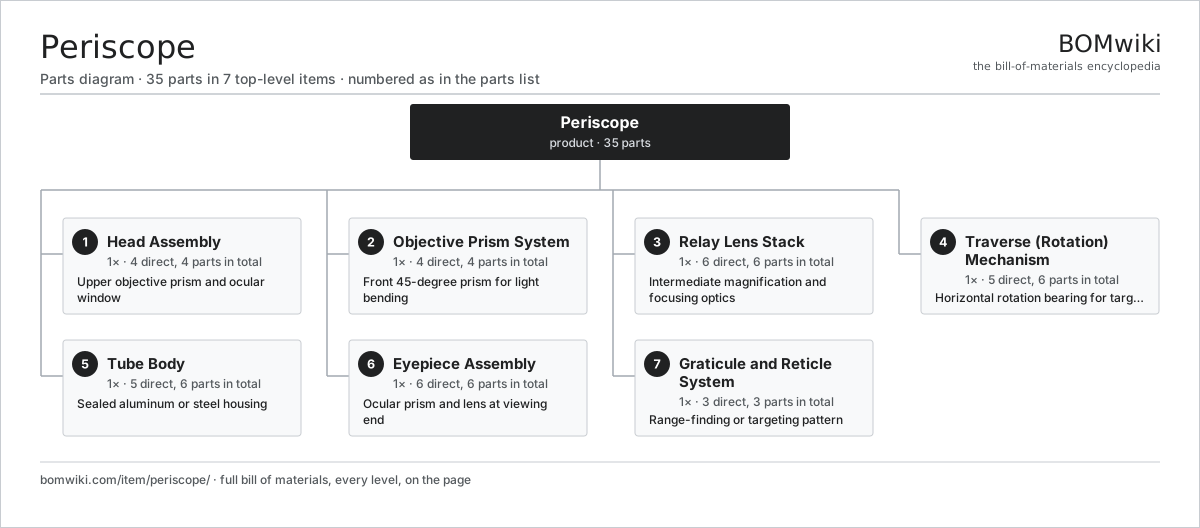
| # | Part | Qty | What it does |
|---|---|---|---|
| 1 | Head Assembly 4 parts | 1× | Upper objective prism and ocular window |
| 2 | Objective Prism System 4 parts | 1× | Front 45-degree prism for light bending |
| 3 | Relay Lens Stack 6 parts | 1× | Intermediate magnification and focusing optics |
| 4 | Traverse (Rotation) Mechanism 5 parts | 1× | Horizontal rotation bearing for target tracking |
| 5 | Tube Body 5 parts | 1× | Sealed aluminum or steel housing |
| 6 | Eyepiece Assembly 6 parts | 1× | Ocular prism and lens at viewing end |
| 7 | Graticule and Reticle System 3 parts | 1× | Range-finding or targeting pattern |
3D model
No 3D model yet. Have a CAD file of this? Add a 3D model. STL renders right on this page; STEP, FreeCAD, and OpenSCAD sources are welcome too (openly licensed, like all 3D models on BOMwiki).
Build & assembly graph
expand / collapse · shared sub-assemblies converge · links to related products · est. labourTap an assembly to expand/collapse · tap a part to open it · use “Open page” for any node · drag to pan, scroll to zoom.
Bill of materials for Periscope
7 top-level lines · 40 rows shown · 35 parts total · indented to 3 levels| # | Item / sub-assembly | Part no. | Qty/assy | Ext. qty | Parts | Type |
|---|---|---|---|---|---|---|
| 1 | Head Assembly 4 parts | periscope-head-assembly | 1× | 1 | 4 | assembly |
| 1.1 | Head Protective Window | periscope-head-window | 1× | 1 | · | part |
| 1.2 | Objective Prism Mount | periscope-objective-prism-housing | 1× | 1 | · | part |
| 1.3 | Head Cover | periscope-head-cover | 1× | 1 | · | part |
| 1.4 | Fastener Set | fastener-set | 1× | 1 | · | part |
| 2 | Objective Prism System 4 parts | periscope-objective-prism | 1× | 1 | 4 | assembly |
| 2.1 | Primary Optical Prism | periscope-prism-primary | 1× | 1 | · | part |
| 2.2 | Cemented Corrector Lens | periscope-prism-cemented-lens | 1× | 1 | · | part |
| 2.3 | Prism Mount Housing | periscope-prism-mount-housing | 1× | 1 | · | part |
| 2.4 | Fastener Set | fastener-set | 1× | 1 | · | part |
| 3 | Relay Lens Stack 6 parts | periscope-relay-lens-stack | 1× | 1 | 6 | assembly |
| 3.1 | Front Relay Lens | periscope-relay-lens-1 | 1× | 1 | · | part |
| 3.2 | Field Lens | periscope-relay-lens-2 | 1× | 1 | · | part |
| 3.3 | Intermediate Focusing Lens | periscope-relay-lens-3 | 1× | 1 | · | part |
| 3.4 | Exit Relay Lens | periscope-relay-lens-4 | 1× | 1 | · | part |
| 3.5 | Relay Barrel | periscope-relay-barrel | 1× | 1 | · | part |
| 3.6 | Fastener Set | fastener-set | 1× | 1 | · | part |
| 4 | Traverse (Rotation) Mechanism 5 parts | periscope-traverse-mechanism | 1× | 1 | 6 | assembly |
| 4.1 | Traverse Bearing Assembly | periscope-traverse-bearing | 1× | 1 | · | part |
| 4.2 | Traverse Drive Gear | periscope-traverse-gear | 1× | 1 | · | part |
| 4.3 | Traverse Handwheel | periscope-traverse-handwheel | 1× | 1 | · | part |
| 4.4 | Ball Bearing | ball-bearing | 2× | 2 | · | part |
| 4.5 | Fastener Set | fastener-set | 1× | 1 | · | part |
| 5 | Tube Body 5 parts | periscope-tube-body | 1× | 1 | 6 | assembly |
| 5.1 | Main Tube | periscope-main-tube | 1× | 1 | · | part |
| 5.2 | Upper Tube Coupling | periscope-tube-coupling-upper | 1× | 1 | · | part |
| 5.3 | Lower Tube Coupling | periscope-tube-coupling-lower | 1× | 1 | · | part |
| 5.4 | O-Ring Set | oring-set | 2× | 2 | · | part |
| 5.5 | Vibration Damping Inserts | periscope-anti-vibration-damper | 1× | 1 | · | part |
| 6 | Eyepiece Assembly 6 parts | periscope-eyepiece-assembly | 1× | 1 | 6 | assembly |
| 6.1 | Eyepiece Prism | periscope-eyepiece-prism | 1× | 1 | · | part |
| 6.2 | Primary Eyepiece Lens | periscope-ocular-lens-1 | 1× | 1 | · | part |
| 6.3 | Field Correction Lens | periscope-ocular-lens-2 | 1× | 1 | · | part |
| 6.4 | Ocular Housing | periscope-ocular-housing | 1× | 1 | · | part |
| 6.5 | Eyecup | periscope-eyecup | 1× | 1 | · | part |
| 6.6 | Fastener Set | fastener-set | 1× | 1 | · | part |
| 7 | Graticule and Reticle System 3 parts | periscope-graticule-reticle | 1× | 1 | 3 | assembly |
| 7.1 | Graticule Glass Plate | periscope-graticule-glass | 1× | 1 | · | part |
| 7.2 | Graticule Mount | periscope-graticule-mount | 1× | 1 | · | part |
| 7.3 | Reticle Illumination Circuit | periscope-reticle-illumination | 1× | 1 | · | part |
Something wrong in this list? Report a problem with this BOM.
Related products
same domain, ranked by shared parts Digital Cinema Projector
383 parts · shares 2 with this page
Digital Cinema Projector
383 parts · shares 2 with this page
 Industrial 3D Scanner
149 parts · shares 2 with this page
Industrial 3D Scanner
149 parts · shares 2 with this page
 Laser Tracker
142 parts · shares 2 with this page
Laser Tracker
142 parts · shares 2 with this page
 Mirrorless Camera
503 parts · shares 2 with this page
Mirrorless Camera
503 parts · shares 2 with this page
 Photo Minilab
454 parts · shares 2 with this page
Photo Minilab
454 parts · shares 2 with this page
Sourcing: possible vendors
Browse the supplier directory → Prices, MOQ, and lead times are algorithmic estimates, not quotes, and not claims about these companies. Company mappings are curated by keyword; est. price band $100–$8k. How estimates work| Vendor | HQ | Specialty | MOQ | Lead time |
|---|---|---|---|---|
|
🇯🇵Canon
canon.com ↗
|
Tokyo, JP | Imaging & optics | 500 units | 10–16 wks |
|
🇯🇵Nikon
nikon.com ↗
|
Tokyo, JP | Imaging & optics | 500 units | 10–16 wks |
|
🇩🇪ZEISS
zeiss.com ↗
|
Oberkochen, DE | Optics & optoelectronics | 500 units | 10–16 wks |
| leica-camera.com ↗ | Wetzlar, DE | Cameras & optics | 500 units | 10–16 wks |
| flir.com ↗ | Wilsonville, US | Thermal imaging | 500 units | 10–16 wks |
973-word article