Phase Contrast Microscope
ProductOverview
A phase-contrast microscope converts invisible refractive-index differences in transparent specimens into observable amplitude contrast, enabling visualization of unstained cells, bacteria, and subcellular structures without fixation or dyes. The technique exploits a subtle phase shift: light traversing a transparent medium with slightly different refractive index (like a living cell, ~1.37, immersed in water or saline, ~1.33) slows down, accumulating a ~0.25 radian phase lag. To the human eye, phase is invisible; cells appear nearly transparent. Phase-contrast microscopy adds an optical trick: a 10× Phase Objective retarder plate converts the phase lag into amplitude loss, darkening the cell.
This technique revolutionized biology because cells can be imaged living, moving, and dividing, no fixed stains, no dyes, no artifacts from sample preparation. The Objective Turret carries four phase objectives (10×, 20×, 40×, 100×), and the Condenser Assembly includes matching Annulus Turret apertures essential for correct optical sectioning.
How it works
Light from the Light Source (100 W halogen or LED) passes through the Field Iris and Aplanatic Condenser at 1.4 NA. The condenser has a focal plane at which an Annulus Turret aperture sits, a thin annular ring (donut-shaped opening), not a full circular aperture. This annular light cone matches the conjugate diameter of the phase plate inside each objective.
The annular light enters the specimen, which has transparent regions (cytoplasm) and slightly denser regions (nucleus). Light passing through transparent cytoplasm emerges with a phase shift ~0.25 rad (a quarter wavelength of 550 nm light is ~0.14 μm). Light through the nucleus shifts phase more (~0.5 rad). The 10× Phase Objective objective collects this light and focuses it to an intermediate image. Embedded in the objective's rear focal plane (the Fourier plane of the specimen) is a 10× Phase Objective phase plate, typically a quarter-wave retarder on a thin metallic film.
The phase plate accomplishes two things:
- It retards the undeviated light by an additional π/2 (quarter wave), bringing phase-shifted specimen light from +0.25 rad back toward 0 rad.
- It attenuates the undeviated light by ~0.75 (75% absorption), so the amplitude of the undeviated component is no longer dominant.
In the image plane, the amplitude of specimen light is roughly the same as the attenuated undeviated light, so their interference is no longer completely constructive (as in brightfield). The phase difference now translates to amplitude variation: dense regions appear darker (more destructive interference), transparent regions lighter. This is phase contrast.
The binocular Eyepiece Assembly magnifies the intermediate image 100–1000×. Proper condenser alignment and annulus matching are critical: if the annulus is too small, contrast is high but resolution drops; if too large, the phase plate receives off-axis light and produces halos.
Annulus matching and alignment
Each objective has a different phase plate designed for a specific condenser aperture. The 10× Annulus annular aperture for 10× objectives has a different diameter than the 100× Annulus for 100× (oil immersion). When changing magnifications, the operator must also rotate the Annulus Turret turret to the matching annulus. Mismatching annulus and objective reduces contrast and introduces phase halos around cell edges, a common error in poor-quality phase images.
Focus mechanism
The Focus Mechanism combines a Coarse Focus Knob for rapid positioning (2 mm per revolution) and a Fine Focus Knob micrometer (0.002 mm per division). The Focus Bearing pins ride on a precision Focus Block block, allowing smooth vertical motion with <1 μm repeatability. Manual focus in phase contrast requires gentle hand control to maintain optical section (the ~0.5 μm focal depth at 100×).
Condenser criticality
The Condenser Assembly must be focused precisely on the specimen plane. The Condenser Focus micrometer dial allows 1 μm adjustments. A misaligned condenser (out of focus by >5 μm) dramatically reduces contrast and causes vignetting. The Field Iris field iris should also match the 10× Phase Objective field of view, when too large, it admits stray light and reduces contrast.
Advantages and limitations
Phase contrast excels at imaging living cells in culture, bacteria, and tissue sections without staining. Quantitative phase measurements can extract dry mass and 3D topography. However, phase-contrast images lack color and fine detail; thick specimens (>10 μm) show phase halos; and the technique works best in the 0.1–1 μm optical section range.
Camera integration
The Camera Interface can couple a digital camera, typically a monochrome CCD or CMOS sensor, for quantitative image analysis and time-lapse recording of living cells.
Phase Contrast Microscope parts and their functions
8 top-level parts · 34 parts in total · full bill of materials below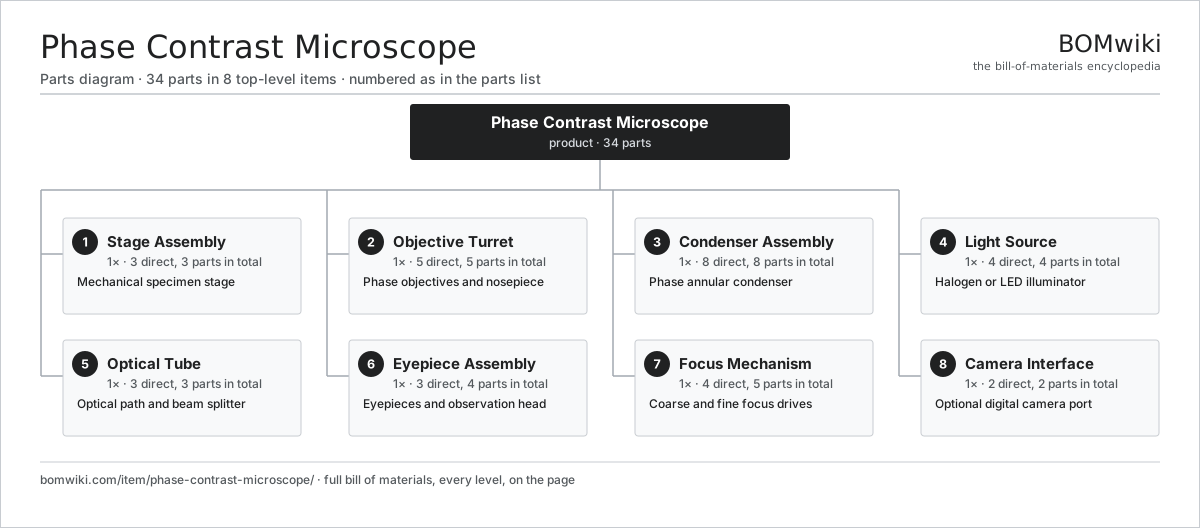
| # | Part | Qty | What it does |
|---|---|---|---|
| 1 | Stage Assembly 3 parts | 1× | Mechanical specimen stage |
| 2 | Objective Turret 5 parts | 1× | Phase objectives and nosepiece |
| 3 | Condenser Assembly 8 parts | 1× | Phase annular condenser |
| 4 | Light Source 4 parts | 1× | Halogen or LED illuminator |
| 5 | Optical Tube 3 parts | 1× | Optical path and beam splitter |
| 6 | Eyepiece Assembly 3 parts | 1× | Eyepieces and observation head |
| 7 | Focus Mechanism 4 parts | 1× | Coarse and fine focus drives |
| 8 | Camera Interface 2 parts | 1× | Optional digital camera port |
3D model
No 3D model yet. Have a CAD file of this? Add a 3D model. STL renders right on this page; STEP, FreeCAD, and OpenSCAD sources are welcome too (openly licensed, like all 3D models on BOMwiki).
Build & assembly graph
expand / collapse · shared sub-assemblies converge · links to related products · est. labourTap an assembly to expand/collapse · tap a part to open it · use “Open page” for any node · drag to pan, scroll to zoom.
Bill of materials for Phase Contrast Microscope
8 top-level lines · 40 rows shown · 34 parts total · indented to 3 levels| # | Item / sub-assembly | Part no. | Qty/assy | Ext. qty | Parts | Type |
|---|---|---|---|---|---|---|
| 1 | Stage Assembly 3 parts | phase-contrast-microscope-stage-assembly | 1× | 1 | 3 | assembly |
| 1.1 | Stage Plate | phase-contrast-microscope-stage-plate | 1× | 1 | · | part |
| 1.2 | Slide Holder | phase-contrast-microscope-slide-holder | 1× | 1 | · | part |
| 1.3 | Mechanical Stage | phase-contrast-microscope-stage-mechanism | 1× | 1 | · | part |
| 2 | Objective Turret 5 parts | phase-contrast-microscope-optical-turret | 1× | 1 | 5 | assembly |
| 2.1 | 10× Phase Objective | phase-contrast-microscope-phase-objective-10x | 1× | 1 | · | part |
| 2.2 | 20× Phase Objective | phase-contrast-microscope-phase-objective-20x | 1× | 1 | · | part |
| 2.3 | 40× Phase Objective | phase-contrast-microscope-phase-objective-40x | 1× | 1 | · | part |
| 2.4 | 100× Phase Objective | phase-contrast-microscope-phase-objective-100x | 1× | 1 | · | part |
| 2.5 | Turret Body | phase-contrast-microscope-turret-body | 1× | 1 | · | part |
| 3 | Condenser Assembly 8 parts | phase-contrast-microscope-condenser-assembly | 1× | 1 | 8 | assembly |
| 3.1 | Aplanatic Condenser | phase-contrast-microscope-aplanatic-condenser | 1× | 1 | · | part |
| 3.2 | Annulus Turret | phase-contrast-microscope-annulus-slider | 1× | 1 | · | part |
| 3.3 | 10× Annulus | phase-contrast-microscope-annulus-10x | 1× | 1 | · | part |
| 3.4 | 20× Annulus | phase-contrast-microscope-annulus-20x | 1× | 1 | · | part |
| 3.5 | 40× Annulus | phase-contrast-microscope-annulus-40x | 1× | 1 | · | part |
| 3.6 | 100× Annulus | phase-contrast-microscope-annulus-100x | 1× | 1 | · | part |
| 3.7 | Condenser Focus | phase-contrast-microscope-condenser-focus | 1× | 1 | · | part |
| 3.8 | Field Iris | phase-contrast-microscope-iris-field | 1× | 1 | · | part |
| 4 | Light Source 4 parts | phase-contrast-microscope-light-source | 1× | 1 | 4 | assembly |
| 4.1 | Halogen Bulb | phase-contrast-microscope-halogen-bulb | 1× | 1 | · | part |
| 4.2 | Lamp Housing | phase-contrast-microscope-lamp-housing | 1× | 1 | · | part |
| 4.3 | Power Supply | phase-contrast-microscope-power-supply | 1× | 1 | · | part |
| 4.4 | Intensity Control | phase-contrast-microscope-intensity-control | 1× | 1 | · | part |
| 5 | Optical Tube 3 parts | phase-contrast-microscope-optical-tube | 1× | 1 | 3 | assembly |
| 5.1 | Binocular Head | phase-contrast-microscope-binocular-head | 1× | 1 | · | part |
| 5.2 | Beam Splitter | phase-contrast-microscope-beam-splitter | 1× | 1 | · | part |
| 5.3 | Tube Body | phase-contrast-microscope-tube-body | 1× | 1 | · | part |
| 6 | Eyepiece Assembly 3 parts | phase-contrast-microscope-eyepiece-assembly | 1× | 1 | 4 | assembly |
| 6.1 | 10× Eyepiece | phase-contrast-microscope-eyepiece-10x | 2× | 2 | · | part |
| 6.2 | Focusing Eyepiece | phase-contrast-microscope-eyepiece-focusing | 1× | 1 | · | part |
| 6.3 | Focus Rings | phase-contrast-microscope-focus-rings | 1× | 1 | · | part |
| 7 | Focus Mechanism 4 parts | phase-contrast-microscope-focus-mechanism | 1× | 1 | 5 | assembly |
| 7.1 | Coarse Focus Knob | phase-contrast-microscope-coarse-focus-knob | 1× | 1 | · | part |
| 7.2 | Fine Focus Knob | phase-contrast-microscope-fine-focus-knob | 1× | 1 | · | part |
| 7.3 | Focus Block | phase-contrast-microscope-focus-block | 1× | 1 | · | part |
| 7.4 | Focus Bearing | phase-contrast-microscope-focus-bearing | 2× | 2 | · | part |
| 8 | Camera Interface 2 parts | phase-contrast-microscope-camera-interface | 1× | 1 | 2 | assembly |
| 8.1 | Camera Mount | phase-contrast-microscope-camera-mount | 1× | 1 | · | part |
| 8.2 | Camera Relay | phase-contrast-microscope-camera-relay | 1× | 1 | · | part |
Something wrong in this list? Report a problem with this BOM.
Sourcing: possible vendors
Browse the supplier directory → Prices, MOQ, and lead times are algorithmic estimates, not quotes, and not claims about these companies. Company mappings are curated by keyword; est. price band $1k–$500k. How estimates work| Vendor | HQ | Specialty | MOQ | Lead time |
|---|---|---|---|---|
| thermofisher.com ↗ | Waltham, US | Lab instruments | 100 units | 10–18 wks |
|
🇺🇸Agilent
agilent.com ↗
|
Santa Clara, US | Analytical instruments | 100 units | 10–18 wks |
|
🇺🇸Bruker
bruker.com ↗
|
Billerica, US | Scientific instruments | 100 units | 10–18 wks |
|
🇯🇵Shimadzu
shimadzu.com ↗
|
Kyoto, JP | Analytical instruments | 100 units | 10–18 wks |
|
🇺🇸Waters
waters.com ↗
|
Milford, US | Chromatography & MS | 100 units | 10–18 wks |
821-word article