Photo Booth
ProductOverview
The photo booth is one of the oldest vending formats still in service, the first coin-operated Photomaton opened in New York in 1925, and its modern descendants split into two trades: ID booths printing biometric-compliant passport photos in stations and city halls, and event booths printing fun strips. Both share the same architecture: a Booth Enclosure with a sitting compartment and an equipment column, a hidden Camera Module, a calibrated Lighting Rig rig, and a Dye-Sublimation Printer that delivers in under a minute.
What the booth really sells is repeatability. Every variable a photographer would adjust, subject distance, face height, focus, exposure, background, lighting angle, is frozen by the cabinet geometry, which is why the machine can be operated by anyone and still produce a compliant ID photo.
Geometry and capture
The sitter's position is fixed by the Seat Unit: the classic trick is the threaded Seat Column, spin the Seat Assembly to raise or lower your face to lens height, marked by the Framing Mirror. The Seat Base keeps the distance to the lens constant, so the Lens Assembly is prefocused once at the factory and never hunts.
The camera itself, an CMOS Image Sensor of APS-C class, sits behind the half-silvered Camera Window on a rigid Camera Mount. Hiding the camera is deliberate: sitters look at the mirror or screen naturally instead of staring down a lens barrel. Capture is flash-synchronised by the Trigger Sync Board, which fires shutter and Main Flash inside a millisecond window.
Lighting follows studio practice in miniature. The flash discharges its Flash Capacitor through a xenon tube (or drives a high-current LED array via Power MOSFET switching) in a 1–2 ms burst, short enough to freeze a fidgeting child, and the Diffuser Panel spreads it into soft frontal light. Two Fill LED Panel panels at 5,500 K light the live preview and lift shadows. Behind the sitter, the Interior Panels provide the uniform light-grey background that ID standards require, and the Privacy Curtain keeps venue lighting from contaminating the exposure.
The session
Payment goes through the Payment Module module, the Coin Acceptor into a keyed Cash Box, or a tap on the Card Reader. The Touchscreen & Preview then runs the session: format choice, live preview on the LCD Panel, an audible countdown through the Speaker, several frames captured, and a retake/accept decision. ID configurations on the PC Board apply ICAO 9303 processing, automatic face detection, the regulation crop placing eyes and chin within tolerance bands, and compliance checks for glasses glare or tilted heads, and several countries' booths transmit the photo digitally to the passport authority instead of (or alongside) printing.
Printing
Dye-sublimation is used because prints emerge dry, continuous-tone, and water-resistant, inkjet would smear in a vending context and silver halide needs chemistry. The Dye-Sub Printhead presses the Ribbon Cassette against coated paper from the Media Roll and vaporises dye into the receiving layer in three passes, yellow, magenta, cyan, with the Print Transport shuttling the sheet back under the head for each pass, then a fourth pass laminates a clear overcoat. Each dot can take 256 density levels, giving true photographic tone at 300 dpi without halftoning. The Media Cutter slices the result into strips or a single sheet, and it drops into the Print Chute 8 to 15 seconds after the last frame. Ribbon and paper are paired 1:1, about 700 prints per reload through the Service Door.
Operations
Booths are route-operated like vending machines. The Telemetry Module reports prints remaining, takings, and faults over 4G so an operator visits only to reload media and empty the cashbox; the Buffer SSD buffers session images and, in ID units, purges them after delivery for privacy compliance. The Signage Lighting doubles as an in-use indicator. Power needs are modest, about 250 W average with 1 kW peaks while the flash capacitor recharges, so a booth installs anywhere with a standard outlet, which is much of why the format has survived a century of competing photography.
Photo Booth parts and their functions
9 top-level parts · 56 parts in total · full bill of materials below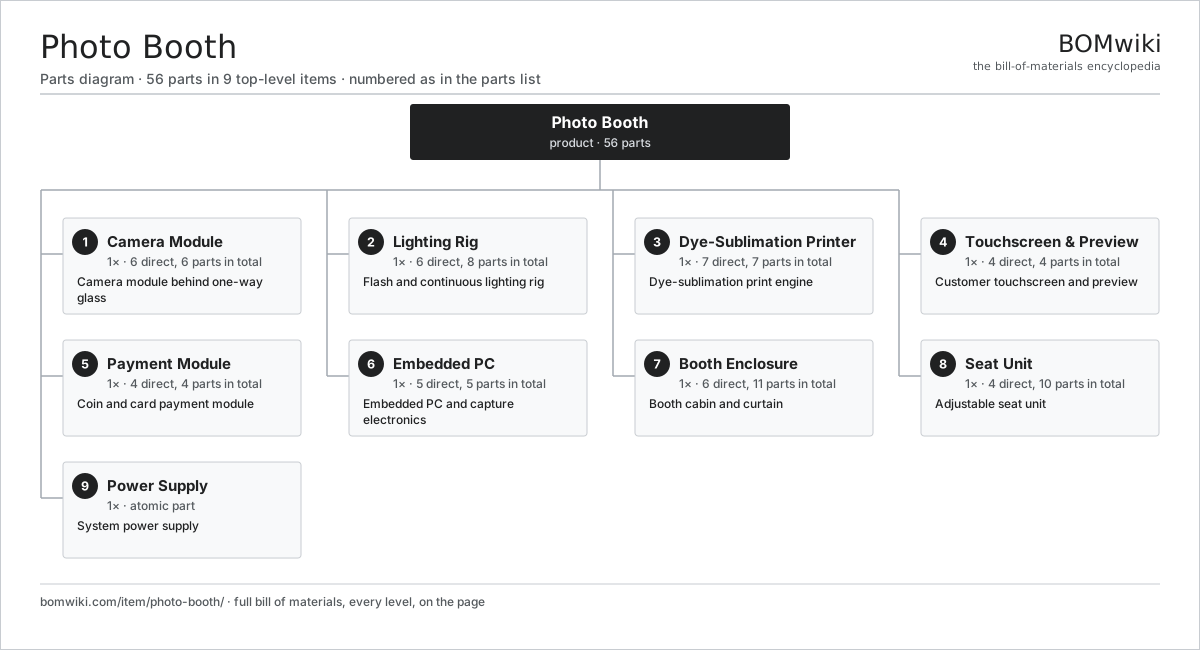
| # | Part | Qty | What it does |
|---|---|---|---|
| 1 | Camera Module 6 parts | 1× | Camera module behind one-way glass |
| 2 | Lighting Rig 6 parts | 1× | Flash and continuous lighting rig |
| 3 | Dye-Sublimation Printer 7 parts | 1× | Dye-sublimation print engine |
| 4 | Touchscreen & Preview 4 parts | 1× | Customer touchscreen and preview |
| 5 | Payment Module 4 parts | 1× | Coin and card payment module |
| 6 | Embedded PC 5 parts | 1× | Embedded PC and capture electronics |
| 7 | Booth Enclosure 6 parts | 1× | Booth cabin and curtain |
| 8 | Seat Unit 4 parts | 1× | Adjustable seat unit |
| 9 | Power Supply | 1× | System power supply |
3D model
No 3D model yet. Have a CAD file of this? Add a 3D model. STL renders right on this page; STEP, FreeCAD, and OpenSCAD sources are welcome too (openly licensed, like all 3D models on BOMwiki).
Build & assembly graph
expand / collapse · shared sub-assemblies converge · links to related products · est. labourTap an assembly to expand/collapse · tap a part to open it · use “Open page” for any node · drag to pan, scroll to zoom.
Bill of materials for Photo Booth
9 top-level lines · 56 rows shown · 56 parts total · indented to 3 levels| # | Item / sub-assembly | Part no. | Qty/assy | Ext. qty | Parts | Type |
|---|---|---|---|---|---|---|
| 1 | Camera Module 6 parts | photo-booth-camera | 1× | 1 | 6 | assembly |
| 1.1 | CMOS Image Sensor | image-sensor | 1× | 1 | · | part |
| 1.2 | Lens Assembly | camera-lens | 1× | 1 | · | part |
| 1.3 | Camera Window | photo-booth-camera-window | 1× | 1 | · | part |
| 1.4 | Camera Mount | photo-booth-camera-mount | 1× | 1 | · | part |
| 1.5 | Trigger Sync Board | photo-booth-trigger-board | 1× | 1 | · | part |
| 1.6 | Framing Mirror | photo-booth-preview-mirror | 1× | 1 | · | part |
| 2 | Lighting Rig 6 parts | photo-booth-lighting | 1× | 1 | 8 | assembly |
| 2.1 | Main Flash | photo-booth-flash-unit | 1× | 1 | · | part |
| 2.2 | Diffuser Panel | photo-booth-softbox-diffuser | 1× | 1 | · | part |
| 2.3 | Fill LED Panel | photo-booth-fill-led | 2× | 2 | · | part |
| 2.4 | Flash Capacitor | photo-booth-flash-capacitor | 1× | 1 | · | part |
| 2.5 | Power MOSFET | mosfet | 2× | 2 | · | part |
| 2.6 | SMD Passive (R/C/L) | smd-passives | 1× | 1 | · | part |
| 3 | Dye-Sublimation Printer 7 parts | photo-booth-printer | 1× | 1 | 7 | assembly |
| 3.1 | Dye-Sub Printhead | photo-booth-dyesub-head | 1× | 1 | · | part |
| 3.2 | Ribbon Cassette | photo-booth-ribbon-cassette | 1× | 1 | · | part |
| 3.3 | Media Roll | photo-booth-media-roll | 1× | 1 | · | part |
| 3.4 | Media Cutter | photo-booth-media-cutter | 1× | 1 | · | part |
| 3.5 | Print Transport | photo-booth-print-transport | 1× | 1 | · | part |
| 3.6 | Print Chute | photo-booth-print-chute | 1× | 1 | · | part |
| 3.7 | Microcontroller | mcu | 1× | 1 | · | part |
| 4 | Touchscreen & Preview 4 parts | photo-booth-touchscreen | 1× | 1 | 4 | assembly |
| 4.1 | LCD Panel | lcd-panel | 1× | 1 | · | part |
| 4.2 | Touch Digitizer | touch-digitizer | 1× | 1 | · | part |
| 4.3 | Screen Bezel | photo-booth-screen-bezel | 1× | 1 | · | part |
| 4.4 | Speaker | speaker | 1× | 1 | · | part |
| 5 | Payment Module 4 parts | photo-booth-payment | 1× | 1 | 4 | assembly |
| 5.1 | Coin Acceptor | photo-booth-coin-acceptor | 1× | 1 | · | part |
| 5.2 | Card Reader | photo-booth-card-reader | 1× | 1 | · | part |
| 5.3 | Cash Box | photo-booth-cashbox | 1× | 1 | · | part |
| 5.4 | Wire Bundle | wire-bundle | 1× | 1 | · | part |
| 6 | Embedded PC 5 parts | photo-booth-computer | 1× | 1 | 5 | assembly |
| 6.1 | PC Board | photo-booth-pc-board | 1× | 1 | · | part |
| 6.2 | Buffer SSD | photo-booth-storage-ssd | 1× | 1 | · | part |
| 6.3 | Telemetry Module | photo-booth-telemetry-module | 1× | 1 | · | part |
| 6.4 | Compute SoC Module | soc-module | 1× | 1 | · | part |
| 6.5 | Wire Bundle | wire-bundle | 1× | 1 | · | part |
| 7 | Booth Enclosure 6 parts | photo-booth-enclosure | 1× | 1 | 11 | assembly |
| 7.1 | Sheet Metal Panel | sheet-panel | 6× | 6 | · | part |
| 7.2 | Privacy Curtain | photo-booth-curtain | 1× | 1 | · | part |
| 7.3 | Interior Panels | photo-booth-interior-panels | 1× | 1 | · | part |
| 7.4 | Signage Lighting | photo-booth-signage-lighting | 1× | 1 | · | part |
| 7.5 | Service Door | photo-booth-service-door | 1× | 1 | · | part |
| 7.6 | Fastener Set | fastener-set | 1× | 1 | · | part |
| 8 | Seat Unit 4 parts | photo-booth-seating | 1× | 1 | 10 | assembly |
| 8.1 | Seat Assembly 5 parts | seat-assembly | 1× | 1 | 7 | assembly |
| 8.1.1 | Seat Frame | seat-frame | 1× | 1 | · | part |
| 8.1.2 | Seat Foam | seat-foam | 2× | 2 | · | part |
| 8.1.3 | Seat Cover | seat-cover | 1× | 1 | · | part |
| 8.1.4 | Seat Motor | seat-motor | 2× | 2 | · | part |
| 8.1.5 | Seat Heater Mat | seat-heater | 1× | 1 | · | part |
| 8.2 | Seat Column | photo-booth-seat-column | 1× | 1 | · | part |
| 8.3 | Seat Base | photo-booth-seat-base | 1× | 1 | · | part |
| 8.4 | Coil Spring | coil-spring | 1× | 1 | · | part |
| 9 | Power Supply | power-supply | 1× | 1 | · | part |
Something wrong in this list? Report a problem with this BOM.
Related products
same domain, ranked by shared parts Ice Vending Machine
213 parts · shares 4 with this page
Ice Vending Machine
213 parts · shares 4 with this page
 Airport Check-In Kiosk
60 parts · shares 5 with this page
Currency Exchange Kiosk
75 parts · shares 5 with this page
Airport Check-In Kiosk
60 parts · shares 5 with this page
Currency Exchange Kiosk
75 parts · shares 5 with this page
 Hotel Check-In Kiosk
57 parts · shares 5 with this page
Hotel Check-In Kiosk
57 parts · shares 5 with this page
 Self-Checkout Kiosk
56 parts · shares 5 with this page
Self-Checkout Kiosk
56 parts · shares 5 with this page
Sourcing: possible vendors
Browse the supplier directory → Prices, MOQ, and lead times are algorithmic estimates, not quotes, and not claims about these companies. Company mappings are curated by keyword; est. price band $1k–$30k. How estimates work| Vendor | HQ | Specialty | MOQ | Lead time |
|---|---|---|---|---|
| cranems.com ↗ | Williston, US | Vending machines | 50 units | 10–16 wks |
|
🇪🇸Azkoyen
azkoyen.com ↗
|
Peralta, ES | Vending & payment | 50 units | 10–16 wks |
| fujielectric.com ↗ | Tokyo, JP | Vending & power electronics | 50 units | 10–16 wks |
| sanden-rs.com ↗ | Isesaki, JP | Vending & retail systems | 50 units | 10–16 wks |
| tcnvend.com ↗ | Changsha, CN | Vending machines | 50 units | 10–16 wks |
734-word article