Linear Air Track
ProductOverview
The linear air track, or air table, is a fundamental apparatus for teaching and researching classical mechanics without the confounding effects of friction. A perforated metal rail conducts pressurized air through thousands of tiny holes, creating a cushion that levitates small gliders a fraction of a millimeter above the rail surface. When gliders move along this nearly frictionless surface, they obey Newton's laws with remarkable fidelity, accelerating uniformly under applied force, conserving momentum in collisions, and maintaining constant velocity when no net force is applied. The apparatus has been standard in physics laboratories since the 1960s because it transforms kinematics and dynamics from calculation exercises into measurable phenomena. Students release a glider and watch it accelerate down a slight incline, or collide two gliders and observe momentum conservation directly via photogate timers.
The physical principle rests on Bernoulli's effect and the pressure-velocity relationship in flowing fluids. Low-pressure air (50–200 Pa gauge, or about 0.5–2% above atmospheric) flows through the rail perforation and forms a thin layer (0.2–0.5 mm) between the glider skirt and the rail surface. This air film supports the glider's weight and separates it from the rail, eliminating friction, there is no contact, only a fluid boundary layer. This is the same principle that allows an air hockey puck to glide frictionlessly on an air table.
How it works
Air supply and pressure regulation: The Air Pressure System draws air at atmospheric pressure and compresses it to a gauge pressure of 50–200 Pa. This modest pressure difference is delivered to the Plenum Header Tank, a header tank that collects the compressed air and feeds it uniformly to the Perforated Rail System.
Rail perforation and air film: The Perforated Aluminum Rail is an aluminum extrusion with thousands of 0.5 mm diameter holes on 2–3 mm spacing. Air exits these holes continuously, forming a thin pressurized layer between the rail surface and the Air Cushion Skirt on the bottom of each glider. The pressure differential (internal rail pressure minus external atmospheric pressure) is balanced by the weight of the glider, so the glider hovers stably 0.2–0.5 mm above the rail surface. This margin is tiny, a sheet of paper is 0.1 mm thick, so the glider must be level; otherwise, it tilts, the air film becomes asymmetric, and friction increases sharply.
Glider motion and dynamics: Once levitated, a Glider Cart Assembly experiences virtually no friction. If released on a level track, it coasts indefinitely (in practice, slowly damped by air viscosity over several minutes). If the track is slightly tilted (or if a force is applied via a weight hanging from a string over a pulley), the glider accelerates uniformly at a = F/m. Because friction is negligible (coefficient < 0.01), this acceleration is directly measurable and matches theoretical predictions within 1–2%.
Photogate timing: Photogate Timing System sensors positioned along the rail detect when a glider passes and measure the time interval between gates. The glider carries a flag or block that passes through the infrared beam of each photogate. A Timing Counter Board counter board records the time to the nearest millisecond. From multiple gate crossings, velocity (distance/time) and acceleration (change in velocity/change in time) can be calculated. These measurements transform abstract kinematics into quantitative data that students can analyze and compare to theoretical predictions.
Collision studies: Two gliders can collide elastically (using Collision Spring Bumper bumpers) or inelastically (when coupled magnetically). Photogate measurements before and after collision reveal whether momentum is conserved, a central tenet of classical mechanics. If two gliders of known mass collide and their velocities are measured before and after, students verify:
m₁v₁ᵢ + m₂v₂ᵢ = m₁v₁f + m₂v₂f
This verification, seeing conservation of momentum emerge from real measurements, is pedagogically powerful.
Incline studies: By adjusting the Adjustable Leveling Foot, the rail can be tilted slightly (1–2 degrees). A glider released on the incline accelerates due to the component of gravity along the plane: a = g sin(θ). By varying θ and measuring acceleration, students verify that a ∝ sin(θ) and probe how friction (minimal) affects the result.
Design requirements and limitations
Leveling precision: Because the air gap is so small (0.2–0.5 mm), the rail must be level to within 0.1 mm per meter. This is achieved through Adjustable Leveling Foot threaded adjusters and a precision spirit or digital level. If the rail is tilted, gliders accelerate due to gravity alone, spoiling experiments meant to study applied forces or other dynamics.
Pressure stability: The Blower Motor must provide stable pressure; fluctuations cause the glider to bob or drift laterally. Some designs incorporate a pressure regulator to dampen blower pulsations.
Glider mass and weight distribution: Light gliders (50 g) respond quickly to forces but are more susceptible to air damping and lateral instability. Heavier gliders (150 g) are more stable but slower. Most teaching labs use gliders in the 80–120 g range as a compromise.
Air damping: Even though friction is near zero, the glider experiences a small viscous force due to air flowing around the skirt. This damping is proportional to velocity and becomes noticeable at high speeds (> 2 m/s). For most experiments (which involve speeds 0.1–1 m/s), damping is negligible.
Photogate accuracy: Modern solid-state photogates achieve ± 1 millisecond precision, sufficient for measuring accelerations to within 5%. Older mechanical stopwatch-based timers were less precise, which is why photogate kits represent a major educational advancement.
Variants and extensions
Rotational dynamics: Some air tracks include a rotating turntable or disk on a central bearing, allowing study of angular velocity, angular acceleration, and rotational inertia using the same frictionless platform.
Force sensors: Load cells integrated into the track or gliders directly measure applied forces, closing the loop between force, mass, and acceleration.
Electromagnetic enhancement: Some kits include electromagnets on the rail that can apply forces to iron-loaded gliders, enabling programmable acceleration patterns and feedback control studies.
Digital photogates and sensors: Modern kits use wireless sensors and log data directly to a computer, enabling real-time graphing and statistical analysis.
Historical significance
The air track was developed in the early 1960s as physics education moved away from purely theoretical problem-solving toward hands-on measurement and verification. Before the air track, friction was an ever-present source of error in mechanics experiments. The air track's near-frictionless environment finally allowed students to observe Newton's laws in nearly ideal conditions, a fundamental shift toward experimental validation in physics teaching. Today, it remains one of the most trusted demonstrations of classical mechanics.
Linear Air Track parts and their functions
7 top-level parts · 43 parts in total · full bill of materials below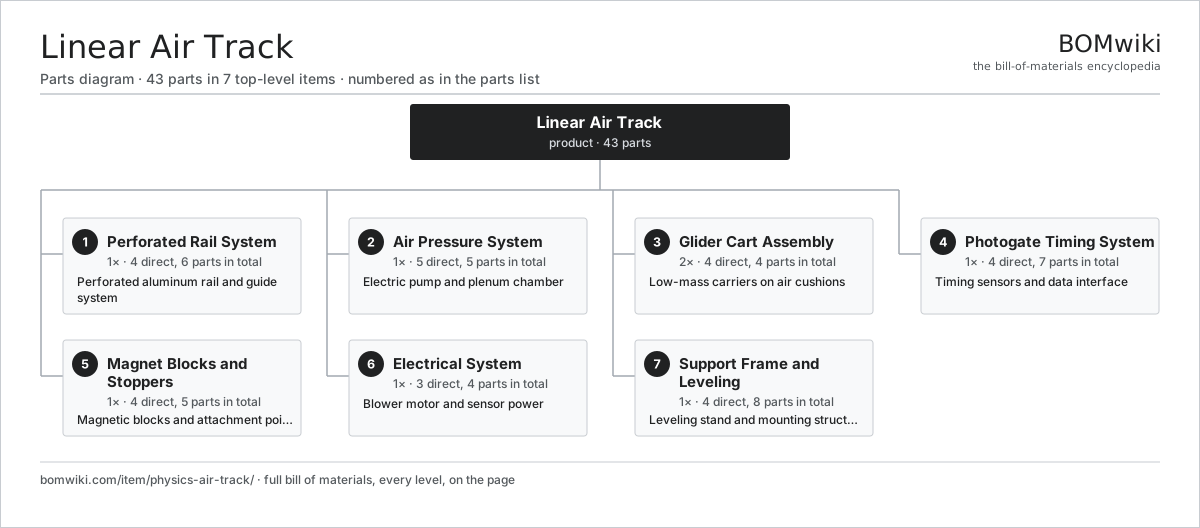
| # | Part | Qty | What it does |
|---|---|---|---|
| 1 | Perforated Rail System 4 parts | 1× | Perforated aluminum rail and guide system |
| 2 | Air Pressure System 5 parts | 1× | Electric pump and plenum chamber |
| 3 | Glider Cart Assembly 4 parts | 2× | Low-mass carriers on air cushions |
| 4 | Photogate Timing System 4 parts | 1× | Timing sensors and data interface |
| 5 | Magnet Blocks and Stoppers 4 parts | 1× | Magnetic blocks and attachment points |
| 6 | Electrical System 3 parts | 1× | Blower motor and sensor power |
| 7 | Support Frame and Leveling 4 parts | 1× | Leveling stand and mounting structure |
3D model
No 3D model yet. Have a CAD file of this? Add a 3D model. STL renders right on this page; STEP, FreeCAD, and OpenSCAD sources are welcome too (openly licensed, like all 3D models on BOMwiki).
Build & assembly graph
expand / collapse · shared sub-assemblies converge · links to related products · est. labourTap an assembly to expand/collapse · tap a part to open it · use “Open page” for any node · drag to pan, scroll to zoom.
Bill of materials for Linear Air Track
7 top-level lines · 35 rows shown · 43 parts total · indented to 3 levels| # | Item / sub-assembly | Part no. | Qty/assy | Ext. qty | Parts | Type |
|---|---|---|---|---|---|---|
| 1 | Perforated Rail System 4 parts | physics-air-track-rail-assembly | 1× | 1 | 6 | assembly |
| 1.1 | Perforated Aluminum Rail | physics-air-track-rail | 1× | 1 | · | part |
| 1.2 | Rail End Cap | physics-air-track-rail-end-cap | 2× | 2 | · | part |
| 1.3 | Plenum Coupling | physics-air-track-rail-connector | 1× | 1 | · | part |
| 1.4 | O-Ring Set | oring-set | 2× | 2 | · | part |
| 2 | Air Pressure System 5 parts | physics-air-track-blower-system | 1× | 1 | 5 | assembly |
| 2.1 | Blower Motor | physics-air-track-blower-motor | 1× | 1 | · | part |
| 2.2 | Blower Impeller | physics-air-track-blower-fan | 1× | 1 | · | part |
| 2.3 | Plenum Header Tank | physics-air-track-plenum-chamber | 1× | 1 | · | part |
| 2.4 | Inlet Air Filter | physics-air-track-air-filter | 1× | 1 | · | part |
| 2.5 | Blower Silencer | physics-air-track-silencer | 1× | 1 | · | part |
| 3 | Glider Cart Assembly 4 parts | physics-air-track-gliders | 2× | 2 | 4 | assembly |
| 3.1 | Glider Sled Shell | physics-air-track-glider-body | 1× | 2 | · | part |
| 3.2 | Air Cushion Skirt | physics-air-track-air-cushion-skirt | 1× | 2 | · | part |
| 3.3 | Magnetic Coupling Hook | physics-air-track-glider-hook | 1× | 2 | · | part |
| 3.4 | Mass Insert Block | physics-air-track-mass-insert | 1× | 2 | · | part |
| 4 | Photogate Timing System 4 parts | physics-air-track-photogate-system | 1× | 1 | 7 | assembly |
| 4.1 | Photogate Sensor | physics-air-track-photogate-unit | 2× | 2 | · | part |
| 4.2 | Photogate Mounting Bracket | physics-air-track-gate-bracket | 2× | 2 | · | part |
| 4.3 | Timing Counter Board | physics-air-track-timing-interface | 1× | 1 | · | part |
| 4.4 | Connector | connector | 2× | 2 | · | part |
| 5 | Magnet Blocks and Stoppers 4 parts | physics-air-track-accessory-mount | 1× | 1 | 5 | assembly |
| 5.1 | Neodymium Magnet | neodymium-magnet | 2× | 2 | · | part |
| 5.2 | Collision Spring Bumper | physics-air-track-spring-block | 1× | 1 | · | part |
| 5.3 | Rail End Stop | physics-air-track-end-stop | 1× | 1 | · | part |
| 5.4 | Fastener Set | fastener-set | 1× | 1 | · | part |
| 6 | Electrical System 3 parts | physics-air-track-power-supply | 1× | 1 | 4 | assembly |
| 6.1 | Power Supply | power-supply | 1× | 1 | · | part |
| 6.2 | Connector | connector | 2× | 2 | · | part |
| 6.3 | Variable Voltage Control | physics-air-track-voltage-switch | 1× | 1 | · | part |
| 7 | Support Frame and Leveling 4 parts | physics-air-track-frame | 1× | 1 | 8 | assembly |
| 7.1 | Frame Support Leg | physics-air-track-frame-legs | 2× | 2 | · | part |
| 7.2 | Adjustable Leveling Foot | physics-air-track-leveling-foot | 3× | 3 | · | part |
| 7.3 | Rail Mounting Clamp | physics-air-track-rail-clamp | 2× | 2 | · | part |
| 7.4 | Fastener Set | fastener-set | 1× | 1 | · | part |
Something wrong in this list? Report a problem with this BOM.
Related products
same domain, ranked by shared parts Atomic Absorption Spectrometer
648 parts · shares 3 with this page
Autoclave Sterilizer
282 parts · shares 3 with this page
Automatic Titrator
65 parts · shares 3 with this page
Benchtop Bioreactor
487 parts · shares 3 with this page
Dissolution Tester
370 parts · shares 3 with this page
Atomic Absorption Spectrometer
648 parts · shares 3 with this page
Autoclave Sterilizer
282 parts · shares 3 with this page
Automatic Titrator
65 parts · shares 3 with this page
Benchtop Bioreactor
487 parts · shares 3 with this page
Dissolution Tester
370 parts · shares 3 with this page
 Fatigue Testing Rig
412 parts · shares 3 with this page
Fatigue Testing Rig
412 parts · shares 3 with this page
Sourcing: possible vendors
Browse the supplier directory → Prices, MOQ, and lead times are algorithmic estimates, not quotes, and not claims about these companies. Company mappings are curated by keyword; est. price band $1k–$500k. How estimates work| Vendor | HQ | Specialty | MOQ | Lead time |
|---|---|---|---|---|
| thermofisher.com ↗ | Waltham, US | Lab instruments | 100 units | 10–18 wks |
|
🇺🇸Agilent
agilent.com ↗
|
Santa Clara, US | Analytical instruments | 100 units | 10–18 wks |
|
🇺🇸Bruker
bruker.com ↗
|
Billerica, US | Scientific instruments | 100 units | 10–18 wks |
|
🇯🇵Shimadzu
shimadzu.com ↗
|
Kyoto, JP | Analytical instruments | 100 units | 10–18 wks |
|
🇺🇸Waters
waters.com ↗
|
Milford, US | Chromatography & MS | 100 units | 10–18 wks |
1,132-word article