Pneumatic Pinch Valve
ProductOverview
A pneumatic pinch valve shuts off flow the way a thumb stops a garden hose: compressed air squeezes a thick rubber tube flat. The Elastomer Sleeve is the only part touching the medium, there is no seat, stem, gland, or cavity, so the valve handles media that wreck conventional trim: mine tailings, lime slurry, cement, sand, plastic granulate, fibrous pulp, wastewater grit, and food products that demand a crevice-free bore. When open it presents a smooth full-diameter rubber pipe with no pressure drop beyond ordinary pipe friction and nowhere for solids to lodge.
The trade-offs are equally plain: line pressure is limited by what air can overcome (commonly 6 bar, 10 bar with reinforced sleeves), throttling range is modest, and the sleeve is a wear part exchanged on a maintenance schedule rather than a permanent component.
How it works
The sleeve sits inside a two-piece Valve Body whose Body Halfs bolt around it to form a sealed annular chamber. To close, the Solenoid Pilot Valve routes compressed air through the Air Port into this annulus. Air pressure acts on the whole outer surface of the sleeve; because that area is large, a differential of only 2–2.5 bar above line pressure flattens the tube into a lip-shaped, bubble-tight closure. Solids caught in the pinch line simply embed in the rubber, which seals around them, the reason pinch valves achieve drop-tight shutoff on slurries that destroy gate and ball valve seats.
To open, the solenoid de-energizes and the Quick-Exhaust Valve dumps the annulus air locally, instead of forcing it back through metres of pilot tubing. Two effects restore the bore: line pressure pushes from inside, and the Reinforcement Cords, fabric plies vulcanized into the rubber wall, act as a spring that pulls the tube round again. On suction lines or in dry-powder service, where the medium cannot help, the cord rebound does the work alone, which is why sleeve construction matters more than any other specification of the valve.
The pilot circuit is conventional pneumatics: a 5 µm Pilot Air Filter with water trap, a Pressure Regulator set to the required differential, the 3/2-way solenoid with its 24 VDC Solenoid Coil, and Pilot Tubing Kit between them. Throttling is possible by applying intermediate pilot pressures, the sleeve assumes an elliptical part-closed shape, but the usable control band is roughly the last 50% of stroke, and sustained throttling accelerates fatigue at the fold lines.
Construction
The sleeve is built like a short piece of multi-ply hose. The Sleeve Inner Tube lining, 5–15 mm thick, is compounded for the duty: soft natural rubber outwears almost everything on sliding abrasion, EPDM covers chemicals and 100 °C, NBR handles oils, FKM acids. The flared Sleeve Cuffs at each end are clamped between the body and the End Flange by a Cuff Clamp Ring, sealing the line without separate gaskets. The Flange Stud Set passes through flange, cuff, and body at each end; tightening it to the specified torque is the whole installation procedure.
Because the closure element is hidden, position must be inferred. The standard method is a Pressure Sensor on the annulus, sustained pilot pressure proves closure, optionally confirmed by a Closure Limit Sensor, a spring feeler that touches the flattened sleeve. Both wire back through the Junction Box.
Service and failure behaviour
Sleeve life is the maintenance story. On clean liquids at low pressure a sleeve survives millions of cycles; on coarse sharp slurry at 6 bar it may need replacement in months. Failure is benign and visible: the sleeve weeps medium through a fatigue crack into the body, where a drain hole or the body joint shows the leak before it becomes a line break. Replacement takes minutes, unbolt the flanges, slide out the old sleeve, slide in the new one, with no lapping, packing, or adjustment.
A normally open valve fails open on air or power loss; processes needing fail-closed behaviour use a spring-and-roller mechanical pinch variant or hold a local air reservoir with a check valve. Pilot air must be dry: condensate freezing in the annulus in winter is the most common cause of a pinch valve that refuses to open.
Pneumatic Pinch Valve parts and their functions
6 top-level parts · 33 parts in total · full bill of materials below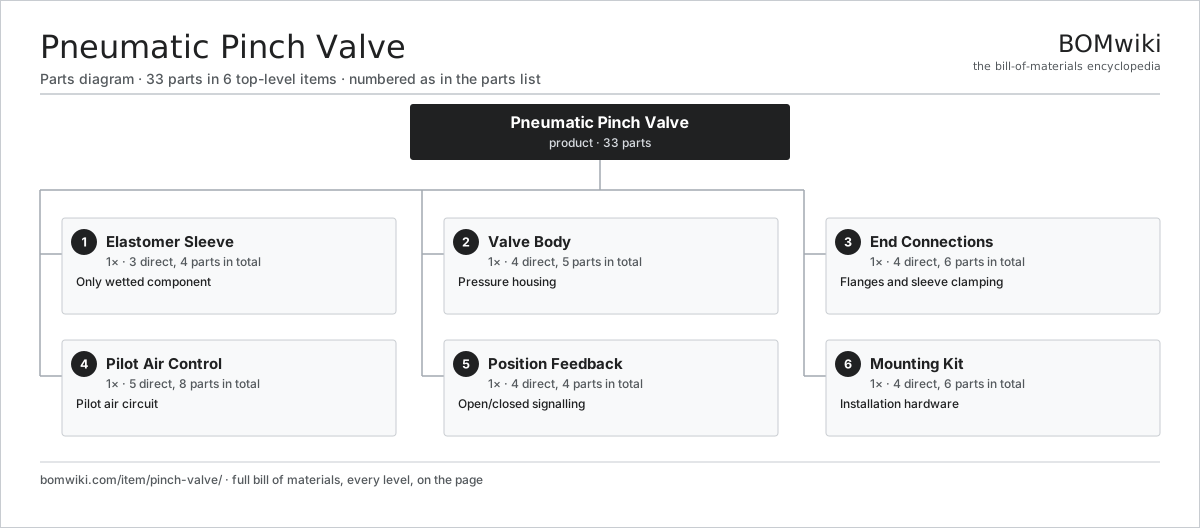
| # | Part | Qty | What it does |
|---|---|---|---|
| 1 | Elastomer Sleeve 3 parts | 1× | Only wetted component |
| 2 | Valve Body 4 parts | 1× | Pressure housing |
| 3 | End Connections 4 parts | 1× | Flanges and sleeve clamping |
| 4 | Pilot Air Control 5 parts | 1× | Pilot air circuit |
| 5 | Position Feedback 4 parts | 1× | Open/closed signalling |
| 6 | Mounting Kit 4 parts | 1× | Installation hardware |
3D model
No 3D model yet. Have a CAD file of this? Add a 3D model. STL renders right on this page; STEP, FreeCAD, and OpenSCAD sources are welcome too (openly licensed, like all 3D models on BOMwiki).
Build & assembly graph
expand / collapse · shared sub-assemblies converge · links to related products · est. labourTap an assembly to expand/collapse · tap a part to open it · use “Open page” for any node · drag to pan, scroll to zoom.
Bill of materials for Pneumatic Pinch Valve
6 top-level lines · 34 rows shown · 33 parts total · indented to 3 levels| # | Item / sub-assembly | Part no. | Qty/assy | Ext. qty | Parts | Type |
|---|---|---|---|---|---|---|
| 1 | Elastomer Sleeve 3 parts | pinch-valve-sleeve | 1× | 1 | 4 | assembly |
| 1.1 | Sleeve Inner Tube | pinch-valve-sleeve-tube | 1× | 1 | · | part |
| 1.2 | Reinforcement Cords | pinch-valve-sleeve-cords | 1× | 1 | · | part |
| 1.3 | Sleeve Cuff | pinch-valve-sleeve-cuff | 2× | 2 | · | part |
| 2 | Valve Body 4 parts | pinch-valve-body | 1× | 1 | 5 | assembly |
| 2.1 | Body Half | pinch-valve-body-half | 2× | 2 | · | part |
| 2.2 | Air Port | pinch-valve-air-port | 1× | 1 | · | part |
| 2.3 | Body Joint Seal | pinch-valve-body-seal | 1× | 1 | · | part |
| 2.4 | Fastener Set | fastener-set | 1× | 1 | · | part |
| 3 | End Connections 4 parts | pinch-valve-end-connections | 1× | 1 | 6 | assembly |
| 3.1 | End Flange | pinch-valve-flange | 2× | 2 | · | part |
| 3.2 | Cuff Clamp Ring | pinch-valve-clamp-ring | 2× | 2 | · | part |
| 3.3 | Flange Stud Set | pinch-valve-stud-set | 1× | 1 | · | part |
| 3.4 | Fastener Set | fastener-set | 1× | 1 | · | part |
| 4 | Pilot Air Control 5 parts | pinch-valve-air-control | 1× | 1 | 8 | assembly |
| 4.1 | Solenoid Pilot Valve 4 parts | pinch-valve-solenoid | 1× | 1 | 4 | assembly |
| 4.1.1 | Solenoid Coil | pinch-valve-solenoid-coil | 1× | 1 | · | part |
| 4.1.2 | Pilot Spool | pinch-valve-solenoid-spool | 1× | 1 | · | part |
| 4.1.3 | Coil Spring | coil-spring | 1× | 1 | · | part |
| 4.1.4 | Connector | connector | 1× | 1 | · | part |
| 4.2 | Pressure Regulator | pinch-valve-regulator | 1× | 1 | · | part |
| 4.3 | Quick-Exhaust Valve | pinch-valve-quick-exhaust | 1× | 1 | · | part |
| 4.4 | Pilot Air Filter | pinch-valve-air-filter | 1× | 1 | · | part |
| 4.5 | Pilot Tubing Kit | pinch-valve-tubing | 1× | 1 | · | part |
| 5 | Position Feedback 4 parts | pinch-valve-position-feedback | 1× | 1 | 4 | assembly |
| 5.1 | Pressure Sensor | pressure-sensor | 1× | 1 | · | part |
| 5.2 | Closure Limit Sensor | pinch-valve-limit-sensor | 1× | 1 | · | part |
| 5.3 | Junction Box | pinch-valve-junction-box | 1× | 1 | · | part |
| 5.4 | Wire Bundle | wire-bundle | 1× | 1 | · | part |
| 6 | Mounting Kit 4 parts | pinch-valve-mounting-kit | 1× | 1 | 6 | assembly |
| 6.1 | Foot Bracket | pinch-valve-foot-bracket | 2× | 2 | · | part |
| 6.2 | Pipe Support Saddle | pinch-valve-pipe-saddle | 2× | 2 | · | part |
| 6.3 | Identification Plate | pinch-valve-id-plate | 1× | 1 | · | part |
| 6.4 | Fastener Set | fastener-set | 1× | 1 | · | part |
Something wrong in this list? Report a problem with this BOM.
Related products
same domain, ranked by shared parts Hydraulic Power Unit
91 parts · shares 4 with this page
Hydraulic Power Unit
91 parts · shares 4 with this page
 Irrigation Pump Station
1,881 parts · shares 4 with this page
Irrigation Pump Station
1,881 parts · shares 4 with this page
 Mainline Pipeline Pump
166 parts · shares 3 with this page
Mainline Pipeline Pump
166 parts · shares 3 with this page
 Control Valve
46 parts · shares 3 with this page
Hydraulic Test Bench
77 parts · shares 3 with this page
Control Valve
46 parts · shares 3 with this page
Hydraulic Test Bench
77 parts · shares 3 with this page
 Boiler Feedwater Pump
169 parts · shares 3 with this page
Boiler Feedwater Pump
169 parts · shares 3 with this page
Sourcing: possible vendors
Browse the supplier directory → Prices, MOQ, and lead times are algorithmic estimates, not quotes, and not claims about these companies. Company mappings are curated by keyword; est. price band $50–$50k. How estimates work| Vendor | HQ | Specialty | MOQ | Lead time |
|---|---|---|---|---|
|
🇩🇰Grundfos
grundfos.com ↗
|
Bjerringbro, DK | Pumps | 200 units | 6–12 wks |
|
🇺🇸Xylem
xylem.com ↗
|
Washington, US | Water technology | 200 units | 6–12 wks |
| flowserve.com ↗ | Irving, US | Pumps & valves | 200 units | 6–12 wks |
|
🇩🇪KSB
ksb.com ↗
|
Frankenthal, DE | Pumps & valves | 200 units | 6–12 wks |
| parker.com ↗ | Cleveland, US | Motion & fluid control | 200 units | 6–12 wks |
735-word article