Pipe Beveling Machine
ProductOverview
A pipe beveling machine prepares the end of a pipe or tube for butt-welding by cutting a 37.5° or 45° beveled edge (also called a V-groove or chamfer). Proper beveling is essential: it provides a welding groove where the filler metal is deposited, ensures full penetration of the weld into the base metal, and reduces the amount of filler metal needed. A Split-Frame Clamp opens and slides onto the pipe, then tightens to hold it rigidly. A rotating Tool Carriage Assembly carrying one or more Tool Holders and Bits orbits around the pipe, with the tool bit(s) cutting the bevel as they revolve. The operator manually infeeeds the tools via a Infeed Mechanism, watching for proper chip formation and surface finish. Portable models weigh 50–200 kg and can be carried to jobsites; fixed installations bolt to a workbench. Pipe beveling is a staple in pipeline construction, pressure-vessel fabrication, and any shop that welds heavy-wall tubing.
Clamp system
The Split-Frame Clamp is the machine's anchor. A hinged C-frame made of steel or ductile iron, it splits vertically; the Upper Frame Half and Lower Frame Half are joined by a Hinge Pin. To clamp a pipe, the frame is opened (usually by hand or with a quick-release lever), slid over the pipe end, and then closed and tightened. Tightening can be:
- Manual: Two or four Clamping Screw handles are cranked, drawing the frame halves together.
- Hydraulic: Solenoid-actuated cylinders clamp rapidly and with constant force.
The Clamping Pad, typically soft rubber or bronze, grips the outer diameter of the pipe without marring it. The clamping force must be sufficient to resist the cutting forces (which can exceed 1000 N for heavy pipes) without slipping. Once clamped, the pipe is locked in place and cannot rotate, the tool carriage will orbit around it.
Tool carriage and cutting action
The Tool Carriage Assembly, a ring-shaped steel or aluminum member, fits over the pipe and rotates around it. A Carriage Bearing (typically a ball or roller bearing) allows smooth rotation. The Driver Gear, a pinion gear, is driven by the Drive Motor and Gearbox via a Gearbox. As the carriage revolves, the Face Bevel Tool at its leading edge cuts the bevel profile into the pipe end face. The tool bit is positioned at the bevel angle (typically 37.5° or 45° from horizontal); as the carriage rotates and the tool is gradually infed via the Infeed Mechanism, it progressively cuts deeper, removing metal chips in a helical path around the pipe circumference.
Cutting tool configuration
The Tool Holders and Bits block can hold 2–4 tools:
- Face bevel tool: Cuts the main beveled surface, removing most of the material.
- Back bevel tool (optional): Cuts the inside edge, removing the sharp inner corner.
- Finishing tool: Light-duty tool for final surface finish, often at slightly higher feed for burnishing.
Each tool is a small high-speed steel or carbide cutter, held in a adjustable post that allows tool height and angle tweaking. Multiple tools can engage simultaneously if spaced properly, increasing material removal rate. Alternatively, the operator selects one tool, completes one pass, then indexes to the next tool position for a subsequent pass with different geometry.
Infeed and depth control
The Infeed Mechanism controls tool engagement depth. A hand-operated Infeed Screw (typical on portable machines) advances the tool carriage downward toward the pipe end face at a rate set by the operator's turning speed. As the carriage rotates (at 2–50 rpm depending on the speed selector), the operator continuously feeds in, watching chips and surface finish. A depth gauge or witness mark on the infeed screw helps the operator judge final bevel depth. Once the desired bevel is cut, the operator locks the carriage with the Infeed Lock and stops the motor. Some larger fixed installations use a motorized Infeed Mechanism with a dial or programmed feed rate, making the process semi-automatic.
Motor and drive
The Drive Motor and Gearbox is typically 1–5 kW AC induction (on 110V or 220V single-phase for portable models) or a 24 VDC motor powered by a portable battery (for truly remote installations). The Gearbox reduces motor speed by a factor of 5–20, providing torque and allowing the Tool Carriage Assembly to revolve at a manageable speed (2–50 rpm). The Speed Selector often provides 2–4 discrete speeds: slow speed (2–10 rpm) for heavy roughing with high feedrates, and fast speed (20–50 rpm) for light finishing and small-diameter pipes. The Drive Coupling, usually a flexible coupling, transmits torque while accommodating minor misalignment.
Typical beveling cycle
A 500 mm (20") O.D., 12 mm wall carbon steel pipe (ASTM A53) needs beveling for a butt weld on a pressure vessel. The pipe is clamped vertically in the Split-Frame Clamp on a workbench, secured with 4 clamping screws. The operator selects low speed (5 rpm) and engages the motor. The Tool Carriage Assembly begins orbiting. The operator uses the Infeed Mechanism hand-wheel to slowly advance the Face Bevel Tool into the pipe end. Chips flow out; the edge begins to show the 37.5° bevel profile. After about 2 minutes of steady infeed, the desired depth (roughly 60% of the wall thickness for a V-groove) is reached. The operator locks the infeed, stops the motor, and retracts the carriage. A second pass with a finishing tool is optional for surface quality. The finished bevel is inspected with a bevel gage or caliper, and the pipe is ready for welding.
Material considerations
Beveling speed depends on the pipe material:
- Carbon steel: 20–50 m/min cutting speed → moderate carriage speed and feedrate.
- Stainless steel: 10–25 m/min (lower speed, more heat generation) → slow carriage speed, careful infeed.
- Duplex stainless: 15–30 m/min → intermediate speed, soluble-oil coolant recommended.
- Cast iron: 5–15 m/min (brittle, produces small chips) → slow speed, dry or mist cooling to clear chips.
Wall thickness also matters: thin-wall pipe (1–2 mm) can bend during clamping, requiring careful setup; thick-wall (10–15 mm) requires heavy infeed force and benefits from slow speed and coolant.
Portable vs. fixed installations
Portable machines (50–200 kg) are carried to jobsites on pipelines or in confined spaces (e.g., inside tanks for pipe preparation). They clamp to the pipe with simple hand screws and rely on a hand-cranked infeed for simplicity and reliability (no hydraulics to fail in the field). Cycle times are longer (15–30 minutes per bevel) but acceptable given the installation convenience.
Fixed shop installations (500–1500 kg) bolt permanently to a pedestal or workbench. They often have hydraulic clamping, motorized infeed, and coolant systems for production runs. With proper setup, they can produce 2–4 bevels per hour, making them economical for high-volume fabrication.
Comparison to other beveling methods
- Flame beveling: Hot oxy-fuel torch cuts the bevel; fast but surface quality is poor and distortion is high. Used only for carbon steel in rough applications.
- Plasma cutting: Fast and clean, but requires plasma equipment and proper ventilation. Cost advantage for high volumes.
- Grinding: Produces excellent surface finish but is very slow (30–60 minutes for heavy pipe).
- Machining (lathe/mill): Very precise but requires part removal and handling; impractical for large-diameter, long-length pipes.
For general fabrication, mechanical beveling (with this machine or a dedicated pipe bevel cutter) is the industry standard.
Pipe Beveling Machine parts and their functions
7 top-level parts · 35 parts in total · full bill of materials below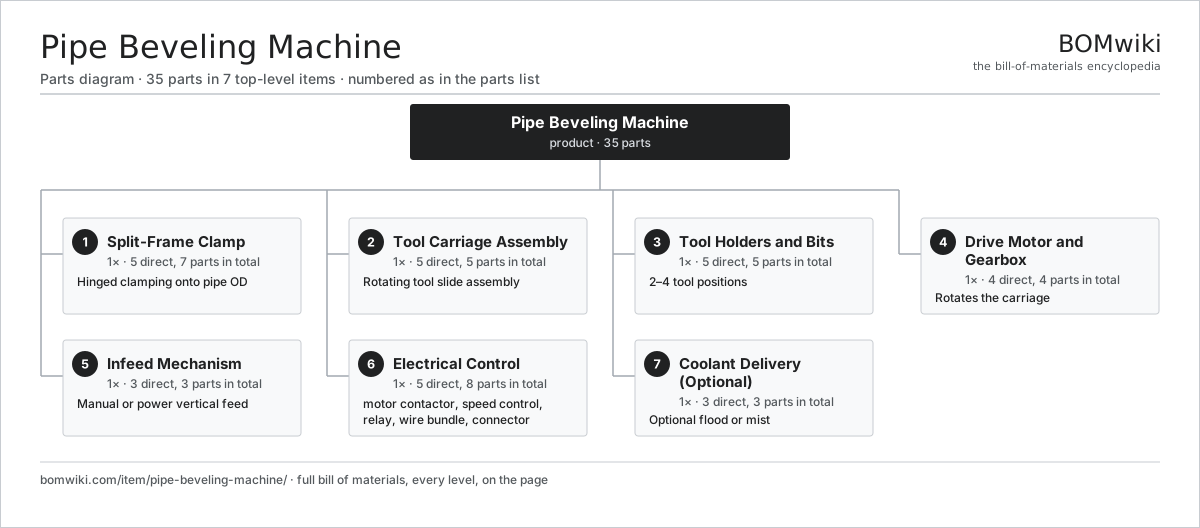
| # | Part | Qty | What it does |
|---|---|---|---|
| 1 | Split-Frame Clamp 5 parts | 1× | Hinged clamping onto pipe OD |
| 2 | Tool Carriage Assembly 5 parts | 1× | Rotating tool slide assembly |
| 3 | Tool Holders and Bits 5 parts | 1× | 2–4 tool positions |
| 4 | Drive Motor and Gearbox 4 parts | 1× | Rotates the carriage |
| 5 | Infeed Mechanism 3 parts | 1× | Manual or power vertical feed |
| 6 | Electrical Control 5 parts | 1× | Motor starter and speed selection. |
| 7 | Coolant Delivery (Optional) 3 parts | 1× | Optional flood or mist |
3D model
No 3D model yet. Have a CAD file of this? Add a 3D model. STL renders right on this page; STEP, FreeCAD, and OpenSCAD sources are welcome too (openly licensed, like all 3D models on BOMwiki).
Build & assembly graph
expand / collapse · shared sub-assemblies converge · links to related products · est. labourTap an assembly to expand/collapse · tap a part to open it · use “Open page” for any node · drag to pan, scroll to zoom.
Bill of materials for Pipe Beveling Machine
7 top-level lines · 37 rows shown · 35 parts total · indented to 3 levels| # | Item / sub-assembly | Part no. | Qty/assy | Ext. qty | Parts | Type |
|---|---|---|---|---|---|---|
| 1 | Split-Frame Clamp 5 parts | pipe-beveling-machine-split-frame-clamp | 1× | 1 | 7 | assembly |
| 1.1 | Upper Frame Half | pipe-beveling-machine-frame-upper | 1× | 1 | · | part |
| 1.2 | Lower Frame Half | pipe-beveling-machine-frame-lower | 1× | 1 | · | part |
| 1.3 | Hinge Pin | pipe-beveling-machine-hinge-pin | 1× | 1 | · | part |
| 1.4 | Clamping Screw | pipe-beveling-machine-clamp-screw | 2× | 2 | · | part |
| 1.5 | Clamping Pad | pipe-beveling-machine-clamping-pad | 2× | 2 | · | part |
| 2 | Tool Carriage Assembly 5 parts | pipe-beveling-machine-tool-carriage | 1× | 1 | 5 | assembly |
| 2.1 | Carriage Body | pipe-beveling-machine-carriage-body | 1× | 1 | · | part |
| 2.2 | Tool Block Mount | pipe-beveling-machine-tool-block-mount | 1× | 1 | · | part |
| 2.3 | Carriage Bearing | pipe-beveling-machine-carriage-bearing | 1× | 1 | · | part |
| 2.4 | Driver Gear | pipe-beveling-machine-carriage-driver-gear | 1× | 1 | · | part |
| 2.5 | Fastener Set | fastener-set | 1× | 1 | · | part |
| 3 | Tool Holders and Bits 5 parts | pipe-beveling-machine-cutting-tool-holders | 1× | 1 | 5 | assembly |
| 3.1 | Tool Holder Block | pipe-beveling-machine-tool-holder-block | 1× | 1 | · | part |
| 3.2 | Face Bevel Tool | pipe-beveling-machine-tool-bit-37-5 | 1× | 1 | · | part |
| 3.3 | Back Bevel Tool | pipe-beveling-machine-tool-bit-back-bevel | 1× | 1 | · | part |
| 3.4 | Finishing Tool | pipe-beveling-machine-tool-bit-finishing | 1× | 1 | · | part |
| 3.5 | Fastener Set | fastener-set | 1× | 1 | · | part |
| 4 | Drive Motor and Gearbox 4 parts | pipe-beveling-machine-drive-motor | 1× | 1 | 4 | assembly |
| 4.1 | Electric Motor | pipe-beveling-machine-drive-motor-body | 1× | 1 | · | part |
| 4.2 | Gearbox | pipe-beveling-machine-gearbox | 1× | 1 | · | part |
| 4.3 | Drive Coupling | pipe-beveling-machine-drive-coupling | 1× | 1 | · | part |
| 4.4 | Speed Selector | pipe-beveling-machine-speed-selector | 1× | 1 | · | part |
| 5 | Infeed Mechanism 3 parts | pipe-beveling-machine-infeed-mechanism | 1× | 1 | 3 | assembly |
| 5.1 | Infeed Screw | pipe-beveling-machine-infeed-screw | 1× | 1 | · | part |
| 5.2 | Infeed Control | pipe-beveling-machine-infeed-dial | 1× | 1 | · | part |
| 5.3 | Infeed Lock | pipe-beveling-machine-infeed-locking-clamp | 1× | 1 | · | part |
| 6 | Electrical Control 5 parts | pipe-beveling-machine-electrical | 1× | 1 | 8 | assembly |
| 6.1 | Motor Contactor | pipe-beveling-machine-motor-contactor | 1× | 1 | · | part |
| 6.2 | Speed Control | pipe-beveling-machine-speed-rheostat | 1× | 1 | · | part |
| 6.3 | Relay | relay | 1× | 1 | · | part |
| 6.4 | Wire Bundle | wire-bundle | 1× | 1 | · | part |
| 6.5 | Connector | connector | 4× | 4 | · | part |
| 7 | Coolant Delivery (Optional) 3 parts | pipe-beveling-machine-coolant-delivery | 1× | 1 | 3 | assembly |
| 7.1 | Coolant Pump | pipe-beveling-machine-coolant-pump | 1× | 1 | · | part |
| 7.2 | Coolant Nozzle | pipe-beveling-machine-coolant-nozzle | 1× | 1 | · | part |
| 7.3 | Coolant Catch Pan | pipe-beveling-machine-coolant-pan | 1× | 1 | · | part |
Something wrong in this list? Report a problem with this BOM.
Sourcing: possible vendors
Browse the supplier directory → Prices, MOQ, and lead times are algorithmic estimates, not quotes, and not claims about these companies. Company mappings are curated by keyword; est. price band $10k–$1M. How estimates work| Vendor | HQ | Specialty | MOQ | Lead time |
|---|---|---|---|---|
|
🇩🇪DMG MORI
dmgmori.com ↗
|
Bielefeld, DE | Machine tools | 5 units | 12–20 wks |
|
🇯🇵Mazak
mazak.com ↗
|
Oguchi, JP | Machine tools | 5 units | 12–20 wks |
| haascnc.com ↗ | Oxnard, US | CNC machine tools | 5 units | 12–20 wks |
|
🇯🇵Okuma
okuma.com ↗
|
Niwa, JP | Machine tools | 5 units | 12–20 wks |
|
🇩🇪Trumpf
trumpf.com ↗
|
Ditzingen, DE | Laser & sheet-metal machines | 5 units | 12–20 wks |
1,338-word article