Pipe Facing Machine
ProductOverview
The pipe facing machine (also called pipe mill or pipe beveler) is a specialized machine tool that machines the cut end of pipe to produce a square (perpendicular) face and a bevel (chamfer) suitable for welding. In fabrication shops, pipeline contractors, and pressure vessel manufacturing, pipes must be cut to length (via band saw or oxy-fuel torch), then faced and beveled to remove burn marks, scale, and irregularities, ensuring clean metal-to-metal contact at the weld root.
The machine centers a pipe using an expandable Pipe Mandrel and Clamping Assembly, clamps it securely with hydraulic or pneumatic jaws, and rotates it at 500–3,000 rpm via the Spindle Bearing Pair and Spindle Drive Motor. A Tool Feed and Advance System advances a hardened carbide tool head (facing cutter and bevel cutter) axially toward the pipe end, producing a perpendicular face with controlled chamfer per ISO 5817 or ASME B16.25 standards.
The facing operation produces a smooth surface finish (Ra 63–125 microinches typical), removing heat-affected zone (HAZ) discoloration from torch cutting, and ensures root gap clearance is uniform. The bevel angle (typically 37.5° or 45°) and bevel height (1/8–1/4 inch) are critical to achieving full root penetration in orbital or manual TIG/MIG welding.
How It Works
Pipe Setup: A length of pipe (e.g., 30 inches of 6 inch OD, schedule 40) is positioned vertically on the machine baseplate. The operator manually expands the Expandable Mandrel (conical or expanding mandrel) by hand or pilot pressure, centering the pipe bore concentrically and radially. The pipe is then gripped securely by three Clamping Jaw advancing via a hydraulic cylinder (50–150 psi), clamping with 500–1,000 lbs force.
Spindle Engagement: The operator energizes the Spindle Drive Motor (5–15 hp VFD-driven motor) to a preset speed (typically 1,000–2,000 rpm for 6 inch pipe). The speed is set to maintain surface speed ~200–400 SFM (surface feet per minute), which depends on pipe diameter and material (steel vs. stainless).
Coolant On: The Coolant Pump (1–3 gpm) sprays soluble oil or synthetic coolant via Spray Nozzle nozzles, cooling the tool and pipe and flushing chips.
Tool Advance: The operator engages the Tool Feed and Advance System, advancing the tool head axially at a programmed feed rate (0.005–0.050 inch/revolution). A stepper or servo motor drives a Lead Screw Drive, providing smooth and repeatable tool advance.
Facing Cut: The Facing (Perpendicular) Cutter (perpendicular single-point tool) makes the first pass, removing ~0.050–0.100 inch of material from the pipe end face. This removes scale, HAZ discoloration, and corrosion, producing a shiny, clean metal face. The facing tool is indexed radially inward with each pass; typical facing requires 1–3 passes to clean and square the end.
Bevel Cut: Once facing is complete, the Bevel Insert (37.5° or 45° angled tool) makes a single or double pass around the circumference, creating the bevel at a controlled depth (typically 1/8 inch for 6 inch pipe, 1/4 inch for 12 inch pipe).
Spindle Stop and Clamp Release: The operator disengages the feed motor (tool stops advancing) and the spindle slows to a stop. The clamp jaws retract via solenoid actuation, and the mandrel cone is manually retracted or spring-ejected, releasing the pipe.
Part Removal: The finished pipe, with a square face and clean bevel, is removed manually or by overhead hoist.
Total cycle time is typically 3–8 minutes per cut end (1–2 minutes spindle time plus setup), allowing a crew to face and bevel 50–100 pipe ends per 8-hour shift.
Centering and Accuracy
The expandable Expandable Mandrel is critical: it expands uniformly as it enters the pipe bore, contacting the bore wall at a diameter slightly larger than nominal bore ID. This self-centering action (via the tapered cone geometry) ensures runout <0.002 inch TIR, meaning the pipe axis is held concentrically within the spindle centerline.
The Base Casting is precision-ground (often by the manufacturer via surface grinder) to ensure the spindle axis is perpendicular to the baseplate within 0.001 inch. This perpendicularity is critical: if the spindle is tilted even 0.005 inch, the faced end will be inclined, and the pipe face will not sit flat on a mating flange.
Field leveling is performed with Leveling Foot (adjustable threaded feet) and a precision spirit level. Once leveled, the machine should maintain perpendicularity within 0.001–0.002 inch, ensuring weld-ready pipe end prep.
Tool Selection and Material
The facing and bevel cutting inserts are typically carbide (cemented tungsten carbide) or ceramic (aluminum oxide), rated for 200–500 SFM depending on material:
- Carbon Steel Pipe: 300–400 SFM, standard carbide inserts.
- Stainless Steel Pipe: 150–250 SFM, carbide with cobalt binder or coated carbide to reduce diffusion wear.
- Duplex or Super-Duplex Stainless: 100–200 SFM, ceramic or solid carbide with special coolant (neat oil preferred over water-soluble).
Insert wear is visible as a build-up of metal on the insert edge (built-up edge, or BUE). When BUE appears, surface finish degrades, and the insert is replaced. A single carbide insert typically faces 20–50 pipe ends before replacement; a bevel insert lasts 50–100 ends.
Bevel Angle and Welding Preparation
The bevel angle (37.5° or 45°) is set to match the welding root opening and penetration requirements:
- 45° Bevel: Used for thin-wall (0.035–0.125 inch) pipes, single-pass orbital root welds. Provides a tight root opening (~0.050–0.075 inch gap) and small included angle (90° total face angle).
- 37.5° Bevel: Used for thicker wall (0.125–0.250 inch) pipes, multi-pass root welds. Larger included angle (~75°) accommodates multiple passes and deeper penetration.
After facing and beveling, the pipe end is measured with a profile gauge or caliper to verify the bevel angle ±2°, face perpendicularity <0.001 inch, and edge condition (no chatter marks or chips).
Portable Mounting and On-Site Use
Most pipe facing machines are portable (2,000–5,000 lbs), mounted on a four-wheel cart or skid for ease of repositioning between job sites. The machine operates from standard 480V three-phase or 208V single-phase power (depending on model), with a flexible power cord. On-site setup requires:
- Level the machine base using adjustable feet and a spirit level.
- Connect power and coolant tank.
- Load and center the first pipe.
- Set spindle speed and feed rate on the Electrical Control Panel.
Typical setup time is 30 minutes, allowing small crews to perform in-situ pipe prep without shipping pipes back to a central shop.
Maintenance and Safety
The Spindle Bearing Pair is packed with lithium grease and sealed; spindle life is typically 2,000–5,000 hours before bearing wear (increased runout) necessitates bearing replacement. The VFD and motor are serviced per manufacturer schedules (annual filter changes in dusty environments). The Return Line Filter is cleaned or replaced weekly to prevent tool corrosion and maintain lubricity.
Emergency stops are critical: the machine must have a large red Emergency Stop Circuit button that immediately de-energizes the spindle motor, releases the clamp, and shuts off the coolant pump. Long hair and loose clothing must never be worn around the machine; chip shields and guards are mandatory.
Pipe Facing Machine parts and their functions
8 top-level parts · 34 parts in total · full bill of materials below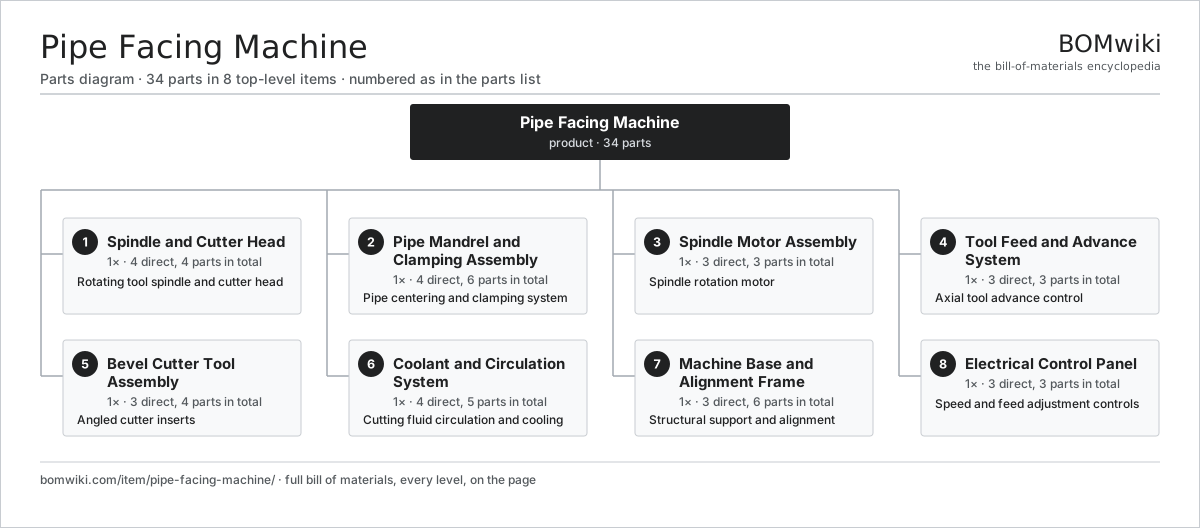
| # | Part | Qty | What it does |
|---|---|---|---|
| 1 | Spindle and Cutter Head 4 parts | 1× | Rotating tool spindle and cutter head |
| 2 | Pipe Mandrel and Clamping Assembly 4 parts | 1× | Pipe centering and clamping system |
| 3 | Spindle Motor Assembly 3 parts | 1× | Spindle rotation motor |
| 4 | Tool Feed and Advance System 3 parts | 1× | Axial tool advance control |
| 5 | Bevel Cutter Tool Assembly 3 parts | 1× | Angled cutter inserts |
| 6 | Coolant and Circulation System 4 parts | 1× | Cutting fluid circulation and cooling |
| 7 | Machine Base and Alignment Frame 3 parts | 1× | Structural support and alignment |
| 8 | Electrical Control Panel 3 parts | 1× | Speed and feed adjustment controls |
3D model
No 3D model yet. Have a CAD file of this? Add a 3D model. STL renders right on this page; STEP, FreeCAD, and OpenSCAD sources are welcome too (openly licensed, like all 3D models on BOMwiki).
Build & assembly graph
expand / collapse · shared sub-assemblies converge · links to related products · est. labourTap an assembly to expand/collapse · tap a part to open it · use “Open page” for any node · drag to pan, scroll to zoom.
Bill of materials for Pipe Facing Machine
8 top-level lines · 35 rows shown · 34 parts total · indented to 3 levels| # | Item / sub-assembly | Part no. | Qty/assy | Ext. qty | Parts | Type |
|---|---|---|---|---|---|---|
| 1 | Spindle and Cutter Head 4 parts | pipe-facing-machine-head-assembly | 1× | 1 | 4 | assembly |
| 1.1 | Spindle Bearing Pair | pipe-facing-machine-spindle-bearing | 1× | 1 | · | part |
| 1.2 | Tool Change Interface | pipe-facing-machine-spindle-nose | 1× | 1 | · | part |
| 1.3 | Spindle Drive Motor | pipe-facing-machine-spindle-motor | 1× | 1 | · | part |
| 1.4 | Chip and Coolant Guard | pipe-facing-machine-head-shield | 1× | 1 | · | part |
| 2 | Pipe Mandrel and Clamping Assembly 4 parts | pipe-facing-machine-clamp-mandrel | 1× | 1 | 6 | assembly |
| 2.1 | Expandable Mandrel | pipe-facing-machine-mandrel-cone | 1× | 1 | · | part |
| 2.2 | Clamping Jaw | pipe-facing-machine-clamp-jaws | 3× | 3 | · | part |
| 2.3 | Clamp Hydraulic or Pneumatic Cylinder | pipe-facing-machine-clamp-actuator | 1× | 1 | · | part |
| 2.4 | Mandrel Thrust Bearing | pipe-facing-machine-clamp-bearing-housing | 1× | 1 | · | part |
| 3 | Spindle Motor Assembly 3 parts | pipe-facing-machine-drive-motor | 1× | 1 | 3 | assembly |
| 3.1 | Motor Housing | pipe-facing-machine-motor-body | 1× | 1 | · | part |
| 3.2 | Motor-to-Spindle Coupling | pipe-facing-machine-motor-coupling | 1× | 1 | · | part |
| 3.3 | Variable Frequency Drive | pipe-facing-machine-motor-vfd-controller | 1× | 1 | · | part |
| 4 | Tool Feed and Advance System 3 parts | pipe-facing-machine-feed-mechanism | 1× | 1 | 3 | assembly |
| 4.1 | Lead Screw Drive | pipe-facing-machine-feed-screw | 1× | 1 | · | part |
| 4.2 | Feed Motor | pipe-facing-machine-feed-motor | 1× | 1 | · | part |
| 4.3 | Feed Carriage Slide | pipe-facing-machine-feed-carriage | 1× | 1 | · | part |
| 5 | Bevel Cutter Tool Assembly 3 parts | pipe-facing-machine-bevel-tooling | 1× | 1 | 4 | assembly |
| 5.1 | Bevel Tool Holder | pipe-facing-machine-bevel-tool-body | 1× | 1 | · | part |
| 5.2 | Bevel Insert | pipe-facing-machine-bevel-cutter-inserts | 2× | 2 | · | part |
| 5.3 | Facing (Perpendicular) Cutter | pipe-facing-machine-facing-cutter | 1× | 1 | · | part |
| 6 | Coolant and Circulation System 4 parts | pipe-facing-machine-coolant-system | 1× | 1 | 5 | assembly |
| 6.1 | Coolant Pump | pipe-facing-machine-coolant-pump | 1× | 1 | · | part |
| 6.2 | Coolant Tank | pipe-facing-machine-coolant-tank | 1× | 1 | · | part |
| 6.3 | Spray Nozzle | pipe-facing-machine-coolant-nozzle | 2× | 2 | · | part |
| 6.4 | Return Line Filter | pipe-facing-machine-coolant-filter | 1× | 1 | · | part |
| 7 | Machine Base and Alignment Frame 3 parts | pipe-facing-machine-base-frame | 1× | 1 | 6 | assembly |
| 7.1 | Base Casting | pipe-facing-machine-base-casting | 1× | 1 | · | part |
| 7.2 | Spindle Head Pads | pipe-facing-machine-spindle-head-mounting | 1× | 1 | · | part |
| 7.3 | Leveling Foot | pipe-facing-machine-base-leveling-feet | 4× | 4 | · | part |
| 8 | Electrical Control Panel 3 parts | pipe-facing-machine-control-panel | 1× | 1 | 3 | assembly |
| 8.1 | Control Logic Unit | pipe-facing-machine-control-PLC | 1× | 1 | · | part |
| 8.2 | Speed Display (Optional) | pipe-facing-machine-control-display | 1× | 1 | · | part |
| 8.3 | Emergency Stop Circuit | pipe-facing-machine-control-emergency-stop | 1× | 1 | · | part |
Something wrong in this list? Report a problem with this BOM.
Sourcing: possible vendors
Browse the supplier directory → Prices, MOQ, and lead times are algorithmic estimates, not quotes, and not claims about these companies. Company mappings are curated by keyword; est. price band $10k–$50M. How estimates work| Vendor | HQ | Specialty | MOQ | Lead time |
|---|---|---|---|---|
|
🇺🇸SLB
slb.com ↗
|
Houston, US | Oilfield services & equipment | made to order | 24–48 wks |
| halliburton.com ↗ | Houston, US | Oilfield services | made to order | 24–48 wks |
| bakerhughes.com ↗ | Houston, US | Energy technology | made to order | 24–48 wks |
|
🇺🇸NOV
nov.com ↗
|
Houston, US | Drilling equipment | made to order | 24–48 wks |
| technipfmc.com ↗ | London, GB | Subsea & surface systems | made to order | 24–48 wks |
1,286-word article