Pipe Jacking Machine
ProductOverview
A pipe jacking machine is a small-diameter horizontal boring system that remotely excavates utility tunnels, typically 0.3–3 m diameter, under streets, railways, and obstacles using continuous pipe propulsion. The machine combines rotary cutting (like a TBM), slurry or foam face support, and sequential pipe jacking to advance a complete tunnel ring without open trenching. Pipe jacking dominates utility crossings where ground settlement and surface disruption are intolerable.
The system is faster and cheaper than slurry TBMs for diameters under 2.5 m but requires intermediate jacking stations every 50–100 m to overcome friction and maintain advance rate. The entire operation is remote, operators remain safely in a launch shaft or control cabin at the surface.
System Architecture
A pipe jacking setup consists of four main areas: the Main Jacking Station in the launch shaft (typically a 30 m × 15 m × 8 m deep reinforced concrete pit), intermediate Interjack Stations (Multiple) located in access shafts along the drive line, the Control and Drive Container with the main drive motor and hydraulic systems, and the Spoil Separation and Removal for soil processing at ground level.
The Cutting Shield Assembly leads, rotating continuously to bore a hole while maintaining face pressure via slurry or foam conditioning. The pipe-jacking-machine-guidance-system with a pipe-jacking-machine-laser-unit and Laser Total Station ensures alignment to within ±25 mm over 100+ meter drives.
Cutting and Face Control
The Cutting Face Opening Configuration varies by soil type: open face for stiff clay, slurry chamber for sand/saturated soils, and screw auger bulkhead for mixed ground. The Cutting Shield Assembly is a rotating hardened-steel head with pipe-jacking-machine-disc-cutters (or scrapers in soft clay) that continuously fragments soil. The excavated cuttings either discharge directly (open face) or are pushed into a pressurized chamber where pipe-jacking-machine-slurry-system bentonite slurry lifts them to surface via pipe-jacking-machine-slurry-hose.
The Slurry Separation Plant receives cuttings-laden slurry, separates soil via hydrocyclones and shakers, and recovers bentonite for recirculation. A secondary Screw Auger Conveyor or centrifuge dewatering system reduces spoil volume by 30–40% before disposal.
Main Jacking Station
The launch shaft houses the Main Jacking Station, a reinforced concrete pit with a pipe-jacking-machine-reaction-frame bolted to the pit back wall. The frame supports a series of Main Jacking Cylinders (typically 100–300 mm bore × 2000+ mm stroke) that push against a Guide Ring Assembly, which centers the first pipe segment. As each 2.5 m pipe advances, the next segment is prepared behind it.
The reaction beam anchors to concrete deadman blocks or rock bolts with 200+ tonne pulldown capacity. Soil movement is monitored with Steerable Jacking Pads and real-time laser targets. Modern systems achieve 50–100 mm vertical and horizontal accuracy over 500 m drives.
Intermediate Jacking Stations
Beyond the economic reach of main jacking force (typically 50–100 m), Interjack Stations (Multiple) are installed inside access shafts. These portable Interjack Station Frame assemblies grip the pipe string and apply additional Interjack Cylinders thrust (500–2000 kN each), effectively resetting the available jacking distance.
Each interjack carries a local Interjack Power Unit powered by a diesel or electric motor. Communication via radio or cable links interjack operation to the main control system, maintaining coordinated pressure distribution.
Drive Motor and Control
The Control and Drive Container houses the main pipe-jacking-machine-motor (100–300 kW electric or diesel), pipe-jacking-machine-gearbox (10:1 to 50:1 reduction), and Main Hydraulic Pump for hydraulic jacking circuits. The pipe-jacking-machine-vfd-panel provides proportional control of cutting head speed (typically 5–20 rpm) and face pressure regulation.
The pipe-jacking-machine-remote-control allows the operator in a control cabin to adjust advance rate (10–50 mm/min), monitor Laser Total Station laser feedback in real-time, and steer via proportional Steerable Jacking Pads if the machine begins to drift.
Steering and Alignment
Real-time steering relies on Digital Inclinometer (measuring pitch and roll) and Survey Target Reflectors (prism panels on the pipe string) sighted by the Laser Total Station theodolite. Drift is corrected by selective jacking of Steerable Jacking Pads, small cylinders on the jacking frame that apply side loads to steer the next pipe increment.
Modern systems employ laser gyroscopes and GPS for long drives but remain dependent on theodolite backup and periodic probe drilling to confirm alignment ahead.
Soil-Specific Strategies
- Firm clay: Open-face machine with simple scrapers; no face pressure needed
- Sand and silt: Slurry chamber with 2–4 bar bentonite pressure to prevent face collapse
- Mixed ground: Screw-auger EPB chamber with back-pressure control and foam conditioning
- Hard rock: Hardened disc cutters and higher torque; slower advance (5–10 m/day vs. 50+ m/day in clay)
Typical Drive Sequence
- Launch shaft prepared with jacking frame and guide ring
- First segment installed and centered
- Jacking begins at 10–30 mm/min; laser and inclinometer monitored continuously
- Every 50 m, advance halts; interjack installed in access shaft
- Process repeats until arrival shaft
- Machine retrieved by disconnecting pipes and winching segments out
A 200 m drive with two interjacks typically requires 30–50 days depending on ground, spoil plant efficiency, and segment supply.
Settlement and Risk Mitigation
Pipe jacking minimizes surface settlement compared to open-cut because the pipe wall is continuously supported and no wide excavation zone is exposed. Settlement typically remains <10 mm for drives >30 m from surface, though fine sand drives require face pressure management to prevent heave. Probe drilling ahead detects unexpected voids, utilities, or hazards before breakout.
Pipe Jacking Machine parts and their functions
7 top-level parts · 38 parts in total · full bill of materials below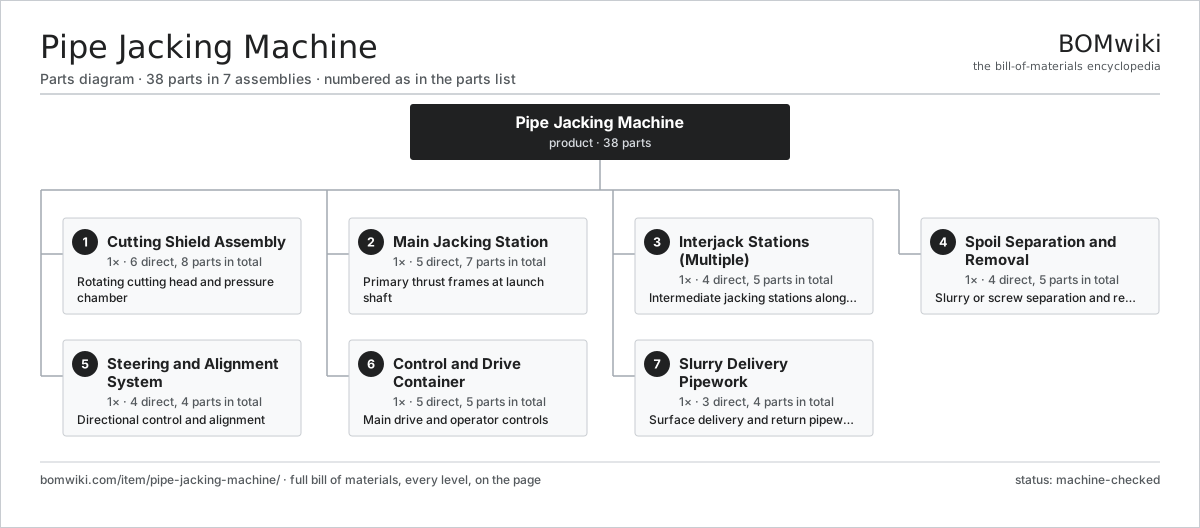
| # | Part | Qty | What it does |
|---|---|---|---|
| 1 | Cutting Shield Assembly 6 parts | 1× | Rotating cutting head and pressure chamber |
| 2 | Main Jacking Station 5 parts | 1× | Primary thrust frames at launch shaft |
| 3 | Interjack Stations (Multiple) 4 parts | 1× | Intermediate jacking stations along line |
| 4 | Spoil Separation and Removal 4 parts | 1× | Slurry or screw separation and removal |
| 5 | Steering and Alignment System 4 parts | 1× | Directional control and alignment |
| 6 | Control and Drive Container 5 parts | 1× | Main drive and operator controls |
| 7 | Slurry Delivery Pipework 3 parts | 1× | Surface delivery and return pipework |
3D model
No 3D model yet. Have a CAD file of this? Add a 3D model — STL renders right on this page; STEP, FreeCAD, and OpenSCAD sources are welcome too (openly licensed, like all 3D models on BOMwiki).
Build & assembly graph
expand / collapse · shared sub-assemblies converge · links to related products · est. labourTap an assembly to expand/collapse · tap a part to open it · use “Open page” for any node · drag to pan, scroll to zoom.
Bill of materials for Pipe Jacking Machine
7 top-level lines · 38 rows shown · 38 parts total · indented to 3 levels| # | Item / sub-assembly | Part no. | Qty/assy | Ext. qty | Parts | Type |
|---|---|---|---|---|---|---|
| 1 | Cutting Shield Assembly 6 parts | pipe-jacking-machine-cutting-shield | 1× | 1 | 8 | assembly |
| 1.1 | Shield Body (Cutting Head) | pipe-jacking-machine-shield-body | 1× | 1 | · | part |
| 1.2 | Cutting Face Opening Configuration | pipe-jacking-machine-opening-design | 1× | 1 | · | part |
| 1.3 | Main Bearing Assembly | pipe-jacking-machine-main-bearing | 1× | 1 | · | part |
| 1.4 | Scraper Ring Tools | pipe-jacking-machine-scrapers | 1× | 1 | · | part |
| 1.5 | Ball Bearing | ball-bearing | 2× | 2 | · | part |
| 1.6 | Pressure Sensor | pressure-sensor | 2× | 2 | · | part |
| 2 | Main Jacking Station 5 parts | pipe-jacking-machine-main-jacking-station | 1× | 1 | 7 | assembly |
| 2.1 | Jacking Reaction Frames | pipe-jacking-machine-jacking-frames | 1× | 1 | · | part |
| 2.2 | Main Jacking Cylinders | pipe-jacking-machine-jacking-cylinders | 1× | 1 | · | part |
| 2.3 | Reaction Beam | pipe-jacking-machine-reaction-beam | 1× | 1 | · | part |
| 2.4 | Guide Ring Assembly | pipe-jacking-machine-guide-ring | 1× | 1 | · | part |
| 2.5 | Pressure Sensor | pressure-sensor | 3× | 3 | · | part |
| 3 | Interjack Stations (Multiple) 4 parts | pipe-jacking-machine-interjack-stations | 1× | 1 | 5 | assembly |
| 3.1 | Interjack Station Frame | pipe-jacking-machine-interjack-frame | 1× | 1 | · | part |
| 3.2 | Interjack Cylinders | pipe-jacking-machine-interjack-cylinders | 1× | 1 | · | part |
| 3.3 | Interjack Power Unit | pipe-jacking-machine-interjack-pump | 1× | 1 | · | part |
| 3.4 | Pressure Sensor | pressure-sensor | 2× | 2 | · | part |
| 4 | Spoil Separation and Removal 4 parts | pipe-jacking-machine-spoil-system | 1× | 1 | 5 | assembly |
| 4.1 | Slurry Separation Plant | pipe-jacking-machine-separation-plant | 1× | 1 | · | part |
| 4.2 | Screw Auger Conveyor | pipe-jacking-machine-screw-auger | 1× | 1 | · | part |
| 4.3 | Slurry or Spoil Pump | pipe-jacking-machine-spoil-pump | 1× | 1 | · | part |
| 4.4 | Pressure Sensor | pressure-sensor | 2× | 2 | · | part |
| 5 | Steering and Alignment System 4 parts | pipe-jacking-machine-steering-system | 1× | 1 | 4 | assembly |
| 5.1 | Laser Total Station | pipe-jacking-machine-total-station | 1× | 1 | · | part |
| 5.2 | Digital Inclinometer | pipe-jacking-machine-inclinometer | 1× | 1 | · | part |
| 5.3 | Survey Target Reflectors | pipe-jacking-machine-target-reflectors | 1× | 1 | · | part |
| 5.4 | Steerable Jacking Pads | pipe-jacking-machine-steering-pads | 1× | 1 | · | part |
| 6 | Control and Drive Container 5 parts | pipe-jacking-machine-control-container | 1× | 1 | 5 | assembly |
| 6.1 | Main Drive Motor | pipe-jacking-machine-main-motor | 1× | 1 | · | part |
| 6.2 | Main Reduction Gearbox | pipe-jacking-machine-main-gearbox | 1× | 1 | · | part |
| 6.3 | Main Hydraulic Pump | pipe-jacking-machine-main-pump | 1× | 1 | · | part |
| 6.4 | Main Control Panel | pipe-jacking-machine-control-panel | 1× | 1 | · | part |
| 6.5 | IGBT Power Module | igbt-module | 1× | 1 | · | part |
| 7 | Slurry Delivery Pipework 3 parts | pipe-jacking-machine-slurry-lines | 1× | 1 | 4 | assembly |
| 7.1 | Flexible Hose Assemblies | pipe-jacking-machine-hose-sections | 1× | 1 | · | part |
| 7.2 | Rigid Steel Delivery Pipes | pipe-jacking-machine-rigid-pipes | 1× | 1 | · | part |
| 7.3 | Pressure Sensor | pressure-sensor | 2× | 2 | · | part |
Related products
same domain, ranked by shared parts Microtunneling Machine
35 parts · shares 2 with this page
Rebar Shearing and Bending Line
361 parts · shares 2 with this page
Microtunneling Machine
35 parts · shares 2 with this page
Rebar Shearing and Bending Line
361 parts · shares 2 with this page
 Slurry Tunnel Boring Machine
57 parts · shares 2 with this page
Slurry Tunnel Boring Machine
57 parts · shares 2 with this page
 Tunnel Muck Conveyor
43 parts · shares 2 with this page
Tunnel Muck Conveyor
43 parts · shares 2 with this page
 Tunnel Ventilation Fan
33 parts · shares 2 with this page
Tunnel Ventilation Fan
33 parts · shares 2 with this page
 Construction Hoist
457 parts · shares 1 with this page
Construction Hoist
457 parts · shares 1 with this page
Sourcing: possible vendors
Prices, MOQ, and lead times are algorithmic estimates, not quotes, and not claims about these companies. Company mappings are curated by keyword; est. price band $15k–$2M. How estimates work| Vendor | HQ | Specialty | MOQ | Lead time |
|---|---|---|---|---|
| caterpillar.com ↗ | Irving, US | Construction & mining equipment | made to order | 16–28 wks |
|
🇯🇵Komatsu
komatsu.com ↗
|
Tokyo, JP | Construction & mining equipment | made to order | 16–28 wks |
|
🇸🇪Volvo CE
volvoce.com ↗
|
Gothenburg, SE | Construction equipment | made to order | 16–28 wks |
|
🇨🇭Liebherr
liebherr.com ↗
|
Bulle, CH | Cranes & heavy equipment | made to order | 16–28 wks |
|
🇨🇳XCMG
xcmg.com ↗
|
Xuzhou, CN | Construction machinery | made to order | 16–28 wks |
995-word article