Pipe Laser
ProductOverview
A pipe laser is a compact, battery-powered laser alignment tool designed for underground utility construction. It projects a red laser line along the centerline of sewers, storm drains, water mains, and conduits during installation. The device mounts directly onto the pipe with a universal clamp, uses gravity and a precision pendulum to self-level the line to ±2°, and allows remote wireless control of laser on/off and slope grade adjustment from up to 10 meters away. This eliminates manual sight lines (string, chalk marks) and allows crews to guide excavators or trenchless equipment with centimeter accuracy over 30+ meter shot lengths.
Pipe lasers are essential in municipal and utility construction, where main installation tolerances are typically ±50 mm vertically and ±100 mm laterally. By projecting a visible red line to a target card held downstream, operators verify pipe alignment in real time, accelerating construction and improving quality control.
How it works
The laser assembly mounts on the pipe with the clamp mechanism. A 30 mW red laser diode emits a narrow beam that passes through a custom optical train consisting of spherical and cylindrical lenses. The spherical lens collimates the laser's natural divergence into a tight cone; the cylindrical lens stretches it into a vertical laser line. The beam exits the optical head and projects downstream along the pipe's centerline.
A gravity-sensing pendulum inside the head ensures the line is truly horizontal despite small mounting misalignments or pipe sag. If the pipe tilts ±2°, the pendulum pivots to rotate a light-path prism, redirecting the laser beam to maintain a horizontal projection. This automatic compensation requires no electronic servo or feedback, pure gravity and mechanical design.
The grade adjustment mechanism allows the operator to dial in a slope (1%, 2%, etc.) for sanitary sewer or graded main installations. Each full turn of the screw equals 5° of slope; the operator rotates the screw while observing the laser line on a target card held by a crew member downstream, until the line aligns with a marked grade reference on the card.
Wireless control is provided by the Wireless Remote: buttons for laser enable/disable and grade up/down communicate via 2.4 GHz radio to a receiver in the laser head. This eliminates the need for an operator to stand next to the laser, freeing them to focus on machine guidance or documentation.
Optical system and line projection
The Laser Diode Module generates a <1° divergence cone at 650 nm (red, eye-safe at 30 mW Class IIIB). The Optical Collimator reshapes this into a vertical cylinder of light ~2 mm thick over a 20–30 meter working distance. Exact beam shape depends on lens spacing and pipe diameter; typical systems are optimized for 75–150 mm nominal pipe diameter, with adjustable divergence for larger or smaller conduits.
A coaxial red LED provides a secondary targeting spot for daylight use; the LED is pulse-modulated to avoid confusion with the main laser line and is not part of the grade-critical alignment.
Gravity compensation and self-leveling
The core innovation is the mechanical pendulum that hangs freely inside the sealed optical head. When the laser head is clamped to a horizontal pipe, the pendulum aligns with gravity and the projection is level. If the pipe tilts (sag from load or uneven ground), the pendulum rotates via a light-path prism to bend the laser beam, keeping the projection horizontal. This compensation works within ±2° and settles to accuracy in <0.5 seconds.
Limitations: if the pipe gradient exceeds ±2°, the laser line will tilt despite the pendulum; in these cases, the grade adjustment mechanism provides manual correction. Damping in the pendulum pivot prevents oscillation from vibrating equipment (pile drivers, compactors).
Remote control and grade setting
The Wireless Remote is a hand-held unit with three buttons:
- Laser On/Off: toggles the laser output via a relay driven by the microcontroller.
- Grade Up: increments the grade-screw servo by one step (~0.1°).
- Grade Down: decrements the grade-screw servo.
A 2.4 GHz transceiver in the remote and laser head communicates over an open ISM band. Working range in the pipe is typically 10 meters (line-of-sight in open pipe, less with obstructions). The operator stands downstream holding the Sight Target and Holder, watching the laser line move across the bullseye as the crew adjusts grade, until alignment is achieved.
Practical deployment in main installation
A typical workflow:
- Setup: Laser clamp mounted on receiving pipe stub, sealed with rubber pads to prevent slipping.
- Daylight targeting: If sun is bright, crew member stands 15–20 m downstream with the target card. Laser line is visible on the card's reflective surface.
- Grade adjustment: Operator remotely commands grade adjustments until the laser line aligns with a marked reference (e.g., 0.5% slope line) on the target card.
- Excavation/insertion: Once lasered-in, the crew guides the incoming pipe, sewer line, or conduit under laser guidance. In trenchless work (horizontal directional drilling, pipe jacking), the target card is mounted on the exit pit wall; the drill or jacking head's GPS or inclinometer is matched to the laser line to ensure accurate grade and alignment.
- Continuous verification: As the line advances, crew members at periodic shot points (every 100–150 m) re-verify the laser line on new target cards, catching any drift due to pipe sag or ground settlement.
Accuracy and limitations
Pipe laser accuracy is typically ±2 mm per 30 m (1:15,000 gradient error) in ideal conditions. This is sufficient for gravity mains (sewers, storm drains, water pipes) where alignment tolerance is ±50 mm. For precision installations (pressure lines, process mains), laser accuracy may be insufficient; surveyors use traditional string-line or optical level with backsights every 30–50 m.
Accuracy degrades in:
- High ambient light: laser line becomes hard to spot on target; some systems include infrared receivers to overcome this, though IR lasers are invisible (safer but require IR viewing cards).
- Long distances: beyond 30 m, atmospheric scatter widens the line; close-range shot verification becomes critical.
- Pipe deflection: plastic pipes can sag 10–20 mm under water fill; laser readings must account for this or be repeated as backfill and compaction occur.
- Temperature swings: laser wavelength shifts slightly with temperature; cold weather can reduce line visibility.
Most municipalities specify laser alignment for sewers and storm drains but require traditional string-line for pressure mains and critical applications. Combined laser + string verification is common on large projects.
Pipe Laser parts and their functions
5 top-level parts · 23 parts in total · full bill of materials below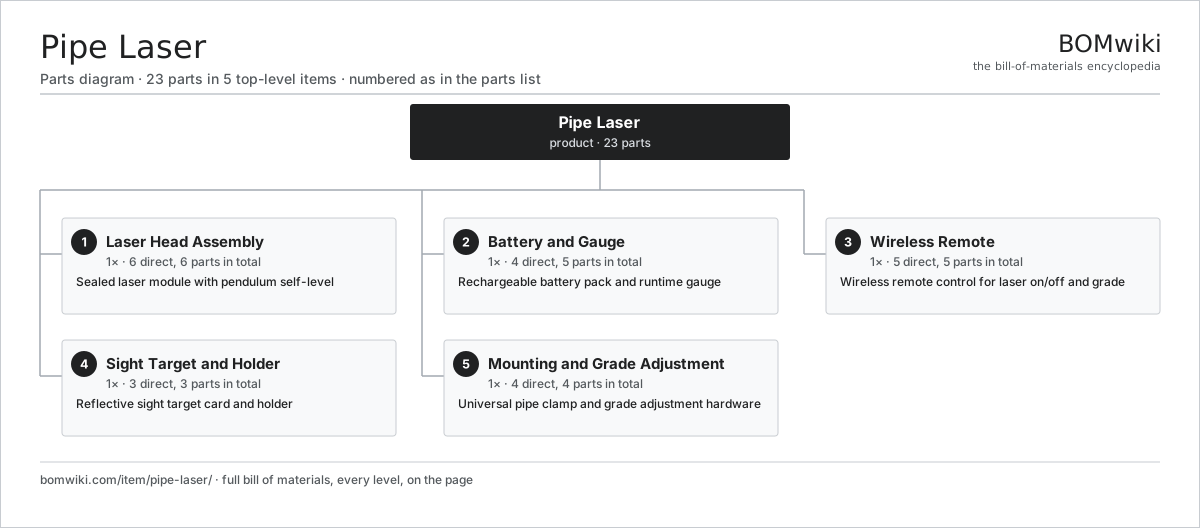
| # | Part | Qty | What it does |
|---|---|---|---|
| 1 | Laser Head Assembly 6 parts | 1× | Sealed laser module with pendulum self-level |
| 2 | Battery and Gauge 4 parts | 1× | Rechargeable battery pack and runtime gauge |
| 3 | Wireless Remote 5 parts | 1× | Wireless remote control for laser on/off and grade |
| 4 | Sight Target and Holder 3 parts | 1× | Reflective sight target card and holder |
| 5 | Mounting and Grade Adjustment 4 parts | 1× | Universal pipe clamp and grade adjustment hardware |
3D model
No 3D model yet. Have a CAD file of this? Add a 3D model. STL renders right on this page; STEP, FreeCAD, and OpenSCAD sources are welcome too (openly licensed, like all 3D models on BOMwiki).
Build & assembly graph
expand / collapse · shared sub-assemblies converge · links to related products · est. labourTap an assembly to expand/collapse · tap a part to open it · use “Open page” for any node · drag to pan, scroll to zoom.
Bill of materials for Pipe Laser
5 top-level lines · 27 rows shown · 23 parts total · indented to 3 levels| # | Item / sub-assembly | Part no. | Qty/assy | Ext. qty | Parts | Type |
|---|---|---|---|---|---|---|
| 1 | Laser Head Assembly 6 parts | pipe-laser-head | 1× | 1 | 6 | assembly |
| 1.1 | Laser Diode Module | pipe-laser-laser-diode | 1× | 1 | · | part |
| 1.2 | Optical Collimator | pipe-laser-collimator | 1× | 1 | · | part |
| 1.3 | Gravity Sensor Pendulum | pipe-laser-pendulum | 1× | 1 | · | part |
| 1.4 | Dichroic Mirror | pipe-laser-mirror | 1× | 1 | · | part |
| 1.5 | Aiming Indicator LED | pipe-laser-aiming-led | 1× | 1 | · | part |
| 1.6 | SMD Passive (R/C/L) | smd-passives | 1× | 1 | · | part |
| 2 | Battery and Gauge 4 parts | pipe-laser-battery | 1× | 1 | 5 | assembly |
| 2.1 | Li-ion Cell, 18650 | li-cell-18650 | 2× | 2 | · | part |
| 2.2 | BMS Board | bms-board | 1× | 1 | · | part |
| 2.3 | Battery Gauge LEDs | pipe-laser-fuel-gauge | 1× | 1 | · | part |
| 2.4 | Connector | connector | 1× | 1 | · | part |
| 3 | Wireless Remote 5 parts | pipe-laser-remote | 1× | 1 | 5 | assembly |
| 3.1 | 2.4 GHz Transceiver | pipe-laser-2.4ghz-module | 1× | 1 | · | part |
| 3.2 | Microcontroller | mcu | 1× | 1 | · | part |
| 3.3 | SMD Passive (R/C/L) | smd-passives | 1× | 1 | · | part |
| 3.4 | Control Buttons | pipe-laser-remote-buttons | 1× | 1 | · | part |
| 3.5 | Li-ion Cell, 18650 | li-cell-18650 | 1× | 1 | · | part |
| 4 | Sight Target and Holder 3 parts | pipe-laser-target | 1× | 1 | 3 | assembly |
| 4.1 | Target Bullseye | pipe-laser-target-card | 1× | 1 | · | part |
| 4.2 | Target Holder | pipe-laser-target-bracket | 1× | 1 | · | part |
| 4.3 | Fastener Set | fastener-set | 1× | 1 | · | part |
| 5 | Mounting and Grade Adjustment 4 parts | pipe-laser-mounts | 1× | 1 | 4 | assembly |
| 5.1 | Pipe Clamp | pipe-laser-pipe-clamp | 1× | 1 | · | part |
| 5.2 | Grade Adjustment Screw | pipe-laser-grade-screw | 1× | 1 | · | part |
| 5.3 | Coil Spring | coil-spring | 1× | 1 | · | part |
| 5.4 | Fastener Set | fastener-set | 1× | 1 | · | part |
Something wrong in this list? Report a problem with this BOM.
Related products
same domain, ranked by shared parts GNSS RTK Rover
35 parts · shares 2 with this page
GNSS RTK Rover
35 parts · shares 2 with this page
 Ground Penetrating Radar
38 parts · shares 2 with this page
Superconductor Materials Lab
1,846 parts · shares 2 with this page
Ground Penetrating Radar
38 parts · shares 2 with this page
Superconductor Materials Lab
1,846 parts · shares 2 with this page
 pH Meter
42 parts · shares 1 with this page
pH Meter
42 parts · shares 1 with this page
 Analytical Balance
54 parts · shares 1 with this page
Analytical Balance
54 parts · shares 1 with this page
Sourcing: possible vendors
Browse the supplier directory → Prices, MOQ, and lead times are algorithmic estimates, not quotes, and not claims about these companies. Company mappings are curated by keyword; est. price band $1k–$500k. How estimates work| Vendor | HQ | Specialty | MOQ | Lead time |
|---|---|---|---|---|
| thermofisher.com ↗ | Waltham, US | Lab instruments | 100 units | 10–18 wks |
|
🇺🇸Agilent
agilent.com ↗
|
Santa Clara, US | Analytical instruments | 100 units | 10–18 wks |
|
🇺🇸Bruker
bruker.com ↗
|
Billerica, US | Scientific instruments | 100 units | 10–18 wks |
|
🇯🇵Shimadzu
shimadzu.com ↗
|
Kyoto, JP | Analytical instruments | 100 units | 10–18 wks |
|
🇺🇸Waters
waters.com ↗
|
Milford, US | Chromatography & MS | 100 units | 10–18 wks |
1,139-word article