Pipe & Cable Locator
ProductOverview
A pipe locator is an electromagnetic detection device used to find buried water pipes, electrical conduits, and metal cables concealed within walls, underground, or under slabs. It operates by transmitting a radio frequency signal at 8–100 kHz that couples to a pipe via induction or direct contact, then receiving the transmitted field at a handheld detector. By moving the receiver across the ground surface or wall and listening to the audio tone, an operator can trace the pipe's path with accuracy to within ±1–2 feet of depth.
Pipe locators are essential tools for excavation planning (avoiding buried utilities), plumbing diagnostics (tracing shutoff valves or drains), electrical work (locating live and dead conduits), and utility locate operations. Professional locators carry them as standard equipment before any digging; homeowners use them to mark utility paths before fence installation or yard work.
How it works
The locator system has two components: a transmitter and a receiver.
Transmitter Phase: The transmitter unit generates a sine or square wave at a selected frequency (8, 33, 50, or 100 kHz) and amplifies it to 1–5 W of RF power. The power is fed into a loop coil (via induction) or directly connected to a pipe using alligator clip probes.
In inductive coupling mode, the transmitter loop radiates a time-varying magnetic field that induces a circulating current (eddy current) in any nearby conductive pipe. The pipe becomes a secondary radiator, re-transmitting the RF signal at the same frequency.
In direct contact mode (clipping the probe to the pipe), the transmitter drives RF current directly onto the pipe, which again acts as a radiator.
Receiver Phase: The operator carries the handheld receiver wand and sweeps it across the ground or wall surface. The wand contains dual orthogonal search coils (one horizontal, one vertical) that detect the magnetic field from the pipe.
The low-noise preamplifier boosts the tiny antenna signal (microvolts) 100–1000×. A lock-in amplifier (synchronous demodulator) extracts the transmitter signal from background noise by multiplying the received signal by a reference clock locked to the transmitter frequency.
The directional processor compares phase and amplitude from the horizontal and vertical coils to determine the pipe's bearing (left/right relative to the receiver) and the angle of approach (up/down relative to ground). The firmware drives an audio speaker that produces a tone whose frequency increases as the receiver approaches the pipe.
The LCD display simultaneously shows:
- Signal strength bar: 8–10 segments indicating proximity (full bar = directly over pipe)
- Depth estimate: Calculated from signal attenuation using a depth model built into firmware
- Current frequency: The active transmitter mode (8/33/50/100 kHz)
- Battery level: Charge percentage
Components & Design
Transmitter
The transmitter is a portable unit (roughly 6×4×2 inches) containing an 8–100 kHz oscillator, a RF amplifier, and a magnetic coupling coil. The oscillator is a function generator allowing frequency selection via a pushbutton or rotary switch. The amplifier is typically Class D (switching mode) for efficiency, outputting up to 5 W peak power.
Frequencies are chosen to maximize detection range while avoiding utility line interference:
- 8 kHz: Deepest penetration (~20 feet), but slowest response. Used for deep buried cable locates.
- 33 kHz: Good balance for 8–15 foot depths. Standard utility locate frequency.
- 50 kHz: For shallower pipes (3–8 feet). Sharper directional null than lower frequencies.
- 100 kHz: Highest frequency, used for very shallow pipes (<3 feet) in walls.
The inductive loop is typically 6–12 inches in diameter, wound around a ferrite core for impedance matching. It radiates a dipole-like field pattern that couples efficiently to vertical pipes and cables.
Receiver Wand
The receiver is a handheld probe (8–10 inches long, 2 inches diameter) containing two search coils: one horizontal (detects vertical pipes) and one vertical (detects horizontal pipes). The coils are tuned via LC resonance to the transmitter frequency for maximum signal-to-noise ratio.
The preamplifier is a low-noise op-amp circuit (e.g., OPA128 or LT1028) providing 40–60 dB of gain before the lock-in stage. The lock-in amplifier (a phase-sensitive detector) multiplies the received signal by a reference clock derived from the microcontroller, extracting only energy at the transmitter frequency and rejecting noise at other frequencies. This technique allows detection of signals buried 40–60 dB below the noise floor.
The directional processor continuously compares the phase and magnitude from the horizontal and vertical coils. If the horizontal coil signal is strongest, the pipe is directly below. If the signal is strongest on one side of the wand, the operator is to the left or right of the pipe centerline. The firmware guides the operator toward the pipe via audio feedback and LED bar.
Depth Estimation
Pipe depth is estimated by measuring signal attenuation as the pipe is approached. The received signal strength decays inversely with distance cubed (3 dB per octave in distance). By comparing the received signal at two positions (e.g., directly over the pipe vs. 10 feet away), the depth processor solves for burial depth using an empirical attenuation model.
Depth accuracy is ±1–2 feet because the model depends on pipe material and soil conductivity, which vary. Metallic pipes (copper, steel) are easiest to locate and provide the most accurate depth. PVC and concrete pipes are harder to locate (they must be "live" with conductive water or wrapped with a tracer wire). Wet soil increases coupling; dry sandy soil decreases it.
Battery & Display
The rechargeable li-ion battery (7.4–12V, 2–3 Ah) powers both transmitter and receiver for 8–12 hours typical use. The battery includes a management system protecting against over-charge and thermal runaway. A micro-USB port allows charging from any standard USB power adapter (2–4 hours full charge).
The LCD display on the receiver shows real-time signal information. The LED bar graph (8–10 segments) provides visual feedback; the speaker tone audibly increases in frequency as the operator approaches the pipe. The combination of audio + visual feedback allows intuitive locating even in noisy environments.
Operating Frequencies & Applications
8 kHz (Very Low Frequency - VLF)
- Deepest penetration for underground locate (15–20 feet possible)
- Best for utility cable locates in soil
- Slowest response, coarse directional null
33 kHz (Standard Utility Frequency)
- 8–15 foot depth capability
- Adopted by USDA and utility locate industry as standard
- Good response time and directional resolution
50 kHz (Medium Frequency)
- 3–8 foot depth
- Used for shallow water mains and house branch lines
- Sharper directional null than 33 kHz
100 kHz (High Frequency)
- <3 feet depth
- Used in walls and above-slab locates
- Maximum directional accuracy, but attenuates quickly in soil
Installation & Locating Procedure
Transmitter Setup: Place the transmitter directly over (inductive coupling) or clipped to the pipe using direct contact probes. Turn on the transmitter; the green LED should illuminate.
Frequency Selection: Start at 33 kHz (standard). If the pipe is very deep (>15 feet), try 8 kHz. For shallow pipes (<3 feet), try 50 or 100 kHz.
Gain Adjustment: Hold the receiver 10 feet from the transmitter. Adjust gain until the audio tone is audible but not saturated (not continuously loud).
Locating Walk: Walk perpendicular to the suspected pipe direction, listening to the tone and watching the LCD signal strength bar. The tone increases as you approach the pipe center.
Marking: When the signal is strongest and the LCD shows maximum strength and depth estimate, mark the ground with chalk or tape.
Depth Verification: The LCD depth readout provides an estimate. Verification requires careful calibration or reference to known depth points (e.g., nearby floor penetrations).
Tracing the Path: Continue walking to find the next peak, then the next, tracing the pipe path across a large area.
Limitations & Error Sources
Factors Reducing Detection
- Non-metallic pipes: PVC, clay, concrete pipes do not conduct RF well. They must be wrapped with a "tracer wire" (thin copper wire alongside the pipe) for locating.
- Dry soil or sand: Low electrical conductivity reduces signal coupling. Results improve after rain.
- Multiple parallel utilities: If pipes run side-by-side, the locator may lock onto the wrong one.
- Shallow depth + high frequency: At 100 kHz, detection beyond 2–3 feet is difficult.
- Human error: Operators new to locating often position the wand incorrectly (not directly above the pipe) or select the wrong frequency.
Depth Accuracy
The depth estimate is empirical and can be ±2–3 feet in error, especially in conductive soil. Professional locators use this as a guideline, not a guarantee. Actual depth must be verified by excavation or inspection.
Interference
Nearby electrical transmission lines (50/60 Hz power) can couple noise into the receiver. Most locators include bandpass filtering around the transmitter frequency, but in electrically noisy areas (near substations, power poles), results may degrade.
Standards & Professional Practice
The USDA One-Call System (www.call811.com) requires utility locates before any excavation. Professional locators follow the ANSI/ACPA C-800-16 standard, which specifies the 33 kHz frequency as the industry standard for public utility locates. Color-coded markings indicate utility type: red (electrical), yellow (gas), blue (water), green (sewer), white (proposed excavation).
Many states require private utilities (septic, well, irrigation) to also be located and marked before excavation. Some municipalities mandate professional locating services for all digging projects; others allow homeowner DIY locating if the homeowner accepts liability for missed utilities.
Insurance and liability are major concerns: striking a buried electrical cable or gas line during excavation can be fatal. Most homeowner insurance does not cover damage from struck utilities; the liability falls on the person conducting the excavation. Professional locator services cost $75–250 depending on property size but are mandatory in many jurisdictions.
Pipe & Cable Locator parts and their functions
7 top-level parts · 48 parts in total · full bill of materials below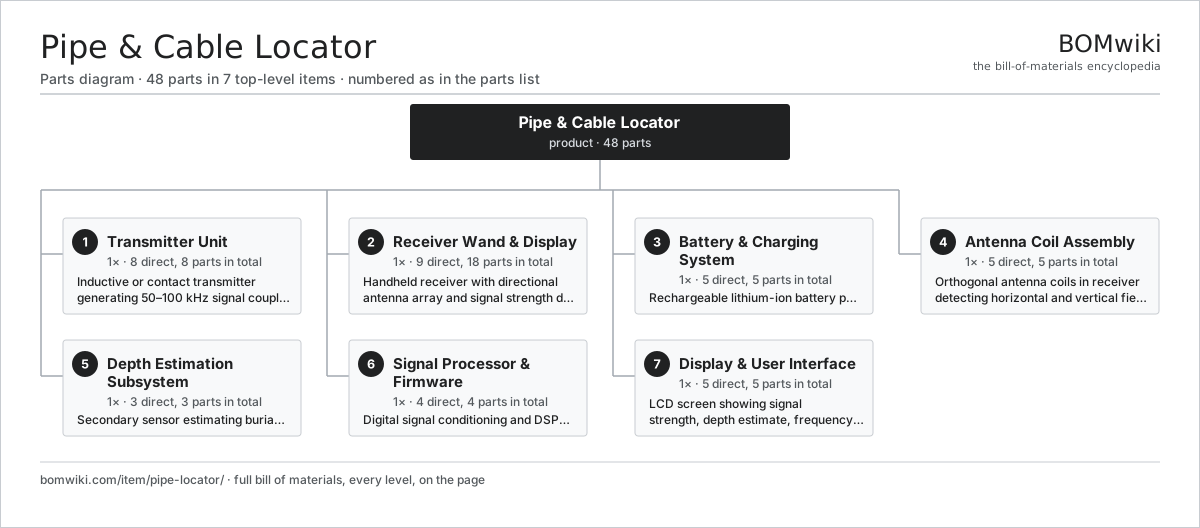
| # | Part | Qty | What it does |
|---|---|---|---|
| 1 | Transmitter Unit 8 parts | 1× | Inductive or contact transmitter generating 50–100 kHz signal coupled to pipes/cables |
| 2 | Receiver Wand & Display 9 parts | 1× | Handheld receiver with directional antenna array and signal strength display |
| 3 | Battery & Charging System 5 parts | 1× | Rechargeable lithium-ion battery powering transmitter and receiver 8–12 hours |
| 4 | Antenna Coil Assembly 5 parts | 1× | Orthogonal antenna coils in receiver detecting horizontal and vertical field components |
| 5 | Depth Estimation Subsystem 3 parts | 1× | Secondary sensor estimating burial depth based on signal strength attenuation |
| 6 | Signal Processor & Firmware 4 parts | 1× | Digital signal conditioning and DSP for frequency discrimination and noise filtering |
| 7 | Display & User Interface 5 parts | 1× | LCD screen showing signal strength, depth estimate, frequency mode, and battery level |
3D model
No 3D model yet. Have a CAD file of this? Add a 3D model. STL renders right on this page; STEP, FreeCAD, and OpenSCAD sources are welcome too (openly licensed, like all 3D models on BOMwiki).
Build & assembly graph
expand / collapse · shared sub-assemblies converge · links to related products · est. labourTap an assembly to expand/collapse · tap a part to open it · use “Open page” for any node · drag to pan, scroll to zoom.
Bill of materials for Pipe & Cable Locator
7 top-level lines · 51 rows shown · 48 parts total · indented to 3 levels| # | Item / sub-assembly | Part no. | Qty/assy | Ext. qty | Parts | Type |
|---|---|---|---|---|---|---|
| 1 | Transmitter Unit 8 parts | pipe-locator-transmitter | 1× | 1 | 8 | assembly |
| 1.1 | Transmitter Housing | pipe-locator-transmitter-chassis | 1× | 1 | · | part |
| 1.2 | 8–100 kHz Oscillator | pipe-locator-oscillator | 1× | 1 | · | part |
| 1.3 | RF Power Amplifier | pipe-locator-power-amplifier | 1× | 1 | · | part |
| 1.4 | Transmitter Loop Coil | pipe-locator-transmitter-coil | 1× | 1 | · | part |
| 1.5 | Frequency Selection Switch | pipe-locator-frequency-selector | 1× | 1 | · | part |
| 1.6 | Direct Connect Probe | pipe-locator-direct-connect-probe | 1× | 1 | · | part |
| 1.7 | Transmitter Battery | pipe-locator-power-battery | 1× | 1 | · | part |
| 1.8 | Transmitter LED | pipe-locator-led-indicator | 1× | 1 | · | part |
| 2 | Receiver Wand & Display 9 parts | pipe-locator-receiver-wand | 1× | 1 | 18 | assembly |
| 2.1 | Receiver Grip Handle | pipe-locator-receiver-handle | 1× | 1 | · | part |
| 2.2 | Antenna Coil Assembly 5 parts | pipe-locator-antenna-coils | 2× | 2 | 5 | assembly |
| 2.2.1 | Horizontal Search Coil | pipe-locator-horizontal-coil | 1× | 2 | · | part |
| 2.2.2 | Vertical Search Coil | pipe-locator-vertical-coil | 1× | 2 | · | part |
| 2.2.3 | Coil Former Bobbin | pipe-locator-coil-former | 1× | 2 | · | part |
| 2.2.4 | Resonator Capacitor | pipe-locator-coil-resonator | 1× | 2 | · | part |
| 2.2.5 | Coil Shielding Can | pipe-locator-shielding-can | 1× | 2 | · | part |
| 2.3 | Preamplifier | pipe-locator-receiver-preamp | 1× | 1 | · | part |
| 2.4 | Lock-In Demodulator | pipe-locator-lock-in-amplifier | 1× | 1 | · | part |
| 2.5 | Directional Signal Processor | pipe-locator-directional-processor | 1× | 1 | · | part |
| 2.6 | Depth Estimation Calculator | pipe-locator-depth-calculator | 1× | 1 | · | part |
| 2.7 | LCD Display Panel | pipe-locator-display-lcd | 1× | 1 | · | part |
| 2.8 | Audible Tone Speaker | pipe-locator-speaker-buzzer | 1× | 1 | · | part |
| 2.9 | Gain Control Potentiometer | pipe-locator-gain-adjustment | 1× | 1 | · | part |
| 3 | Battery & Charging System 5 parts | pipe-locator-battery-pack | 1× | 1 | 5 | assembly |
| 3.1 | Li-Ion Battery Cell | pipe-locator-li-ion-cell | 1× | 1 | · | part |
| 3.2 | Battery Management System | pipe-locator-battery-bms | 1× | 1 | · | part |
| 3.3 | Charging Port | pipe-locator-charging-connector | 1× | 1 | · | part |
| 3.4 | Voltage Monitor Chip | pipe-locator-battery-monitor | 1× | 1 | · | part |
| 3.5 | PTC Fuse | pipe-locator-fuse-protection | 1× | 1 | · | part |
| 4 | Antenna Coil Assembly 5 parts | pipe-locator-antenna-coils | 1× | 1 | 5 | assembly |
| 4.1 | Horizontal Search Coil | pipe-locator-horizontal-coil | 1× | 1 | · | part |
| 4.2 | Vertical Search Coil | pipe-locator-vertical-coil | 1× | 1 | · | part |
| 4.3 | Coil Former Bobbin | pipe-locator-coil-former | 1× | 1 | · | part |
| 4.4 | Resonator Capacitor | pipe-locator-coil-resonator | 1× | 1 | · | part |
| 4.5 | Coil Shielding Can | pipe-locator-shielding-can | 1× | 1 | · | part |
| 5 | Depth Estimation Subsystem 3 parts | pipe-locator-depth-sensor | 1× | 1 | 3 | assembly |
| 5.1 | Depth Reference Coil | pipe-locator-depth-reference-coil | 1× | 1 | · | part |
| 5.2 | Logarithmic Amplifier | pipe-locator-attenuation-log-amp | 1× | 1 | · | part |
| 5.3 | Depth Lookup Firmware | pipe-locator-depth-lookup-table | 1× | 1 | · | part |
| 6 | Signal Processor & Firmware 4 parts | pipe-locator-signal-processor | 1× | 1 | 4 | assembly |
| 6.1 | Microcontroller CPU | pipe-locator-cpu | 1× | 1 | · | part |
| 6.2 | Analog Converter Chip | pipe-locator-adc-dac | 1× | 1 | · | part |
| 6.3 | DSP Firmware Library | pipe-locator-dsp-library | 1× | 1 | · | part |
| 6.4 | Calibration Data ROM | pipe-locator-calibration-rom | 1× | 1 | · | part |
| 7 | Display & User Interface 5 parts | pipe-locator-display-module | 1× | 1 | 5 | assembly |
| 7.1 | LCD Display | pipe-locator-lcd-panel | 1× | 1 | · | part |
| 7.2 | Signal Strength Indicator | pipe-locator-signal-strength-bar | 1× | 1 | · | part |
| 7.3 | Frequency Select Button | pipe-locator-frequency-select-button | 1× | 1 | · | part |
| 7.4 | Gain Adjustment Potentiometer | pipe-locator-gain-adjustment-dial | 1× | 1 | · | part |
| 7.5 | Volume Control Slider | pipe-locator-audio-volume-control | 1× | 1 | · | part |
Something wrong in this list? Report a problem with this BOM.
Sourcing: possible vendors
Browse the supplier directory → Prices, MOQ, and lead times are algorithmic estimates, not quotes, and not claims about these companies. Company mappings are curated by keyword; est. price band $20–$3k. How estimates work| Vendor | HQ | Specialty | MOQ | Lead time |
|---|---|---|---|---|
|
🇺🇸Kohler
kohler.com ↗
|
Kohler, US | Plumbing fixtures | 1,000 units | 6–12 wks |
|
🇯🇵TOTO
toto.com ↗
|
Kitakyushu, JP | Sanitaryware | 1,000 units | 6–12 wks |
|
🇯🇵LIXIL
lixil.com ↗
|
Tokyo, JP | Plumbing (Grohe, American Std) | 1,000 units | 6–12 wks |
|
🇺🇸Moen
moen.com ↗
|
North Olmsted, US | Faucets & fixtures | 1,000 units | 6–12 wks |
|
🇨🇭Geberit
geberit.com ↗
|
Rapperswil, CH | Sanitary systems | 1,000 units | 6–12 wks |
1,773-word article