Plansifter
ProductOverview
The plansifter is a high-capacity gyratory sieve used throughout the grain and flour milling industry to classify mill streams into uniform size fractions. Unlike simple single-deck static sieves, a plansifter uses multiple stacked decks, each with a different mesh size, in a machine that oscillates in a controlled elliptical pattern. This motion keeps fines flowing across mesh surfaces and prevents bridging or blinding (clogging) that would reduce efficiency.
The plansifter is indispensable for separating flour into distinct grades (e.g., patent flour, clear flour, shorts, bran) following a Flour Roller Mill break and reduction sequence. The machine excels at handling products with varying moisture and density, automatically classifying them without operator intervention or manual screening.
How it works
Raw mill product (flour or middlings) enters the Stacked Sieve Box Assembly through a hopper onto the top Top Sieve Frame, which typically holds a coarse mesh (60–100 mesh for flour). The gyratory motion, generated by the Eccentric Drive Shaft rotating inside the Gyratory Drive Unit, imparts an elliptical or circular orbit to the entire sieve stack at 300–500 rpm.
As the sieve bounces and orbits, material on the top mesh is continuously thrown upward and forward. Fine particles (those passing through 60 mesh) fall through the mesh, while coarser particles roll across the deck and drop off the end toward a Discharge Material Chute.
The undersize from the top deck cascades onto the Middle Sieve Frame, which holds a finer mesh (e.g., 100–140 mesh). This repeat of the process separates another size fraction. Multiple decks (typically three to five) each remove a size grade, with the finest material (passing the bottom deck) collecting as the ultimate undersize fraction.
The Suspension and Isolation System uses Suspension Coil Spring elements at the four corners to suspend the sieve stack. These springs allow the Eccentric Drive Shaft crank arm to drive the stack in its gyratory motion while isolating vibration from the supporting Supporting Steel Frame.
Mesh selection and grading
Mesh sizes are chosen to separate flour into commercial grades:
- Coarse mesh (40–60): Removes bran and large middlings
- Medium mesh (100–140): Separates flour from fine shorts
- Fine mesh (150–200): Separates premium patent flour from bread flour
The number of decks and mesh selections determine how many product grades the machine yields. A four-deck plansifter might produce five saleable products (four through undersize each deck, plus one oversize).
Vibration and isolation
The Vibration Damper mounted in the suspension limits oscillation amplitude after the motor stops, improving operator safety and reducing shock loads to the frame. The Vibration Isolation Foot under the machine prevent vibration from radiating to the mill floor and affecting other equipment.
The Vibration Transducer continuously monitors sieve motion and can trigger alarms if amplitude exceeds limits, indicating mesh clogging or motor issues.
Mesh life and maintenance
Woven Mesh Screen screens experience wear from abrasion and impact as products slide across them. Mesh life depends on product hardness, moisture, and mesh material; stainless steel lasts longer than brass but is more expensive. Typical replacement intervals are 500–2000 tons of throughput.
When a mesh becomes partially blind (clogged with fine particles), grading efficiency falls dramatically. Regular cleaning, sometimes with brushes or low-pressure air during operation, can extend mesh life. Gaskets (Chute Connection Gasket) must also be inspected and replaced to prevent product bypass, which ruins grading accuracy.
Motor control and operation
Modern plansifters use variable-frequency drives (VFDs) to adjust gyratory speed, allowing operators to fine-tune separation by changing orbit frequency. Lower speeds suit delicate products, while higher speeds increase throughput for robust materials.
The Control and Vibration Monitoring PLC can trigger automatic shutdowns if vibration exceeds safe levels or if product level sensors indicate overflow, preventing spillage and maintaining consistent product grades.
Throughput and product quality
A typical flour plansifter handling 20 ton/h of mill product separates it into four distinct fractions within 30–60 seconds total residence time. The machine's ability to handle variable input (moisture, density) and still maintain grading accuracy (>95% of each size fraction falls within the target mesh range) makes it far superior to manual or batch sieving.
High-quality flour mills often use two plansifters in series: one for primary grading and a second for regrading shorts or intermediate fractions to improve overall extraction rate.
Plansifter parts and their functions
8 top-level parts · 94 parts in total · full bill of materials below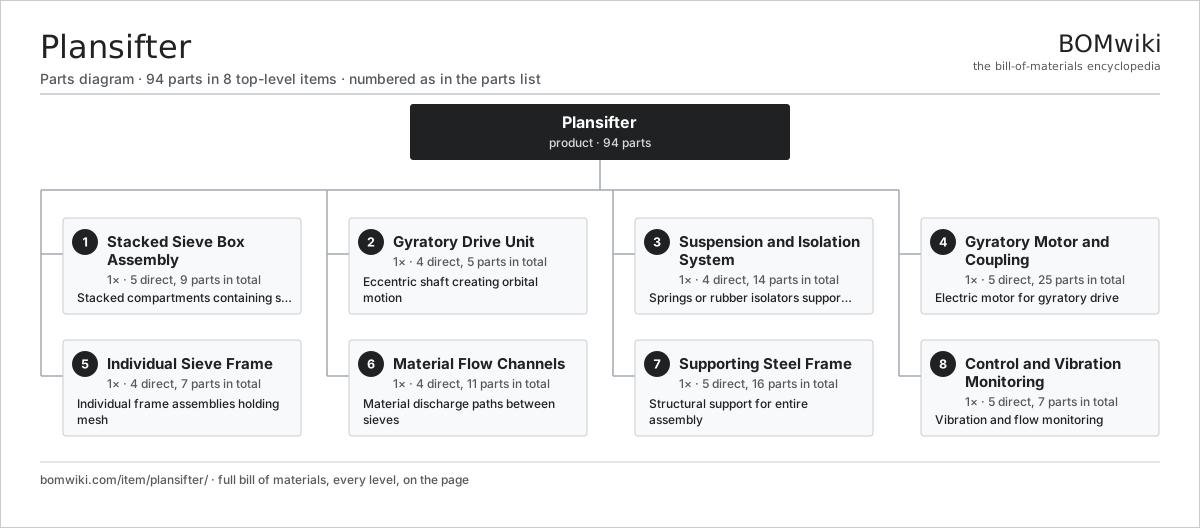
| # | Part | Qty | What it does |
|---|---|---|---|
| 1 | Stacked Sieve Box Assembly 5 parts | 1× | Stacked compartments containing sieves |
| 2 | Gyratory Drive Unit 4 parts | 1× | Eccentric shaft creating orbital motion |
| 3 | Suspension and Isolation System 4 parts | 1× | Springs or rubber isolators supporting sieves |
| 4 | Gyratory Motor and Coupling 5 parts | 1× | Electric motor for gyratory drive |
| 5 | Individual Sieve Frame 4 parts | 1× | Individual frame assemblies holding mesh |
| 6 | Material Flow Channels 4 parts | 1× | Material discharge paths between sieves |
| 7 | Supporting Steel Frame 5 parts | 1× | Structural support for entire assembly |
| 8 | Control and Vibration Monitoring 5 parts | 1× | Vibration and flow monitoring |
3D model
No 3D model yet. Have a CAD file of this? Add a 3D model. STL renders right on this page; STEP, FreeCAD, and OpenSCAD sources are welcome too (openly licensed, like all 3D models on BOMwiki).
Build & assembly graph
expand / collapse · shared sub-assemblies converge · links to related products · est. labourTap an assembly to expand/collapse · tap a part to open it · use “Open page” for any node · drag to pan, scroll to zoom.
Bill of materials for Plansifter
8 top-level lines · 51 rows shown · 94 parts total · indented to 3 levels| # | Item / sub-assembly | Part no. | Qty/assy | Ext. qty | Parts | Type |
|---|---|---|---|---|---|---|
| 1 | Stacked Sieve Box Assembly 5 parts | plansifter-sieve-boxes | 1× | 1 | 9 | assembly |
| 1.1 | Top Sieve Frame | plansifter-sieve-frame-1 | 1× | 1 | · | part |
| 1.2 | Middle Sieve Frame | plansifter-sieve-frame-2 | 1× | 1 | · | part |
| 1.3 | Bottom Sieve Frame | plansifter-sieve-frame-3 | 1× | 1 | · | part |
| 1.4 | Sieve Mesh Screen | plansifter-mesh-panel | 3× | 3 | · | part |
| 1.5 | Deck Gasket Seal | plansifter-deck-seals | 3× | 3 | · | part |
| 2 | Gyratory Drive Unit 4 parts | plansifter-gyrating-drive | 1× | 1 | 5 | assembly |
| 2.1 | Eccentric Drive Shaft | plansifter-eccentric-shaft | 1× | 1 | · | part |
| 2.2 | Drive Shaft Bearing | plansifter-drive-bearing | 2× | 2 | · | part |
| 2.3 | Inertia Balance Weight | plansifter-counterweight | 1× | 1 | · | part |
| 2.4 | Drive Crank Arm | plansifter-crank-arm | 1× | 1 | · | part |
| 3 | Suspension and Isolation System 4 parts | plansifter-flexible-suspension | 1× | 1 | 14 | assembly |
| 3.1 | Suspension Coil Spring | plansifter-suspension-spring | 4× | 4 | · | part |
| 3.2 | Spring Bushing Element | plansifter-spring-bushing | 4× | 4 | · | part |
| 3.3 | Spring Mounting Bracket | plansifter-suspension-bracket | 4× | 4 | · | part |
| 3.4 | Vibration Damper | plansifter-damping-element | 2× | 2 | · | part |
| 4 | Gyratory Motor and Coupling 5 parts | plansifter-drive-motor | 1× | 1 | 25 | assembly |
| 4.1 | Motor Housing | motor-housing | 1× | 1 | · | part |
| 4.2 | Rotor Assembly 4 parts | rotor-assembly | 1× | 1 | 19 | assembly |
| 4.2.1 | Rotor Shaft | rotor-shaft | 1× | 1 | · | part |
| 4.2.2 | Rotor Core | rotor-core | 1× | 1 | · | part |
| 4.2.3 | Neodymium Magnet | neodymium-magnet | 16× | 16 | · | part |
| 4.2.4 | Ball Bearing | ball-bearing | 1× | 1 | · | part |
| 4.3 | Stator Assembly 3 parts | stator-assembly | 1× | 1 | 3 | assembly |
| 4.3.1 | Stator Core (laminations) | stator-core | 1× | 1 | · | part |
| 4.3.2 | Copper Winding | copper-winding | 1× | 1 | · | part |
| 4.3.3 | Slot Insulation | stator-insulation | 1× | 1 | · | part |
| 4.4 | Motor Coupling | plansifter-coupling | 1× | 1 | · | part |
| 4.5 | Connector | connector | 1× | 1 | · | part |
| 5 | Individual Sieve Frame 4 parts | plansifter-sieve-frames | 1× | 1 | 7 | assembly |
| 5.1 | Frame Perimeter Tube | plansifter-frame-perimeter | 1× | 1 | · | part |
| 5.2 | Woven Mesh Screen | plansifter-sieve-mesh | 1× | 1 | · | part |
| 5.3 | Mesh Tension Device | plansifter-mesh-tensioner | 4× | 4 | · | part |
| 5.4 | Fastener Set | fastener-set | 1× | 1 | · | part |
| 6 | Material Flow Channels 4 parts | plansifter-channels | 1× | 1 | 11 | assembly |
| 6.1 | Internal Baffle Plate | plansifter-baffle-plate | 4× | 4 | · | part |
| 6.2 | Discharge Material Chute | plansifter-discharge-chute | 3× | 3 | · | part |
| 6.3 | Chute Connection Gasket | plansifter-chute-seal | 3× | 3 | · | part |
| 6.4 | Fastener Set | fastener-set | 1× | 1 | · | part |
| 7 | Supporting Steel Frame 5 parts | plansifter-frame | 1× | 1 | 16 | assembly |
| 7.1 | Base Frame Plate | plansifter-base-frame | 1× | 1 | · | part |
| 7.2 | Support Post | plansifter-vertical-posts | 4× | 4 | · | part |
| 7.3 | Cross-Bracing Member | plansifter-cross-braces | 6× | 6 | · | part |
| 7.4 | Vibration Isolation Foot | plansifter-vibration-feet | 4× | 4 | · | part |
| 7.5 | Fastener Set | fastener-set | 1× | 1 | · | part |
| 8 | Control and Vibration Monitoring 5 parts | plansifter-control-panel | 1× | 1 | 7 | assembly |
| 8.1 | Microcontroller | mcu | 1× | 1 | · | part |
| 8.2 | Vibration Transducer | plansifter-vibration-sensor | 1× | 1 | · | part |
| 8.3 | Material Level Detector | plansifter-product-level-sensor | 2× | 2 | · | part |
| 8.4 | Relay | relay | 2× | 2 | · | part |
| 8.5 | Power Supply | power-supply | 1× | 1 | · | part |
Something wrong in this list? Report a problem with this BOM.
Related products
same domain, ranked by shared parts Bottle Washing Machine
2,388 parts · shares 12 with this page
Brine Chilling System
239 parts · shares 12 with this page
Bottle Washing Machine
2,388 parts · shares 12 with this page
Brine Chilling System
239 parts · shares 12 with this page
 Candy Cane Machine
258 parts · shares 12 with this page
Candy Slab Cutter
84 parts · shares 12 with this page
Candy Cane Machine
258 parts · shares 12 with this page
Candy Slab Cutter
84 parts · shares 12 with this page
Sourcing: possible vendors
Browse the supplier directory → Prices, MOQ, and lead times are algorithmic estimates, not quotes, and not claims about these companies. Company mappings are curated by keyword; est. price band $1k–$500k. How estimates work| Vendor | HQ | Specialty | MOQ | Lead time |
|---|---|---|---|---|
| gea.com ↗ | Düsseldorf, DE | Process technology | 20 units | 12–20 wks |
| buhlergroup.com ↗ | Uzwil, CH | Food & materials processing | 20 units | 12–20 wks |
| tetrapak.com ↗ | Pully, CH | Food packaging & processing | 20 units | 12–20 wks |
| jbtc.com ↗ | Chicago, US | Food processing equipment | 20 units | 12–20 wks |
| alfalaval.com ↗ | Lund, SE | Heat transfer & separation | 20 units | 12–20 wks |
724-word article