Pneumatic Resistance Machine
ProductOverview
A pneumatic resistance machine uses pressurized air in cylinders to create smooth, load-independent resistance. Unlike weights or magnetic brakes, where resistance is constant or varies with speed, air resistance depends on compressibility and flow rate: heavier loads or faster movement both increase resistance. The advantage is comfort: there is no sudden "lock out" or jar at the end of a motion, because the cylinder naturally cushions deceleration. The user feels smooth, progressive loading throughout the range of motion, mimicking the feeling of pushing through viscous fluid.
Typical machines have one or two Air Cylinder Pair connected to a lever arm or platform. A 136 kg user pressing a leg-press lever or moving an arm handle induces the cylinder piston to extend, displacing air. That air is sourced from a Compressor and Pressure Regulation onboard the machine: a Air Compressor pumps air into a Pressure Accumulator Tank at 6–10 bar, and a Pressure Regulator lets the user dial down the working pressure to 2–10 bar, directly controlling resistance.
Pneumatic cylinders and resistance mechanism
Each Cylinder Barrel is a sealed steel tube with a Piston Rod piston rod extending outward. One end of the rod is capped with a connection fitting that mounts to the machine lever or linkage. The cylinder barrel is anchored to the machine frame. When the user moves the lever, the rod either extends (pushing air out of the cylinder) or retracts (drawing air back in).
The magic is in the throttling: air flow through the cylinder is not free. A End Cushion is a metering orifice near the end of the cylinder that restricts flow, particularly on the rod-side (the small-diameter end). As the piston moves fast, it wants to displace a large volume of air quickly, but the cushion orifice limits flow. This creates back-pressure and resisting force. A faster movement demands higher pressure to achieve the same flow, so the user feels resistance that increases with speed.
The Rod Seal (usually polyurethane) prevents air leakage. It experiences continuous wear as the rod slides through it, especially in high-use commercial settings. Seals typically last 2–5 years before internal leakage becomes noticeable (the machine requiring longer compressor run times to maintain pressure).
Pressure regulation and load control
The Pressure Regulator is a spring-loaded valve that maintains a constant downstream pressure. If the user selects 5 bar, the regulator holds the supply to the cylinders at 5 bar regardless of demand. The Solenoid Valve is an electronically-controlled valve that can switch pressure on and off or meter it dynamically based on the Control Board.
A Digital Pressure Gauge (digital or mechanical) shows the current setting. Some machines allow the user to change pressure between reps by turning a knob or pushing buttons; others fix it at the start of a set.
The relationship between pressure and effort is not linear: doubling the pressure roughly doubles the resistance, but the sensation is more subtle because the user also becomes fatigued and slows, which reduces the speed-dependent component of resistance. This non-linear feel is often cited as an advantage: it is forgiving to beginners (high pressure is needed to create any resistance, so light loads feel light) and engaging to advanced users (precise pressure adjustments yield perceptible load changes).
Compressor and air supply
The Air Compressor is a piston compressor (small reciprocating piston driven by an electric motor) or, in some designs, a rotary-screw compressor. A typical commercial machine uses a 0.5–1.0 kW motor to run a compressor that builds pressure from 0 to 10 bar in 60–120 seconds. Once the Pressure Accumulator Tank is pressurized, a pressure-switch maintains it by running the compressor briefly every 5–10 minutes during use.
The Air Filter Dryer cartridge is essential: compressed air is humid and can corrode the internal cylinder surfaces if not dried. The dryer uses silica gel or a desiccant to absorb moisture, and a particulate filter traps dust that would jam the seals.
The compressor is audible, generating 70–80 dB of noise during pressurization. In a busy gym, this is noticeable but not disruptive.
User experience and motion feel
The sensation of pneumatic resistance is uniquely smooth. There is no sticking or binding at the start of motion like some friction machines, and no jarring lockout like a weight machine stopping against the frame. Instead, resistance builds gradually as speed increases. For example, a leg press on a pneumatic machine at 5 bar feels light and easy for the first 50 mm of movement, then progressively harder as the user pushes faster or accelerates. A very slow, controlled press requires minimal force; a fast, explosive press requires much more.
This property makes pneumatic machines favored for rehabilitation and for athletes training movement speed. A user can perform the same exercise at multiple intensity levels just by changing their movement speed, without changing the machine setup. A deconditioned person performs slow, controlled reps against light air resistance; an athlete performs explosive reps and feels higher load.
Seat and positioning
The Seat and Adjustment Assembly is adjustable fore and aft on a Seat Adjustment Track, with a Seat Lock Pin lock at discrete 50–100 mm intervals. The Seat Cushion Pad and Seat Back Support are foam-padded vinyl, contoured for comfort during loaded repetitions.
Correct positioning is critical. If the Seat Pan is too far forward, the user's knees extend beyond toes and shear forces increase; too far back, and the user will tend to lean forward, loading the back undesirably. Most machines have a sizing guide, e.g., "when your knee is bent 90°, your knee should be directly above your ankle", printed on the machine.
Mechanical linkage and motion transfer
The Movement Lever and Linkage is the handle or foot platform the user contacts. A leg press machine has a large platform; an arm machine has a grip or handle. The lever is mounted on a Pivot Bearing, often a rod end bearing or sealed spherical bearing rated for high shock loads (a user pushing explosively places brief peak loads on the bearing).
A Connecting Rod (or multiple rods) connect the lever to the cylinder rod. This linkage can be one-to-one (lever moves 300 mm, rod extends 300 mm) or geared (lever moves 300 mm, rod extends 150 mm), changing the mechanical advantage. A longer lever with shorter rod extension provides greater mechanical advantage at the handle (easier to move, but the cylinder must generate higher pressure to resist the same effort).
Reliability and maintenance
Pneumatic machines are mechanically robust. Seals are the main wear item. A Rod Seal will develop internal leakage after heavy use, evidenced by longer compressor run times. Replacement requires removing the cylinder cap and swapping the seal, a field-serviceable task costing $20–100 in parts and labor.
The Air Compressor itself rarely fails; the motor and pump are simple and overbuilt. If a machine "won't hold pressure," the problem is usually a leaky seal or a crack in the air tank, not the compressor.
The Pressure Accumulator Tank can rust internally if moisture is not managed. Draining the tank monthly (a small drain plug at the base) prevents this and extends tank life to 10+ years.
Electronic components are minimal: the Control Board is often not present on simple machines, which use only a mechanical regulator. Machines with digital displays and adjustable solenoid valves are more susceptible to electrical failures, though the circuitry is usually simple (24V DC logic, no high-power switching).
Downsides and use limitations
Pneumatic machines cannot easily produce extremely high loads. At 10 bar with a 40 mm cylinder, the force available is roughly 1250 N (125 kg push equivalent) on a single cylinder. For serious strength training, a barbell or plate-loaded machine is more practical.
The compressor run time and noise are minor drawbacks in some settings. A machine left idle for weeks may develop rust inside the air tank, requiring a brief pressurization cycle to "dry it out" before use.
Regulations differ by region; some jurisdictions classify pneumatic machines as pressure vessels and require annual inspection, adding to maintenance cost.
Pneumatic Resistance Machine parts and their functions
7 top-level parts · 52 parts in total · full bill of materials below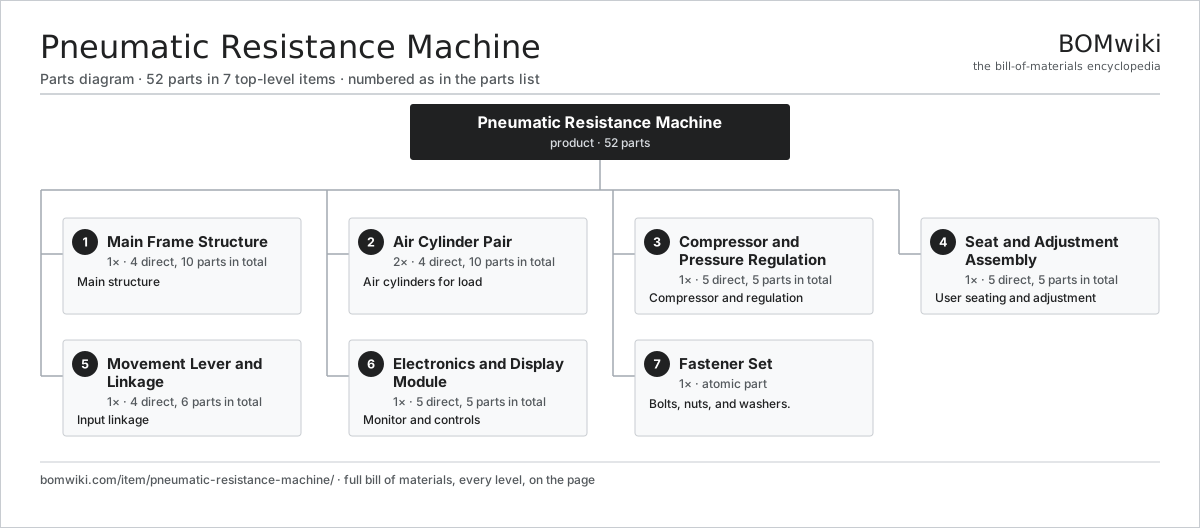
| # | Part | Qty | What it does |
|---|---|---|---|
| 1 | Main Frame Structure 4 parts | 1× | Main structure |
| 2 | Air Cylinder Pair 4 parts | 2× | Air cylinders for load |
| 3 | Compressor and Pressure Regulation 5 parts | 1× | Compressor and regulation |
| 4 | Seat and Adjustment Assembly 5 parts | 1× | User seating and adjustment |
| 5 | Movement Lever and Linkage 4 parts | 1× | Input linkage |
| 6 | Electronics and Display Module 5 parts | 1× | Monitor and controls |
| 7 | Fastener Set | 1× | Bolts, nuts, and washers. |
3D model
No 3D model yet. Have a CAD file of this? Add a 3D model. STL renders right on this page; STEP, FreeCAD, and OpenSCAD sources are welcome too (openly licensed, like all 3D models on BOMwiki).
Build & assembly graph
expand / collapse · shared sub-assemblies converge · links to related products · est. labourTap an assembly to expand/collapse · tap a part to open it · use “Open page” for any node · drag to pan, scroll to zoom.
Bill of materials for Pneumatic Resistance Machine
7 top-level lines · 34 rows shown · 52 parts total · indented to 3 levels| # | Item / sub-assembly | Part no. | Qty/assy | Ext. qty | Parts | Type |
|---|---|---|---|---|---|---|
| 1 | Main Frame Structure 4 parts | pneumatic-resistance-machine-frame | 1× | 1 | 10 | assembly |
| 1.1 | Frame Base Plate | pneumatic-resistance-machine-frame-base | 1× | 1 | · | part |
| 1.2 | Vertical Support Post | pneumatic-resistance-machine-vertical-support | 2× | 2 | · | part |
| 1.3 | Crossmember Tube | pneumatic-resistance-machine-crossmember | 3× | 3 | · | part |
| 1.4 | Pivot Block Assembly | pneumatic-resistance-machine-pivot-mount | 4× | 4 | · | part |
| 2 | Air Cylinder Pair 4 parts | pneumatic-resistance-machine-cylinders | 2× | 2 | 10 | assembly |
| 2.1 | Cylinder Barrel | pneumatic-resistance-machine-cylinder-unit | 2× | 4 | · | part |
| 2.2 | Piston Rod | pneumatic-resistance-machine-cylinder-rod | 2× | 4 | · | part |
| 2.3 | Rod Seal | pneumatic-resistance-machine-rod-seal | 4× | 8 | · | part |
| 2.4 | End Cushion | pneumatic-resistance-machine-cushion | 2× | 4 | · | part |
| 3 | Compressor and Pressure Regulation 5 parts | pneumatic-resistance-machine-pressure-system | 1× | 1 | 5 | assembly |
| 3.1 | Air Compressor | pneumatic-resistance-machine-compressor | 1× | 1 | · | part |
| 3.2 | Pressure Accumulator Tank | pneumatic-resistance-machine-air-tank | 1× | 1 | · | part |
| 3.3 | Pressure Regulator | pneumatic-resistance-machine-pressure-regulator | 1× | 1 | · | part |
| 3.4 | Solenoid Valve | pneumatic-resistance-machine-solenoid-valve | 1× | 1 | · | part |
| 3.5 | Air Filter Dryer | pneumatic-resistance-machine-filter-dryer | 1× | 1 | · | part |
| 4 | Seat and Adjustment Assembly 5 parts | pneumatic-resistance-machine-seat-assy | 1× | 1 | 5 | assembly |
| 4.1 | Seat Pan | pneumatic-resistance-machine-seat-pan | 1× | 1 | · | part |
| 4.2 | Seat Cushion Pad | pneumatic-resistance-machine-seat-pad | 1× | 1 | · | part |
| 4.3 | Seat Back Support | pneumatic-resistance-machine-seat-back | 1× | 1 | · | part |
| 4.4 | Seat Adjustment Track | pneumatic-resistance-machine-seat-track | 1× | 1 | · | part |
| 4.5 | Seat Lock Pin | pneumatic-resistance-machine-seat-pin | 1× | 1 | · | part |
| 5 | Movement Lever and Linkage 4 parts | pneumatic-resistance-machine-lever-arm | 1× | 1 | 6 | assembly |
| 5.1 | Primary Lever Arm | pneumatic-resistance-machine-lever | 1× | 1 | · | part |
| 5.2 | Connecting Rod | pneumatic-resistance-machine-link-rod | 2× | 2 | · | part |
| 5.3 | Pivot Bearing | pneumatic-resistance-machine-pivot-bearing | 2× | 2 | · | part |
| 5.4 | Foot Platform | pneumatic-resistance-machine-end-foot | 1× | 1 | · | part |
| 6 | Electronics and Display Module 5 parts | pneumatic-resistance-machine-display | 1× | 1 | 5 | assembly |
| 6.1 | Control Board | pneumatic-resistance-machine-control-pcb | 1× | 1 | · | part |
| 6.2 | LCD Panel | lcd-panel | 1× | 1 | · | part |
| 6.3 | Digital Pressure Gauge | pneumatic-resistance-machine-pressure-gauge | 1× | 1 | · | part |
| 6.4 | Microcontroller | mcu | 1× | 1 | · | part |
| 6.5 | Power Supply | power-supply | 1× | 1 | · | part |
| 7 | Fastener Set | fastener-set | 1× | 1 | · | part |
Something wrong in this list? Report a problem with this BOM.
Related products
same domain, ranked by shared parts Anti-Gravity Treadmill
96 parts · shares 3 with this page
Anti-Gravity Treadmill
96 parts · shares 3 with this page
 Baseball Pitching Machine
144 parts · shares 3 with this page
Vertical Climber
59 parts · shares 3 with this page
Baseball Pitching Machine
144 parts · shares 3 with this page
Vertical Climber
59 parts · shares 3 with this page
 Smart Fitness Mirror
36 parts · shares 2 with this page
Climbing Ladder Ergometer
136 parts · shares 2 with this page
Percussion Massage Gun
71 parts · shares 2 with this page
Smart Fitness Mirror
36 parts · shares 2 with this page
Climbing Ladder Ergometer
136 parts · shares 2 with this page
Percussion Massage Gun
71 parts · shares 2 with this page
Sourcing: possible vendors
Browse the supplier directory → Prices, MOQ, and lead times are algorithmic estimates, not quotes, and not claims about these companies. Company mappings are curated by keyword; est. price band $100–$10k. How estimates work| Vendor | HQ | Specialty | MOQ | Lead time |
|---|---|---|---|---|
| lifefitness.com ↗ | Rosemont, US | Fitness equipment | 200 units | 8–14 wks |
| technogym.com ↗ | Cesena, IT | Fitness equipment | 200 units | 8–14 wks |
|
🇺🇸Peloton
onepeloton.com ↗
|
New York, US | Connected fitness | 200 units | 8–14 wks |
| johnsonhealthtech.com ↗ | Taichung, TW | Fitness (Matrix) | 200 units | 8–14 wks |
|
🇺🇸Precor
precor.com ↗
|
Woodinville, US | Fitness equipment | 200 units | 8–14 wks |
1,436-word article