Pneumatic Vacuum Elevator
ProductOverview
A pneumatic vacuum elevator moves its cab with air pressure instead of cables, hydraulics, or a counterweight. The car is a close-fitting piston inside a transparent vertical tube; turbines at the top of the tube pump air out of the space above the cab, and the higher atmospheric pressure underneath pushes the car upward. To descend, the system simply readmits air at a controlled rate and gravity does the work, drawing almost no power.
The format was commercialized in the early 2000s for the residential market. Because the Cylinder Shaft is self-supporting and the system needs no pit, no machine room, and no hoistway construction, a unit can be installed against a balcony edge or through a circular floor cutout in two to three days. Capacity is modest, roughly 159 to 205 kg depending on tube diameter, with travel up to about 15 m over as many as five stops.
How it works
The physics is the same as a drinking straw. The Vacuum Head Unit carries three Vacuum Turbine impellers, each driven by its own Blower Motor. When the cab is called upward, the controller stages the turbines on, evacuating the volume between the Cab Head Plate and the sealed Head Plate. A pressure differential of only one or two tenths of a bar across the roof disc is enough: on a 933 mm cab that is several thousand newtons of net upward force.
The boundary between vacuum and atmosphere is the Cab Seal System. An annular Annular Lip Seal around the cab roof drags lightly along the polycarbonate wall; the pressure difference itself energizes the lip, pressing it outward harder as the vacuum deepens, so the seal improves exactly when it matters. A Wear Ring keeps the lip concentric, and Guide Shoe pads on the cab frame prevent rotation and chatter.
Descent is the elegant part. The turbines stay off while the servo-driven Descent Control Valve bleeds air back into the upper tube at a metered rate. The cab settles downward on a cushion of air at about the same speed it rose, consuming only the few watts the valve actuator and controller need. Two Pressure Sensor elements track the differential continuously, and Turbine Check Valve flaps stop air from short-circuiting back through idle turbines.
Structure
The tube doubles as the structure and the pressure vessel. Curved Polycarbonate Panel sections of 6–8 mm polycarbonate clamp into extruded Aluminum Column posts, with machined Joint Ring joints keeping each section round and an O-Ring Set gasketing every seam. The whole column stands on a Base Ring bolted to the finished floor, no pit, because the cab floor parks at floor level and nothing travels below it.
Each landing has a curved Door Leaf sealed by a compression Door Gasket. The doors are part of the pressure boundary: a leaking landing door shows up immediately as turbines running longer to reach lift-off differential. A Door Interlock on each landing refuses to open unless the cab is parked there, verified by a Hall Sensor.
Safety
Air pressure alone never holds the parked cab. At each landing a spring-applied Arrest Brake pins the cab mechanically to the structure, and the same device acts as an overspeed arrester: if descent exceeds the trip threshold, the Brake Shoe pair clamps the guide column. The failure modes are inherently benign compared with traction elevators, there are no ropes to break, and a loss of vacuum simply causes the cab to descend on the metering of the Vacuum Relief Valve and seal leakage rather than to fall.
During a power outage, a passenger is never trapped above floor level for long: the Emergency Vent Valve can be opened (automatically via the backup 12 V Battery, or manually by an attendant) and the cab floats down to the lowest landing, where the door interlock releases. The Main Control Board supervises everything, staging one, two, or three turbines depending on load, holding the differential within limits, and answering Landing Call Station requests.
Practical limits
The trade-offs are noise and capacity. Turbines pull around 4.5 kW total during ascent and sound like a large vacuum cleaner despite the Exhaust Muffler; many installations remote-mount the head unit up to 9 m away to move the noise out of living space. Payload is capped by tube diameter, the largest standard tube at 1,316 mm carries about 205 kg, enough for a wheelchair and attendant but not for furniture. Within those limits, the appeal is real: a transparent, machine-room-less elevator that installs in days and descends for free.
Pneumatic Vacuum Elevator parts and their functions
8 top-level parts · 122 parts in total · full bill of materials below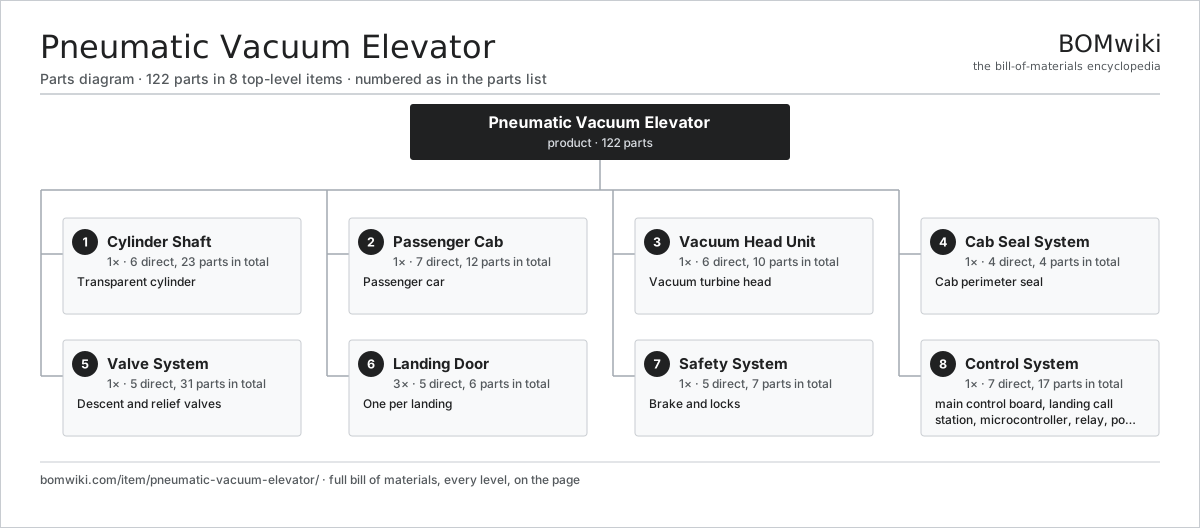
| # | Part | Qty | What it does |
|---|---|---|---|
| 1 | Cylinder Shaft 6 parts | 1× | Transparent cylinder |
| 2 | Passenger Cab 7 parts | 1× | Passenger car |
| 3 | Vacuum Head Unit 6 parts | 1× | Vacuum turbine head |
| 4 | Cab Seal System 4 parts | 1× | Cab perimeter seal |
| 5 | Valve System 5 parts | 1× | Descent and relief valves |
| 6 | Landing Door 5 parts | 3× | One per landing |
| 7 | Safety System 5 parts | 1× | Brake and locks |
| 8 | Control System 7 parts | 1× | Controller that sequences turbines, valves, locks, and landing calls. |
3D model
No 3D model yet. Have a CAD file of this? Add a 3D model. STL renders right on this page; STEP, FreeCAD, and OpenSCAD sources are welcome too (openly licensed, like all 3D models on BOMwiki).
Build & assembly graph
expand / collapse · shared sub-assemblies converge · links to related products · est. labourTap an assembly to expand/collapse · tap a part to open it · use “Open page” for any node · drag to pan, scroll to zoom.
Bill of materials for Pneumatic Vacuum Elevator
8 top-level lines · 57 rows shown · 122 parts total · indented to 3 levels| # | Item / sub-assembly | Part no. | Qty/assy | Ext. qty | Parts | Type |
|---|---|---|---|---|---|---|
| 1 | Cylinder Shaft 6 parts | pneumatic-vacuum-elevator-shaft | 1× | 1 | 23 | assembly |
| 1.1 | Polycarbonate Panel | pneumatic-vacuum-elevator-pc-panel | 12× | 12 | · | part |
| 1.2 | Aluminum Column | pneumatic-vacuum-elevator-column | 4× | 4 | · | part |
| 1.3 | Joint Ring | pneumatic-vacuum-elevator-ring | 4× | 4 | · | part |
| 1.4 | Base Ring | pneumatic-vacuum-elevator-base-ring | 1× | 1 | · | part |
| 1.5 | O-Ring Set | oring-set | 1× | 1 | · | part |
| 1.6 | Fastener Set | fastener-set | 1× | 1 | · | part |
| 2 | Passenger Cab 7 parts | pneumatic-vacuum-elevator-cab | 1× | 1 | 12 | assembly |
| 2.1 | Cab Frame | pneumatic-vacuum-elevator-cab-frame | 1× | 1 | · | part |
| 2.2 | Cab Head Plate | pneumatic-vacuum-elevator-cab-roof | 1× | 1 | · | part |
| 2.3 | Cab Floor | pneumatic-vacuum-elevator-cab-floor | 1× | 1 | · | part |
| 2.4 | Cab Door | pneumatic-vacuum-elevator-cab-door | 1× | 1 | · | part |
| 2.5 | Guide Shoe | pneumatic-vacuum-elevator-guide-shoe | 6× | 6 | · | part |
| 2.6 | LCD Panel | lcd-panel | 1× | 1 | · | part |
| 2.7 | Speaker | speaker | 1× | 1 | · | part |
| 3 | Vacuum Head Unit 6 parts | pneumatic-vacuum-elevator-head-unit | 1× | 1 | 10 | assembly |
| 3.1 | Vacuum Turbine | pneumatic-vacuum-elevator-turbine | 3× | 3 | · | part |
| 3.2 | Head Plate | pneumatic-vacuum-elevator-head-plate | 1× | 1 | · | part |
| 3.3 | Exhaust Muffler | pneumatic-vacuum-elevator-muffler | 1× | 1 | · | part |
| 3.4 | Head Shell | pneumatic-vacuum-elevator-head-shell | 1× | 1 | · | part |
| 3.5 | Blower Motor | blower-motor | 3× | 3 | · | part |
| 3.6 | Wire Bundle | wire-bundle | 1× | 1 | · | part |
| 4 | Cab Seal System 4 parts | pneumatic-vacuum-elevator-seal-system | 1× | 1 | 4 | assembly |
| 4.1 | Annular Lip Seal | pneumatic-vacuum-elevator-lip-seal | 1× | 1 | · | part |
| 4.2 | Seal Retainer | pneumatic-vacuum-elevator-seal-retainer | 1× | 1 | · | part |
| 4.3 | Wear Ring | pneumatic-vacuum-elevator-wear-ring | 1× | 1 | · | part |
| 4.4 | Fastener Set | fastener-set | 1× | 1 | · | part |
| 5 | Valve System 5 parts | pneumatic-vacuum-elevator-valve-system | 1× | 1 | 31 | assembly |
| 5.1 | Descent Control Valve | pneumatic-vacuum-elevator-descent-valve | 1× | 1 | · | part |
| 5.2 | Vacuum Relief Valve | pneumatic-vacuum-elevator-relief-valve | 1× | 1 | · | part |
| 5.3 | Turbine Check Valve | pneumatic-vacuum-elevator-check-valve | 3× | 3 | · | part |
| 5.4 | Pressure Sensor | pressure-sensor | 2× | 2 | · | part |
| 5.5 | Servo Motor 4 parts | servo-motor | 1× | 1 | 24 | assembly |
| 5.5.1 | Stator Assembly 3 parts + deeper › | stator-assembly | 1× | 1 | 3 | assembly |
| 5.5.2 | Rotor Assembly 4 parts + deeper › | rotor-assembly | 1× | 1 | 19 | assembly |
| 5.5.3 | Encoder | encoder | 1× | 1 | · | part |
| 5.5.4 | Motor Housing | motor-housing | 1× | 1 | · | part |
| 6 | Landing Door 5 parts | pneumatic-vacuum-elevator-doors | 3× | 3 | 6 | assembly |
| 6.1 | Door Leaf | pneumatic-vacuum-elevator-door-leaf | 1× | 3 | · | part |
| 6.2 | Door Interlock | pneumatic-vacuum-elevator-door-interlock | 1× | 3 | · | part |
| 6.3 | Door Gasket | pneumatic-vacuum-elevator-door-gasket | 1× | 3 | · | part |
| 6.4 | Door Hinge | pneumatic-vacuum-elevator-door-hinge | 2× | 6 | · | part |
| 6.5 | Hall Sensor | hall-sensor | 1× | 3 | · | part |
| 7 | Safety System 5 parts | pneumatic-vacuum-elevator-safety | 1× | 1 | 7 | assembly |
| 7.1 | Arrest Brake | pneumatic-vacuum-elevator-arrest-brake | 1× | 1 | · | part |
| 7.2 | Brake Shoe | pneumatic-vacuum-elevator-brake-shoe | 2× | 2 | · | part |
| 7.3 | Emergency Vent Valve | pneumatic-vacuum-elevator-emergency-vent | 1× | 1 | · | part |
| 7.4 | Coil Spring | coil-spring | 2× | 2 | · | part |
| 7.5 | 12 V Battery | lv-battery | 1× | 1 | · | part |
| 8 | Control System 7 parts | pneumatic-vacuum-elevator-controls | 1× | 1 | 17 | assembly |
| 8.1 | Main Control Board | pneumatic-vacuum-elevator-main-board | 1× | 1 | · | part |
| 8.2 | Landing Call Station | pneumatic-vacuum-elevator-call-station | 3× | 3 | · | part |
| 8.3 | Microcontroller | mcu | 1× | 1 | · | part |
| 8.4 | Relay | relay | 4× | 4 | · | part |
| 8.5 | Power Supply | power-supply | 1× | 1 | · | part |
| 8.6 | Wire Bundle | wire-bundle | 1× | 1 | · | part |
| 8.7 | Connector | connector | 6× | 6 | · | part |
Something wrong in this list? Report a problem with this BOM.
Related products
same domain, ranked by shared parts Home Elevator
133 parts · shares 14 with this page
Home Elevator
133 parts · shares 14 with this page
 Wheelchair Platform Lift
89 parts · shares 13 with this page
Wheelchair Platform Lift
89 parts · shares 13 with this page
 Moving Walkway
1,050 parts · shares 13 with this page
Moving Walkway
1,050 parts · shares 13 with this page
 Dumbwaiter
128 parts · shares 13 with this page
Freight Elevator
229 parts · shares 13 with this page
Dumbwaiter
128 parts · shares 13 with this page
Freight Elevator
229 parts · shares 13 with this page
Sourcing: possible vendors
Browse the supplier directory → Prices, MOQ, and lead times are algorithmic estimates, not quotes, and not claims about these companies. Company mappings are curated by keyword; est. price band $10k–$200k. How estimates work| Vendor | HQ | Specialty | MOQ | Lead time |
|---|---|---|---|---|
|
🇺🇸Otis
otis.com ↗
|
Farmington, US | Elevators & escalators | 20 units | 14–24 wks |
| schindler.com ↗ | Ebikon, CH | Elevators & escalators | 20 units | 14–24 wks |
|
🇫🇮KONE
kone.com ↗
|
Espoo, FI | Elevators & escalators | 20 units | 14–24 wks |
| tkelevator.com ↗ | Düsseldorf, DE | Elevators | 20 units | 14–24 wks |
| mitsubishielectric.com ↗ | Tokyo, JP | Elevators & electronics | 20 units | 14–24 wks |
828-word article