Polarizing Microscope
ProductOverview
A polarizing microscope visualizes the optical anisotropy of crystalline and fibrous specimens by exploiting polarized light and optical retardation. Crystals, minerals, muscle fibers, collagen, and oriented polymers have anisotropic refractive indices: light travels at different velocities along different crystal axes (birefringence). This instrument detects and measures birefringence using a Linear Polarizer below the stage that emits linearly polarized light, and an Analyzer above the specimen that is crossed 90° to the polarizer. In crossed polars, the field appears black (extinction) unless the specimen is birefringent. Crystals rotated 45° to the polarizer axes appear bright (their principal refractive indices are aligned at 45° to the polarizer), providing rich color and contrast.
The instrument is standard in mineralogy, petrology, materials science, and histology for identifying crystal phases, determining fiber orientation, and diagnosing tissue pathology. The Rotating Stage rotating stage allows precise angular measurement of extinction angles, helping identify unknown minerals. The Bertrand Lens provides conoscopic observation, viewing the objective's back focal plane, which displays characteristic interference patterns revealing birefringence sign, magnitude, and optical axis orientation.
How it works
Light from the Light Source (100 W halogen) passes through the Iris Diaphragm and Linear Polarizer, emerging as linearly polarized light with electric field oscillating in one direction (conventionally, north-south). This polarized light travels through the Condenser and onto the specimen.
In the specimen, if it is isotropic (like glass or an amorphous polymer), the light remains linearly polarized and exits unchanged. If the specimen is crystalline and birefringent, the crystal acts as a dual-polarized system. The incident linearly polarized light can be decomposed into two orthogonal components along the crystal's principal optical axes (fast and slow axes). These components travel at different speeds through the crystal, introducing a phase difference, the retardation, typically ranging from 0 to λ (one full wavelength, ~550 nm for visible light).
Exiting the specimen, this retarded light is now elliptically polarized (or circularly polarized in special cases). It then passes through the Analyzer, which is oriented perpendicular to the original polarizer (crossed polars). In crossed polars, only the component of the elliptical light aligned with the analyzer axis is transmitted. For an optically inactive (isotropic) specimen or a birefringent specimen oriented along the polarizer axis (extinction position), the analyzer blocks all light and the field is black. For a birefringent specimen oriented at 45° to the polarizer, maximum light transmits.
The color of birefringent crystals depends on retardation:
- Retardation 0 nm: black (extinction).
- Retardation 30 nm (0.05λ): gray.
- Retardation 150 nm (0.28λ): yellowish.
- Retardation 350 nm (0.65λ): blue.
- Retardation 550 nm (λ): red.
Optional Wave Plate (λ) and Wave Plate (λ/2) retarder plates inserted into the optical path add known phase shifts, allowing measurement of specimen birefringence by color matching (the Michel-Lévy color chart).
Rotating stage and extinction
The Rotating Stage rotating stage allows the specimen to be rotated 360° while monitoring the transmitted light intensity. Birefringent crystals show an extinction pattern: light intensity is zero (extinction) every 90° of rotation, and maximum every 45°. The angle at which extinction first appears (relative to the polarizer axis) is the extinction angle, a key identifying characteristic for mineral determination. The Rotation Motor can automate this measurement.
Bertrand lens and conoscopic observation
The Bertrand Lens Element redirects light from the objective's back focal plane (Fourier plane of the specimen) onto the eyepiece, creating a conoscopic image. Rather than viewing the magnified specimen, the observer sees an interference pattern characteristic of the crystal's optical properties. For a uniaxial crystal (like calcite), a black cross appears centered on the field when the optic axis is perpendicular to the specimen plane. The shape and color of this cross reveal the birefringence magnitude and sign. The Conoscopic Eyepiece is optimized for wide-field viewing of these patterns.
Strain-free objectives
Microscope objective lenses themselves introduce slight birefringence (from mechanical strain in the glass). To prevent this artifact from masking the specimen's true birefringence, polarizing microscope objectives are strain-free: they are either unstressed glass or specially annealed to remove internal stress. The 10× Strain-Free Objective through 100× Oil Strain-Free Objective are optically certified for zero birefringence.
Applications
Mineralogists use polarizing microscopes to identify unknown minerals via their birefringence, refractive indices (via immersion oils), and extinction angles. Petrograpers analyze thin sections of igneous and metamorphic rocks. In materials science, fiber orientation and crystallinity are assessed. Histologists detect collagen and muscle fiber organization in tissue. Polymer scientists characterize crystalline phases and draw-induced orientation.
Polarizing Microscope parts and their functions
8 top-level parts · 32 parts in total · full bill of materials below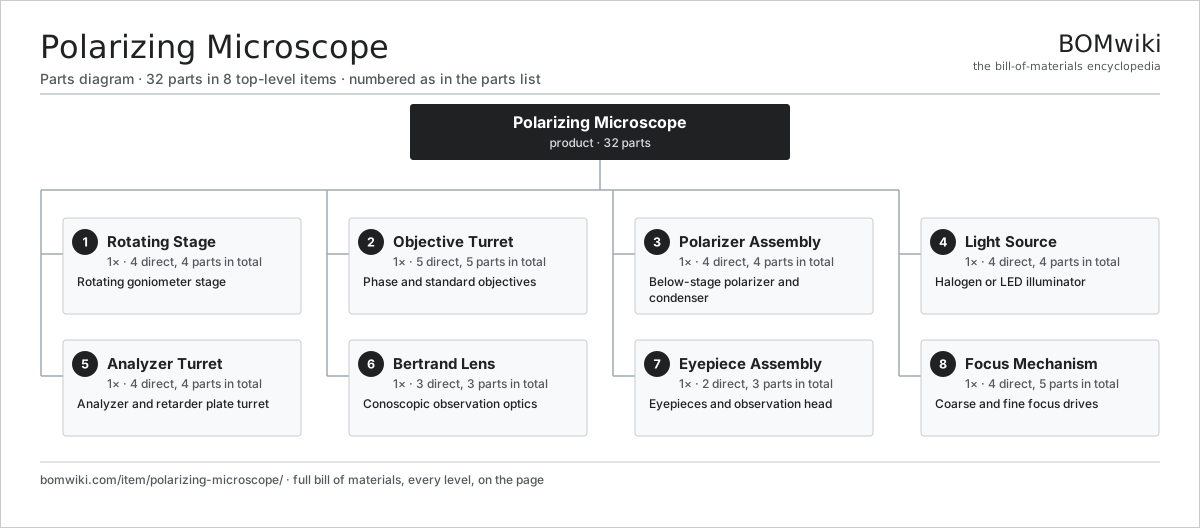
| # | Part | Qty | What it does |
|---|---|---|---|
| 1 | Rotating Stage 4 parts | 1× | Rotating goniometer stage |
| 2 | Objective Turret 5 parts | 1× | Phase and standard objectives |
| 3 | Polarizer Assembly 4 parts | 1× | Below-stage polarizer and condenser |
| 4 | Light Source 4 parts | 1× | Halogen or LED illuminator |
| 5 | Analyzer Turret 4 parts | 1× | Analyzer and retarder plate turret |
| 6 | Bertrand Lens 3 parts | 1× | Conoscopic observation optics |
| 7 | Eyepiece Assembly 2 parts | 1× | Eyepieces and observation head |
| 8 | Focus Mechanism 4 parts | 1× | Coarse and fine focus drives |
3D model
No 3D model yet. Have a CAD file of this? Add a 3D model. STL renders right on this page; STEP, FreeCAD, and OpenSCAD sources are welcome too (openly licensed, like all 3D models on BOMwiki).
Build & assembly graph
expand / collapse · shared sub-assemblies converge · links to related products · est. labourTap an assembly to expand/collapse · tap a part to open it · use “Open page” for any node · drag to pan, scroll to zoom.
Bill of materials for Polarizing Microscope
8 top-level lines · 38 rows shown · 32 parts total · indented to 3 levels| # | Item / sub-assembly | Part no. | Qty/assy | Ext. qty | Parts | Type |
|---|---|---|---|---|---|---|
| 1 | Rotating Stage 4 parts | polarizing-microscope-stage-assembly | 1× | 1 | 4 | assembly |
| 1.1 | Rotating Stage Base | polarizing-microscope-stage-base | 1× | 1 | · | part |
| 1.2 | Slide Clamp | polarizing-microscope-slide-clamp | 1× | 1 | · | part |
| 1.3 | Rotation Scale | polarizing-microscope-rotation-scale | 1× | 1 | · | part |
| 1.4 | Rotation Motor | polarizing-microscope-rotation-motor | 1× | 1 | · | part |
| 2 | Objective Turret 5 parts | polarizing-microscope-optical-turret | 1× | 1 | 5 | assembly |
| 2.1 | 10× Strain-Free Objective | polarizing-microscope-strain-free-objective-10x | 1× | 1 | · | part |
| 2.2 | 20× Strain-Free Objective | polarizing-microscope-strain-free-objective-20x | 1× | 1 | · | part |
| 2.3 | 40× Strain-Free Objective | polarizing-microscope-strain-free-objective-40x | 1× | 1 | · | part |
| 2.4 | 100× Oil Strain-Free Objective | polarizing-microscope-strain-free-objective-100x | 1× | 1 | · | part |
| 2.5 | Turret Body | polarizing-microscope-turret-body | 1× | 1 | · | part |
| 3 | Polarizer Assembly 4 parts | polarizing-microscope-polarizer-assembly | 1× | 1 | 4 | assembly |
| 3.1 | Linear Polarizer | polarizing-microscope-linear-polarizer | 1× | 1 | · | part |
| 3.2 | Condenser | polarizing-microscope-aplanatic-condenser | 1× | 1 | · | part |
| 3.3 | Iris Diaphragm | polarizing-microscope-iris-diaphragm | 1× | 1 | · | part |
| 3.4 | Polarizer Mount | polarizing-microscope-polarizer-mount | 1× | 1 | · | part |
| 4 | Light Source 4 parts | polarizing-microscope-light-source | 1× | 1 | 4 | assembly |
| 4.1 | Lamp Bulb | polarizing-microscope-lamp-bulb | 1× | 1 | · | part |
| 4.2 | Lamp Housing | polarizing-microscope-lamp-housing | 1× | 1 | · | part |
| 4.3 | Power Supply | polarizing-microscope-power-supply | 1× | 1 | · | part |
| 4.4 | Intensity Control | polarizing-microscope-intensity-rheostat | 1× | 1 | · | part |
| 5 | Analyzer Turret 4 parts | polarizing-microscope-analyzer-turret | 1× | 1 | 4 | assembly |
| 5.1 | Analyzer | polarizing-microscope-analyzer-polarizer | 1× | 1 | · | part |
| 5.2 | Wave Plate (λ) | polarizing-microscope-wave-plate-lambda | 1× | 1 | · | part |
| 5.3 | Wave Plate (λ/2) | polarizing-microscope-wave-plate-half-lambda | 1× | 1 | · | part |
| 5.4 | Analyzer Motor | polarizing-microscope-turret-motor | 1× | 1 | · | part |
| 6 | Bertrand Lens 3 parts | polarizing-microscope-bertrand-lens | 1× | 1 | 3 | assembly |
| 6.1 | Bertrand Lens Element | polarizing-microscope-bertrand-lens-element | 1× | 1 | · | part |
| 6.2 | Bertrand Turret | polarizing-microscope-bertrand-turret | 1× | 1 | · | part |
| 6.3 | Conoscopic Eyepiece | polarizing-microscope-conoscopic-eyepiece | 1× | 1 | · | part |
| 7 | Eyepiece Assembly 2 parts | polarizing-microscope-eyepiece-assembly | 1× | 1 | 3 | assembly |
| 7.1 | 10× Eyepiece | polarizing-microscope-eyepiece-10x | 2× | 2 | · | part |
| 7.2 | Focus Ring | polarizing-microscope-eyepiece-focus-ring | 1× | 1 | · | part |
| 8 | Focus Mechanism 4 parts | polarizing-microscope-focus-mechanism | 1× | 1 | 5 | assembly |
| 8.1 | Coarse Focus Knob | polarizing-microscope-coarse-focus-knob | 1× | 1 | · | part |
| 8.2 | Fine Focus Micrometer | polarizing-microscope-fine-focus-micrometer | 1× | 1 | · | part |
| 8.3 | Focus Carriage | polarizing-microscope-focus-carriage | 1× | 1 | · | part |
| 8.4 | Focus Bearing | polarizing-microscope-focus-bearing | 2× | 2 | · | part |
Something wrong in this list? Report a problem with this BOM.
Sourcing: possible vendors
Browse the supplier directory → Prices, MOQ, and lead times are algorithmic estimates, not quotes, and not claims about these companies. Company mappings are curated by keyword; est. price band $1k–$500k. How estimates work| Vendor | HQ | Specialty | MOQ | Lead time |
|---|---|---|---|---|
| thermofisher.com ↗ | Waltham, US | Lab instruments | 100 units | 10–18 wks |
|
🇺🇸Agilent
agilent.com ↗
|
Santa Clara, US | Analytical instruments | 100 units | 10–18 wks |
|
🇺🇸Bruker
bruker.com ↗
|
Billerica, US | Scientific instruments | 100 units | 10–18 wks |
|
🇯🇵Shimadzu
shimadzu.com ↗
|
Kyoto, JP | Analytical instruments | 100 units | 10–18 wks |
|
🇺🇸Waters
waters.com ↗
|
Milford, US | Chromatography & MS | 100 units | 10–18 wks |
788-word article